

A roll-up is a planned acquisition sequence where a platform company buys multiple smaller, comparable businesses to create scale, cut shared costs, and often capture a higher valuation multiple than any single business could command alone. Private equity firms, strategic acquirers, and ambitious owner-operators run roll-ups when a market is fragmented and the economics of combining similar businesses clearly beat growing one business alone.
TL;DR:
- Successful roll-ups rely on comparable targets in fragmented industries to ensure predictable integration and valuation improvements.
- A documented operating system and clear integration plan are essential to absorb new acquisitions without disrupting value.
- Timing for completing a full roll-up program typically spans several years, with private deals taking longer than public mergers.
- Key metrics to track include adjusted EBITDA, revenue per location, customer retention, and synergy realization to measure success.
- Centralizing functions like finance and procurement while preserving customer relationships and leadership helps retain goodwill and maximize synergies.
Table of Contents
- What a roll-up is and how it works
- Why investors and owners use roll-ups
- Step-by-step roll-up process: sourcing to integration
- When roll-ups work best and typical target industries
- Integration risks and failure modes
- Key metrics, timeline, and signs of success
- Due diligence and regulatory checklist
- Practical example: a short roll-up case study
- Decision checklist: is a roll-up right for you?
- How we help owners prepare for consolidation and roll-up exits
- What actually determines a roll-up’s success
- Get your business roll-up ready
- FAQ
- Sources
What a roll-up is and how it works
A roll-up starts with a platform company: the first acquisition, or an existing business, that becomes the operating base for everything added afterward. From there, the buyer acquires add-ons, smaller companies folded into the platform’s systems, brand, and management structure.
Two terms come up constantly in this world. A bolt-on usually refers to an add-on that expands capability or geography. A tuck-in describes a smaller acquisition absorbed almost entirely into the platform, often losing its original name and back-office functions. Both aim at the same outcome: multiple arbitrage, buying smaller businesses at a lower valuation multiple than the combined, larger entity can command once it is assembled.
Deal structures vary by size and sector, but common patterns include:
- All-cash purchases for small, owner-operated add-ons with simple balance sheets
- Debt-financed deals using the platform’s cash flow or asset base as collateral
- Equity rollovers, where a selling owner keeps a minority stake in the combined company
- Earnout structures that tie part of the purchase price to future performance
As the DealRoom guide to roll-up acquisitions notes, the model works best when targets are genuinely comparable, not just adjacent.
Why investors and owners use roll-ups
The appeal of a roll-up comes down to a few repeatable value drivers, and understanding which one applies to your market changes how you structure the whole program.
- Economies of scale: shared back-office functions, bulk purchasing, and centralized administration lower the cost base across every add-on.
- Cross-selling and revenue synergies: a combined customer base can be sold a wider service menu than any single acquired business offered alone.
- Multiple arbitrage: buying small businesses at modest multiples and selling the combined platform at a materially higher one, a core reason private equity firms favor the strategy.
- Market share and geographic reach: assembling several regional operators into one brand creates coverage that would take years to build organically.
Our Mid-Market Growth Strategies guide covers related scaling plays that complement a roll-up when organic growth alone will not get you there fast enough.
Step-by-step roll-up process: sourcing to integration
Running a roll-up is less about finding deals and more about building a repeatable machine. The sequence matters.
- Build or acquire a platform with a repeatable playbook. Before buying anything else, the platform needs documented processes for operations, finance, and customer service that a new add-on can plug into quickly.
- Define target screen criteria. Revenue range, margin profile, customer concentration, owner dependency, and geographic fit should all be written down before sourcing begins.
- Source through brokers, direct outreach, and industry networks. Fragmented markets often have hundreds of small operators who have never considered selling until approached directly.
- Apply consistent valuation conventions. Most small add-ons trade on a multiple of adjusted EBITDA, with earnouts bridging gaps between buyer and seller expectations on future performance.
- Negotiate deal mechanics carefully. Transition services agreements (TSAs) keep a seller involved for a defined period to stabilize operations, while earnouts align incentives if growth projections are uncertain.
- Build the integration plan before close, not after. According to INSEAD’s analysis of buy-and-build strategy, preparing the operating model during diligence, not scrambling afterward, is what separates roll-ups that realize their synergies from ones that stall.
- Execute 100-day priorities. Payroll, systems access, customer communication, and leadership roles need clear answers in the first weeks, long before deeper process integration begins.
Each cycle through this sequence should get faster as the platform’s playbook matures, which is the entire point of calling it repeatable.
When roll-ups work best and typical target industries
Two signals matter more than any other when deciding whether a market suits a roll-up: fragmentation and comparability. A fragmented market has many small operators and no dominant leader. Comparable targets share similar service models, customer types, and margin structures, which makes integration and valuation far more predictable.
- Health services: dental, veterinary, and physical therapy practices often fit, given consistent service delivery and licensing patterns.
- Home and specialty services: HVAC, daycare, and funeral services are commonly cited examples of fragmented, comparable markets.
- Specialty distribution and business services: regional distributors and service firms with similar operating models roll up cleanly.
- Software platforms: niche software businesses with overlapping customer bases can combine around shared infrastructure.
The DealRoom guide lists these sectors among the common examples, while warning that combining unrelated business models under one roof usually destroys the comparability that made the strategy attractive in the first place.
Integration risks and failure modes
Sourcing deals is the easy part. Integration is where most roll-ups succeed or quietly fall apart, and the failure modes repeat often enough to be predictable.
Culture clashes between acquired teams and the platform’s management style can drain morale fast, especially when centralization feels like it erases what made the acquired business distinct. Losing key leaders or technical staff shortly after close removes the institutional knowledge that justified the purchase price. Systems and data migration, payroll, CRM, inventory, often takes longer than planned and disrupts customers if rushed. Overpaying for add-ons or layering on too much acquisition debt can leave the combined entity fragile even if operations run smoothly.
Our guide to scaling a mid-market business systematically covers the operating model decisions that make integration repeatable rather than reactive.
- Retain key talent through retention bonuses or defined leadership roles before close
- Decide explicitly what to centralize (finance, procurement) versus what to preserve (customer-facing teams, specialist culture)
- Prioritize systems and data migration early, since delays compound across every subsequent add-on
- Stress-test leverage assumptions against a slower-than-planned integration timeline
Pro Tip: Centralize the functions that create scale, like finance and procurement, and leave customer-facing processes alone until you understand exactly why customers chose that business in the first place.
As the Financial Times has noted in its analysis of merger integration choices, deciding what not to standardize is rarely obvious, and over-focusing on cost cuts can quietly undermine the innovation and talent that made an acquisition worth buying.
Key metrics, timeline, and signs of success
Roll-ups reward owners who track the right numbers from the first add-on onward, not just at exit.
- Adjusted EBITDA across the combined entity, the baseline for valuation and lender covenants
- Revenue per location or per unit, which shows whether add-ons are performing to platform standard
- Customer retention through transition periods, an early warning sign for integration problems
- Synergies realized versus synergies projected, tracked deal by deal rather than assumed in aggregate
Merger and acquisition activity, which found that while average time from announcement to completion in sampled public deals runs around five and a half months, private add-on programs typically execute over several years rather than in a single transaction. That distinction matters when setting expectations with investors or lenders who may be used to faster public deal timelines.
Multiple arbitrage only shows up in outcomes once the combined entity is large and stable enough to attract buyers willing to pay the higher multiple, which is why rushing the add-on count rarely pays off.
Due diligence and regulatory checklist
Every add-on deserves the same discipline as the platform acquisition itself, even when it feels routine after a few rounds. Standard diligence covers financial statements, tax exposure, employment agreements, customer contracts, licensing, data and privacy practices, and due diligence investigation in Massachusetts focused on regulatory compliance and risk.
- Confirm financial, tax, and employment diligence on every target, not just the platform
- Review licensing and regulatory requirements specific to the industry and jurisdiction
- Check antitrust exposure once the combined entity starts approaching meaningful market share
- Flag securities and disclosure obligations early for any structure involving outside investor capital
Our sell-side due diligence guide outlines who to bring in and when. Regulatory requirements depend heavily on structure and jurisdiction, as a 2025 SEC release on M&A and business development company activity makes clear, so roll-ups are never exempt from the antitrust, securities, tax, or licensing rules that apply to any other acquisition.
Practical example: a short roll-up case study
Consider a hypothetical regional HVAC roll-up to see the sequence in practice.
- The platform centralizes finance, payroll, and scheduling software within the first 90 days.
- Over the next two years, it acquires three add-ons in neighboring markets, each purchased at a 4 to 5x multiple, preserving each add-on’s local service teams and branding during a transition period.
- Combined adjusted EBITDA across the four businesses reaches $7 million, with shared procurement and reduced administrative overhead improving margins.
- The combined entity, now large enough to interest strategic buyers or larger private equity platforms, sells at a 7x multiple, capturing the gap between acquisition and exit multiples.
What stayed local: customer relationships and service crews. What centralized: back-office systems and purchasing. That split protected the goodwill each add-on had built with its own customers while still capturing the cost synergies that justified the deals.
Decision checklist: is a roll-up right for you?
Before committing capital or time to a roll-up, a few honest checks save a lot of downstream pain.
- Confirm your market is genuinely fragmented, with comparable targets rather than loosely related businesses
- Verify your platform’s playbook is documented well enough that a new team could run it without you
- Assess whether your capital structure and governance can handle multiple simultaneous integrations
- Weigh alternatives like organic growth or a single strategic merger before committing to a multi-year acquisition program
How we help owners prepare for consolidation and roll-up exits
Getting ready for a roll-up, whether as the platform being built or the target being acquired, starts with an honest look at how dependent the business is on its owner. Our Enterprise Assessment and ProfitDriver Analysis™ identify where documented systems are missing and where profit is leaking before a buyer or integration partner ever looks at the books.
- We assess operational dependency on the owner as a first step toward exit readiness
- We map specific profit drivers so leadership knows what to fix before negotiating any deal
- We build documented playbooks through our AOS framework so operations survive a change in ownership
- We connect exit-ready businesses to buyers, advisors, and fractional executives through our network
A typical initial diagnostic reveals operational gaps that would worry a buyer most, and the recommended first step is usually fixing those before entering any acquisition conversation.
What actually determines a roll-up’s success
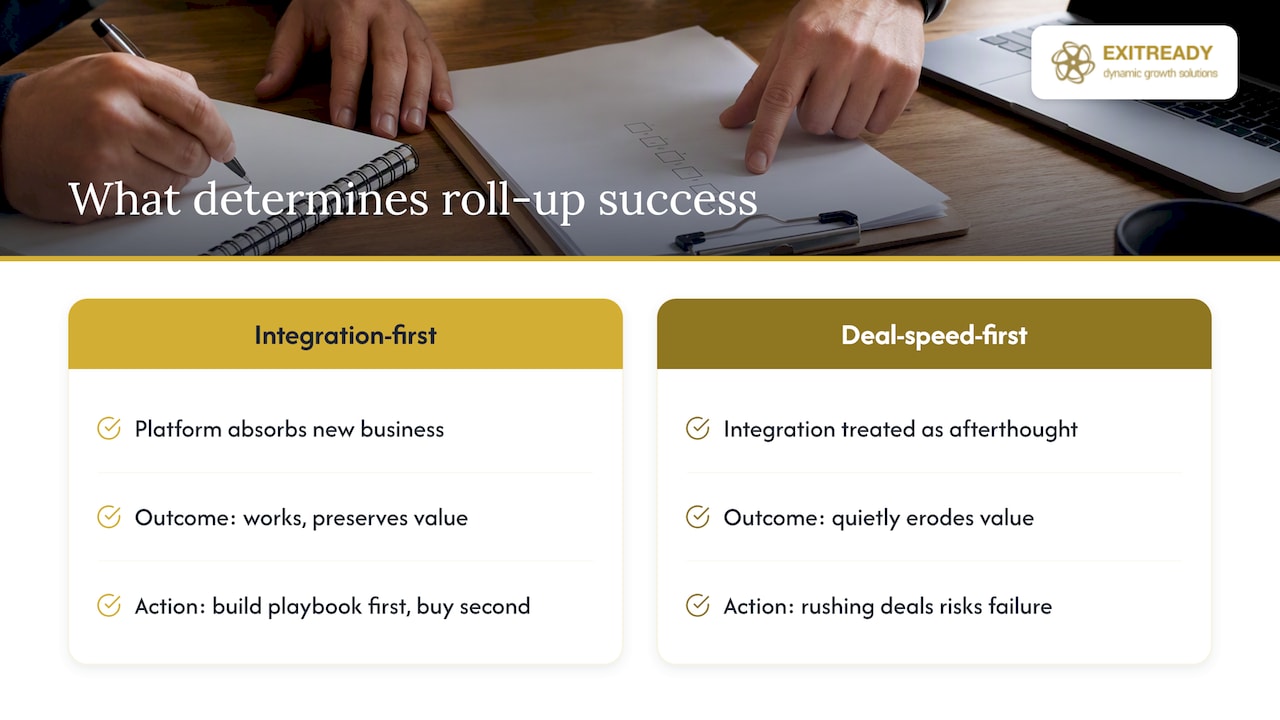
The single biggest factor separating roll-ups that work from ones that quietly erode value is not deal-sourcing speed, it is whether the platform’s operating system can absorb a new business without breaking what made it valuable. Owners who treat integration as an afterthought consistently underperform the ones who build the playbook first and buy second.
If you are considering a roll-up, slow down the deal pipeline long enough to pressure-test whether your systems can actually absorb what you are about to buy. A diagnostic conversation with an advisor before the first letter of intent is worth more than a rushed valuation model.
— Andre
Get your business roll-up ready
Preparing for a roll-up, on either side of the table, comes down to the same question: can your operations run without you in the room? Our Growth Sprint and Enterprise Sprint programs build the documented playbooks and delegation systems that make a platform company genuinely repeatable, while our ProfitDriver Analysis™ pinpoints exactly where margin is being left on the table before you negotiate your next acquisition.

- Our Growth Sprint and Performance Sprint programs build the operating systems that make add-on integration faster and less disruptive
- Our Enterprise Assessment maps owner dependency and operational gaps before you buy or sell
- Our ProfitDriver Analysis™ identifies specific profit levers that affect valuation and integration outcomes
If you are weighing a roll-up as a buyer, a seller, or a platform looking to get acquisition-ready, start with our Application Form to discuss which program fits your stage.
FAQ
Is a roll-up a good investment strategy?
A roll-up can be a strong strategy when the target market is fragmented, the targets are genuinely comparable, and the buyer has a repeatable integration playbook. It carries real risk when buyers overpay, over-leverage the deal, or combine unrelated business models, so the strategy’s success depends heavily on execution discipline rather than the model itself.
What is a roll-up strategy?
A roll-up strategy is a planned series of acquisitions where a buyer establishes or acquires a platform company and then purchases multiple smaller, related businesses, called add-ons, to combine them into one larger operating group. It is most common in fragmented industries with many small or regional operators and no dominant market leader, according to search-based industry summaries.
What is the 7 5 3 1 rule in investing?
This rule is not a recognized standard within roll-up or buy-and-build strategy and definitions of it vary widely across sources. It is not covered by the authoritative sources on roll-up acquisitions referenced in this guide, so we would rather point you to the mechanics, metrics, and timelines described above than offer an unverified definition.
How long should it take to execute a private equity roll-up?
Private roll-ups and buy-and-build programs typically execute add-ons over several years rather than as a single transaction, based on SEC analysis of U.S. merger and acquisition activity. Average time from announcement to completion in sampled public deals runs around five and a half months, but a full roll-up program, from platform acquisition through several add-ons to exit, is a multi-year undertaking.
Sources
- How private equity firms can ace buy-and-build | INSEAD Knowledge
- Analysis of merger & acquisition activity (SEC DERA white paper)
- The definitive guide to mastering roll-up acquisitions | DealRoom
One Response