

Operational excellence for mid-market firms starts with one move: adopt a single, integrated operating model that aligns process, people, governance, and technology, then launch a focused operational assessment within the next 30 days.
That’s the verdict. Not a dozen parallel initiatives. Not a technology overhaul. One operating model, assessed and piloted before you scale anything.
Your 30-day startup checklist:
- Assign an assessment owner (a senior operational leader, not the CEO alone) with a clear mandate and 20% of their time ring-fenced.
- Scope the assessment to your top three revenue-generating or highest-cost processes — nothing broader.
- Identify one quick win to pilot in the first 30 days: a process with a visible bottleneck, a willing team, and a measurable output.
Copy that into your next leadership agenda. The rest of this playbook tells you exactly what to do after.
Table of Contents
- Why operational efficiency is a strategic priority for mid-market firms right now
- The four pillars of operational excellence for mid-market companies
- How to implement operational excellence: from assessment to sustained performance
- Which KPIs should you track, and how do you build a useful dashboard?
- How leaders must lead change to lock in operational gains
- Which technology tools actually move the needle for mid-market operations?
- Key Takeaways
- The real reason most mid-market operational programs fall short
- What working with Dynamicgrowthsolutions looks like
- Useful sources and further reading
Why operational efficiency is a strategic priority for mid-market firms right now
Efficiency isn’t a cost-cutting exercise. For mid-market companies, it’s the primary mechanism for funding growth without diluting equity or taking on expensive debt.
HBR’s analysis of AchieveNEXT CFO Alliance data makes this explicit: improving productivity and efficiency ranks as the number-two strategic priority for mid-market CFOs, and cross-functional digital integration produces outsized productivity gains. The implication is direct — efficiency frees capital that would otherwise sit locked in slow processes, excess inventory, or redundant headcount.
The macro environment sharpens the case. Inflation, elevated interest rates, and tariff pressures have compressed margins across manufacturing, distribution, and services. Operational levers are often the fastest path to margin recovery that doesn’t require a revenue miracle.
“Operational efficiency helps middle market companies compete — and the data shows leaders know it. In Baker Tilly’s 2026 mid-market survey, many leaders say technology is central to their strategy, and a majority report using AI specifically to improve efficiencies.”
That 76% figure is worth pausing on. It’s not a future aspiration — it’s what your peers are doing now. The companies that treat operational improvement as a strategic growth lever, rather than a back-office housekeeping task, are the ones building scalable value and exit readiness that commands premium multiples.
The four pillars of operational excellence for mid-market companies
| Pillar | What it covers | Success indicators |
|---|---|---|
| Process excellence | Lean, Six Sigma, BPM, PDCA cycles | Shorter cycle times; defect rate below target; strong SOP coverage |
| People and talent | Role clarity, incentive alignment, retention | Voluntary turnover below industry benchmark; most roles with documented scorecards |
| Leadership and governance | Operating rhythms, decision rights, North Star KPIs | Weekly ops review held on schedule; decisions escalated to CEO kept low |
| Technology and data | BPM tools, analytics, AI augmentation | Dashboard adoption; timely time-to-insight; automation covering repeatable admin tasks |
Mid-market companies face constraints that enterprise firms don’t: fixed-cost buckets are tighter, owner dependency is real, and there’s rarely a dedicated transformation office. That changes how you apply each pillar.
For process excellence, Lean, Six Sigma, PDCA, and BPM are all valid methods — but pick one per initiative, not all four simultaneously. Start with visible, frequent, fixable processes: order fulfillment, invoicing, onboarding. These deliver fast feedback and build team confidence.
For people and talent, the constraint is usually role ambiguity, not headcount. When everyone is doing “whatever it takes,” accountability disappears. A RACI matrix for your top ten processes costs nothing and clarifies ownership immediately.
For technology, the Baker Tilly data showing 76% AI adoption for efficiency isn’t a reason to rush an AI deployment — it’s a signal that your competitors are already extracting value from digital tools. Prioritize tools with fast time-to-value and low integration cost.
How to implement operational excellence: from assessment to sustained performance
The sequence matters more than the speed. McKinsey’s transformation research is clear: fix the operating model and governance first, then layer process and technology changes on top. Companies that skip straight to technology consistently underperform.
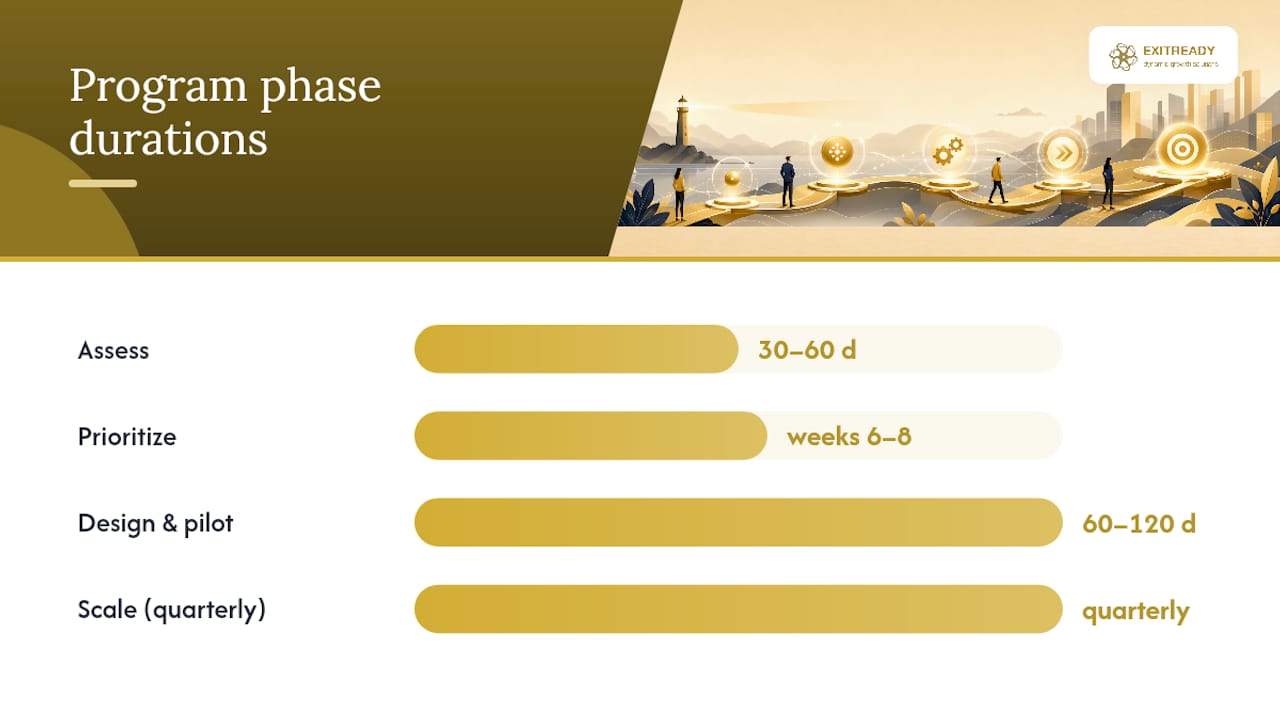
- Assess (30–60 days): Map your top processes, identify the three to five highest-impact improvement opportunities, and baseline your current KPIs. The CEO or CFO sponsors this phase; a program lead runs it day-to-day.
- Prioritize (weeks 6–8): Score initiatives by effort, impact, and speed-to-result. Select three to five pilots. Avoid initiatives that require a full ERP replacement before you see results.
- Design and pilot (60–120 days): Map the current process, analyze bottlenecks, redesign, and test at small scale before committing resources. A 90-day pilot should have a named owner, a defined success metric, a go/no-go gate at day 45, and a rollback plan.
- Scale (quarterly waves): Proven pilots roll out function by function. Each wave adds governance checkpoints and updates the SOP library.
- Sustain (ongoing): Monthly performance reviews, quarterly SOP audits, and an annual operating model refresh keep the system alive.
A pilot’s go/no-go gate at day 45 should answer three questions: Is the metric moving in the right direction? Is the team adopting the new process? Has any downstream process been disrupted? If two of three are green, proceed.
On cost and return: private equity case studies in the lower middle market report measurable EBITDA expansion from systematic operational programs. The time-to-payback on well-scoped pilots is typically within the first two quarters, driven by working capital release and productivity gains — not by headcount reduction alone.
Which KPIs should you track, and how do you build a useful dashboard?
Leading indicators tell you whether your process is healthy before the financial results show up. Lagging indicators confirm whether the improvement stuck. You need both.
| KPI category | Example metrics | Cadence |
|---|---|---|
| Throughput / cycle time | Order-to-cash days; time-to-hire | Weekly |
| Quality | Defect rate; rework hours; error rate per process | Weekly |
| Cost and margin | Gross margin by product line; overhead as % of revenue | Monthly |
| Working capital | DSO, DPO, inventory turns | Monthly |
| Customer | NPS; retention rate; on-time delivery | Monthly/Quarterly |
A dashboard works when it has three things: an owner for each metric, a defined review cadence, and a threshold that triggers action. Without thresholds, dashboards become wallpaper.
- Set a red/amber/green threshold for each KPI before you launch the dashboard, not after.
- Limit the executive dashboard to eight to twelve metrics — more than that and nothing gets acted on.
- Separate operational dashboards (weekly, team-level) from strategic dashboards (monthly, leadership-level).
For mid-market firms specifically, working capital metrics often deliver the fastest visible ROI. Reducing DSO by five days in a $50M revenue business frees meaningful cash without touching headcount or capex.
How leaders must lead change to lock in operational gains
Process redesign is the easy part. Getting people to actually use the new process — that’s where most programs stall.
Stepwise process improvement research consistently shows that improvements fail not because the redesign was wrong, but because leadership visibility dropped after the launch. The fix is structural: build the review cadence into the leadership calendar before the pilot starts, not after.
A practical leadership checklist for sustaining gains:
- Attend the weekly operational review for the first 90 days of every pilot — no delegation.
- Celebrate the first team that hits a process milestone publicly, even if the result is small.
- When a process breaks down, ask “what in the system failed?” before asking “who failed?”
- Build capability, not dependency: train two internal champions per function who can run improvement cycles without external help.
Owner dependency is the most common structural pitfall in mid-market firms. When the founder or CEO is the de facto decision-maker for every operational exception, the business cannot scale. The remedy is explicit: document the decision rules, assign the authority, and hold the new owner accountable in the weekly review.
Which technology tools actually move the needle for mid-market operations?
The tool category matters less than the selection criteria. Mid-market companies have been burned by ERP projects that ran 18 months over schedule and delivered half the promised functionality. The answer isn’t to avoid technology — it’s to sequence it correctly.
- BPM and workflow tools — (examples: Monday.com, Process Street, Kissflow): best for making process steps visible, assigning ownership, and tracking completion. Low integration cost, fast time-to-value.
For IT delivery, co-managed IT services give mid-market firms enterprise-grade support without the overhead of a full internal IT department — a practical model when you’re scaling technology faster than your team can absorb it.
Pro Tip: Before any AI or automation deployment, run a two-week “data quality audit” on the process you plan to automate. Automation amplifies bad data as fast as it amplifies good data.

Point solutions beat full ERP replacement for most mid-market firms in the first two years of a transformation. A targeted BPM tool plus a BI layer on your existing data will outperform a new ERP that takes 18 months to configure and another 12 to adopt.
Key Takeaways
Mid-market operational excellence requires a single integrated operating model, not a collection of isolated projects — start with a focused assessment, pilot one process, and scale what works.
| Point | Details |
|---|---|
| Start with one operating model | Align process, people, governance, and technology before adding new tools or initiatives. |
| Assessment first, always | A 30–60 day assessment scoped to your top three processes prevents wasted pilot investment. |
| Lead and lag KPIs both matter | Track cycle time and quality weekly; confirm margin and working capital impact monthly. |
| Technology follows process | Deploy BPM and BI tools on proven processes; avoid ERP replacement in the first two years. |
| Dynamicgrowthsolutions AOS | Provides a structured assessment-to-certification pathway that replaces owner dependency with documented, scalable systems. |
The real reason most mid-market operational programs fall short
Most mid-market leaders understand that operational excellence matters. The gap isn’t knowledge — it’s commitment to treating operations as a system rather than a list of problems to fix one at a time.
The conventional wisdom says: hire a consultant, get a report, implement the recommendations. What actually works is different. The companies that sustain operational gains are the ones that build the governance infrastructure first — the weekly reviews, the decision rights, the SOP ownership — and then layer process and technology improvements on top of a structure that can hold them.
The other thing most articles won’t tell you: the owner’s behavior is the operating model’s biggest variable. If the CEO keeps making exceptions to the new process, the team learns that the process is optional. Operational excellence is, at its core, a leadership discipline before it’s a management methodology.
If you’re serious about scaling your mid-market business systematically, commit an executive sponsor, schedule the assessment sprint this quarter, and treat the first 90-day pilot as a proof of concept for your entire operating model — not just one process.
What working with Dynamicgrowthsolutions looks like
Mid-market leaders who are ready to move from diagnosis to execution have two clear entry points with Dynamicgrowthsolutions.
Option 1 — Assessment and pilot (30–90 days): Dynamicgrowthsolutions runs a structured operational assessment, identifies your top three to five improvement opportunities, and designs a 90-day pilot with defined success metrics. Deliverables include a prioritized roadmap, baseline KPI report, and a pilot playbook your team can run. Bring your COO or VP of Operations to the first call.
Option 2 — Full AOS implementation (6–18 months): A complete operating model build-out covering all four subsystems, SOP library, delegation framework, governance cadence, and exit-readiness certification. This is the program for owners who want the business to run without them — and to be positioned for a premium exit.
To prepare for an initial conversation, document your top three operational pain points, your current revenue and headcount, and your 24-month strategic objective (growth, exit, or both). That context lets Dynamicgrowthsolutions scope the right engagement on the first call.
Apply for the AOS program or explore the business transformation framework to understand the full methodology before you engage.
Useful sources and further reading
- How midsize companies can maximize growth and efficiency | HBR
- How seven steps can help midsize industrials crack the transformation code | McKinsey
- Operational efficiency helps middle market companies compete | Baker Tilly
- The Operations Playbook: A Systematic Approach for Achieving and Maintaining Operations Excellence | Middle Market Center
- How to improve and optimize business processes, step-by-step | TechTarget
- What is process improvement? | Zapier
- Operational excellence as a driver of value in lower middle market private equity | Omnigence AM
- Improving your business processes | MindTools
3 Responses