

Most mid-market owners know the feeling: revenue is growing, but the business feels more fragile, not more solid. Every new hire needs hand-holding. Every exception lands on your desk. Learning to scale mid-market business systematically is the difference between a company that grows with you and one that collapses the moment you step back. This guide walks you through the exact sequence, from building operating rhythms to crafting exit-ready documentation, that turns an owner-dependent operation into a self-sustaining, high-value asset.
Table of Contents
- Understanding the challenge: why many mid-market businesses struggle to scale systematically
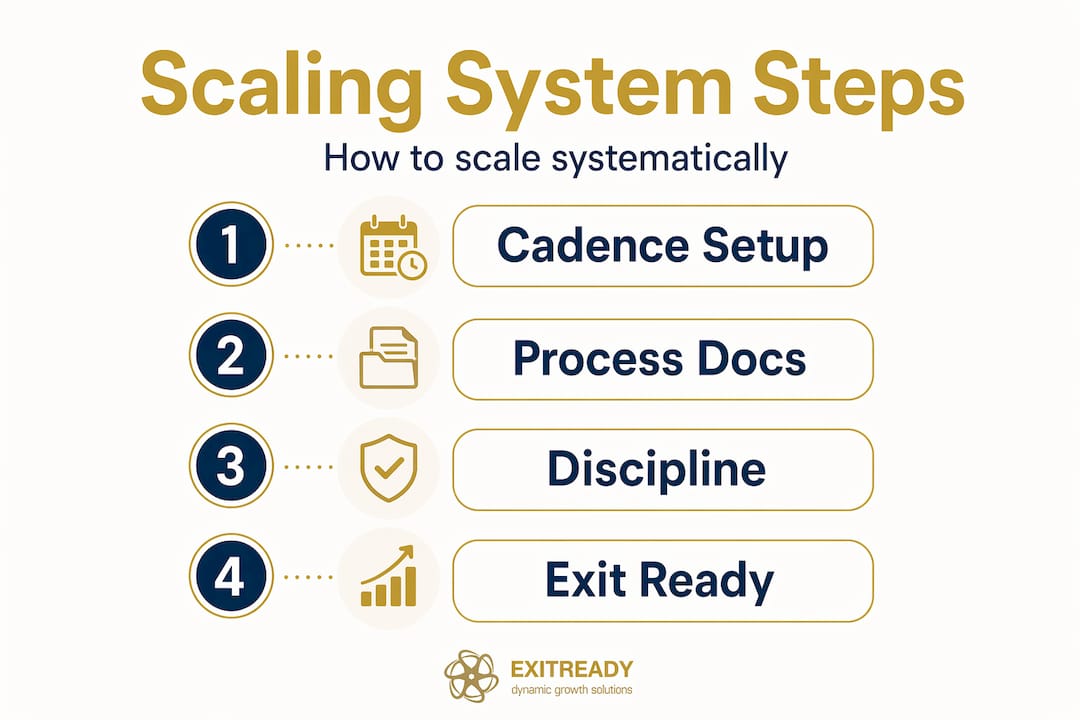
- Preparing to scale: building your operating cadence and governance rhythm
- Documenting processes: crafting scalable, usable standard operating procedures (SOPs)
- Enforcement and exit readiness: bridging documentation with operational discipline and valuation
- Optimizing operations infrastructure: technology, workflows, and management for scale
- The hidden execution gap: why documentation alone won’t scale your business
- How EXITREADY helps mid-market businesses scale systematically and prepare for exit
- Frequently asked questions
Key Takeaways
| Point | Details |
|---|---|
| Operating cadence drives scaling | Establishing weekly, monthly, and quarterly rhythms with ownership improves execution speed and alignment. |
| Focus SOPs on critical processes | Document the top 10 core workflows to reduce operational risk and support scalable growth. |
| Enforce systems beyond documentation | Embed decision gatekeeping and accountability into workflows to truly de-risk the business. |
| Prepare exit 12–24 months ahead | Systematize documentation and controls early to maximize valuation and reduce diligence risk. |
| Optimize infrastructure for scale | Ensure IT, workflows, and management align with growth demands and buyer expectations. |
Understanding the challenge: why many mid-market businesses struggle to scale systematically
Most mid-market owners are exceptional operators. That’s exactly the problem. When you are the system, the business scales until it hits you as the ceiling. Revenue plateaus, errors multiply, and every growth push triggers more chaos instead of more capacity.
The root cause is almost never effort. It’s the absence of documented, enforced processes. When knowledge lives in people’s heads rather than written systems, you get inconsistent execution across teams, decision bottlenecks at the owner level, and a fragile operation that can’t survive turnover or due diligence. Learning to work on your business not in it is the first mental shift that unlocks systematic scaling.
The compounding risk is real. As one growth advisor puts it, “documentation reduces rework, clarifies decisions, and makes the organization less dependent on individuals over time” — but most operators don’t discover this until they’re deep in a late-stage diligence process, staring at a buyer’s questionnaire they can’t answer.
Here’s what that fragility looks like in practice:
- Founder dependency: Critical pricing, hiring, or client decisions require the owner’s direct involvement every time.
- Undocumented workarounds: Teams develop informal “shadow processes” that work until the person who invented them leaves.
- No clear decision authority: Staff escalate everything upward because no written rule tells them what they can decide on their own.
- Inconsistent outputs: The same task done by two people produces two different results, at two different quality levels.
“The businesses that struggle most during diligence are rarely the ones with poor financials. They’re the ones where the owner IS the operations manual.”
Each of these problems reduces your exit valuation directly. Buyers and private equity firms apply risk discounts to businesses where one person’s departure threatens continuity. Systematic scaling removes those discounts.
With these challenges clear, the next step is preparing your business through foundational systematization.
Preparing to scale: building your operating cadence and governance rhythm
An operating cadence is the scheduled rhythm of meetings, metrics, and decisions your team follows at weekly, monthly, and quarterly intervals. Think of it as the heartbeat of your business. Without it, execution is episodic. With it, execution becomes predictable.

Teams generating $10M to $100M in revenue can move from chaotic execution to steady, reliable progress in roughly 2 to 3 months once that rhythm is put on the calendar and enforced. That’s a remarkably short timeline for a meaningful operational shift.
Here’s how to build yours, in the right order:
- Start with a weekly revenue standup (15 to 30 minutes). Cover pipeline, blockers, and last week’s wins. One person owns the agenda. One person records actions. Non-negotiable cadence.
- Add a monthly operating review. Review KPIs across all departments. Surface variances. Assign corrective owners. This is where you catch problems before they compound.
- Introduce a quarterly strategic review. Compare performance to annual targets. Update priorities. Align leadership on the next 90 days. Tie decisions to exit milestones if applicable.
- Assign a meeting owner to every session. A meeting without a single accountable owner drifts into a discussion forum. Owners prepare agendas, run the session, and distribute action items.
- Document decisions in every meeting. Not summaries. Actual decisions, the rationale behind them, and who is responsible for execution. This creates the audit trail buyers love.
- Build a KPI Tree to maintain metric hierarchy. Your company-level revenue goal breaks into department-level drivers, which break into team-level leading indicators. Every person knows which number they personally move.
Pro Tip: Before you launch all three cadence layers at once, run only the weekly standup for 30 days. The discipline muscle needs to form before you add weight. Trying to implement all cadence layers simultaneously usually collapses under resistance.
| Cadence layer | Frequency | Primary focus | Key output |
|---|---|---|---|
| Revenue standup | Weekly | Pipeline and blockers | Action list with owners |
| Operating review | Monthly | KPI variances and corrections | Corrective action log |
| Strategic review | Quarterly | Target vs. actual and priorities | 90-day priority alignment |
| Board or advisor sync | Quarterly | Growth and exit milestones | Updated exit readiness score |
If you’re also introducing operating rhythms inside a business that already has legacy habits, expect two to four weeks of friction. That friction is healthy. Push through it. Your business exit planning will look very different after six months of clean operating data than it does today.
Having set up your governance rhythm, you next focus on documenting critical processes to sustain growth and scalability.
Documenting processes: crafting scalable, usable standard operating procedures (SOPs)
Most SOP initiatives fail not because owners don’t care, but because they try to document everything at once, produce 80-page manuals no one reads, and never validate whether the documents actually work.
The more effective approach is ruthlessly focused. Prioritize your top 10 most critical processes, validate each one with a new employee who can complete the task without asking a single question, and schedule quarterly reviews with assigned Process Owners. That’s the standard that makes SOPs a genuine operational asset rather than a compliance exercise.
Here’s what makes an SOP actually usable:
- Start with a verb. Every step begins with an action: “Open,” “Review,” “Send,” “Confirm.” Passive phrasing creates ambiguity.
- Use decision flowcharts for conditional steps. If X happens, do Y. If Z happens, escalate to [name/role]. Flowcharts eliminate interpretation.
- Break complex processes into sub-SOPs. A 40-step document is a document no one follows. A master SOP with links to three focused sub-SOPs is something a person can actually navigate.
- Apply the ‘Rule of 10.’ If a task generates frustration or errors more than ten times, it needs an SOP. That filter keeps your library small and high-impact.
- Assign Process Owners, not just document owners. A Process Owner is responsible for the work being done correctly, not just the document being updated.
- Run quarterly SOP dusting. Every 90 days, each Process Owner reviews their SOPs for accuracy. Takes less than an hour per document. Keeps the library current and trusted.
Pro Tip: The single fastest validation test for any SOP is handing it to someone who has never done the task and watching them execute it. Every point where they pause, ask a question, or make a wrong assumption is a documentation gap. Fix it before you roll it out broadly.
Well-documented operations aren’t just an internal efficiency tool. They directly affect your business exit preparations and the multiples buyers are willing to pay. A business where any trained person can execute the core processes is a fundamentally less risky acquisition than one where institutional knowledge walks out the door when a key person leaves.
Once documentation is in place, enforcing system discipline and linking it to exit readiness ensures your business shines to buyers.
Enforcement and exit readiness: bridging documentation with operational discipline and valuation
Here’s an uncomfortable truth many consultants gloss over. Documentation is necessary, but it’s not sufficient. Buyers care whether founder-dependent decisions are encoded into workflows and whether ownership discipline is genuinely practiced, not just described in a binder.
Enforcement means building systems where the right person makes each decision, every time, without the founder needing to be in the room. It requires two things documentation doesn’t provide: escalation protocols and ownership accountability.
| What documentation does | What enforcement adds |
|---|---|
| Captures how work should be done | Confirms work is actually done that way |
| Assigns process steps | Assigns decision authority |
| Reduces knowledge loss | Reduces variance in execution |
| Supports training | Creates accountability trails |
| Improves onboarding speed | Enables auditable management |
For exit readiness specifically, start preparing 12 to 24 months before your target market date. That runway gives you time to build clean, verifiable financial packages, standardize your go-to-market processes, and develop the management depth that signals to buyers the business doesn’t depend on you.
Practical enforcement actions to implement now:
- Build a decision rights matrix that specifies which decisions are made at which level, with no ambiguity.
- Establish escalation triggers so teams know exactly when to escalate and exactly who receives the escalation.
- Align your monthly and quarterly reporting rhythms to the operational due diligence standards buyers and PE firms apply. Your internal operating data should already look like what a buyer’s team would produce during diligence.
- Build a data room 18 months out. Not as a project, but as a living document. Every key operational and financial metric, updated monthly.
Pro Tip: Review the types of buyers you are likely to attract before you build your data room. Strategic buyers and financial buyers scrutinize very different things. Knowing your audience shapes what you document and how.
With enforcement and exit readiness aligned, refining your operational infrastructure and tech stack further powers scalable growth.
Optimizing operations infrastructure: technology, workflows, and management for scale
As you scale, the systems carrying your business either multiply your capacity or become the bottleneck. Most mid-market firms have a patchwork of tools that made sense at $5M and become chaos at $30M. Operational due diligence by buyers covers efficiency, IT architecture, cybersecurity, data management, and business continuity planning as areas that either add or destroy deal value.
Here is what a pre-scale infrastructure audit should cover:
- ERP and CRM integration: Are your financial and customer systems sharing data, or is someone exporting spreadsheets between them every week?
- Workflow automation: Identify every manual step that happens more than 20 times per month. Each one is a candidate for automation or elimination.
- Cybersecurity posture: Mid-market companies are disproportionately targeted. Buyers apply risk discounts for poor security hygiene.
- Management structure: Can your current leadership team handle 40% more revenue without you adding more direct reports to your own plate?
- Business continuity: What happens if your top two people leave simultaneously? The answer to that question defines your resilience score in any diligence process.
| Infrastructure area | Common gap at $10M to $50M | Target state for scale |
|---|---|---|
| ERP/CRM integration | Manual data transfer | Automated, real-time sync |
| Workflow documentation | Verbal or tribal knowledge | Documented and versioned SOPs |
| Cybersecurity | Basic antivirus only | Policy, training, and access controls |
| Management depth | Owner plus one layer | Two full management layers |
| Financial reporting | Monthly after 15 days close | Monthly close within 5 to 7 days |
Understanding why most businesses never sell often comes down to infrastructure gaps that weren’t addressed until diligence started. By then, it’s too late to fix them without discounting the deal.
Having optimized your infrastructure, the next section shares a fresh perspective on systematization and exit readiness many owners overlook.
The hidden execution gap: why documentation alone won’t scale your business
After working through hundreds of mid-market operating assessments, the pattern is unmistakable. Companies that invest heavily in SOP libraries often feel more prepared than they actually are. The documents are thorough. The binders look impressive. And yet, when you observe actual execution, the team isn’t following the SOPs. They’re following what the founder told them last Tuesday in a hallway conversation.
This is what operational diligence frameworks call “execution topology fragility”. Shadow systems, founder-gatekept decisions, and informal override practices exist in nearly every mid-market business. They’re invisible until stress hits, a key person leaves, or a buyer’s team starts pulling on threads.
The shift that actually works is encoding critical decisions into the workflow itself. Not just writing down what to do, but building the meeting cadence, the KPI ownership, and the escalation structure so that the right decision happens automatically, even when you’re not watching.
True systematization is a behavior change program, not a documentation project. You can work on your business not in it only when the business has been engineered to run without your constant input. That engineering is what buyers pay a premium for.
Pro Tip: Once a quarter, pick three high-frequency processes and observe them in real time without announcing it. Compare what you see to the documented SOP. The gap between those two things is your actual execution risk.
Awareness of this gap isn’t discouraging. It’s the most valuable insight you can have before entering a growth phase or a sale process. Fix the execution gap first. Everything else compounds from there.
How EXITREADY helps mid-market businesses scale systematically and prepare for exit
Knowing the framework is one thing. Having the infrastructure, the expert support, and the accountability structure to actually implement it is another.

Dynamic Growth Solutions’ EXITREADY program is built specifically for mid-market owners who are serious about building management systems for sustainable growth and preparing for a premium exit. We implement operating cadences, SOP frameworks, decision rights structures, and KPI trees inside your actual business, not as a theoretical exercise. Our team aligns your internal rhythms to the exact exit planning standards buyers expect, so diligence becomes a confirmation rather than a discovery process. If you’re ready to stop being the ceiling of your own company, the AOS entrepreneur application is the right starting point.
Frequently asked questions
What is an operating cadence and why is it important for scaling a mid-market business?
An operating cadence is a scheduled rhythm of meetings, metrics, and decisions at weekly, monthly, and quarterly levels that aligns teams and keeps execution on track. Teams between $10M and $100M in revenue can move from chaos to steady growth in roughly 2 to 3 months after putting that rhythm in place and enforcing it consistently.
How many SOPs should my business focus on for effective systematization?
Focus on the top 10 most critical processes that drive revenue or carry the highest operational risk, and schedule quarterly reviews to keep them current and validated. A small, trusted SOP library outperforms a large, ignored one every time.
How far in advance should I prepare operationally for a potential business exit?
Start at least 12 to 24 months before your planned exit, building clean financial packages, documented processes, and management depth that signals operational maturity to buyers.
What distinguishes effective system enforcement from merely having process documentation?
Effective enforcement means critical decisions are coded into workflows with clear ownership and accountability, so execution doesn’t depend on the founder’s presence or informal override habits that documentation alone can’t prevent.
How does aligning internal reporting rhythms help with exit readiness?
Matching your internal meeting and metric cadence to the quarterly and monthly review cycles buyers expect reduces friction during diligence and demonstrates that your business runs on systems, not on personalities.