

Most mid-market owners with $2 million to $20 million in EBITDA can sell to a private equity buyer, and the price they get comes down to two things: whether the EBITDA is clean and defensible, and whether the business runs without the owner in the room. Expect five to seven months from launch to signing if you run a real process. Spend the next 12 to 24 months fixing add-backs, building a management bench, and commissioning a sell-side Quality of Earnings report, and you materially change the outcome.
TL;DR:
- A structured sell-side process typically takes five to seven months and can be compressed at the risk of leaving money on the table.
- Buyers focus on normalized EBITDA, recurring revenue, growth potential, management strength, and financial hygiene during due diligence.
- Early preparation, such as building management depth and cleaning financials, significantly increases the chance of attaining top valuation multiples.
- A competitive auction often yields higher prices and better terms than off-market deals, which tend to close faster but with less leverage.
- The first two years post-sale involve transition planning, operational adjustments, and maintaining culture, with success relying on deliberate communication and management continuity.
Table of Contents
- What Is the Sell to Private Equity Process, Step by Step?
- What Do Private Equity Buyers Actually Look For?
- How Should You Prepare Before Going to Market?
- What Due Diligence Reveals, and Where Deals Fall Apart
- How Deal Structure Actually Determines What You Take Home
- How Do You Evaluate Competing Offers?
- What Happens in the First Two Years After Closing?
- How Dynamicgrowthsolutions Maps to This Entire Process
- Andre’s Take: What Actually Moves the Needle
- Ready to Build an Exit-Ready Business?
- Sources
What Is the Sell to Private Equity Process, Step by Step?
A private equity sale moves through five distinct phases, and each one has its own rhythm, its own risks, and its own way of quietly destroying value if you rush it. Understanding the sequence matters because most owners lose leverage not during negotiation, but during the gaps between phases when they stop controlling the narrative.
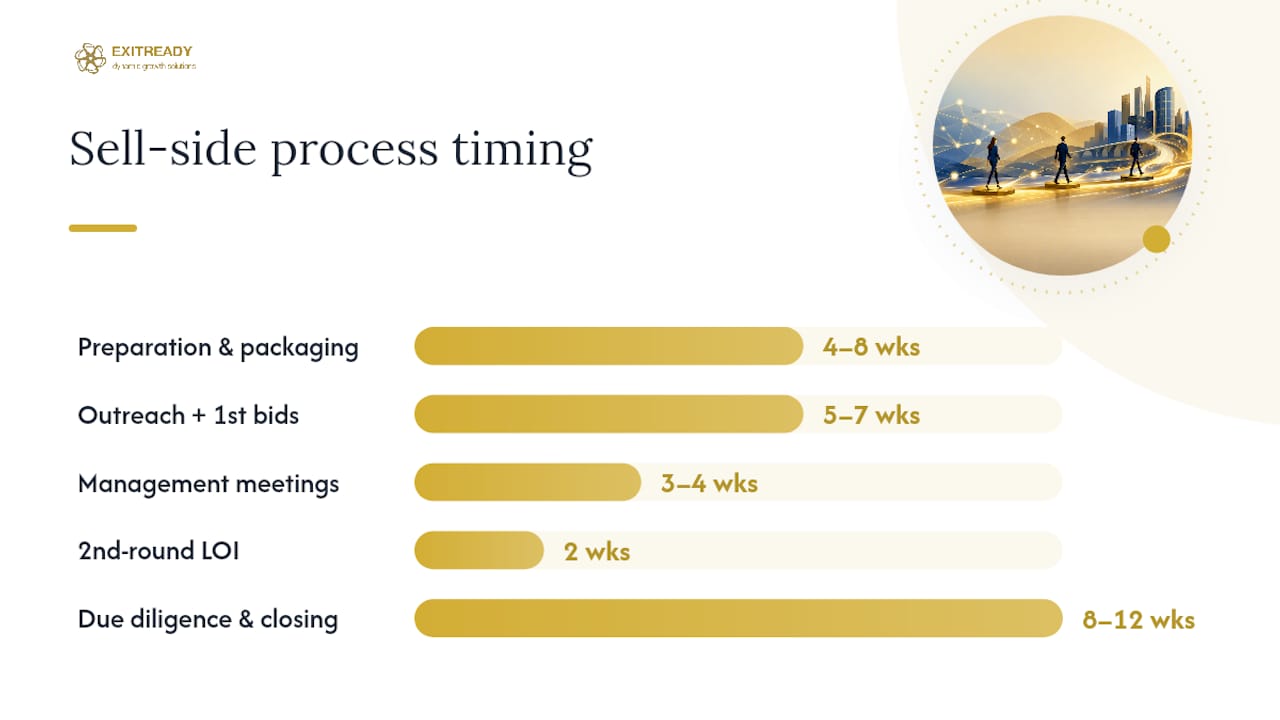
Here’s how a structured sell-side process typically unfolds, based on standard deal lifecycle timing:
- Preparation and packaging (4 to 8 weeks). Your advisor builds the Confidential Information Memorandum (CIM), assembles a virtual data room (VDR), and finalizes a sell-side Quality of Earnings report. This is the single most controllable phase, and it’s the one owners most often shortchange.
- Buyer outreach (3 to 4 weeks). Your advisor contacts a curated list of PE firms and strategic buyers, sending teasers and then the full CIM to parties who sign confidentiality agreements.
- First-round bids or indications of interest (2 to 3 weeks). Interested buyers submit preliminary, non-binding valuations based on the CIM alone.
- Management meetings (3 to 4 weeks). Shortlisted buyers meet your leadership team, tour operations, and ask pointed questions about growth levers and key-person risk.
- Second-round letters of intent (2 weeks). Finalists submit binding or semi-binding offers with proposed structure, financing, and exclusivity terms.
- Due diligence and closing (8 to 12 weeks). The winning bidder confirms everything in the LOI through financial, legal, commercial, and operational review, then signs and funds.
Add it up and a well-run process lands around five to seven months. Compress it below roughly four months and you generally leave money on the table, because buyers interpret speed as either desperation or a seller who hasn’t done the homework, according to deal-lifecycle data from Dealroom.
You’ll also face a structural choice early: run a competitive auction with multiple bidders, or negotiate off-market with a single buyer who approached you directly. Off-market deals close faster because they skip the outreach and first-round bidding entirely, but sellers routinely sacrifice pricing leverage in exchange for that speed, since there’s no competing bid to keep the buyer honest. A structured auction, by contrast, creates real pricing tension. Sellers who test the market with multiple qualified bidders avoid taking the first pre-emptive offer, which can land 15% to 30% lower than what a competitive process would have produced.
The prep phase is where the whole timeline gets either compressed or extended. A clean VDR, a defensible CIM, and a completed QofE let buyers move through diligence in weeks instead of months, because there’s nothing to chase down. Sloppy prep does the opposite: every missing document or unexplained add-back triggers another round of buyer questions, and each round adds a week or two to closing. If you want a sense of how this phase should be sequenced against the rest of your calendar, a multi-year exit timeline is worth mapping out before you ever call an advisor.
One more timing reality: buyers know their own return math, and it shapes how patient they’ll be with your process. Most PE firms target something like a 3x multiple on invested capital and north of 20% IRR across the life of the fund, which constrains what they can pay and how quickly they need to move. That discipline is why a rushed, half-prepared process rarely produces the top bid. The firm on the other side of the table is running the numbers whether you are or not.
What Do Private Equity Buyers Actually Look For?
PE buyers underwrite a business the same way every time, regardless of industry: normalized EBITDA, recurring revenue mix, growth runway, and margin stability, in roughly that order of importance. Get inside that checklist and the rest of your prep work writes itself.
Normalized EBITDA is the anchor. Buyers strip out one-time expenses, owner perks, and non-recurring revenue to find the “true” cash-generating power of the business. Every add-back you claim needs a paper trail, because an unverified add-back is the fastest way to trigger a price cut during diligence.
Recurring revenue changes the multiple conversation entirely. A business with multi-year contracts or subscription-like revenue gets priced differently than one living deal to deal, because the buyer’s underwriting model can actually forecast next year’s cash flow.
Growth runway matters almost as much as current performance. Buyers want to see two or three concrete levers, whether that’s untapped geography, an underpriced product line, or a sales team that hasn’t hit capacity, not just a hockey-stick projection with no mechanism behind it.
Management depth might be the most underestimated lever in the entire process. A buyer pricing in the risk of losing the owner post-close will discount the offer accordingly, sometimes sharply. Here’s the checklist buyers actually run:
- Does the business survive 90 days without the owner physically present?
- Is there a documented org chart with real decision authority below the top?
- Are customer relationships owned by sales staff, or does everything route through the founder?
- Is revenue concentrated in a handful of accounts, or spread across a base that can absorb one loss?
Financial hygiene rounds out the checklist: reviewed or audited financials, a clean cap table with no surprise equity holders, and books that reconcile without a forensic accountant. This is not glamorous work, but it’s exactly the kind of thing that shows up as a line item in the offer.
Pro Tip: Audited or reviewed financials often add roughly 0.5 to 1.0 turns of EBITDA multiple in the lower middle market, simply because they eliminate a category of diligence risk buyers would otherwise price into a lower offer, per guidance on acquisition readiness.
How Should You Prepare Before Going to Market?
The gap between owners who get top-decile multiples and owners who get average ones is almost always preparation time. Sellers who start 18 to 24 months ahead, building management depth, cleaning up financials, and shifting toward recurring revenue, materially increase their odds of landing at the top of their sector’s valuation range.
The long-run roadmap (12 to 24 months out):
- Build a leadership layer that can run day-to-day operations without you, and document who owns what decision.
- Write down your SOPs. Undocumented institutional knowledge is a liability buyers discount heavily.
- Push your revenue mix toward contracts, subscriptions, or repeat-order relationships wherever your industry allows it.
- Diversify your customer base if any single account represents more than 10% to 15% of revenue.
- Get two to three years of financials reviewed, or audited if you can afford it.
The short-run checklist (6 to 12 weeks before launch):
- Assemble your virtual data room: contracts, cap table, financials, HR records, IP documentation, all indexed and ready.
- Commission a sell-side QofE from a recognized accounting firm. This single step is one of the most effective ways to prevent last-minute price reductions, because it verifies your EBITDA before a buyer’s own accountants get a chance to challenge it.
- Fix your bookkeeping. Reconcile every account. Resolve every unexplained journal entry.
- Define your walk-away number and your target cash-at-close figure before you talk to a single buyer.
You’ll need a small team of outside advisors, and timing their involvement matters. Bring in your CPA first, months before launch, to clean up the books. Layer in a QofE provider once financials are stable. Engage an M&A advisor or buy-side connector to run outreach and manage the auction. Bring legal counsel in by the time you’re drafting the LOI, not after.
For a structured way to sequence all of this against your own calendar, an exit-readiness assessment can show you exactly where the gaps are before a buyer finds them for you.
What Due Diligence Reveals, and Where Deals Fall Apart
Diligence is where sell-side processes die, and it’s rarely the big obvious problems that kill deals. It’s the small, undisclosed things that make a buyer wonder what else you didn’t mention.
Buyers work through four diligence buckets simultaneously: financial and QofE verification, legal and contract review, commercial and customer analysis, and operational, IT, and HR review. Confirmatory diligence typically runs 60 to 90 days, and it’s where most price adjustments happen when a seller walked in unprepared.
The pitfalls that trigger a re-trade or a walkaway tend to repeat across deals:
- Add-backs the seller claimed but can’t document with receipts, invoices, or board minutes.
- Related-party transactions that weren’t disclosed upfront, like a lease with an entity the owner also controls.
- Key-person risk that becomes obvious the moment buyers meet the team and realize one person holds every customer relationship.
- Contract defects, such as change-of-control clauses that let a major customer walk the moment ownership shifts.
- Customer concentration that looked fine on a summary slide but falls apart under a detailed revenue breakdown.
The fix for most of this is running a mock diligence exercise before you ever go to market. Hire an outside advisor to poke holes in your own story the way a buyer’s diligence team will. This exercise typically surfaces 70% to 80% of the issues that would otherwise surface for real, giving you time to fix or explain them before they become a negotiating chip against you. Pair that with an indexed VDR and a running Q&A tracker, so every buyer question gets answered once and documented, not re-litigated three separate times with three separate advisors.
How Deal Structure Actually Determines What You Take Home
The headline number on a letter of intent is almost never the number you actually receive at close, and understanding why separates owners who negotiate well from owners who get surprised at the closing table.
PE deals for platform-sized businesses commonly price at 4x to 8x EBITDA, but the multiple is only half the story. What matters just as much is how that value splits across four components:
- Cash at close typically runs 60% to 80% of total consideration, and it’s the only part of the deal you can spend the day after signing.
- Equity rollover usually falls between 10% and 30% of proceeds, tying part of your payout to how well the business performs after you no longer fully control it.
- Seller notes are deferred payments the buyer promises over time, essentially making you a lender to your own former company.
- Earnouts condition part of the price on hitting future performance targets, shifting risk back onto you if the post-close business underperforms.
Statistic snapshot: Most PE firms underwrite deals to hit roughly a 3x return multiple and 20%+ IRR across the fund’s life. That target discipline is exactly why buyers lean on rollover and earnouts instead of paying everything in cash. Deferred structures let them hit their return hurdles without overpaying up front.
Rollover equity deserves particular scrutiny before you sign anything. Negotiate minority governance rights, information rights, and tag-along or drag-along provisions up front, because that equity is illiquid and its eventual value depends entirely on how well the sponsor executes and how long the fund holds the asset.
How Do You Evaluate Competing Offers?
Price is the number everyone fixates on, but it’s rarely the number that should decide which offer you take. Score every LOI across five axes before you get emotionally attached to the biggest headline figure.
- Cash at close. A higher percentage here means less of your payout is tied to future performance you no longer fully control.
- Certainty of financing. A buyer with committed capital closes faster and with fewer surprises than one still lining up debt financing.
- Governance and rights. If you’re rolling equity, what board seats, information rights, and veto powers come with that stake?
- Cultural and strategic fit. Does this buyer’s playbook match how you want the business, and your people, treated post-close?
- Rollover upside. What’s the sponsor’s actual track record executing this type of buy-and-build thesis?
Running a real competitive process, rather than negotiating bilaterally with the first interested party, routinely produces both a higher price and more favorable terms, because multiple bidders create pressure that a single buyer never has to feel.
Watch for red flags that should lower a score regardless of headline price: financing that’s “in progress” rather than committed, aggressive requests for extended exclusivity before diligence even starts, or a buyer who won’t specify governance terms on rollover equity. Any of those should make you slow down, not speed up.
What Happens in the First Two Years After Closing?
Closing isn’t the finish line. Most deals include a transition period, typically 6 to 24 months, where you stay involved in some capacity, whether that’s a full operating role, a consulting agreement, or an earnout tied to specific KPIs.
- Transition timelines vary by deal, but expect defined milestones and regular check-ins if any part of your proceeds depends on an earnout.
- Operational changes arrive quickly under new ownership: new reporting cadences, board oversight, and often new hires layered above or beside your existing team.
- Preserving culture takes deliberate effort. The owners who navigate this best keep communicating with staff directly instead of letting the sponsor’s integration team be the only voice employees hear.
- Rolled equity converts to cash later, usually when the sponsor exits through a sale, a recapitalization, a secondary sale, or occasionally an IPO, which can be anywhere from three to seven years out depending on fund life.
How Dynamicgrowthsolutions Maps to This Entire Process
Every prep task in this guide, documented SOPs, a management team that operates independently of the owner, KPI dashboards buyers can trust, is exactly what the AOS (Accelerated Operating System) framework at Dynamicgrowthsolutions is built to install. Instead of scrambling to build these systems in a compressed six-week window before launch, owners who work through structured business transformation programs build them methodically, months ahead of any buyer conversation. The exit-readiness certification process, paired with access to a vetted buyer and advisor network, exists specifically to close the gap between where your business operates today and where PE underwriting standards expect it to be.
Andre’s Take: What Actually Moves the Needle
Owners fixate on finding the right buyer. Wrong priority. Fix your management bench, get a sell-side QofE, and document your systems first, then buyers come find you. My caution: don’t accept a pre-emptive bid just because it feels flattering. Run the process. My tactical tip: build your walk-away number on paper before your first buyer call, not during the negotiation.
— Andre
Ready to Build an Exit-Ready Business?
Most owners trying to prepare for a PE sale on their own end up doing it twice, once badly under time pressure right before launch, and once properly if a deal falls through in diligence. Dynamicgrowthsolutions built the AOS framework specifically to avoid that second pass: documented playbooks, management depth, and clean KPI reporting installed 12 to 24 months out, not scrambled together in a six week sprint. The exit-readiness certification also puts qualifying businesses in front of a curated network of buyers and advisors already primed for exactly the kind of process this guide describes.
If you’re within two years of a potential sale, or just want an honest read on where your gaps are, the business exit planning program is the practical next step. Request an assessment and find out exactly what a buyer’s diligence team would flag today.
Sources
- Private Equity Deal: Structure, Process, Lifecycle (2026)
- How to Get Acquired by Private Equity at the Best Valuation
- How to Sell Your Business to a Private Equity Firm (2026) | DealSeam