

Strategic buyers often pay a premium when the present value of realistic, net synergies exceeds the premium they offer. Cost synergies are the more controllable kind, while revenue synergies carry more timing and execution risk, as L.E.K. Consulting finds. BCG’s plausibility test is the check to ask for.
TL;DR:
- Cost savings are the most controllable synergy, and acquirers often seek 6–10% of a business’s revenue, with ambitious targets reaching 8–18%.
- Revenue synergies receive probability weights of 35–80% and delays of 12–36 months; buyers subtract taxes and integration costs before comparing present value with the premium.
- Ask buyers for an itemized synergy map naming each initiative, owner, timeline, and cost; unweighted revenue forecasts can inflate bids and invite repricing.
- Compare offers beyond headline price: strategic buyers value product fit and distribution, while financial buyers may match through platform acquisitions; weigh earnouts and retention terms.
Table of Contents
- What types of synergies do strategic buyers count?
- How do synergies turn into a higher bid?
- How do buyers model synergies, and what should you check?
- What does the integration playbook look like?
- How do strategic and financial buyers differ?
- What should you do now to attract strategic buyers?
- Treat synergy promises as deliverables you can test
- Get your business ready for a synergy-driven sale
- FAQ
- Sources
What types of synergies do strategic buyers count?
Buyers sort synergies by how much they trust them. Hard synergies show up in the numbers, and soft ones depend on people and culture.
- Cost synergies: consolidated G&A, procurement savings, and shared facilities. Buyers announce these first because they are the easiest to control. L.E.K. reports that median acquirers often seek savings equal to 6–10% of target revenue, with more ambitious targets of 8–18%.
- Revenue synergies: cross-selling, new channels, and bundled offers. Value leaks easily here, and BCG warns that revenue synergies are prone to leakage.
- Financial synergies: tax benefits and added debt capacity.
- Soft synergies: a shared operating model and compatible culture, which are hard to price but often decide whether the hard numbers arrive.
A combined firm is worth more than two standalone firms only if these sources actually materialize.
How do synergies turn into a higher bid?
The logic is simple: combined value equals the two standalone values plus synergies. A rational buyer shares part of those expected synergies with you through the price, because it must outbid other suitors. Higher expected synergies raise purchase prices, and both strategic and financial buyers lean on them to justify premiums.
The buyer’s internal hurdle is the part owners rarely see:
- The present value of net synergies, after one-off integration costs and taxes, should exceed the premium paid.
- Whatever the buyer keeps is its reward for taking on execution risk.
- Credible, itemized synergy plans also help the buyer’s own valuation, which makes a stretch bid easier to defend.
BCG and TUM recommend a synergy plausibility test that compares net synergies against the premium to avoid value-destructive deals. If a buyer’s offer fails its own test, expect a price cut or a heavier earnout later.
How do buyers model synergies, and what should you check?
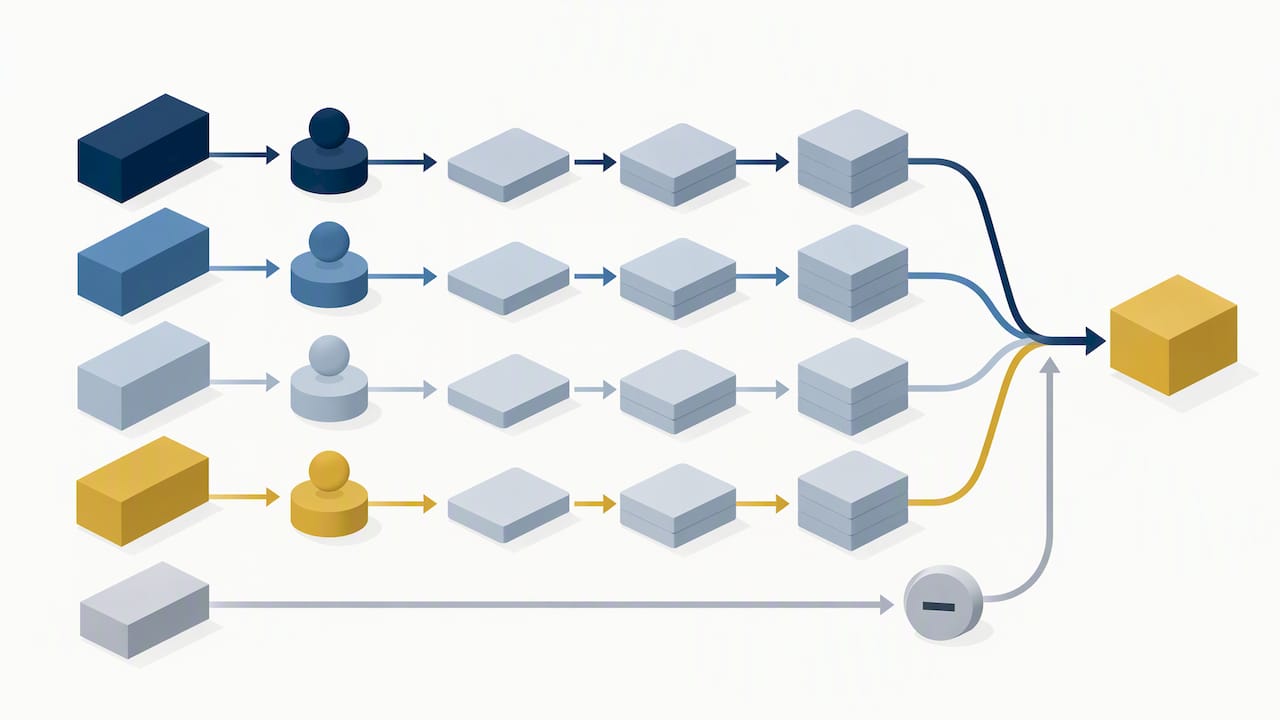
Good buyers use two lenses at once. A top-down check compares targets with benchmarks, such as savings as a percentage of revenue. A bottom-up list names each initiative, its owner, its timing, and its one-time cost. Either lens alone misleads: benchmarks ignore your specifics, and initiative lists can pile up wishful items.
Disciplined buyers then adjust for risk:
- Revenue synergies get probability weights, often 35–80%, and delays of 12–36 months.
- The adjusted stream is discounted to a present value, and integration costs are subtracted.
- That net figure is compared with the premium offered.
A bid built on a detailed, time-bound synergy map reflects achievable value rather than generic projections. A bid that skips probability weights is probably padded, and padded bids tend to get re-traded in diligence.
Pro Tip: Ask every serious buyer to show its synergy map: the levers, the owners, the timeline, and the expected one-time costs.
What does the integration playbook look like?
Buyers who capture synergies start planning in diligence, not after closing. BCG advises setting stretch targets to build a buffer. Its seven steps to accelerate revenue synergies work as a checklist you can expect a serious buyer to follow:
- Form a pre-day-one clean team to validate the top cross-sell levers.
- Develop joint offers.
- Plan product integrations.
- Set revenue targets.
- Choose the go-to-market model.
- Enable the sales team.
- Run targeted cross-sell campaigns, tracked on a regular cadence.
An integration management office (IMO) holds this together. It centralizes measurement, runs a weekly cadence to unblock teams, and owns the synergy KPIs. Our roll-up playbook covers how integration-first buyers sequence this work, and Altiam’s team extension workflow shows one way to staff the extra workstreams.
Pro Tip: Ask who will own each synergy initiative and how performance will be measured. Vague ownership is the first sign of leakage.
How do strategic and financial buyers differ?
Their motives set their pricing. A strategic buyer is an industry player acquiring a company to capture synergies and long-term value, and it is often willing to pay premium prices. A financial buyer is driven by returns, leverage, and an eventual exit.
- Strategic buyers: pay for distribution access, product fit, and cost overlap. Higher premiums usually come with integration commitments.
- Financial buyers: underwrite cash flow, but may pay for synergies through a platform and add-on strategy.
- Where they collide: an add-on to an existing platform can match a strategic bid.
Compare offers on more than headline price: integration commitments, earnouts, and retention terms all change what you keep. Our guide to types of business buyers goes deeper.
What should you do now to attract strategic buyers?
Synergy claims only move price when a buyer can verify them quickly. Work through this list before you go to market:
- Prepare clean product-level and account-level data so a clean team can validate cross-sell opportunities fast.
- Draft a one-page synergy map for likely acquirers: top levers, estimated timing, one-time costs, and accountable owners.
- Document operating processes and rehearse integration on the riskiest areas: IT, fulfillment, and pricing.
- Build KPIs and an IMO-ready dashboard you can hand a buyer, which shortens the integration ramp and lowers perceived risk.
Operational discipline is what makes the map believable, which is why operational efficiency matters to price. Our guide on how to attract strategic buyers expands on each step.
Pro Tip: Build the synergy map from the buyer’s side of the table: where would their sales team add revenue from your customers in the first year?
Treat synergy promises as deliverables you can test
Most owners hear “synergies” and relax, as if a big number were a done deal. I’d do the opposite: treat each promise as a deliverable with an owner, a date, and a budget. Ask to see the plausibility math and the integration cost plan during diligence. A buyer that welcomes the questions has probably done the work, and one that dodges them is asking you to carry its risk.
— Andre
Get your business ready for a synergy-driven sale
A synergy map is only as credible as the operations behind it. We built our Enterprise Assessment and AOS to help owners document those levers, run a ProfitDriver analysis, and prepare integration playbooks before buyers arrive. Start with a readiness diagnostic and see where a strategic buyer would look first.

FAQ
Do strategic buyers pay more than other buyers?
Often, yes, because they can justify a premium with synergies a financial buyer cannot capture. Investopedia notes they are often willing to pay premium prices. The premium still has to pass the buyer’s own test against net synergy value.
What are the main types of synergies?
Cost, revenue, and financial synergies are core types, with soft cultural and operating-model synergies also relevant. McKinsey frames the core levers as cost, capital, and revenue. Cost synergies are the most reliable.
Can you give an example of a strategic buyer?
A competitor, a supplier, or a customer in your industry that wants your product line, channel, or capacity is a strategic buyer. A software firm buying a smaller rival to cross-sell to its customers is a typical case.
Why do revenue synergies get discounted?
They depend on customers and sales teams changing behavior, which takes time and often falls short. BCG warns that value leakage is common, so buyers weight these gains by probability and push them out in time.
Sources
- How Successful M&A Deals Split the Synergies
- Keys to Unlocking Merger Value: Cost Synergies | L.E.K. Consulting
- Ey