

The fastest, most reliable gross margin gains come from two moves run together: short pricing and promotion tests, and a landed-cost rebuild that exposes where procurement and freight are quietly eating profit. Both can show results within 30 to 60 days. Structural changes, like sourcing redesign or inventory footprint shifts, take longer and should follow once the quick wins fund and validate the bigger program.
TL;DR:
- Test prices on selected SKUs against unchanged controls, then judge results by incremental margin dollars rather than revenue or sales volume alone.
- Recalculate SKU costs to include freight, duties, broker fees, insurance, and receiving, since factory prices alone can misstate true profitability.
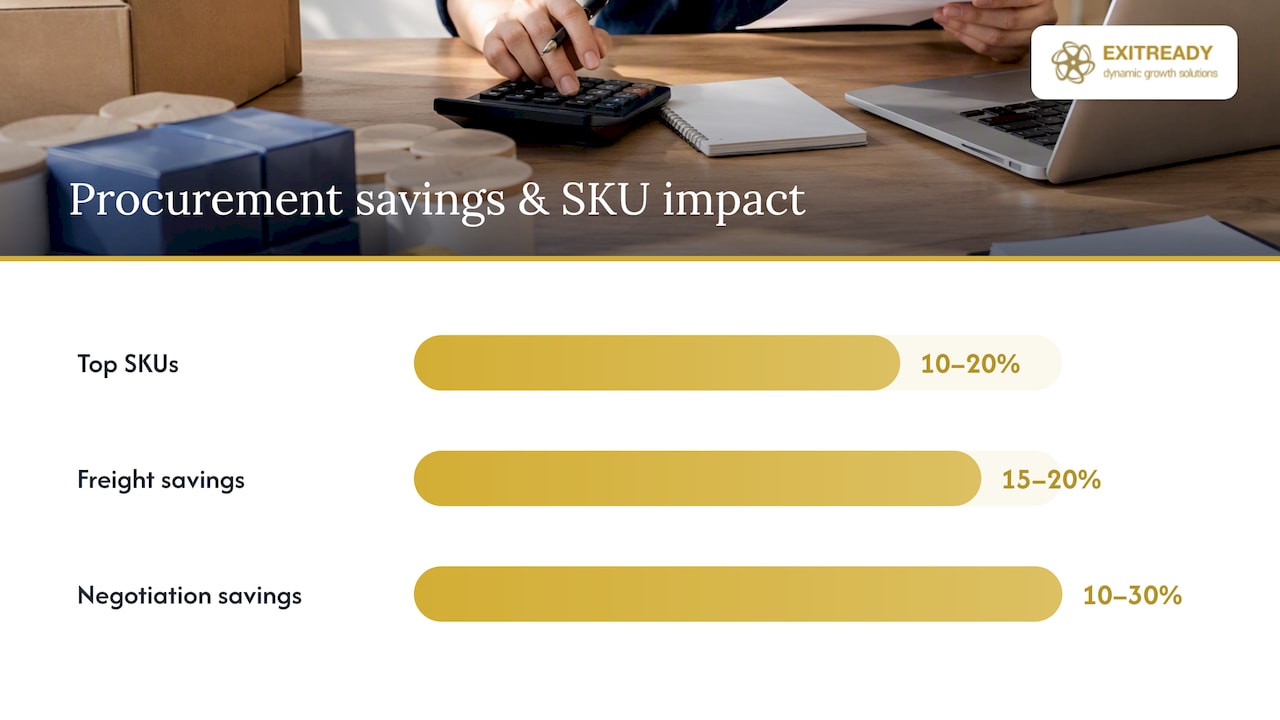
- Focus first on the top 10–20% of SKUs driving most COGS or margin impact, and build cost models before supplier negotiations.
- Some supplier engagements report savings of 10–30% of COGS; freight renegotiations have delivered savings in the mid teens to 20% range.
- Give merchants, operations, and supply chain shared ownership, and review margin, SKU costs, average order value, and markdowns weekly to keep gains from reversing.
Table of Contents
- What Is Gross Margin and What Counts as a Good Benchmark?
- Why Margin Gains Matter for Cash Flow and Valuation
- Quick Wins: Pricing Tests, Promotions, and Bundling
- Rebuilding COGS and Squeezing Procurement Costs
- Operational Moves That Make Margin Gains Stick
- How to Sequence a Margin Improvement Program
- How a Structured Diagnostic Accelerates Margin Work
- What Owners Consistently Get Wrong About Margin Work
- Get a Clear Read on Your Margin Before You Guess at Fixes
- FAQ
- Sources
What Is Gross Margin and What Counts as a Good Benchmark?
Gross margin is revenue minus cost of goods sold (COGS), divided by revenue. Contribution margin goes a step further, subtracting variable selling costs too, which makes it the better guide for pricing decisions on individual offers. Operating margin subtracts fixed overhead on top of that.
There is no universal “good” number, so compare against your own category rather than a generic target. One common error inflates margin from the start: leaving freight, duties, and handling fees out of COGS. That omission can overstate true margin by a meaningful amount, which is why a landed-cost view matters before any improvement plan begins.
Why Margin Gains Matter for Cash Flow and Valuation
A small percentage-point increase in gross margin flows almost entirely to the bottom line, since fixed costs do not move with it. On $5 million in revenue, a 2-point margin improvement adds $100,000 in annual profit with no added sales effort, cash that can fund inventory, hiring, or debt paydown without new financing.
That cash flexibility also shapes how a business is valued. Buyers and investors price recurring margin expansion as a sign of operational discipline, not luck. But margin gains built purely on price increases are fragile: survey data show firms’ ability to pass input costs to customers has fallen since 2022, especially among services firms, so pricing alone is not a durable strategy.
Quick Wins: Pricing Tests, Promotions, and Bundling
These moves are reversible, measurable, and fast. Run them in parallel with the COGS work below rather than waiting for one to finish before starting the other.
- Test prices at the SKU level: raise price on a sample of SKUs with low elasticity and hold a control group unchanged to isolate the true margin effect.
- Audit every standing promotion: many discounts persist long after the reason for them has disappeared, quietly eroding margin on volume that would have sold anyway.
- Build bundles around high-margin items: pair a lower-margin anchor product with higher-margin add-ons rather than discounting the anchor directly.
- Set tiered shipping thresholds and minimum order sizes: these lift average order value without touching sticker price, which customers resist less than a direct increase.
- Segment customers by margin contribution: route higher-margin offers to the buyers who have shown willingness to pay for them, instead of blasting the same promotion to everyone.
Measure each test against a true control group and track incremental margin dollars, not just revenue lift. A promotion that grows volume while shrinking margin per unit is not a win. For pricing guided by true economics rather than headline gross margin, a contribution margin view often produces better decisions, and a practical pricing framework can help structure how tests feed into broader marketing strategy.
Rebuilding COGS and Squeezing Procurement Costs
Before negotiating anything, rebuild cost of goods sold to a true landed-cost basis per SKU: factory price plus freight, duties, broker fees, insurance, and receiving costs. Freight and duties alone can add a wide range on top of quoted factory price, and without that full picture, negotiation targets the wrong line items.
- Segment SKUs using Pareto logic: the top 10 to 20% of items typically drive the majority of COGS or margin impact, so prioritize negotiation and rationalization there first.
- Build a should-cost model for your highest-impact SKUs before entering supplier talks, so you know the real cost floor rather than negotiating against a list price.
- Time renegotiations around supplier slow seasons and use volume commitments or extended payment terms as leverage instead of price alone.
- Treat freight and duties as a separate lever: renegotiated freight contracts often deliver savings in the mid-teens to 20% range, and persistent duty costs may justify redesigning the sourcing footprint entirely.
Disciplined supplier negotiation has delivered savings in the 10 to 30% range of COGS in various engagements, which makes it one of the highest-leverage moves available once the landed-cost picture is accurate. A structured SKU rationalization process helps prioritize which items to fix, which to renegotiate, and which to drop entirely.
Pro Tip: Run the landed-cost rebuild before any supplier negotiation. Negotiating from an inflated cost baseline wastes leverage you will not get back.
Operational Moves That Make Margin Gains Stick
Quick wins buy time and cash. Structural changes make the gains permanent.
- Better demand forecasting and inventory planning cut markdowns and shrinkage, two of the quietest margin killers in retail and distribution businesses.
- Design-to-value work and modularizing product architecture remove hidden cost that customers never notice or pay for.
- AI and automation tend to deliver the strongest return in procurement, dynamic pricing, and production scheduling, where forecast accuracy improvements directly cut inventory and transportation waste.
- None of this holds without governance: a margin-management office with cross-functional ownership and incentives tied to margin outcomes, not just revenue, keeps the gains from quietly reversing within a year.
Margin programs that stay inside finance tend to stall. They scale when merchants, operations, and supply chain teams share accountability for the outcome.
How to Sequence a Margin Improvement Program
A workable program runs in three overlapping phases, not one long project.
- Days 1 to 60: run pricing and promotion tests, rebuild landed cost, and open supplier renegotiation conversations.
- Days 60 to 120: lock in procurement savings, formalize pricing changes that tested well, and roll bundling and AOV tactics company-wide.
- Days 90 to 180 and beyond: redesign sourcing footprint, modularize products, and install the governance structure that keeps margin on the agenda permanently.
Track gross margin percentage, SKU-level COGS, pass-through rate, average order value, and markdown rate weekly, in one shared dashboard rather than separate finance and sales spreadsheets. A performance engine that connects these KPIs to a regular review cadence keeps the program from losing momentum once the initial wins are banked.
How a Structured Diagnostic Accelerates Margin Work
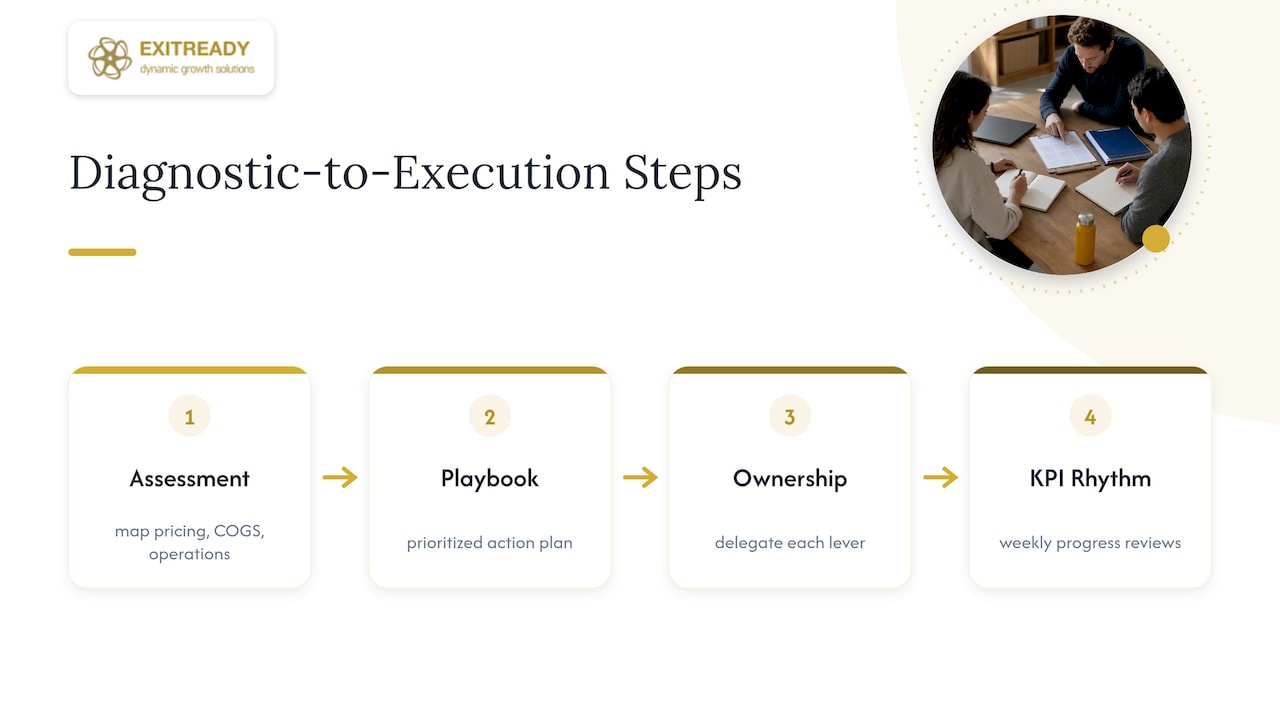
We built our ProfitDriver Analysis™ as a diagnostic-to-execution system: it maps where margin is leaking across pricing, COGS, and operations before recommending any fix. Clients typically move through an assessment, a prioritized action playbook, delegated ownership of each lever, and a weekly KPI rhythm to track progress. Internal pilots work well for quick pricing and promotion tests. Procurement overhauls and operating-model redesign usually move faster with outside structure holding the sequence together.
What Owners Consistently Get Wrong About Margin Work
The most common mistake is stopping after the pricing tests land, treating a 30-day win as the finish line instead of the funding for the harder procurement and structural work that follows. The second is letting finance run the whole initiative alone, when merchants and operations hold the SKU-level knowledge that makes the numbers real. The third is miscounting COGS by leaving out landed costs, which makes every downstream decision wrong. Owners who sequence the work, assign a named owner to each lever, and review progress weekly see gains that hold.
— Andre
Get a Clear Read on Your Margin Before You Guess at Fixes
Running pricing tests and a landed-cost rebuild on your own is possible, but most owners find the hardest part is knowing which SKUs and suppliers to touch first. A short Growth Sprint gives you a focused diagnostic and a prioritized action list within weeks, without a long-term commitment.

For businesses needing a deeper operating-model rebuild once the quick wins are banked, our AOS Value Creation Partnership adds the governance and playbooks to make the gains permanent. A first conversation typically clarifies which levers matter most for your business and what results to expect within 90 days. Schedule a strategy call to get started.
FAQ
Is 20% gross margin good?
Compare against your own category’s norms rather than a flat benchmark.
What does margin improvement mean?
Margin improvement means raising the percentage of revenue retained after direct costs, through levers like pricing, promotion discipline, procurement savings, or product mix changes. It is usually pursued through a sequence of fast pricing and cost tests followed by structural operational changes.
What does it mean if gross margin increases?
A rising gross margin usually means a business is either charging more effectively, controlling direct costs better, or shifting sales toward higher-margin products. It is a strong signal of operational health as long as the increase holds up after accounting for full landed costs.
Is a 70% gross margin good?
In physical goods or distribution businesses, a margin that high is unusual and worth double-checking against a landed-cost basis.
Sources
- Pareto principle guidance for product and procurement focus — NetSuite
- Amid rising input costs, many Tenth District firms report passing along fewer costs to customers – Kansas City Fed
- How to Lower Your Cost of Goods Sold Without Cutting Corners — No Logo