

Service delivery capacity planning means sizing staff, documented playbooks, tools, and reserve capacity to meet forecasted demand and service-level agreements, rather than reacting to whatever lands on a team’s desk. The first move is building 60 to 90 day demand visibility from your sales pipeline and picking one delivery process to document this month. A guided path like Dynamic Growth Solutions’s AOS gives mid-market leaders a structured way to get there faster.
TL;DR:
- Build forecasts from probability weighted CRM stages, signed contracts awaiting start, renewals, backlog, and seasonality; convert projected engagement hours into headcount by role.
- Reserve 10% to 15% of billable capacity for surges, set utilization targets by role, and review bench size quarterly against pipeline volatility.
- Redeploy trained employees before hiring when possible, since median time to fill for nonexecutive roles is about 39 days and internal moves retain institutional knowledge.
- Document one high volume or high risk workflow first, validate plain language instructions with practitioners, and review the playbook every two quarters.
- Connect CRM and time tracking data, update bench availability weekly, and give a named capacity owner authority to reassign staff during monthly reviews.
Table of Contents
- Diagnose demand and set a 60 to 90 day forecast that drives staffing
- Design a staffing model for services: utilization, bench, and internal mobility
- Document the work: playbooks, SIPOC maps, and simple work instructions
- Tools and integrations that create visibility across delivery and sales
- A short implementation roadmap: your first 30, 60, and 90 days
- Measure and govern capacity: the KPIs and cadence that keep plans honest
- Aligning capacity planning with growth strategy and exit planning
- Integrating capacity planning with financial forecasting and budgeting
- Change management practices that keep capacity shifts from disrupting delivery
- Why strategic delegation determines how far capacity can scale
- Author perspective: why owners who plan capacity win exit readiness
- How Dynamic Growth Solutions helps: AOS, assessments, and a next step
- FAQ
- Sources
Diagnose demand and set a 60 to 90 day forecast that drives staffing
Most service firms plan capacity around last year’s budget. That habit breaks down fast when pipeline shifts week to week. Capacity planning guidance from Planview recommends aligning staffing with a rolling 60 to 90 day demand forecast pulled directly from the sales pipeline, not from historical averages alone.
Four data sources feed that forecast:
- CRM pipeline stages, weighted by close probability.
- Signed contracts and statements of work not yet started.
- Recurring billing and renewal dates that signal predictable workload.
- Backlog and known seasonality from prior cycles.
Once you have those numbers, translate them into hours. Take forecasted engagement hours, divide by a realistic utilization target per role, and you get the headcount needed to deliver on time.
A majority of businesses overcommit resources when they lack structured capacity planning, according to Planview’s research on professional services capacity. That single number explains why so many delivery teams feel permanently behind. Build a bench policy before you need one: hold a defined share of billable capacity in reserve and price that reserve into your margin assumptions rather than treating it as overhead you forgot to budget.
Design a staffing model for services: utilization, bench, and internal mobility
Utilization targets only work when they account for more than raw hours.
- Set utilization targets by role, not as one firm-wide number.
- Hold 10% to 15% of billable capacity as bench or flexible capacity for surges.
- Build a pre-vetted contractor bench before demand spikes, not during one.
- Review bench size quarterly against actual pipeline volatility.
Internal mobility deserves more attention than most owners give it. SHRM’s recruiting benchmarking research puts median time-to-fill for nonexecutive roles at about 39 days, and shows growing adoption of internal talent marketplaces specifically because redeploying existing staff is faster than external hiring. Moving a trained employee from a quieter account to a surging one preserves institutional knowledge that a new hire simply does not have yet.
Decide your hiring-versus-contractor line in advance. Roles tied to client relationships and quality standards usually justify permanent hires; short, specialized spikes are often better covered by contractors you already know. Our related breakdown on sales capacity planning walks through the formula for turning pipeline volume into headcount for sales-driven service lines.
Pro Tip: Build your contractor bench during a slow quarter, when you can vet people without the pressure of an active staffing gap.
Document the work: playbooks, SIPOC maps, and simple work instructions
Overdocumented processes get ignored. ASQ’s guidance on process documentation is blunt about this: a usable operating manual favors simple work instructions and visual maps like SIPOC over dense procedural language that nobody rereads after week one.
Start with SIPOC, which maps Suppliers, Inputs, Process, Outputs, and Customers for a given delivery workflow, then add Controls and Measures where relevant. Seven steps make this practical:
- Pick one high-volume or high-risk delivery process to start.
- Interview the people who actually run it, not just their managers.
- Map the current state honestly, including the workarounds.
- Identify the two or three steps where handoffs break down.
- Write plain-language work instructions for each step.
- Validate the draft with the practitioners before publishing it.
- Set a review date, usually every two quarters.
Flowcharts work best for decision-heavy processes with branches; step-by-step instructions work better for repeatable, linear tasks. A related ASQ piece on ISO 9000 documentation makes the same point: document the process as it is actually performed, not the idealized version leadership wishes were true. Our guide to swimlane process mapping is a fast way to expose exactly where those handoffs fail. Once a playbook exists, train on it, version it, and set an update cadence tied to that review date, not to whenever someone remembers.
Pro Tip: A playbook that takes longer to read than the task takes to perform will never get used.
Tools and integrations that create visibility across delivery and sales
Forecasts only matter if the people staffing engagements can see them. That requires your CRM and your delivery or time-tracking system (often a PSA tool) talking to each other, so a signed deal automatically shows up as projected workload against existing capacity.
A workable minimum data model needs just six fields:
- Request date and expected start date.
- Estimated effort in hours.
- Required skills or certifications.
- Service-level agreement or deadline.
- Account priority tier.
- Assigned or proposed owner.
From there, three reports do most of the work: a 60 to 90 day demand heatmap by skill, a rolling utilization table by person or team, and a bench availability view updated weekly. When a skills gap shows up in that heatmap faster than you can hire, a pre-vetted partner or contractor pool, built the way an event production workflow that handles variable staffing for episodic work, covers the gap without derailing the forecast.
A short implementation roadmap: your first 30, 60, and 90 days
You do not need a year-long transformation program to get capacity planning working. Ninety days is enough to go from reactive staffing to a documented, measured system.
- Days 1 to 30: Run a pipeline-to-capacity audit, name one person as capacity owner, and pick one or two delivery processes to document first.
- Days 31 to 60: Lock in bench and contractor agreements, connect your CRM and time-tracking systems, and pilot playbook training with one team.
- Days 61 to 90: Launch the demand and utilization dashboards, formalize redeployment steps for moving staff between accounts, and set a monthly capacity governance meeting.
Keep ownership visible. The capacity owner should report into a monthly review attended by whoever controls hiring and sales commitments, since both decisions affect the same forecast. For a faster running start, our operational assessment checklist walks through a 2 to 4 week diagnostic that covers most of the day-30 audit work.
Pro Tip: Pick processes to document based on where handoffs break most often, not on which team complains the loudest.
Measure and govern capacity: the KPIs and cadence that keep plans honest
A forecast without governance drifts back into chaos within a quarter. Five KPIs cover most of what matters:
- Billable utilization by role and team.
- Backlog-to-capacity ratio, flagging when backlog exceeds available hours.
- Time-to-fill for open roles and redeployments.
- SLA adherence rate across active engagements.
- Bench utilization, tracking how often reserve capacity actually gets used.
Benchmark research from Sage found that firms at the top delivery maturity level report significantly better billable utilization and much higher project margins than firms at the lowest maturity level, using the same general headcount. Governance and documentation, not just staffing levels, drive that gap.
Set trigger thresholds in advance: a backlog-to-capacity ratio above a defined line pauses new sales commitments; a bench utilization rate near zero for two straight cycles signals it is time to hire. Projectmanagement points to a named capacity owner with real authority to reallocate bench resources as the single most effective governance habit. A structured diagnostic like our ProfitDriver Analysis™ or an Enterprise Assessment slots naturally into this monthly rhythm, giving leadership a periodic outside check on whether the numbers still hold up.
Aligning capacity planning with growth strategy and exit planning
Capacity planning and growth strategy are the same conversation told from two angles. Every serious growth target should trace back to a specific capacity answer: who delivers the added work, under what documented process, with what SLA coverage.
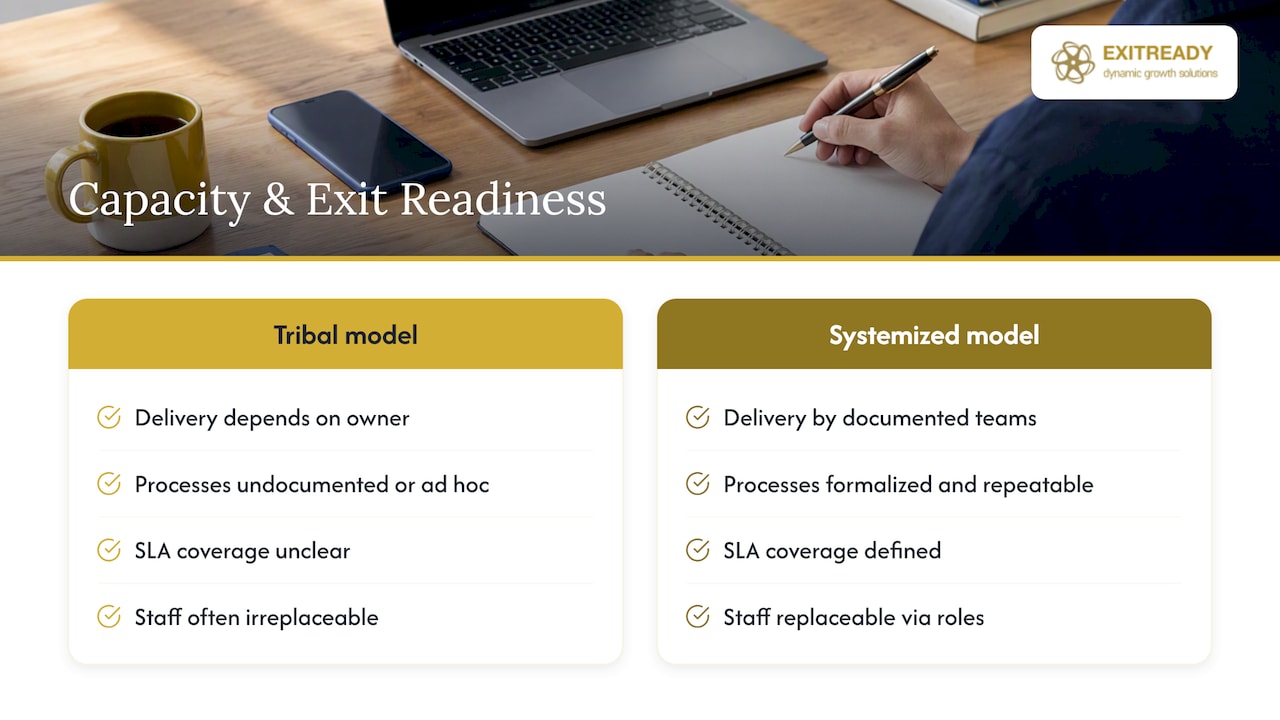
Exit planning raises the stakes further. Buyers and their advisors look hard at whether delivery depends on the owner personally or on systems that would survive new ownership. A business running on tribal knowledge and ad hoc staffing reads as risky, no matter how strong its revenue looks on paper. One documented and measured with the kind of consistency described earlier, utilization tracked, bench policy in place, playbooks current, reads as a business that keeps running without its founder in the room.
This is where capacity planning stops being an operations exercise and becomes a valuation lever. A buyer evaluating two similarly sized firms will usually pay more for the one that can demonstrate predictable delivery capacity and staff who are not irreplaceable. Treating your 90-day forecast, your bench policy, and your playbooks as part of the story you tell a buyer, rather than as internal housekeeping, changes how that story lands. Growth plans and exit plans should be built on the same capacity data, reviewed in the same monthly meeting, not treated as separate workstreams that happen to touch the same org chart.
Integrating capacity planning with financial forecasting and budgeting
Capacity decisions and financial forecasts constantly affect each other, yet many mid-market firms build them in separate spreadsheets that never talk. Every headcount add changes the cost base in next quarter’s budget. Every new signed contract changes the demand side of the capacity model. When these live apart, finance ends up surprised by hiring costs, and operations ends up surprised when a budget freeze blocks a hire the pipeline already justified.
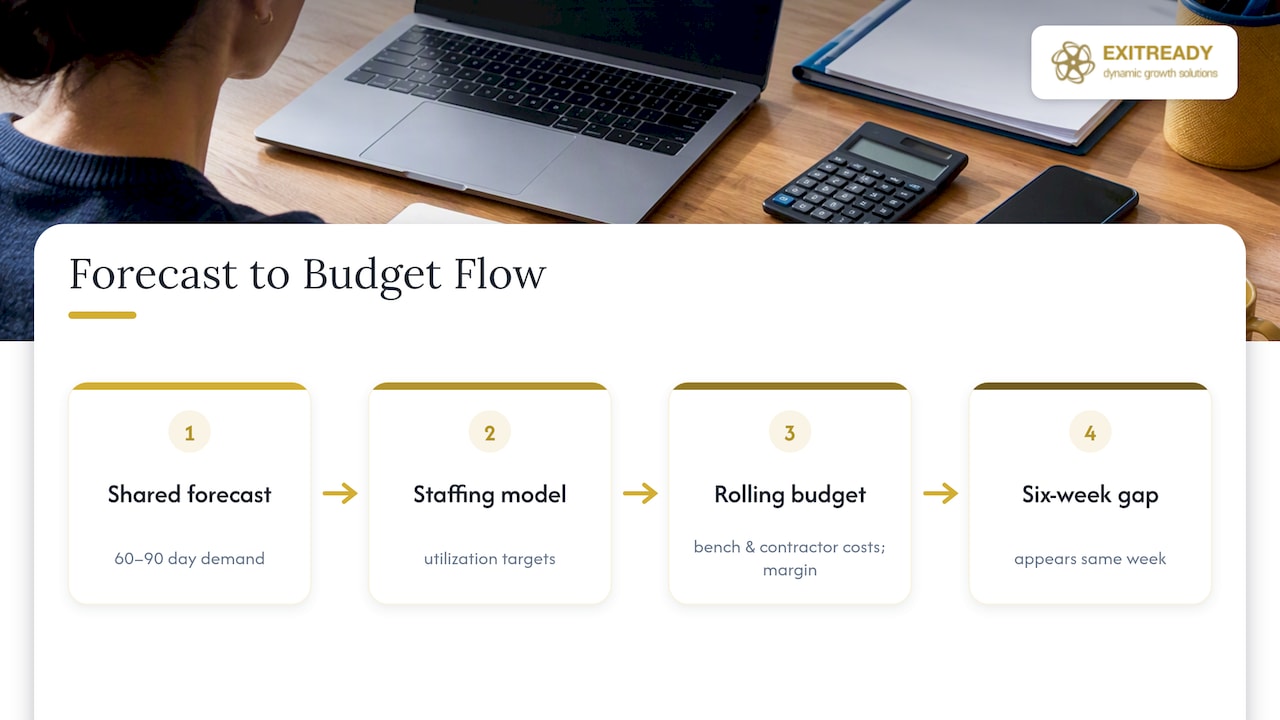
The fix is mechanical rather than complicated: feed the same 60 to 90 day demand forecast used for staffing directly into the rolling budget process. When the demand heatmap shows a skills gap in six weeks, that gap should appear in the budget conversation the same week, not at the next quarterly review. Bench and contractor costs, often treated as a rounding error, deserve their own budget line because they represent a real cost of avoiding overcommitment.
Margin planning benefits most directly. Utilization targets set in the staffing model translate straight into gross margin assumptions in the financial plan. If actual utilization consistently falls below the target used in the budget, that gap shows up as margin erosion before it shows up as a cash problem, giving leadership time to adjust pricing, staffing, or scope before the quarter closes rather than after.
Change management practices that keep capacity shifts from disrupting delivery
Changing staffing models, rolling out new playbooks, or redeploying people between accounts all touch people who were doing their jobs just fine before the change arrived. Handled poorly, capacity adjustments create the exact disruption they were meant to prevent.
Three practices reduce that friction. First, announce redeployment decisions with context, explaining the demand data behind the move, not just the instruction to move. Second, pilot new playbooks or tools with one team before a firm-wide rollout, so early friction gets fixed before it scales. Third, give the capacity owner identified in your governance rhythm the job of communicating changes, so staff hear about shifts from one consistent source rather than through rumor.
Timing matters as much as messaging. Rolling out a new utilization target in the same week as a system migration guarantees confusion about which change caused which problem. Stagger changes where possible, and give teams at least one full cycle to adjust to a new process before layering another change on top of it. The goal is not zero disruption, since any real capacity shift creates some, but disruption that people understand the reason for tends to produce far less resistance than disruption that simply happens to them.
Why strategic delegation determines how far capacity can scale
Capacity planning eventually runs into a ceiling that staffing and tools alone cannot fix: the owner or a handful of senior leaders making every meaningful delivery decision. A documented playbook helps only if someone other than the founder is trusted to follow it and make judgment calls within it.
Delegation, done deliberately, is what lets a bench policy or a redeployment process actually function day to day. If every reassignment of staff between accounts still needs the owner’s sign-off, the 90-day forecast and the governance meeting become theater, because the real bottleneck is a single calendar. Giving a named capacity owner actual authority, not just the title, to shift bench resources or pause new sales when thresholds hit is what turns a plan into an operating rhythm.
Team empowerment compounds that effect. Staff who understand the utilization targets and SLA commitments behind their assignments make better day-to-day calls without escalating every decision upward. That is also, not coincidentally, what makes a business less dependent on any one person, which is the same quality buyers look for during due diligence. Strategic delegation is not a soft leadership virtue here: it is the mechanism that lets capacity plans scale past the size an owner can personally supervise.
Author perspective: why owners who plan capacity win exit readiness
Working with mid-market owners, the pattern repeats: the firms that documented one process and started tracking utilization honestly outpaced the ones chasing a perfect system. Capacity planning rewards simple wins measured consistently, not elaborate frameworks nobody maintains past month two.
The real shift happens when owners stop treating capacity as a delivery headache and start treating it as a valuation lever. A buyer does not pay a premium for busy; they pay for predictable, documented, repeatable. Build toward that, not toward looking productive.
— Andre
How Dynamic Growth Solutions helps: AOS, assessments, and a next step
We built the Accelerated Operating System (AOS) for exactly the gap this guide describes: the space between knowing you need capacity visibility and actually having documented playbooks, staffing rules, and governance running on their own. Our approach starts with diagnosis, not a template.
- Enterprise assessments and profit analysis tools identify where your delivery capacity, margins, and documentation gaps sit today.
- A value creation partnership turns that diagnosis into staffing rules, playbooks, and governance cadences built for your business.
- Growth sprint and performance sprint programs give leadership teams a focused, short-term path to implement the roadmap above.
If building 60 to 90 day demand visibility and documented delivery playbooks sounds like the next right move for your business, explore the AOS assessment and value-creation partnership and schedule a conversation about where your capacity planning stands today.
FAQ
What is service delivery capacity planning?
Service delivery capacity planning is the process of sizing staff, documenting playbooks, and setting reserve capacity to match forecasted demand and service-level commitments. It relies on short-horizon forecasts, usually 60 to 90 days, pulled from the sales pipeline rather than historical budgets alone.
How far ahead should a service firm forecast demand?
Most guidance points to a rolling 60 to 90 day window built from pipeline stages, signed contracts, and recurring billing data. That window gives teams enough lead time to adjust staffing or activate bench capacity before a gap actually hits delivery.
What utilization rate should service teams target?
Firms with higher overall delivery maturity report meaningfully better utilization and margin outcomes at similar headcount levels.
How does internal mobility help with capacity gaps?
Redeploying existing staff to a surging account is typically faster than external hiring, since median time-to-fill for nonexecutive roles runs around 39 days. Internal mobility also preserves institutional knowledge that a new external hire has to rebuild from scratch.
What is the first step a business should take toward capacity planning?
Start with a pipeline-to-capacity audit: compare forecasted demand for the next 60 to 90 days against current staffed hours, and name one person as the capacity owner responsible for the gap. Document one high-volume delivery process in parallel so staffing decisions have a playbook to rely on.
Sources
- Professional services maturity benchmark (Sage)
- Professional Services Capacity Planning: Optimize Resource Management (Planview)
- ASQ process documentation guidance
- SHRM recruiting benchmarks and talent trends
- Projectmanagement