

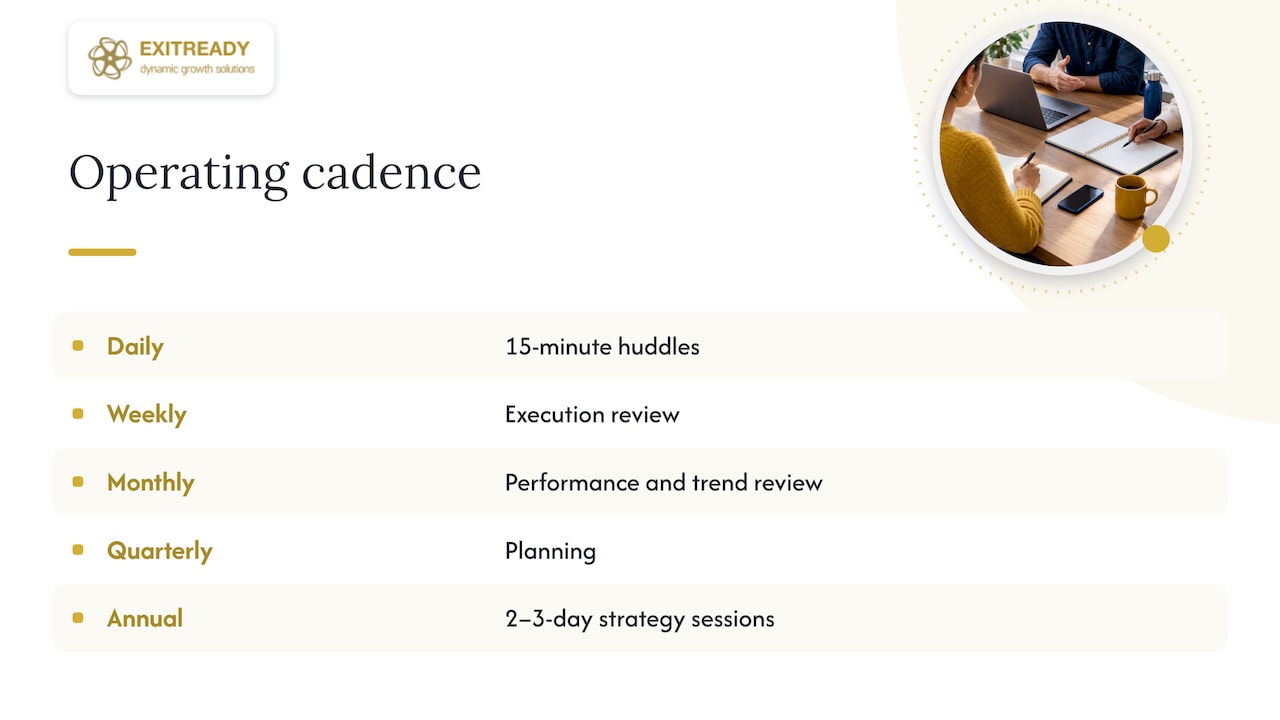
An operating rhythm is the fixed schedule of meetings, reviews and decisions that keeps a company’s strategy tied to its daily work. The best examples layer four cadences: a 15-minute daily huddle, a weekly execution review, a monthly performance review and a quarterly planning session. Each one owns a different decision. Below you will find the examples, the agendas, the timings and the mistakes that turn a rhythm into a calendar full of status updates.
TL;DR
- A workable mid-market rhythm has four layers: daily (about 15 minutes), weekly (60 to 90 minutes), monthly (60 to 90 minutes) and quarterly (half a day to several days).
- Each layer must own a different decision. If every meeting repeats the same update, the rhythm is noise.
- Send data ahead of time, so meeting time goes to judgment and decisions, not to presenting numbers.
- Fold strategy reviews into the monthly and quarterly meetings rather than keeping strategy as a once-a-year event.
- For owners, the point is independence: a rhythm that runs without you is the first proof that the company does not depend on you.
Table of Contents
- What an operating rhythm is, and what it is not
- The four-layer example most mid-market teams start from
- Operating rhythm examples, layer by layer
- Quarterly operating cadence for a specific team: three variations
- How to build your own rhythm in four steps
- Common mistakes
- Our perspective: the rhythm is how an owner steps back
- Want help installing the rhythm?
- FAQ
- Sources
What an operating rhythm is, and what it is not
An operating rhythm (also called an operating cadence, or a management operating rhythm when it covers managers) is a recurring pattern of meetings and reviews. It sets when the team looks at numbers, when it decides, and when it changes course. One practitioner guide frames it as time infrastructure that needs ritual discipline: the agreed rhythm, cadence and process for reviewing your strategy.
It is not a pile of meetings. It is also not a project plan. A project has an end date. A rhythm repeats, and its value comes from predictability: everyone knows where a problem will be raised and who will decide.
The evidence for consistency is worth reading with some caution. An industry guide on sales cadence cites McKinsey-referenced research that teams with a consistent management cadence outperform peers by 20 to 25% in quota attainment and productivity. That figure comes from a secondary summary and describes sales teams, so treat it as direction, not a promise for your company.
The four-layer example most mid-market teams start from
A common structure, described in a guide to operational reviews, uses daily stand-ups of about 15 minutes, weekly reviews of 60 to 90 minutes, monthly reviews of 60 to 90 minutes, and quarterly planning from a few hours to multiple days. Here is how that looks as a working schedule for a 100-person company with a five-to-eight-person leadership team.
| Cadence | Length | Who | Decision it owns |
|---|---|---|---|
| Daily huddle | 15 minutes | Each team, standing | What is blocked today? |
| Weekly leadership meeting | 60 to 90 minutes | Leadership team | Are we on track this week, and what needs a decision? |
| Monthly performance review | 60 to 90 minutes | Leadership plus function heads | What do the trends say, and where do we move resources? |
| Quarterly planning | Half a day to 2 days | Leadership team | What are the three to five priorities for next quarter? |
| Annual strategy session | 2 to 3 days | Leadership team, sometimes the board | Where are we going, and what must be true to get there? |
The rule that makes the table work comes from the sales cadence guide: each level should own a different management decision, otherwise meetings blur together and the team hears the same update four times.
Operating rhythm examples, layer by layer
Daily: the 15-minute huddle
The daily huddle is tactical. Three questions are enough: what did you finish, what are you doing today, and what is stuck. It is not a place for problem solving. If a blocker needs more than a minute, the two people involved take it offline.
Example: a regional distribution company runs a standing huddle for dispatch at 7:30 a.m. and another for the sales desk at 8:45 a.m. Neither lasts past 15 minutes. The leadership team does not attend. It sees only the escalations that reach the weekly meeting.
Weekly: the execution review
The weekly meeting is where most operating rhythms succeed or fail. One example comes from a guide on running leadership meetings with the Rockefeller Habits, a set of ten routines for running a business, where routine builds freedom because the team stops reinventing the meeting each week.
A 90-minute agenda that works:
- Good news and headlines (5 minutes). One win each, to start with energy.
- Scorecard review (10 minutes). Red and green only. No explanations of green numbers.
- Priority check (10 minutes). The quarter’s three to five priorities: on track or off track.
- Issues list (50 minutes). Pick the top three issues and solve them in the room, ending each with an owner and a date.
- Commitments and wrap-up (15 minutes). Read back who does what by when.
A one-page scorecard keeps step two honest. If you need a template, see our guide to one-page weekly leadership team scorecards, and for agenda formats, our management meeting agenda templates.
Weekly one-on-ones
The manager-to-direct-report layer is part of the rhythm too. Research summarized in a Harvard Business Review piece suggests managers pick between weekly 30-minute meetings or longer bi-weekly sessions, and reports that employees rated weekly meetings highest for engagement regardless of job level. If you are building a rhythm for new managers, our 30, 60, 90 day manager onboarding playbook shows how the coaching cadence fits.
Monthly: performance and trend review
Weekly meetings show what happened. The monthly meeting shows what is changing. A good monthly review looks at three to six months of trend lines, not one month in isolation, and asks about capacity: who is overloaded, which process is breaking, which customer segment is slipping.
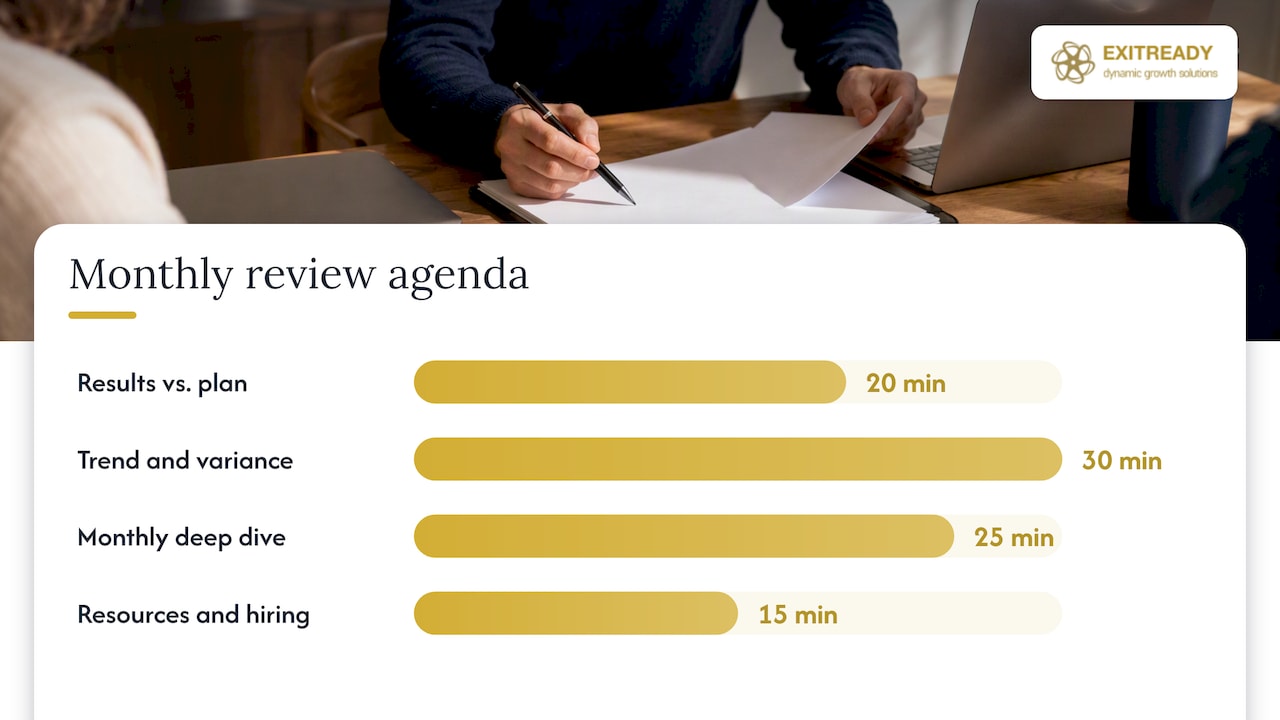
Example agenda (90 minutes):
- Financial and operating results against plan (20 minutes)
- Trend and variance discussion by function (30 minutes)
- One deep dive chosen the month before, for example customer churn or on-time delivery (25 minutes)
- Resource and hiring decisions (15 minutes)
Monthly numbers usually come from several systems. Teams that spend a day assembling them each month often benefit from automating recurring reporting, so the review time goes to the discussion, not the spreadsheet.
A stronger monthly format borrows from large operators. One framework for monthly and quarterly business reviews asks each P&L or operating unit to prepare a written document of six pages or fewer with supporting tables in an appendix. Writing forces clarity in a way slides do not.
Quarterly: planning and the business review
The quarterly cadence is where strategy and operations meet. It usually has two parts: a look back and a look ahead.
Look back (first half-day). Review results against the last quarter’s priorities. Ask which bets worked, which did not, and why. The sales cadence guide notes that effective quarterly business reviews are led by the people who own the results rather than summarized by a manager, which raises accountability and turns the meeting into a forum for setting next-quarter goals.
Look ahead (second half-day). Choose three to five company priorities for the next 90 days. Assign one owner to each. Define what done looks like in measurable terms. Then cascade: each function turns the priorities into its own quarterly goals within a week.
For a deeper treatment, see our piece on the role of quarterly business reviews and a strategy execution framework you can run this quarter.
Annual: the strategy session
Once a year, step back for two to three days. Revisit the three-to-five-year picture, the market and the organization. Set the one or two annual themes that the four quarterly cycles will serve. Then do not leave the annual plan in a binder: every monthly and quarterly meeting should refer back to it.
Quarterly operating cadence for a specific team: three variations
The four layers are a starting point. Teams change them to fit their work.
Sales team. Daily 15-minute pipeline huddle, weekly pipeline review, monthly forecast and win-loss review, quarterly business review led by each rep. The sales cadence guide above treats the rep-led QBR as the centerpiece.
Software or product team. A venture firm’s published description of a SaaS operating cadence is built to synchronize the major functions of a startup so the team works in lockstep. For a product team that usually means weekly prioritization and a quarterly roadmap reset. Teams that keep a long backlog can use prioritization frameworks to rank the work before each planning meeting.
Operations or service business. Daily dispatch or shift huddle, weekly service-level review, monthly cost and capacity review, quarterly process improvement priorities. This is the closest fit for most owner-led mid-market companies, and it pairs with the work in our operational excellence playbook.
How to build your own rhythm in four steps
- Inventory what you already do. List every recurring meeting, report and review. Most companies find duplicates and gaps in an hour.
- Assign each meeting one decision. If you cannot name the decision a meeting owns, cancel it or merge it.
- Fix the calendar. Put the next twelve months of weekly, monthly and quarterly sessions on calendars now. Protect them. A rhythm that moves every time someone is busy is not a rhythm.
- Review the rhythm itself each quarter. Ask what to drop, what to shorten and where decisions are still stuck.
A leader has to own it. One guide to leading an operating rhythm says leaders set the tone and cadence and communicate expectations clearly. In an owner-led company, that means the owner’s calendar is the first thing the rhythm has to change.
Common mistakes
Presenting data live. Practitioners advise sending pre-read materials 48 hours in advance so the meeting time goes to collective judgment and decisions.
Keeping strategy separate. Research from Harvard Business School’s Working Knowledge on strategy management points to a chronic gap between strategy formulation and daily operations. Reviewing strategic priorities in each monthly and quarterly meeting closes it.
Meetings that repeat each other. If Monday’s update is Thursday’s update, one of them has no job.
No owner for decisions. Every issue leaves the room with a name and a date, or it returns next week.
Too many metrics. Weekly scorecards of 5 to 15 numbers get read. Forty do not. Our guide to business performance metrics every owner should track helps you choose.
Our perspective: the rhythm is how an owner steps back
We work with mid-market owners who describe the same pattern: the company runs because they are in the room. Decisions wait for them. Meetings exist to brief them. Nothing is documented because they carry it in their heads.
An operating rhythm is the first practical fix. It moves decisions from the owner’s hallway conversations into a schedule the team owns. In our AOS (Accelerated Operating System) work, we treat the rhythm as one part of a larger set of documented playbooks and delegation systems, and we start with a diagnostic before recommending anything, because the right rhythm for a 40-person distributor is not the right one for a 200-person services firm.
Our advice is plain. Start with the weekly leadership meeting and get it running without you chairing it. When your team can run a clean 90 minutes, hold the decisions, and follow up on commitments while you are away, you have evidence that the business can operate without you. That evidence is also what a buyer looks for. For the longer view, read our guide to working on your business, not in it.
— Andre
Want help installing the rhythm?
If you would rather not build this alone, our Growth Sprint is a one-off engagement priced at $7,500 to $10,000, and the Performance Sprint is $15,000 to $20,000. Both are described on our Sprint page. If you are not sure where your company stands, start with the Growth Readiness Score Card, or schedule a strategy call.
FAQ
What is a management operating rhythm?
It is the schedule of recurring meetings and reviews that managers use to run the business: huddles, weekly execution reviews, monthly performance reviews and quarterly planning. Each has a set agenda, attendees and decision rights. The goal is predictable execution without ad hoc meetings.
How long should each operating cadence meeting be?
A common guide is 15 minutes daily, 60 to 90 minutes weekly and monthly, and half a day or more quarterly. Shorten rather than lengthen when you can. If a weekly meeting regularly overruns, you probably have too many topics, not too little time.
How do I create my own operating rhythm?
List your current meetings, give each one a single decision to own, put the next year of sessions on the calendar and review the whole rhythm every quarter. Begin with the weekly leadership meeting, since the other layers depend on it.
Does a small team need all four layers?
No. A team of ten might need only a weekly meeting, a monthly review and a quarterly planning session. Add the daily huddle when work moves fast enough that blockers cost hours. Add the annual session once the company has more than one planning horizon to manage.
Sources
- Building a Successful Operating Rhythm (Elate guide)
- Operational review cadence: weekly, monthly and quarterly reviews (Moxo)
- Sales Operating Cadence: From Daily Stand-Up to Quarterly QBR
- Make the Most of Your One-on-One Meetings (Harvard Business Review summary)
- Quarterly and Monthly Business Reviews (Working Backwards)
- The Office of Strategy Management (Harvard Business School Working Knowledge)
- The Cadence: How to Operate a SaaS Startup (Craft Ventures)
- Use the Rockefeller Habits to run effective leadership team meetings (Medium)
- Creating an Operating Rhythm as a Leader (Object Edge)