

Recurring revenue usually raises what a buyer will pay for your company, but only the part of it that a buyer believes will keep coming without you. Typical private multiples run from about 2x to 7x annual recurring revenue (ARR) for software, and from 5x to 7x EBITDA for service businesses with strong contracts. Where you land in that range depends on retention, margins, concentration and owner dependency, not on the word “recurring” in your pitch.
This guide shows how buyers value recurring revenue, which multiples are credible in 2026, a worked example, and what to fix 18 to 24 months before you go to market.
TL;DR
- Recurring revenue earns a premium of roughly 2 to 3 turns over one-time revenue in the same industry, but only when it is transferable to a new owner.
- Software multiples are not the public-market headlines: private deals cluster around a 4.5x median revenue multiple, and size, retention and margin move you up or down.
- Buyers test the quality of the revenue: net revenue retention, churn, gross margin and customer concentration.
- If you sell the renewals, lead the key accounts or hold the relationships, buyers price the business as owner-dependent and cap the multiple.
- The fix is a documented, team-led revenue engine, built well before a sale.
Table of Contents
- What counts as recurring revenue in a valuation
- How buyers turn recurring revenue into a price
- Recurring revenue multiples in 2026: what the data shows
- The metrics that decide where you land
- A worked example: the same revenue, two different prices
- Owner dependency: the discount nobody puts in the model
- Our perspective
- How to raise the value of your recurring revenue before a sale
- Where we can help
- Common mistakes when valuing recurring revenue
- FAQ
- Sources
What counts as recurring revenue in a valuation
Recurring revenue is income that repeats each billing period under a subscription, retainer, service contract or renewal. Annual recurring revenue is usually calculated by multiplying monthly recurring revenue by 12 or summing annual subscriptions and other ongoing fees. Buyers read it narrowly.
They will usually include:
- Subscriptions and licenses with a contract term
- Maintenance and managed-service agreements that renew
- Retainers with documented renewal history
They will usually exclude or discount:
- One-time projects, even from repeat customers
- Usage that swings month to month with no floor
- Contracts that are cancellable on short notice with no switching cost
- Revenue that renews only because the owner calls the customer
The distinction matters because the premium is not a label. It is the present value of cash flows a buyer expects to receive. CT Acquisitions explains that a dollar of one-time revenue is worth about a dollar at exit, while a dollar of recurring revenue with 90% retention, discounted at a 12% cost of capital, is worth roughly $4.50 on a present-value basis. That is the logic behind the commonly cited 2x to 3x premium.
How buyers turn recurring revenue into a price
There are three main approaches, and which one applies depends on size and type of business.
Revenue or ARR multiples
The ARR multiple is enterprise value divided by annual recurring revenue. Corporate Finance Institute defines it as what investors will pay for each dollar of ARR. This is the standard language for software and subscription companies, where profit may be reinvested and revenue is the cleaner yardstick.
EBITDA or SDE multiples
Profitable services and tech-enabled businesses are more often priced on earnings. Buyers normalize EBITDA for owner perks and one-off costs, then apply a multiple. For owner-operated businesses under roughly $1M in ARR, buyers tend to use seller’s discretionary earnings, the owner’s cash flow before their own pay, and micro-SaaS in that band typically trades at 2x to 5x SDE.
Discounted cash flow
A buyer who wants to test the headline multiple will model retention, margins and growth directly. This is where recurring revenue shows its real worth, because predictable cash flows are discounted at a lower risk than lumpy project income.
Recurring revenue multiples in 2026: what the data shows
Public headlines mislead sellers. As of Q1 2026, the median ARR multiple for public SaaS companies fell from 7.0x at the start of 2025 to about 3.8x by March 2026. Private companies are a separate market.
| Market segment | Multiple | Source |
|---|---|---|
| Private SaaS, $0 to 5M ARR | 3.3x ARR median | Aventis data via Fungies |
| Private SaaS, above $500M ARR | 6.2x ARR median | Aventis data via Fungies |
| 543 disclosed SaaS M&A deals, 2015 to 2026 | 2.4x first quartile, 4.5x median, 8.1x third quartile | Iconic, citing Aventis |
| Private equity deals, software and tech-enabled services, 2025 | 4.3x median revenue multiple, up from 3.9x in 2024 | R.L. Hulett |
| Strategic deals, same segment, 2025 | 3.0x median, up from 2.0x | R.L. Hulett |
Two lessons follow. First, the spread is wide: the gap between a first-quartile and a third-quartile deal is more than threefold, and that gap is made by revenue quality. Second, size matters. Smaller companies sit at the low end because of concentration and key-person risk.
The public-to-private discount is the most common surprise. Iconic notes that private SaaS companies trade at a 30% to 50% discount to public peers, and that the best private companies can narrow it to 20% to 35%. If you plan your exit around a double-digit public multiple, you are planning around a number no buyer of your size will pay.
Services businesses with contracts
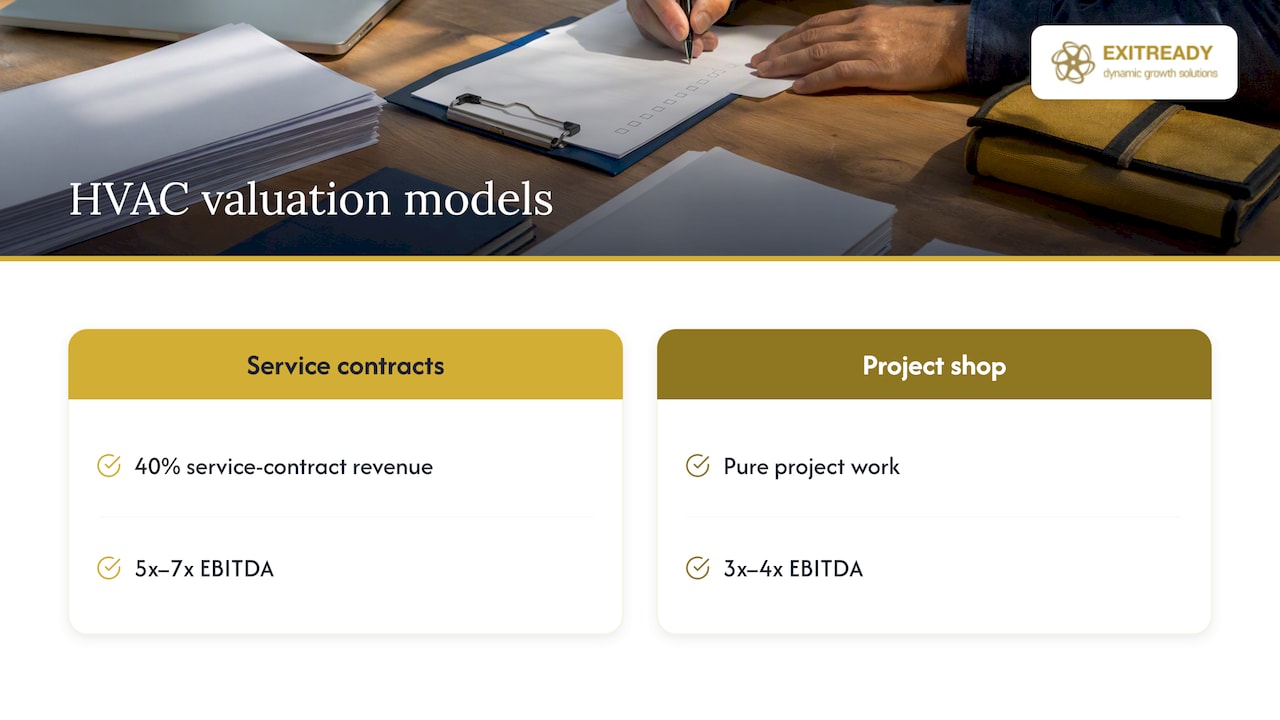
Not every owner sells software. CT Acquisitions gives an example from the trades: an HVAC business with 40 percent service-contract revenue typically sells for 5x to 7x EBITDA, against 3x to 4x for a pure project shop. The same logic applies to managed services, maintenance, compliance and other contract-based work. The industry sets the base multiple; the recurring share moves you up from it.
The metrics that decide where you land
Buyers do not pay for revenue in the abstract. In Iconic’s words, they pay for how defensible that revenue is. Four measures do most of the work, according to Iconic’s 2026 analysis:
- Net revenue retention (NRR). Companies with NRR above 120% trade at a median EV/revenue of 21x, against 9x for those below.
- Rule of 40. Growth rate plus profit margin. Each 10-point improvement is linked to roughly a 1.1x increase in the EV/revenue multiple, per Q4 2025 data.
- Gross margin. Healthy B2B SaaS runs at 70% to 85%.
- Churn. Annual logo churn for healthy B2B SaaS is generally under 5%.
Those figures come from venture-scale software, so treat them as a ceiling for most mid-market firms, not an expectation. The direction holds in every industry, though: higher retention, better margin, lower churn, higher price.
Two more tests apply to almost everyone:
- Customer concentration. If one customer is 30% of recurring revenue, buyers price that customer’s risk, not your average.
- Margin type. CT Acquisitions points out that even with 80% or more recurring revenue, a software business with gross margins below 70% gets priced as a service business, not as a high-multiple product company.
Efficiency also counts. Buyers now look at CAC payback, ideally 12 to 15 months, and LTV:CAC of 3:1 or better as the final check on whether the revenue engine is worth buying. A subscription is no longer a guarantee. One investor commentary makes the point that what investors reward is pricing aligned with the value the customer receives, not the label on the model.
A worked example: the same revenue, two different prices
Take two hypothetical companies, each with $4 million in annual recurring revenue. These numbers are illustrative, not market data, and the multiples are picked from the ranges above.
| Company A | Company B | |
|---|---|---|
| Recurring revenue | $4.0M | $4.0M |
| Net revenue retention | 112% | 94% |
| Largest customer share | 8% | 35% |
| Who leads renewals | Account team | Founder |
| Documented sales process | Yes | No |
| Plausible multiple | Near the 4.5x median | Near the 2.4x first quartile |
| Implied value | About $18M | About $9.6M |
Same top line, a gap of roughly $8.4M. Nothing in that gap comes from the product. It comes from what a buyer can verify about whether the revenue survives the handover. Company B’s founder can close most of that gap, but not in the quarter before a sale.
Owner dependency: the discount nobody puts in the model
This is where recurring revenue valuations most often fall apart. CT Acquisitions says owners often misunderstand that the premium is unlocked only if the revenue is transferable and needs no owner involvement to sustain. Buyers heavily discount revenue that rests on one person’s relationships or on customized work that a successor cannot easily take over.
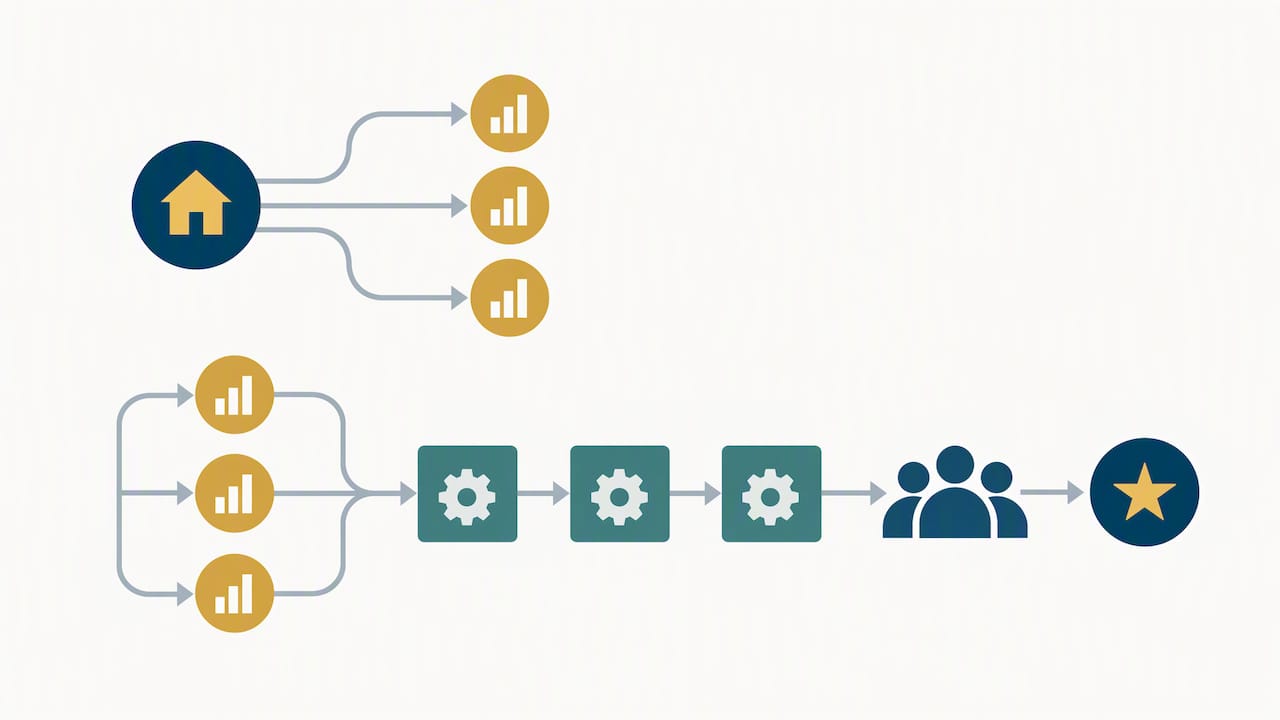
Buyers look for a repeatable sales motion that does not involve you. If you lead sales, negotiate renewals or oversee daily operations, the business reads as a high-risk, owner-dependent asset, and the multiple is capped. The most successful exits move from owner-led revenue to a team-led, system-driven model 18 to 24 months before going to market.
The deal structure punishes dependency too. Earnouts often make up 31% or more of a deal and are rarely fully realized when the business is not operationally independent. A high headline price with a big earnout is a price you may only partly collect.
Our perspective
We see the same pattern in mid-market companies. An owner shows a recurring revenue figure and expects a premium. The buyer asks who renewed the top ten accounts last year, who hired the delivery team, and what happens to the pipeline if the owner takes six weeks off. The honest answers set the multiple.
Our view is that recurring revenue is only half of a valuation story. The other half is whether the business runs on documented systems rather than on the owner. That is why our work starts with a diagnostic, before any program is sold, so recommendations fit your company rather than a template. We then put the revenue engine into playbooks: how renewals are handled, who owns each account, how delegation works, how performance is tracked.
If you are three years from a sale, you have time to build this properly. If you are six months out, be realistic: you can clean up the data and the contracts, but you cannot manufacture a track record of the business running without you. Start earlier than feels necessary. We cover the timeline in why owner exit preparation starts early.
— Andre
How to raise the value of your recurring revenue before a sale
Work through these in order. Each one answers a question a buyer will ask in diligence.
- Define recurring revenue in writing. Split contracted recurring, repeat but uncontracted, and one-time. Buyers will do this split anyway, and they will do it conservatively.
- Calculate retention and churn by cohort. Show at least three years if you have them. Rising NRR is the strongest single signal.
- Lock in terms. Move month-to-month customers to annual agreements where the customer would accept it, and write renewal terms that do not rely on a personal relationship.
- Reduce concentration. If one account is a third of the base, a buyer will either discount or demand an earnout tied to that customer.
- Lift gross margin. Standardize delivery, so the service work that drags margin becomes repeatable. A services-like margin gets a services-like multiple.
- Take yourself out of sales and renewals. Hand key accounts to named team members, and record the handover in playbooks. Our exit-ready business systems examples show what this looks like in practice.
- Get financials and tax structure in order. Audited or reviewed financials are one reason private deals trade at a discount. Tax treatment also changes what you keep, so business sale tax planning belongs in the same timeline as the operational work.
- Test your readiness. Our exit readiness assessment guide explains what an outside review looks at, and the growth readiness score card gives you a first read.
For the wider picture of pricing, see how to maximize your business sale price. Advisors also change outcomes, and our guide to advisors in exit transactions explains who does what.
Where we can help
If you own a mid-market company and your recurring revenue still depends on you, we can help you find where. Our Enterprise Assessment and AOS Value Creation Partnership apply our Accelerated Operating System to documented playbooks, delegation and exit readiness. For a faster, defined project, the Growth Sprint is a one-off engagement at $7,500 to $10,000, and the Performance Sprint is $15,000 to $20,000. If you want to talk through your situation first, use the application form.
Common mistakes when valuing recurring revenue
- Using public multiples. They describe a different market, as the 30% to 50% private discount shows.
- Using rules of thumb as prices. Iconic distinguishes anecdotal rules of thumb from adjusted pricing multiples derived from market research. Only the second belongs in a negotiation.
- Counting every dollar as recurring. Buyers will not.
- Ignoring gross margin. High recurring share with low margin is priced as a services business.
- Treating subscription as a shield. Usage-based and outcome-based models are gaining favor, and buyers look at efficiency in either case.
- Leaving dependency until the final year. The premium needs a record of the business running without you.
FAQ
What is a good ARR multiple?
In private deals, the median is around 4.5x revenue across 543 disclosed SaaS transactions, with a range from 2.4x at the first quartile to 8.1x at the third quartile (Iconic, citing Aventis). Smaller companies sit toward the low end and larger ones toward the high end. Strong retention, high gross margin and low concentration move you up.
How do I value a business with recurring revenue?
Start by separating contracted recurring revenue from one-time revenue. Then apply a market multiple that fits your industry and size, to ARR for software or to normalized EBITDA or SDE for services, and adjust for retention, churn, margin and concentration. A buyer will then test whether the revenue survives without you, which can move the final price more than any formula.
Is recurring revenue always worth a premium?
No. The premium is commonly cited at 2x to 3x over one-time revenue, but it applies only to revenue that is transferable and defensible. Revenue tied to the owner’s relationships, or to weak margins, gets discounted.
How much is a business worth with $1,000,000 in sales?
There is no single answer, because sales are not profit. Under about $1M in ARR, buyers often use SDE, and micro-SaaS trades at roughly 2x to 5x SDE (Iconic). A services business is priced on its normalized earnings and the quality of its recurring share.
Sources
- Recurring Revenue and Business Valuation (2026), CT Acquisitions
- How to Value a Software Company Before You Sell in 2026, Iconic
- How to Sell SaaS: Maximizing Valuation, Iconic
- SaaS Valuations: 2026 Statistics, Fungies
- Software & Tech Enabled Services M&A Update, R.L. Hulett
- ARR Multiple: Definition, Formula, and Examples, CFI
- Consumption vs. subscription vs. success, The Growth Equity Debrief
- Business Sale Tax Planning: Your Priority Playbook