

Owners who want to maximize exit value and preserve their options begin preparing years before they plan to sell. That is not a platitude. It is the operational reality of how transferable value gets built. The active sale process typically runs 6–12 months from listing to close, but the preparation that makes a business worth buying at a premium takes 3–5 years of deliberate work. Confusing those two timelines is the single most expensive mistake mid-market owners make.
Here is what you can start today, regardless of where you are in the timeline:
- Get a formal valuation. You cannot improve what you have not measured. A baseline valuation tells you the gap between where you are and where you need to be.
- Close your books monthly, within a consistent window. Buyers want multiple years of clean, accrual-basis financials. That clock starts now.
- Document every task only you can do. Owner-dependency is the top buyer discount. A written list of those tasks is the first step toward eliminating them.
Dynamicgrowthsolutions’ Accelerated Operating System (AOS) is built specifically to accelerate this systemization work, replacing owner-critical bottlenecks with documented, repeatable processes that hold up under buyer scrutiny.
Table of Contents
- Why owner exit preparation starts early: understanding the timeline
- What do you actually gain by preparing years in advance?
- What does business readiness actually require?
- Are you personally ready for what comes after the sale?
- When should you bring in advisors, and which ones first?
- A timeline-based action checklist for every phase
- What happens when owners wait too long?
- The three-domain framework that exit advisors actually use
- Key Takeaways
- How Dynamicgrowthsolutions helps owners get exit-ready
Why owner exit preparation starts early: understanding the timeline
The phrase “start early” means different things depending on who says it. Here is what it means operationally, broken down into four preparation bands.

| Phase | Timeframe | Primary Goals | Representative Activities |
|---|---|---|---|
| Foundation | 5+ years out | Strategic positioning, margin discipline | Leadership hiring, recurring revenue design, scalable systems |
| Value engineering | 3–5 years out | KPI stabilization, customer diversification | SOP documentation, customer concentration reduction, legal/tax structure review |
| Intensive prep | 12–36 months | Clean financials, diligence readiness | Quality-of-earnings dry run, employment agreements, sell-side data room |
| Active sale | 6–12 months | Market execution | Advisor selection, CIM creation, buyer outreach, negotiation |
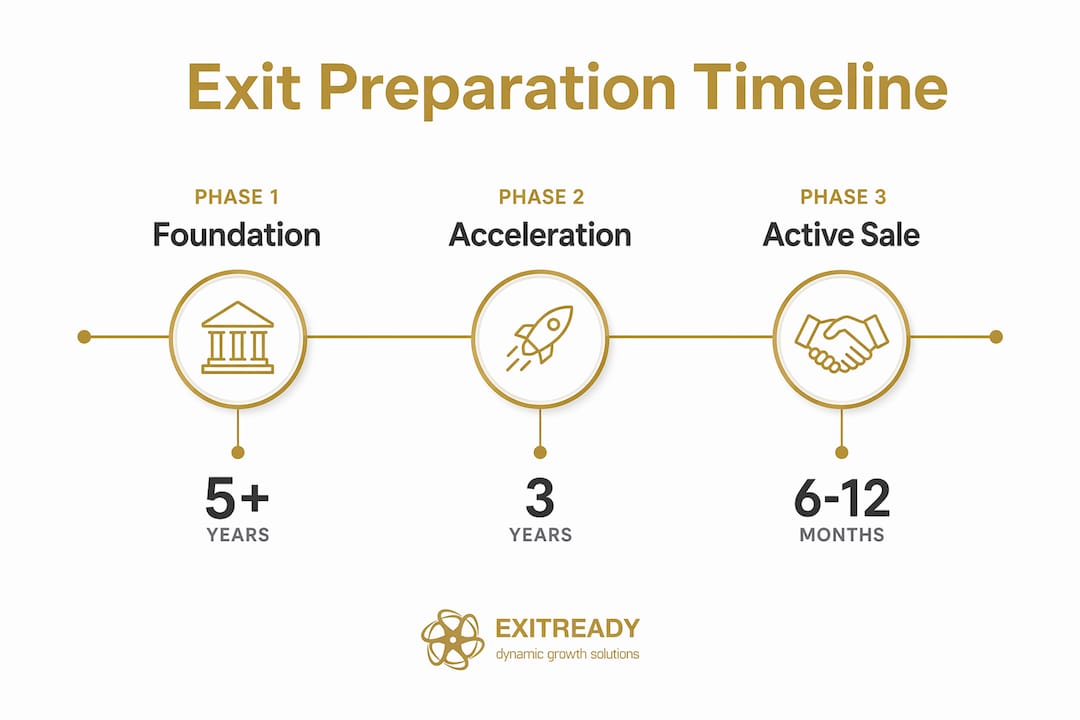
The 36-month playbook used by many M&A advisors breaks intensive prep into three 12-month phases: tighten the operating story, fix diligence gaps, then create a competitive buyer process. That sequencing works because each phase depends on the prior one producing clean trailing data.
A few factors shift where you fall on this timeline:
- Maximum multiple: Requires the full 3–5 year runway. Buyers pay for proven, not projected.
- Liquidity now: Compressing below 18–24 months is possible but typically costs 15–30% of enterprise value.
- Family or management transfer: Often needs the full 3–5+ year runway because leadership development and financing structures take time to mature.
Pro Tip: If you are 5+ years out, the highest-leverage move is not financial cleanup. It is hiring your second tier of management and giving them real operational authority. That team needs 12–18 months of independent performance before any buyer will believe the owner-independence story.
What do you actually gain by preparing years in advance?
The headline answer is a higher sale price. But the mechanics behind that headline are worth understanding, because they tell you exactly where to focus.
Valuation uplift comes from moving four specific metrics to buyer-acceptable profiles: EBITDA margin, cash conversion, customer concentration, and owner dependency. None of those move in 90 days. Buyers acquire systems and predictable performance; multiple years of clean EBITDA growth combined with a functioning management team is what separates a lower multiple from a higher multiple. On a mid-sized EBITDA business, that gap reflects millions in proceeds.
Optionality and negotiating leverage are the less-discussed benefits. An owner who does not need to sell can wait for the right strategic buyer or the right market window. That proactive posture changes every conversation. You walk away from bad terms. You run a competitive process instead of accepting the first offer. You choose your buyer rather than taking whoever shows up.
Deal-risk reduction is where early preparation pays off in ways owners rarely anticipate. Buyers who find clean financials, documented processes, and a capable management team have less to renegotiate. Fewer surprises during diligence means fewer retrades, lower escrow holdbacks, and a higher probability the deal actually closes.
Emotional readiness matters more than most advisors admit. Many owners report profound regret within the first year after closing, with many citing the absence of a post-exit plan as the root cause. Years of preparation give you time to answer the “what comes next” question before the wire hits your account.
Pro Tip: The two highest-dollar-impact moves are two years of clean EBITDA growth and a management team with documented authority. Everything else is secondary. If you only have bandwidth for two initiatives, start there.
What does business readiness actually require?
Buyers are not buying your revenue. They are buying your systems, your team, and the probability that both keep working after you leave. Here is what that means in practice.
Systems and repeatable processes
Every critical function needs a documented SOP. Not a rough outline, but a step-by-step process a new hire could follow. Monthly financial close should happen within a consistent window, on accrual-basis books, with standardized reporting. Buyers pull multiple years of data during diligence; messy or inconsistent records read as operational risk.
KPIs that buyers actually look at
The metrics that move multiples are trailing 12–36 month EBITDA, cash conversion cycle, recurring revenue percentage, and customer concentration. A higher customer concentration typically triggers buyer escrow, earnout requirements, or a price discount. Fixing that requires 18–24 months of pipeline building, not a quick contract shuffle.
Leadership and succession depth
A management team that can run the business without you is not optional. It is the single biggest driver of whether a buyer believes the business is transferable. That team needs time to operate independently, under measurement, before diligence begins. Use the business scalability checklist to identify where leadership gaps exist today.
Contracts, IP, and commercial hygiene
Buyers will check every major contract for assignability. Vendor agreements, customer contracts, software licenses, and lease terms all need to transfer cleanly. Unresolved IP ownership or non-assignable contracts become deal-killers or discount triggers during confirmatory diligence.
| Evidence Buyers Request | Standard Requirement |
|---|---|
| Financial statements | 3 fiscal years, accrual basis |
| Customer concentration analysis | Top customer by revenue, % of total |
| SOP library | Core functions documented and tested |
| Executive org chart | Roles, tenure, comp structure |
| Recurring revenue snapshot | Renewal rates, ARR, contract terms |
| Contract assignability review | All major vendor and customer agreements |
Are you personally ready for what comes after the sale?
Business readiness is only one of three domains that determine exit outcomes. Personal financial readiness and personal readiness, meaning life after the exit, are equally consequential and take just as long to address.
The financial side starts with net-worth modeling. Most owners significantly overestimate after-tax proceeds. Enterprise value is not the number that funds your retirement. After taxes, transaction fees, and debt payoff, the actual liquidity can be significantly lower than the headline number. Running multiple scenarios early, with a financial advisor who understands business exits, lets you set a realistic after-tax target and work backward to the enterprise value you actually need.
Tax and trust structures deserve particular attention. Certain strategies, including grantor retained annuity trusts (GRATs), qualified opportunity zone investments, and charitable remainder trusts, require several months of runway to fund safely. Funding them too close to a signed letter of intent can trigger IRS “contemplation of sale” scrutiny, which unwinds the intended tax benefit entirely. This is not a last-minute task.
The personal readiness piece is harder to quantify but equally important. What are you going to do the Monday after closing? Owners who have not answered that question in writing, with specificity, are the ones who show up in post-exit regret statistics. A written post-exit vision, updated estate and trust documents, and a clear picture of how your identity shifts after the business is gone are all part of a complete exit plan.
Pro Tip: Run your net-worth scenarios before you set your sale price target. Many owners discover they need a higher multiple than the market will pay, which means they need more time to grow EBITDA, not a faster sale process.
When should you bring in advisors, and which ones first?
Advisor sequencing matters as much as advisor selection. Bringing in the wrong advisor at the wrong time either costs money you do not need to spend yet or signals an imminent sale to employees and competitors before you are ready.
The role of advisors in exit transactions follows a clear progression:
- Strategic or exit-planning advisor (3–5 years out): Sets target outcomes, identifies value gaps, and sequences the preparation work. This is the person who tells you what to fix and in what order.
- Tax and estate counsel (18–36 months out): Structures trusts, tax-advantaged transfers, and entity reorganizations with enough runway to be effective and defensible.
- Accountant and financial reporting expert (2–3 years out): Builds GAAP-compliant trailing financials, cleans up add-backs, and prepares the books for a quality-of-earnings review.
- M&A advisor or investment banker (12–18 months pre-market): Designs the sale process, prepares the confidential information memorandum (CIM), and manages buyer outreach.
One practical note: advisory engagement can be staged to avoid prematurely signaling a sale. A strategic advisor working on operational improvements does not announce an exit. An investment banker running a formal process does. Know which signal you are sending before you make the call.
A timeline-based action checklist for every phase
Long-term (5+ years out)
- Commission a formal business valuation to establish your baseline.
- Hire or develop a second tier of management with real operational authority.
- Design recurring revenue streams into your business model.
- Implement margin discipline: track EBITDA monthly, not annually.
- Begin documenting owner-critical processes, starting with the highest-risk ones.
Mid runway (3 years out)
- Diversify your customer base to get the top customer below 15–20% of revenue.
- Stabilize KPIs and build 24+ months of clean trailing data.
- Complete a legal and tax structure review with qualified counsel.
- Document SOPs for all core business functions.
- Run a preliminary exit readiness assessment to identify diligence gaps.
Intensive prep (12–36 months)
- Produce three years of clean, accrual-basis financials.
- Commission a sell-side quality-of-earnings (QoE) dry run.
- Execute employment agreements and key-employee retention plans.
- Build a sell-side data room with all standard buyer-requested documents.
- Finalize trust and tax structures with counsel.
Active sale (6–12 months)
- Select and engage an M&A advisor or investment banker.
- Complete the CIM and prepare management presentations.
- Launch structured buyer outreach with a defined process.
- Develop your negotiation strategy and walk-away terms in advance.
- Begin transition planning for key relationships and operational handoffs.
| Phase | Timeframe | Single Highest-Leverage Action |
|---|---|---|
| Long-term | 5+ years | Hire second-tier management |
| Mid runway | 3 years | Reduce customer concentration |
| Intensive prep | 12–36 months | QoE dry run and data room |
| Active sale | 6–12 months | Structured buyer outreach |
What happens when owners wait too long?
The mistakes that come from delayed preparation are predictable. They show up in every compressed deal, and they are expensive.
Owner dependency left unaddressed is the most common and most costly. A business that cannot function without its founder is not a business a buyer wants to own. It is a job. Buyers discount heavily for this risk, and fixing it takes years of deliberate delegation, SOP documentation, and leadership development. There is no shortcut.
Compressing preparation into the sale window leads directly to retrades, escrow holdbacks, and failed transactions. Owners who compress preparation below 18–24 months typically leave 15–30% of enterprise value on the table. Buyers find the gaps during diligence and use them as leverage. What looked like a clean deal at LOI becomes a renegotiation at closing.
Neglecting personal readiness creates a different kind of problem. Owners who close without a post-exit plan often experience a sharp identity crisis within the first year. The business was not just a source of income. It was a structure, a purpose, and a community. Selling it without a replacement plan is a setup for regret.
Failing to sequence tax and trust moves is a costly technical error. Last-minute trust funding, done too close to a sale agreement, risks IRS “contemplation of sale” challenges that can unwind the entire structure. The tax benefit disappears, and the transaction timeline gets complicated.
Pro Tip: The single most common fix owners can start today is a written owner-dependency audit. List every task, relationship, and decision that only you handle. That list is your preparation roadmap. Start eliminating items from the top.
The three-domain framework that exit advisors actually use
Exit readiness is not a single score. It is the convergence of three distinct domains, and weakness in any one of them weakens the overall outcome.
Business readiness covers the operational and financial gates buyers use to evaluate transferability: monthly close discipline within a consistent window, a functioning management team, documented SOPs, clean contracts, and stable KPIs over a 24–36 month trailing period.
Personal financial readiness covers the owner’s ability to fund the life they want after the exit. This includes funded trusts, a realistic after-tax proceeds model, and a financial plan that does not depend on the business continuing to generate income.
Personal readiness covers the psychological and identity dimension. A written post-exit vision, clarity about what comes next, and emotional preparation for the transition from operator to former owner.
EPI readiness research consistently shows that a small minority of owners report full readiness across all three domains when they go to market. Owners with written plans are significantly more likely to exit on their own terms.
The posture shift matters as much as the preparation itself. Owners who do not need to sell negotiate from a fundamentally different position. They can walk away from a bad offer, wait for a better buyer, or time the market. That leverage is only available to owners who prepared early enough to have it.
Pro Tip: Think of the three domains as a three-legged stool. You can have a perfectly prepared business and still have a bad exit if your personal financial plan is underfunded or your post-exit vision is blank. Work all three in parallel.
Consider an owner who began working on all three domains four years before going to market. By the time the business went to buyers, the management team had 18 months of independent performance on record, customer concentration was below 12%, and the owner had a funded trust and a written plan for what came next. The result was a competitive process with multiple bidders and a multiple at the top of the range for that industry. The preparation, not the sale process, created that outcome.
Key Takeaways
Starting exit preparation 3–5 years before a target sale date is the single most reliable way to maximize after-tax proceeds, preserve negotiating leverage, and avoid the deal-killing gaps that compressed timelines leave behind.
| Point | Details |
|---|---|
| Start with a formal valuation | A baseline valuation reveals the gap between current value and your after-tax target. |
| Build monthly-close discipline now | Buyers require 36 months of clean, accrual-basis financials — that clock starts today. |
| Reduce owner dependency first | Owner dependency takes years to fix and has the single largest impact on valuation. |
| Fund tax structures 18–36 months early | Last-minute trust funding risks IRS scrutiny and can unwind intended tax benefits. |
| Dynamicgrowthsolutions AOS | The Accelerated Operating System builds the documented systems and leadership depth buyers require for a premium exit. |
The case for starting before you think you need to
The pattern I see repeatedly with mid-market owners is this: the ones who prepared early did not do it because they were eager to sell. They did it because they understood that a prepared business is a better business, full stop. The operational discipline required for exit readiness, clean financials, a capable management team, documented processes, is the same discipline that makes a company more profitable and less dependent on any single person.
What gets overlooked in most exit planning conversations is that the preparation itself changes the owner’s relationship to the business. When you are not the bottleneck, you have choices. You can take a month off. You can evaluate a strategic partnership without panic. You can say no to a bad offer because you do not need to say yes. That optionality is worth something independent of any transaction.
The owners who struggle post-exit are almost always the ones who rushed. They sold before the business was truly transferable, before they had a personal plan, before the tax structures were properly funded. The deal closed, but the outcome was not what they expected. Starting years in advance is not just about getting a higher number. It is about having the kind of exit you can actually live with.
How Dynamicgrowthsolutions helps owners get exit-ready
Most owners know they need to reduce dependency and build systems. The hard part is doing it while running the business. Dynamicgrowthsolutions’ Accelerated Operating System gives mid-market owners a structured, proven framework for replacing owner-critical bottlenecks with documented, repeatable processes that hold up under buyer diligence.

The AOS program covers the full operational readiness stack: SOP documentation, KPI dashboards, leadership development, and financial reporting discipline, built around Fortune 500 methodologies adapted for mid-market firms. Owners who complete the program come out with a business that runs without them, which is exactly what buyers pay a premium for. The starting point is a readiness assessment that identifies your highest-priority gaps and sequences the work. If you are serious about a premium exit, start your assessment and see where you actually stand.
Useful sources and further reading
- How far in advance to prepare to sell a business? (Iconic) — Covers the 3–5 year preparation window and the cost of compression; useful for timeline planning.
- Why you need an exit plan long before you’re ready to sell (Entrepreneur) — Explains the posture shift from reactive to proactive and how it changes negotiating leverage.
- Exit readiness: why forward-thinking owners prepare before they sell (Wolf & Company) — Buyer perspective on KPI discipline and what clean financial reporting signals.
- The 36-month playbook (CT Acquisitions) — Detailed phase-by-phase sequencing for owners targeting a premium exit.
- Preparing to sell: 12–24 months before market (Adaptive Capital Partners) — Practical guidance on the intensive prep phase and customer concentration thresholds.
- Exit planning 5-year roadmap (CT Acquisitions) — Covers tax/trust timing, the three-domain framework, and post-exit regret statistics.
- Benefits of exit planning early (Dynamicgrowthsolutions) — Explains how early preparation maximizes valuation and owner control.
- Business exit readiness assessment (Dynamicgrowthsolutions) — Benchmark your current readiness across all three domains before you start.
- How exit valuation multiples work (Dynamicgrowthsolutions) — Explains the mechanics behind multiple expansion and what moves the number.
- Prepare your business for a premium exit (Dynamicgrowthsolutions) — Practical steps and sequencing for owners targeting top-quartile outcomes.