
Maximizing your business sale price means proactively improving your financial performance, operational stability, and risk profile to command stronger buyer multiples before you ever list the company. Formal 12–24 month preparation leads to 20%–35% higher sale prices compared to unprepared businesses. That gap is not a rounding error. It represents hundreds of thousands, or millions, of dollars left on the table by owners who wait too long to act. The industry term for this process is “pre-sale value enhancement,” and it covers everything from financial cleanup to operational independence. Dynamicgrowthsolutions works with mid-market owners on exactly this: building the systems, financials, and management depth that buyers pay premiums for.
What value drivers actually maximize business sale price?
Business valuation is built on two numbers: your EBITDA (earnings before interest, taxes, depreciation, and amortization) or SDE (seller’s discretionary earnings), multiplied by a market multiple. Buyers set that multiple based on how risky and transferable your business looks. Six levers move that multiple more than anything else.
| Value driver | Multiple impact | Typical timeframe |
|---|---|---|
| Reduce owner dependence | +0.5x to +1.5x | 12–24 months |
| Customer diversification | +0.3x to +0.7x | 6–18 months |
| Recurring revenue growth | +0.5x to +1.0x | 12–24 months |
| Pricing optimization | Direct EBITDA lift | 3–6 months |
| Financial cleanliness | Prevents 10%–20% discount | 6–12 months |
| Growth trajectory | +0.5x to +1.0x | 24–36 months |

Each lever affects multiples differently, but they compound when addressed together. A business that scores well across all six categories commands the top of its industry multiple range. One that scores poorly on even two or three gets discounted, sometimes severely.
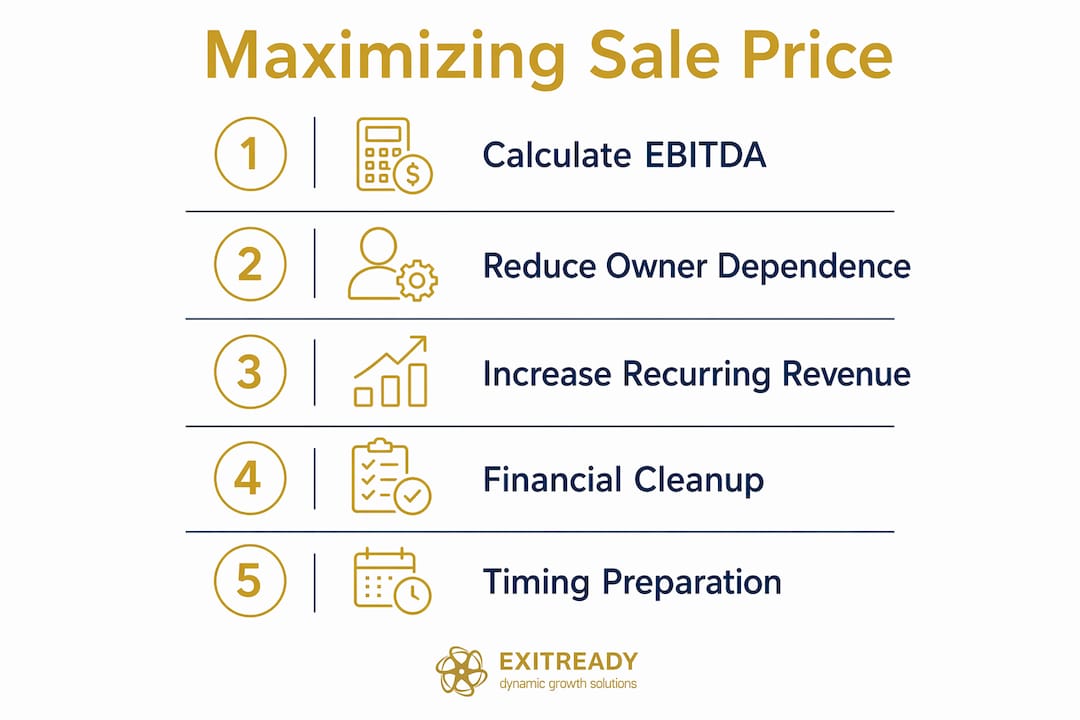
Your first step is calculating your current EBITDA or SDE accurately. Add back owner salary above market rate, personal expenses run through the business, and one-time costs. Then research your industry’s current multiple range. Most mid-market businesses trade between 3x and 8x EBITDA, depending on sector, size, and risk profile. Understanding where you sit within that range tells you exactly which levers to pull.
Pro Tip: Get a third-party business valuation before you start preparing. It gives you a baseline and reveals which specific gaps are costing you the most in multiple points.
Owners often operate below market multiples by 5%–15% simply because they have not addressed known risks. Closing that gap through focused effort adds significant value without requiring revenue growth.
How does owner dependence reduce your sale price?
Owner dependence is the single most common reason buyers discount mid-market businesses. When the owner is the primary salesperson, the key client relationship holder, or the operational decision-maker, buyers see a business that may not survive the transition. Buyers discount valuations for owner-dependent businesses by as much as 0.5x to 1.5x multiple. On a $2 million EBITDA business at a 5x base multiple, that is a $1 million to $3 million reduction in sale price.
Reducing owner dependence requires a deliberate, phased approach:
- Audit your role. List every decision, client relationship, and process that runs through you. This is your dependency map.
- Hire or promote a general manager or COO. This person absorbs your operational authority. Give them 12–18 months to prove it before you go to market.
- Document all processes as SOPs. Standard operating procedures turn institutional knowledge into transferable systems. Documented SOPs increase perceived transferability and buyer confidence directly.
- Transition client relationships. Introduce key accounts to your leadership team. Buyers want to see that clients stay with the business, not with you personally.
- Use equity or performance incentives to retain key staff. A leadership team with financial skin in the game signals stability to buyers.
The timeline for meaningful multiple gains is 12–24 months. Owners who start this process 18 months before listing consistently report smoother due diligence and stronger offers. Dynamicgrowthsolutions builds this transition into its AOS framework, replacing owner dependency with documented, self-sustaining operations.
Pro Tip: Never go to market as the face of the business. Your goal is to be replaceable on paper before the first buyer meeting.
How does customer concentration affect your valuation?
Customer concentration is a risk multiplier that buyers price into every offer. When one client represents 40% or more of revenue, most institutional buyers walk away or demand a significant discount. The thresholds buyers watch are clear: a single customer above 25% of revenue triggers concern, above 40% triggers deal restructuring or earnouts, and above 50% often kills the deal entirely.
The fix requires a deliberate sales and marketing push well before the sale:
- Grow secondary accounts aggressively. Assign a dedicated sales resource to mid-tier clients. Even moving your top customer from 35% to 22% of revenue changes buyer perception completely.
- Add service agreements and retainers. Recurring contracts reduce revenue volatility and make your income more predictable. Recurring revenue increases of 30%–60% of total revenue can boost multiples by 2–3 turns of EBITDA.
- Use auto-renewal structures. Subscription or auto-renewal pricing smooths seasonal dips and signals durability to buyers.
- Raise prices strategically. Most owners are underpricing services by 5%–15%. A price increase flows directly to EBITDA and gets multiplied at exit. A $100,000 EBITDA gain at a 5x multiple adds $500,000 to your sale price.
Recurring revenue shifts your business category in the eyes of buyers, often yielding the largest multiple increase among all improvement levers. A business with 60% recurring revenue is fundamentally less risky than one with 10%. Buyers pay for that certainty.
Pro Tip: Track your revenue concentration monthly. If your top customer grows faster than your business, you are moving in the wrong direction even as revenue climbs.
What financial housekeeping do buyers require before closing?
Financial transparency is the foundation of buyer trust. Buyers and their advisors will scrutinize three years of financial statements. Any inconsistency, unexplained variance, or cash-basis accounting creates doubt, and doubt becomes a price reduction.
The financial cleanup process follows a clear sequence:
- Reconcile three years of books. Every account, every month. Unexplained entries invite buyer skepticism.
- Switch to accrual accounting if you are currently on cash basis. Accrual accounting matches revenue and expenses to the period they occur, which gives buyers a cleaner picture of business performance.
- Commission a CPA-led financial recast. This documents all add-backs and normalizations. Investing $2,000–$5,000 in a recast protects against 10%–20% purchase price reductions during negotiation.
- Separate personal and business expenses completely. Any personal expenses running through the business must be documented as add-backs, not left as ambiguous line items.
- Consider a sell-side quality of earnings (QoE) report. A QoE from a reputable accounting firm costs $40,000–$120,000 but controls negotiation risk and validates your EBITDA figure before buyers challenge it.
The ROI on financial cleanup is among the highest of any pre-sale investment. A buyer who trusts your numbers negotiates less aggressively. One who finds discrepancies during due diligence retrades the price or walks. Clean books also accelerate the due diligence timeline, which reduces the risk of deal fatigue.
Pro Tip: Treat your financials as a marketing document. Buyers are buying future cash flows. If your historical numbers are unclear, they will assume the worst about the future.
Compliance infrastructure also matters. Comprehensive compliance consulting can surface regulatory risks before buyers find them, protecting both deal value and timeline.
When is the right time to sell for the highest price?
Timing is a multiplier on everything else you have built. Buyers pay premiums for businesses with three or more years of growing SDE or EBITDA. Flat or declining performance reduces multiples by 0.5x to 1.0x, even when the business is otherwise well-prepared.
The right time to sell is when your trajectory is up, not when you are tired of running the business. Selling into a growth trend gives buyers confidence in the forward projections they use to justify their offer price. Selling after a flat year forces you to explain the plateau, which shifts negotiating power to the buyer.
Key signals that indicate readiness to go to market:
- Three consecutive years of EBITDA growth
- Owner dependence reduced to a documentable minimum
- No single customer above 20%–25% of revenue
- Clean, audited or reviewed financials for three years
- A leadership team that can operate without daily owner input
- All contracts assignable to a new owner
Running mock due diligence before going to market identifies deal-breakers while you still have time to fix them. This exercise surfaces issues like non-assignable contracts, undocumented intellectual property, or employment agreements that complicate a sale. Fixing these issues before a buyer finds them preserves deal value and prevents last-minute price reductions.
The true sale process starts 12–24 months before you hire a broker. The financial history and operational depth you build in that window set your valuation ceiling. Waiting until you are ready to retire to start preparing is the most expensive mistake mid-market owners make.
Pro Tip: Schedule a mock due diligence review with your advisory team 12 months before your target sale date. Treat every finding as a negotiation risk and fix it before buyers see it.
Key Takeaways
Businesses that prepare for 12–24 months before going to market consistently command 20%–35% higher sale prices than those that list without preparation.
| Point | Details |
|---|---|
| Start preparation early | Begin 12–24 months before listing to build the financial history buyers require. |
| Reduce owner dependence | Eliminating owner reliance adds 0.5x–1.5x to your valuation multiple. |
| Grow recurring revenue | Raising recurring revenue to 30%–60% of total can add 2–3 turns of EBITDA multiple. |
| Clean your financials | A CPA-led recast costing $2,000–$5,000 prevents 10%–20% price reductions at negotiation. |
| Time the sale on a growth trend | Three years of growing EBITDA commands the top of your industry multiple range. |
What I have learned about preparing businesses for sale
The owners who get the best exits share one trait: they treat sale readiness as an ongoing operating discipline, not a one-time project. They are not scrambling to clean up books or document processes six months before listing. They run their business as if a sophisticated buyer is watching every quarter.
The most common misconception I see is that preparation is about making the business look good. It is not. It is about making the business genuinely transferable. Buyers are not fooled by cosmetic fixes. They run quality of earnings reviews, interview your management team, and stress-test your customer relationships. The businesses that hold their price through due diligence are the ones where the preparation is real.
The second misconception is that you need to wait until you are ready to exit before starting. Deal readiness creates operational benefits beyond the sale itself. A business with documented SOPs, a strong leadership team, and clean financials is easier to run, more profitable, and more resilient to economic disruption. You benefit from the preparation whether you sell or not.
Assembling the right advisory team matters as much as the operational work. A good M&A attorney, a CPA who understands business transactions, and an experienced exit planning advisor will identify risks you cannot see from inside the business. Do not try to run this process alone. The cost of good advisors is a fraction of the value they protect.
Start earlier than you think you need to. The owners who wish they had started sooner outnumber the ones who started too early by a wide margin.
— Andre
How Dynamicgrowthsolutions prepares mid-market owners for premium exits
Mid-market owners who want to sell at the top of their industry multiple range need more than good intentions. They need systems, documented processes, and financial clarity built into how the business operates every day.

Dynamicgrowthsolutions built its AOS (Accelerated Operating System) specifically for this. The program addresses owner dependence, operational documentation, and financial transparency through a structured process that mirrors what sophisticated buyers expect to find during due diligence. Owners who complete the program build owner-independent businesses that command stronger multiples and attract more qualified buyers. If you are preparing for a premium exit, the business exit planning resources at Dynamicgrowthsolutions give you a clear starting point. You can also explore what a business operating system actually does for owners preparing to sell.
FAQ
How early should I start preparing my business for sale?
Start at least 12–24 months before your target sale date. Formal preparation in that window leads to 20%–35% higher sale prices compared to businesses that list without preparation.
What is the biggest factor that reduces business sale price?
Owner dependence is the most common valuation penalty. Buyers discount businesses where the owner controls key relationships or decisions by 0.5x–1.5x on the valuation multiple.
Does recurring revenue really increase what buyers will pay?
Yes. Raising recurring revenue to 30%–60% of total revenue can increase your valuation multiple by 2–3 turns of EBITDA, making it one of the highest-impact levers available to mid-market owners.
How much does financial cleanup cost and is it worth it?
A CPA-led financial recast costs $2,000–$5,000 and prevents 10%–20% purchase price reductions during buyer negotiation. A sell-side quality of earnings report costs $40,000–$120,000 but is standard for larger mid-market transactions.
What is a mock due diligence review and why does it matter?
A mock due diligence review is a structured exercise where your advisory team examines your business the way a buyer would. It surfaces deal-breakers like non-assignable contracts or undocumented processes before buyers find them, preserving deal value and negotiation leverage.