

Most business owners think they’re building a scalable company when they’re actually just building a bigger one. Revenue is up, headcount is climbing, and the calendar is full. But understanding what is a scalable business model reveals a different picture: a scalable model generates more revenue without a proportional increase in costs, people, or founder time. That distinction matters enormously for mid-market owners who want to grow profitably, reduce operational dependency, and ultimately position their businesses for premium exits or long-term wealth creation. This guide breaks down the economics, the frameworks, and the practical steps to get you there.
Table of Contents
- Key takeaways
- What is a scalable business model, defined
- Real-world examples of scalable models
- Building scalable operations: the practical levers
- Benefits of scalability and challenges to watch for
- How to create a scalable business model: a practical framework
- My perspective on what actually breaks scalability
- Build your scalable growth strategy with expert support
- FAQ
Key takeaways
| Point | Details |
|---|---|
| Scaling is not just growth | Scalability means revenue increases faster than costs do, improving margins at higher volume. |
| Unit economics drive scalability | If customer acquisition cost and margins worsen as volume grows, your model is not truly scalable. |
| Process before demand | Documenting and automating workflows before scaling demand prevents bottlenecks and quality failures. |
| Leverage is the mechanism | Digital products, platforms, and external partners create leverage that reduces incremental cost per customer. |
| Readiness requires a structure check | Mid-market owners must audit their infrastructure, not just their revenue, before scaling aggressively. |
What is a scalable business model, defined
The scalable business definition comes down to one economic test: when revenue grows, do your costs grow at the same rate? If yes, you are not scaling. You are growing. Scaling means increased revenue without a proportional increase in costs, headcount, or capital requirements.
This matters because the two paths lead to very different financial outcomes. A business that doubles revenue by doubling its workforce has not improved its operational leverage. Margins stay flat. Complexity doubles. The owner works twice as hard. A truly scalable business, by contrast, handles increased demand through systems, automation, and repeatable delivery, not more bodies and more hours.
Three economic criteria define a scalable model:
- Margin improvement at volume. As you serve more customers, gross margins should hold steady or improve. The true scalability test is whether unit economics get better as volume grows.
- Repeatable delivery. Your product or service can be delivered consistently without requiring the founder or senior team to be involved in every transaction.
- Externalizable leverage. You can use technology, partnerships, or automation to absorb demand spikes rather than hiring proportionally.
Pro Tip: Before assuming your business is scalable, run this check: if you doubled your customer count tomorrow, would your costs double too? If the honest answer is yes, you have a growth model, not a scalable one.
Real-world examples of scalable models
Understanding scalable companies gets much clearer when you look at how different model types behave at higher volume. The defining characteristic across all of them is near-zero marginal cost when adding the next customer or unit of output.
| Model type | How it scales | Cost behavior at volume |
|---|---|---|
| SaaS / digital products | Sell the same product to thousands without rebuilding it | Near-zero marginal cost per additional user |
| Subscription / recurring revenue | Predictable cash flow funds infrastructure investment | Fixed costs spread across growing subscriber base |
| Platform businesses | Third-party providers deliver the value; platform captures margin | Incremental cost stays low as network grows |
| Standardized service businesses | Documented workflows and trained teams replace founder delivery | Labor costs grow slower than revenue with good systems |
| Franchise models | Brand and process replicate across locations via franchisees | Capital and operational burden shifts to franchisee |
For mid-market service businesses, the path to scalability often runs through standardization rather than a full model switch. A consulting firm that documents every client engagement process, builds reusable deliverable templates, and trains junior staff to execute them is applying the same logic a SaaS company uses. The front-loaded investment in systems pays off as volume increases because the cost to serve each additional client drops.

Scalability in startups tends to be more obvious since digital products are often built with scalability baked in from day one. For established mid-market firms, the work is more deliberate. You are retrofitting scalable architecture into an existing operation, which requires sequencing and discipline.
Building scalable operations: the practical levers
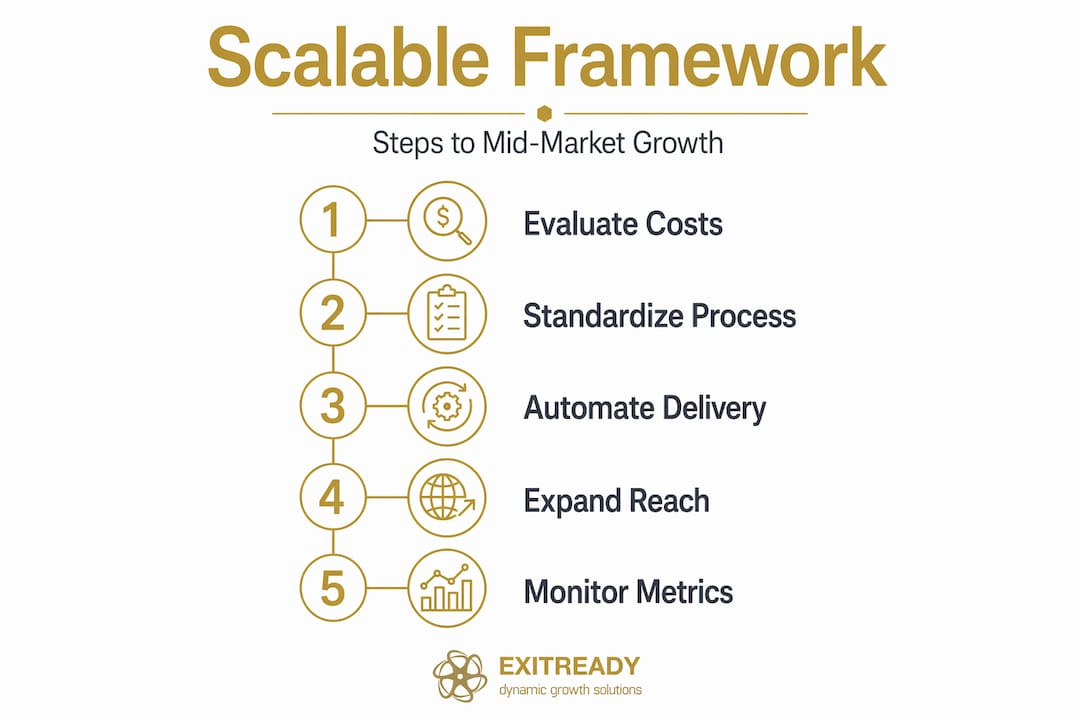
Knowing the theory is one thing. Building the infrastructure is where most mid-market owners get stuck. The combination of automation, standardization, and technology is what actually controls cost and complexity as you grow. Here is a practical sequence that works:
- Map your core delivery process. Before you automate anything, write down exactly how your product or service gets delivered from first contact to final outcome. Most owners discover inconsistencies they did not know existed.
- Identify and eliminate owner dependency. Find every step in the process that requires you personally. Each one is a scalability bottleneck. Redesign those steps so a documented process and a trained team member can handle them.
- Automate the repeatable and rules-based work. Invoicing, onboarding sequences, lead qualification, customer follow-up, and reporting are all candidates. A scalable company can handle far more customers without needing proportionally more staff when automation absorbs the volume.
- Outsource non-core functions. Using external partners for customer service, fulfillment, and specialized services keeps your fixed cost base lean. You pay for capacity as you need it rather than carrying it permanently.
- Track unit economics relentlessly. Monitor customer acquisition cost, lifetime value, gross margin per customer, and payback period. If unit economics worsen as volume grows, your scalability is an illusion built on top of a flawed model.
- Build before you need it. Fast growth without standardized workflows creates bottlenecks and inconsistent customer experience. Sequence matters. Build scalable business infrastructure before you drive significant demand, not after.
Pro Tip: The most common mistake mid-market owners make is scaling their marketing before scaling their operations. You can drive all the demand you want, but if the delivery system breaks under pressure, you train your market to distrust you.
Benefits of scalability and challenges to watch for
The benefits of scalability are substantial. Businesses that scale efficiently see margin expansion, not just revenue growth. They become more attractive to investors and acquirers because their earnings are not entirely dependent on founder involvement. Operational efficiency improves because documented systems reduce errors. And scalability builds mid-market value in ways that make premium exits far more achievable.
But the challenges are real and worth naming directly.
- Scaling too fast without the infrastructure causes quality failures and customer churn that are hard to reverse once they set in.
- Poor unit economics can hide behind strong top-line revenue. Growing revenue with worsening margins is one of the most dangerous traps in mid-market growth.
- Employee misalignment happens when the team grows faster than the culture and operating standards can absorb new people.
- Complexity creep occurs when each new customer segment, geography, or product line adds operational weight without enough revenue justification.
Use this quick checklist to assess your scalability readiness before pushing harder on growth:
- Are your core delivery processes fully documented and executable without you?
- Do your gross margins stay flat or improve as you add customers?
- Is your customer acquisition cost stable or improving over time?
- Do you have technology handling tasks that previously required manual labor?
- Could a capable team member run a week of operations without calling you?
If you answer no to two or more of these, you are not ready to scale aggressively. You are ready to fix your infrastructure first.
How to create a scalable business model: a practical framework
Learning how to create a scalable business requires a structured approach rather than trial and error. Here is a framework you can apply to your existing operation:
- Anchor to one core product and one ideal customer. Scalability collapses under too many simultaneous priorities. Pick the product with the best margin and the customer segment with the highest lifetime value. Build your scalable model around that core before expanding.
- Document everything repeatable. Every process that happens more than once needs a written standard. This is not bureaucracy. It is the mechanism by which you get your time back and reduce your business’s dependency on any single person.
- Run a unit economics audit. Calculate your gross margin per customer, your cost to acquire a customer, and how long it takes to recover that acquisition cost. If those numbers are not already strong, no amount of systematic scaling will fix them.
- Invest in technology that reduces marginal cost. Your CRM, your billing system, your project management platform, and your communication tools should all reduce the cost to serve each additional customer. If your tech stack is creating work instead of eliminating it, replace it.
- Align your organization using a structural framework. Frameworks like the Six S approach (Staff, Shared values, Structure, Speed, Scope, and Series thinking) help teams align for scale rather than just respond to it reactively.
- Set a sustainable pace. Scaling faster than your infrastructure can support destroys the margin gains you are working toward. Discipline on pace is as important as ambition on growth.
For mid-market owners ready to take this further, rebuilding your business for scalable growth in 2026 means addressing both the operational and strategic dimensions of scalability at the same time.
My perspective on what actually breaks scalability
I have worked with enough mid-market businesses to say this plainly: most of them are not failing because their product is weak or their market is wrong. They are failing to scale because the owner is still the operating system.
When I sit down with a founder who is exhausted and frustrated, the conversation almost never reveals a product problem. What it reveals is a business where every important decision, every client issue, and every process deviation routes back to one person. That is not a scalable model. That is a high-revenue job.
The economics-first thinking I have found most useful starts not with revenue projections but with this question: what would it cost me to deliver this product or service without me being involved at all? That number tells you more about your scalability ceiling than any growth chart will. Measurable unit economics that improve with volume are the most honest signal you have.
I have also seen too many founders rush toward automation and technology before they have standardized anything. You cannot automate a process you have not defined. Technology applied to an inconsistent process just makes the inconsistency happen faster.
The businesses I have watched scale well share one trait that rarely gets enough credit: they built their culture and operating standards ahead of their headcount. Structure before speed. Always.
— Andre
Build your scalable growth strategy with expert support
If this article clarified the gap between where your business is and where a truly scalable model could take it, the next step is getting a clear read on your specific constraints and opportunities.

Dynamicgrowthsolutions works with mid-market owners to build the operating infrastructure that makes scaling possible without adding chaos or founder dependency. The 360-ProfitDriver tool uncovers hidden revenue and margin opportunities that most owners do not see until they run a structured analysis. If you want to go deeper, the CEO mastermind events connect you with peers and advisors who have scaled businesses through exactly the challenges you are facing. Scalability is not a lucky outcome. It is a built outcome.
FAQ
What is a scalable business model in simple terms?
A scalable business model generates more revenue without requiring proportional increases in costs, staff, or founder involvement. The key marker is that margins hold or improve as volume grows.
What makes a business scalable?
Repeatable delivery processes, strong unit economics, and the use of automation or external resources to absorb demand are the three core factors that make a business scalable rather than just growing.
What are the best examples of scalable business models?
SaaS platforms, subscription services, and platform businesses are classic examples because they carry near-zero marginal cost per additional customer. Standardized service businesses with documented workflows can also achieve strong scalability.
How do you measure business scalability?
Track gross margin per customer, customer acquisition cost, and payback period as volume increases. If those metrics hold steady or improve, you are scaling. If they worsen, growth is masking a structural problem.
Why do so many businesses struggle with scalability?
Most scalability failures trace back to scaling demand before building the operational infrastructure to support it. Without documented processes and controlled unit economics, faster growth just creates faster problems.