

Most mid-market owners hit a wall somewhere between $5M and $50M in revenue. The business that ran on instinct, hustle, and tribal knowledge starts leaking at the seams. Missed handoffs, duplicated work, decisions that stall because only one person knows the answer. If you want to create scalable business infrastructure that supports real growth or a premium exit, you need more than good intentions. You need systems, governance, and a sequenced plan. This guide walks you through every phase.
Table of Contents
- Understanding scalable business infrastructure
- Preparing your business for scalable growth: assessment and architecture governance
- Executing scalable infrastructure: high-impact initiatives and automation
- Verifying and iterating your scalable infrastructure for long-term success
- Why focusing on infrastructure governance is the hidden key to scalable success
- Explore business management systems designed for scalable growth
- Frequently asked questions
Key Takeaways
| Point | Details |
|---|---|
| Scalable infrastructure investment | Building scalable systems is a foundational investment, not just a growth tactic. |
| Deliberate architecture | Scalable infrastructure requires planned architectural governance to avoid fragility. |
| Pilot and iterate | Implement improvements in small pilots, measuring and refining over 4-6 weeks. |
| Automation and data focus | Automation and robust data management reduce manual work and inefficiencies. |
| Governance balances innovation | Effective governance enables both stability and decentralized innovation at scale. |
Understanding scalable business infrastructure
Scalable business infrastructure is not a technology project. It is an operating decision. It means building the underlying systems of your business so that doubling your revenue does not double your headcount, your chaos, or your personal involvement.
Scalability is an infrastructure investment involving automation, data, and communication that creates repeatability and reduces coordination costs. That last phrase matters. Most mid-market businesses grow by adding people to problems. Scalable infrastructure grows by building systems that handle those problems without adding headcount.
The foundational elements of effective infrastructure for growth include:
- Automation of repeatable tasks. Billing, onboarding, reporting, approvals. Every time a human manually triggers a process that could be triggered by a rule, you are paying a tax on growth.
- Data management. As your business grows, so does the volume of decisions. Without a single source of truth, you make decisions based on gut or whoever spoke last. Good data management for scalable infrastructure means every stakeholder works from the same numbers.
- Communication tools. Slack channels multiplying, email threads that bury decisions, meetings replacing documentation. Communication infrastructure is where the most expensive coordination costs hide.
- Documented business management systems. If your processes live in people’s heads, your business is not scalable. It is fragile.
Pro Tip: Before you invest in any new tool, ask whether your current processes are documented well enough to automate. Automating a broken process just accelerates the wrong outcome.
Preparing your business for scalable growth: assessment and architecture governance
Knowing what scalable infrastructure requires is different from knowing where your business actually stands. Most owners discover, during an honest assessment, that their current systems were built reactively. A new tool was added when a problem appeared. Integrations were duct-taped together. Nobody owns the architecture.

Scalable infrastructure begins with deliberate architectural design, emphasizing governance to avoid complexity and operational risk. That word “deliberate” is doing a lot of work. It means you cannot build flexible business systems by accident.
Here is how to prepare your business for what comes next:
- Audit your current infrastructure against a growth or exit framework. List every system, tool, and manual process. Map what each one does, who owns it, and whether it integrates with other systems. Gaps become obvious fast.
- Identify your three most fragile points. These are usually the places where one person leaving would cause a crisis. Those are your first priorities.
- Design a modular architecture. Modular means each system does one job well and connects cleanly to others. It is the opposite of a platform that does everything poorly.
- Establish governance before you build. Governance means deciding who approves new tools, who sets integration standards, and who maintains documentation. Without it, you end up with 14 project management tools and no shared process. Deliberate architectural governance is what separates companies that scale cleanly from those that grow into a mess.
- Plan for security and access control from day one. As your team grows, so does your exposure. Access permissions are infrastructure. Treat them that way.
Pro Tip: Governance does not mean bureaucracy. The goal is a simple decision-making framework that keeps your systems coherent without slowing your team down. One page is enough to start.
| Infrastructure area | Common gap at scale | What good looks like |
|---|---|---|
| Finance and billing | Manual invoicing, spreadsheet tracking | Automated billing with real-time dashboards |
| People and HR | No onboarding documentation | Documented playbooks, automated workflows |
| Sales and CRM | Scattered notes, no pipeline visibility | Single CRM with stage-based automation |
| Operations | Owner as decision bottleneck | Defined decision rights, documented escalation paths |
| Data and reporting | Siloed data, inconsistent metrics | Unified data layer, shared KPI dashboard |
Executing scalable infrastructure: high-impact initiatives and automation
Assessment gives you a map. Now you need to move. The mistake most business owners make here is trying to fix everything at once. That approach delivers months of disruption and no measurable improvement.
Automation and systematic quality controls lead to significant cost savings, decision acceleration, and error reduction. But only when you choose the right things to automate first.
Follow this execution sequence to develop scalable operations without burning out your team:
- Pick one or two high-impact workflows. Client onboarding and billing are the most common starting points because they are repetitive, error-prone, and directly tied to revenue.
- Map the current process in detail before touching a single tool. You cannot automate what you have not documented. Write out every step, every decision point, every handoff.
- Select technology that supports intelligent orchestration. The difference between basic automation and intelligent orchestration is that orchestration handles exceptions, routes decisions, and connects across systems. Automation solutions for scalable systems should connect your workflows, not just run them in isolation.
- Build a pilot with a small group or limited scope. Do not roll out to your full team on day one. A controlled pilot reveals what breaks before it becomes a business-wide problem.
- Train your team on the why, not just the how. People resist new systems when they feel imposed on them. Show your team what problem the system solves for them personally. Adoption follows understanding.
| Approach | What it delivers | Where it falls short |
|---|---|---|
| Manual process management | Full human judgment on every case | Breaks under volume, creates bottlenecks |
| Basic automation | Reduces repetitive tasks | Cannot handle exceptions or cross-system handoffs |
| Intelligent orchestration | Handles complexity, scales across workflows | Requires upfront design and governance |
Connecting your business exit planning strategies to your infrastructure build is not optional. Buyers pay a premium for businesses that run without the owner. Every automated workflow and documented process you build is equity.
Verifying and iterating your scalable infrastructure for long-term success
Built is not the same as working. And working is not the same as working at scale. The businesses that successfully manage growing business needs are the ones that treat verification as a first-class activity, not an afterthought.
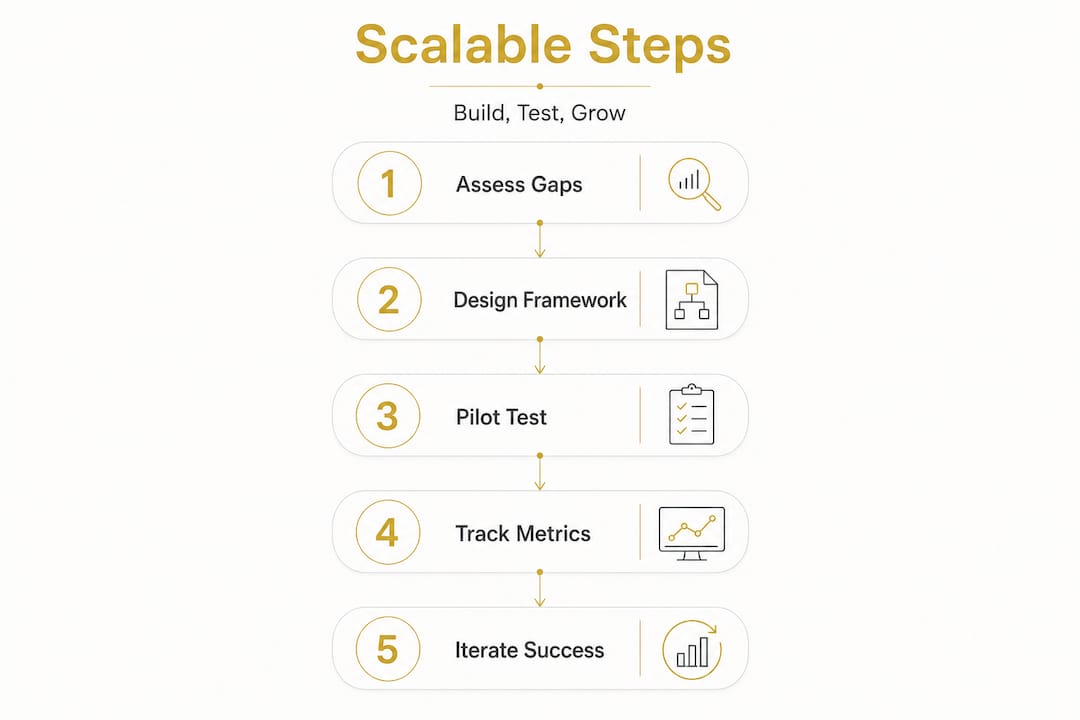
Start with a scoped pilot, establish clear tracking metrics, and iterate based on results from the first 4 to 6 weeks to avoid common scaling failures. This is the part most owners skip because it feels slower than just shipping. It is actually the fastest path to sustainable results.
Here is how to verify and refine your infrastructure investments:
Define your success metrics before the pilot starts:
- Time saved per process cycle (before and after)
- Error rate on automated versus manual tasks
- Employee adoption rate at 30 and 60 days
- Time to decision on key workflows
- Owner hours required per week (this one matters most for exit readiness)
Run your pilot with control:
- Select a representative team or department, not your most tech-forward early adopters.
- Run the old process and the new process in parallel for the first two weeks. This gives you clean comparison data.
- Hold a structured debrief at week three. Not a temperature check. A structured review of your predefined metrics.
- Decide at week six whether to expand, adjust, or stop. Build this decision gate into your plan before you start.
- Document what you learned regardless of the outcome. That documentation is your operating playbook.
Pro Tip: Avoid the trap of measuring activity instead of outcomes. Logging into a new system is not adoption. Completing a workflow without a workaround is adoption.
The goal of all of this is operational independence for exits. A business that requires its owner to function is not a business. It is a job with overhead. Every iteration you make toward verified, self-sustaining infrastructure increases both your freedom and your valuation.
Why focusing on infrastructure governance is the hidden key to scalable success
Here is an uncomfortable truth most infrastructure guides will not say directly: the majority of mid-market scaling failures are not technology failures. They are governance failures. The technology worked. The systems were capable. But nobody owned the architecture, nobody enforced the standards, and over 18 months the business accumulated enough fragmentation to make the whole thing brittle.
Without architectural governance, scaling increases fragility, complexity, and operational risk. We have seen this pattern repeatedly. A business adds a sales tool here, a project tracker there, a communication platform for one team. Each decision makes local sense. Collectively, they create a system nobody fully understands.
The fix is not a better tool. It is a different leadership posture. Governance is a management discipline, not an IT function. It means the owner or leadership team sets explicit standards for how systems are chosen, connected, and maintained. It means someone is accountable for the architecture the way someone is accountable for the P and L.
There is also a sequencing problem that rarely gets named. Businesses often try to address their most visible pain first rather than their most foundational gap. That is like fixing a leaking roof while the foundation is cracked. When you skip foundational operating model inflection points, every system you build on top of them is at risk.
The businesses that scale well are not always the ones with the best technology. They are the ones that balance centralized governance with decentralized execution. The center sets the standards and the integrations. The teams own the workflows within those standards. That balance is what creates a business that grows without becoming chaos.
Infrastructure is not a technology investment. It is a leadership investment. Treat it that way.
Explore business management systems designed for scalable growth
Building the right infrastructure takes more than a plan. It takes proven frameworks, experienced guidance, and systems built specifically for businesses at your stage.

Dynamic Growth Solutions helps mid-market business owners build the documented systems, automated workflows, and governance structures that create genuine operational independence. Whether your goal is sustained growth or a premium exit, their business management systems for sustainable growth are designed to replace owner dependency with repeatable, scalable operations. Their team also provides business exit planning support to maximize valuation when the time is right. Ready to see where your business stands? Start with the AOS entrepreneur application to get a clear picture of your current infrastructure and what it would take to make your business truly exit-ready.
Frequently asked questions
What is the first step to create a scalable business infrastructure?
Begin by assessing current infrastructure gaps against a clear growth or exit framework to identify which areas to prioritize first. Without that honest baseline, you end up investing in the wrong places.
How does automation help scale a business?
Automation of repeatable tasks reduces manual errors and frees your team to focus on higher-value work rather than maintaining routine processes. The compounding effect over 12 to 24 months is significant.
Why is architectural governance important for scaling?
Governance balances innovation speed and system stability, preventing the fragmentation that makes growing businesses brittle. Without it, every new tool adds complexity without adding capability.
How long should pilot testing last when implementing scalable infrastructure changes?
A pilot phase of 4 to 6 weeks gives you enough data to measure real impact and decide whether to expand or adjust before committing your full team.
What common mistake should mid-market owners avoid when scaling infrastructure?
Avoid implementing everything simultaneously without predefined metrics, which eliminates your ability to identify what worked and leads directly to scaling failure.