

Most mid-market business owners hit a wall somewhere between $5M and $50M in revenue. Growth slows, margins shrink, and every decision still flows through you. The effort to rebuild business for scalable growth is not about working harder or hiring faster. It is about dismantling the structural flaws that make your company fragile, founder-dependent, and worth far less than it should be. This guide gives you a practical, sequenced framework to fix those flaws, build systems that work without you, and position your company for a premium exit or long-term expansion.
Table of Contents
- Understanding the problem: why most scaling efforts falter
- Preparation: diagnosing your business and setting clear priorities
- Execution: rebuilding your core systems for scalable growth
- Verification: measuring success and refining for ongoing scalability
- Comparison of approaches: centralized control vs. decentralized autonomy
- Why rebuilding business for scalable growth is a strategic discipline, not just operational work
- How EXITREADY supports mid-market owners in rebuilding for scalable growth
- Frequently asked questions
Key Takeaways
| Point | Details |
|---|---|
| Operational inefficiencies cost 20–30% revenue | Streamlining processes through documented systems significantly reduces operational drag and losses. |
| Measure key metrics consistently | Tracking ARR growth, Rule of 40, and NRR guides strategic decisions and improves valuation. |
| SOPs double valuation multiples | Well-maintained Standard Operating Procedures lower risk and increase buyer confidence. |
| Build systems before scaling | Proactive system development prevents chaos and preserves unit economics during expansion. |
| Delegate and build management layers | Reducing owner dependency with clear roles and leadership increases operational maturity and value. |
Understanding the problem: why most scaling efforts falter
To rebuild effectively, you must first grasp why so many scaling attempts collapse under their own weight. The most common culprit is not the market or the product. It is structural weakness baked into how the business operates day to day.
Founder bottlenecks sit at the center of most scaling failures. When every key decision requires the owner’s approval, growth creates a queue, not momentum. Your team waits. Customers wait. Revenue opportunities pass. This pattern of overcoming bottlenecks during business scaling is one of the most consistent challenges we see across mid-market companies, regardless of industry.
The financial cost is significant. Companies lose 20% to 30% of annual revenue to process friction and inefficiencies every year. That is not a rounding error. On a $20M business, you could be burning $4M to $6M annually on waste embedded in your own workflows.
The valuation impact is equally punishing. Buyers and investors do not just look at revenue. They assess risk. A company where the owner runs sales, approves contracts, manages key client relationships, and resolves operational crises is a liability-heavy acquisition, not a premium asset. Sophisticated buyers define scaling as preserving unit economics while growing, which is nearly impossible when the founder is the system.
Without documented processes, growth does not scale. It multiplies chaos. Common symptoms include:
- Team burnout from informal, undocumented workflows
- Margin erosion as headcount grows faster than revenue
- Client experience inconsistency as tribal knowledge replaces process
- Decision paralysis as the management layer lacks authority or clarity
- Recruiting failures because new hires have no playbooks to follow
The fix is not cosmetic. Restructuring your business for sustainable scaling means changing the underlying architecture, not just adding staff or switching software.
“Owner-dependent businesses are consistently discounted at acquisition. The buyer is not just pricing your revenue. They are pricing what survives after you leave.”
Evaluating your organizational structures and executive teams is where this work begins.
Preparation: diagnosing your business and setting clear priorities
With an understanding of the pitfalls, the next step is assessing your business health and clarifying priorities for systematization before you rebuild anything.
Start with the numbers that matter most. You cannot prioritize what you have not measured. Here are the four metrics that reveal operational and valuation health simultaneously:
- ARR growth rate — annual recurring revenue growth signals market traction and scalability
- EBITDA margin — shows how much of your revenue survives after operational costs
- Net revenue retention (NRR) — measures whether existing customers expand their spend over time
- Rule of 40 — your growth rate plus EBITDA margin combined; above 40 signals a healthy balance
The stakes for hitting these benchmarks are real. Companies with growth above 30%, NRR above 110%, and Rule of 40 scores above 50 can command valuation multiples up to 8x ARR. Most mid-market companies fall well short of that range, largely because operational drag suppresses both growth and margins.
| Metric | Baseline performance | High-value performance |
|---|---|---|
| ARR growth | Below 15% | Above 30% |
| EBITDA margin | 5% to 10% | 20%+ |
| NRR | Below 100% | Above 110% |
| Rule of 40 | Below 30 | Above 50 |
Once you know your numbers, run a focused operational audit to surface the friction points dragging those metrics down. The audit does not need to be elaborate. Ask three questions about every core workflow: Does a documented process exist? Is it followed consistently? Does someone own it?
The answers will expose your highest-priority systematization targets. Focus your early effort on processes that directly touch revenue, client experience, or cash flow. Building systems to reduce owner dependency in these areas generates the fastest valuation and operational gains.
Pro Tip: Rank your top five bottlenecks by the cost of doing nothing. Multiply frequency by time lost by hourly fully-loaded cost of the people involved. That number usually clarifies prioritization faster than any strategic planning session.
Work through these steps before you start rebuilding:
- Pull your trailing 12-month ARR, EBITDA, and NRR data
- Calculate your Rule of 40 score
- Audit your five highest-frequency workflows for documentation and ownership
- Identify the top three processes most dependent on your personal involvement
- Set improvement targets for each metric with a 12-month horizon
This diagnostic phase is the foundation of rebuilding your business for scalable growth with intention rather than reaction.
Execution: rebuilding your core systems for scalable growth
Now that you know what to fix, here is how to rebuild your core systems to enable scalable, sustainable growth.

Documented systems can double company valuation multiples and reduce operational drag significantly. The vehicle for that documentation is the Standard Operating Procedure, or SOP. But most SOP efforts fail because they are treated as a paperwork exercise rather than a performance tool.
Here is an execution framework that works:
- Start with highest-impact, highest-frequency problems. Document the processes that break most often or cost the most when they do.
- Define a clear trigger and output for every SOP. “This process starts when X happens and ends when Y is complete.” No ambiguity.
- Apply the Rule of 10. If any step in your SOP requires more than 10 sub-steps, break it into a separate sub-SOP. Complexity kills adoption.
- Use action verbs for every step. “Send the invoice” beats “Invoice should be sent.” Passive voice in SOPs creates interpretation gaps.
- Add flowcharts for branching logic. Decisions with two or more outcomes need visual maps, not just written steps.
- Test every SOP with a new hire. If they cannot follow it without asking questions, it is not ready.
- Assign a process owner to every SOP. Without ownership, documentation decays.
- Link each SOP to a KPI so you know when performance dips are traceable to a process failure. You can link SOPs to KPIs and maintain review cadence without complex tooling; a simple shared dashboard works.
Prioritize these three areas for your first wave of SOP documentation:
- Onboarding — both client onboarding and employee onboarding drive retention and ramp speed
- Sales process — from first contact to signed contract; every stage needs a documented playbook
- Billing and collections — cash flow breakdowns almost always trace back to undocumented or ignored processes here
| Process area | Why it matters | Impact on valuation |
|---|---|---|
| Client onboarding | Drives NRR and reduces early churn | High |
| Sales playbook | Enables delegation from founder | Very high |
| Billing/collections | Stabilizes cash flow and EBITDA | High |
| HR and onboarding | Reduces training time and turnover | Medium |
| Reporting and KPIs | Creates operational transparency | High |
Pro Tip: Before you build a new SOP, video-record yourself or your best performer doing the task once. That raw recording becomes the draft. Writing from scratch is slower and often misses real-world nuance.
To rearchitect your organizational structures around these systems, you also need to connect documentation to your profit improvement strategies, ensuring each process is tied to a financial outcome, not just operational tidiness.
Verification: measuring success and refining for ongoing scalability
After rebuilding your systems, continuous verification and refinement ensure your growth remains scalable and profitable.
Linking process documentation to performance data and regular reviews prevents the most common failure mode in operational work: SOPs that go stale and slowly erode team trust. A process that was accurate six months ago may now reflect a workflow nobody uses.
Build your verification loop around these practices:
- Implement a real-time dashboard tracking CAC (customer acquisition cost), LTV (lifetime value), churn rate, and contribution margin by segment
- Establish 90-day SOP audits with assigned process owners reviewing accuracy and adoption rates
- Use data to trace performance dips back to specific process failures before escalating to personnel issues
- Run small experiments on process improvements with a subset of the team before rolling changes out broadly
- Hold weekly operational reviews (15 to 30 minutes) focused on metrics, not status updates
- Conduct monthly strategic evaluations to assess whether current systems still fit your growth stage
Here is the verification sequence that works in practice:
- Set a baseline metric for each core process (e.g., onboarding completion rate, sales cycle length)
- Track weekly in your dashboard
- Flag any metric moving more than 10% from baseline for root-cause review
- Assign a process owner to investigate and propose a fix
- Test the fix with a small group, measure, then deploy broadly if effective
- Update the SOP and document the change with a version date
Pro Tip: Add a “last reviewed” date and a “next review due” date to every SOP document. That single field eliminates the guesswork about what is current and creates accountability without requiring a separate tracking system.
Tracking and optimizing scalable growth through this rhythm is also what moves the needle on valuation maximization through operational maturity. Buyers and investors do not take your word for it. They see evidence in consistent metrics over time.
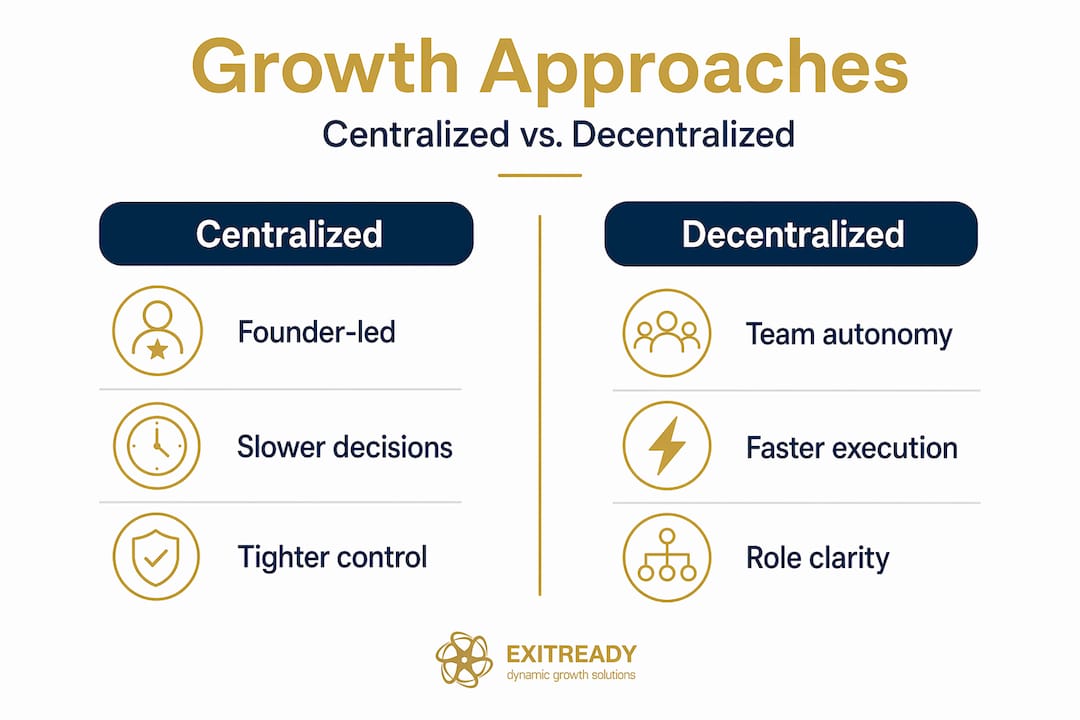
Comparison of approaches: centralized control vs. decentralized autonomy
Understanding organizational design helps you choose the right balance for sustaining growth and maximizing value.
Most mid-market companies operate somewhere between two extremes: the founder controls everything, or the team operates with minimal oversight. Neither extreme scales well.
| Dimension | Centralized control | Decentralized autonomy |
|---|---|---|
| Decision speed | Slow; bottlenecked at founder | Fast; made at team level |
| Consistency | High when founder is present | Variable without clear processes |
| Founder workload | Extreme | Manageable |
| Scalability | Low | High when systems exist |
| Valuation impact | Discounted for key-person risk | Premium for management depth |
| Risk of failure | Burnout and growth ceiling | Drift without clear accountability |
Founder-dependent companies suffer valuation discounts; building management layers enables premium exit terms. That is not an opinion. It is a consistent pattern in acquisition data across mid-market deals.
The most effective approach blends standardization with flexibility. Here is what that looks like in practice:
- Standardize all repeatable processes through documented SOPs
- Define clear decision rights: which decisions require senior approval, which are delegated entirely
- Build a middle management layer that owns specific operational domains (sales, operations, finance, client success)
- Give those managers authority, accountability, and KPIs they own
- Retain founder involvement for strategic direction, major capital decisions, and culture
Pro Tip: Use a simple RACI chart (Responsible, Accountable, Consulted, Informed) for every major process. When everyone knows who decides and who executes, you eliminate the informal approval loops that drain founder time.
Rearchitecting organizational structures for growth is not about removing yourself from the business overnight. It is about deliberately shifting overcoming owner dependency from an aspiration to a designed outcome.
Why rebuilding business for scalable growth is a strategic discipline, not just operational work
Having walked through the practical steps, here is a perspective that most growth articles miss entirely.
Founders routinely confuse scaling with doing more: more hires, more marketing spend, more customers. That instinct is understandable. It is also what causes the most expensive scaling failures. Real scaling is a discipline of preserving unit economics, sequencing talent and technology investments carefully to avoid the kind of growth chaos that destroys margins and burns out your best people.
The deeper truth is that the playbook that got you to $10M is almost always the same playbook that stops you at $20M. Your informal decision-making worked when you had 12 people and knew every client. It becomes a bottleneck at 45 people and 200 clients. Most founders recognize this intellectually but resist disrupting what is currently working. That resistance is where growth stalls.
Building systems before you need them is not cautious or slow. It is actually the most aggressive growth move you can make. Companies that systematize proactively grow through inflection points without losing margin or morale. Companies that wait until the pain is unbearable spend 18 months in cleanup mode instead of expansion mode.
There is also a strategic angle that rarely gets discussed: exit planning is one of the most powerful catalysts for operational improvement. When you commit to preparing your company for a potential exit, you are forced to build the management depth, documented systems, and financial transparency that transform a lifestyle business into an enterprise asset. Even if you never sell, the strategic business ownership mindset that exit readiness demands makes you a better operator today.
The discipline of rebuilding is not a one-time project. It is a continuous practice of questioning whether your current systems can support the next stage of growth, not just the current one.
How EXITREADY supports mid-market owners in rebuilding for scalable growth
If you are ready to move from operational chaos to a business that runs and grows without you at the center of every decision, the methodology matters as much as the intent.

Dynamic Growth Solutions and the EXITREADY platform are built specifically for mid-market owners at this inflection point. The 360-ProfitDriver program targets profitable scaling by identifying margin leaks, systematizing core processes, and building the management infrastructure buyers pay premiums for. You can also join growth and exit workshops to learn directly from operators who have built and sold mid-market companies. And when you are ready to convert operational maturity into a transaction, the exit planning services ensure your company is positioned for a smooth, premium transition. The work you do rebuilding your systems today is the valuation you capture tomorrow.
Frequently asked questions
What are the biggest barriers to scalable growth in mid-market businesses?
Founder dependency, lack of documented systems, and inefficient processes are the most consistent barriers. Businesses with heavy owner dependency face valuation discounts because buyers price the risk of losing the person the business depends on.
How do Standard Operating Procedures (SOPs) impact business valuation?
Well-documented SOPs reduce perceived risk and operational drag, which directly improves acquisition offers. Documented systems can increase acquisition offers to up to 7.1x EBITDA compared to 3.7x for companies without them.
What key metrics should owners track to prepare their business for scalable growth?
Track ARR growth, Rule of 40 score, NRR, CAC, and LTV as your core set. Growth, NRR, and Rule of 40 interact directly to determine the valuation multiple a buyer will apply to your business.
How often should SOPs be reviewed and updated?
At least quarterly, with a named process owner responsible for each review. Implement a quarterly review rhythm with assigned owners to prevent documentation from decaying and losing team trust.
When is the right time to rebuild systems to support scalable growth?
Before the pain forces you to. Invest in systems before they are desperately needed to maintain margin and team morale through growth inflection points instead of spending 18 months in recovery mode.