

A business process owner is the single individual accountable for the end-to-end performance, governance, and outcomes of a defined business process, with the authority to approve changes and align that process with organizational strategy. Without a named owner, improvement projects stall and workflows quietly degrade until someone notices the damage. Authorities including SAP Signavio, APQC and BPMInstitute treat this role as the foundation of any serious business process management program, not an optional governance nicety.
The definition of business process ownership centers on one word: accountability. Not participation, not oversight from a distance. The owner answers for quality, cost, cycle time, and compliance across every handoff in the process, regardless of which department owns a particular step.
Table of Contents
- What does business process ownership mean for daily responsibilities?
- How does a process owner differ from a process manager?
- What skills make an effective process owner?
- What do end-to-end processes look like, and who typically owns them?
- How do you identify and appoint the right process owner?
- How do process owners measure success?
- Common myths and pitfalls that undermine process ownership
- What does the research say about process ownership?
- Key Takeaways
- Why process ownership is the lever most mid-market owners overlook
- Operational independence starts with owned processes
- Useful sources and further reading
What does business process ownership mean for daily responsibilities?
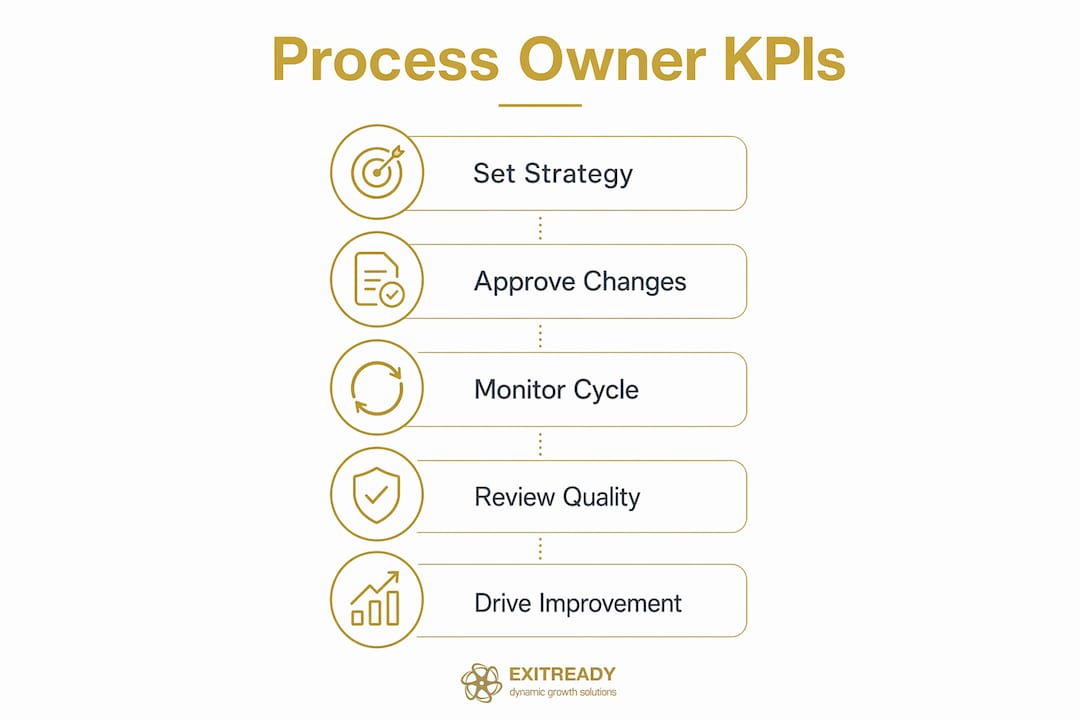
The role breaks into five concrete duty areas, each tied directly to process performance.
- End-to-end performance accountability. The owner tracks quality, cost per transaction, cycle time, and compliance across every step, not just the steps their team performs.
- Setting objectives and KPIs. The owner defines what “good” looks like, translates strategy into measurable targets, and reviews results on a regular cadence.
- Approving process changes. No change to workflow design, tooling, or handoff logic goes live without the owner’s sign-off. This single gate prevents unauthorized drift.
- Governance and decision rights. The owner holds the authority to escalate issues, resolve cross-functional conflicts, and align the process with enterprise strategy when priorities shift.
- Continuous improvement sponsorship. The owner identifies improvement opportunities, prioritizes projects, and approves the resources needed to execute them.
- Coordination across adjacent processes. Order-to-cash touches procurement, finance, and logistics. The owner harmonizes handoffs so no team optimizes locally at the expense of the whole.
Pro Tip: Draft a one-page process ownership charter before the role goes live. It should specify what the owner can change independently, when IT or compliance must be consulted, and which issues escalate to senior leadership. A formal charter removes the ambiguity that causes owners to either overreach or underperform.
How does a process owner differ from a process manager?

The short answer: the owner sets strategy and approves changes; the manager executes day-to-day operations. Conflating the two is the most common governance mistake in mid-market organizations.
| Role | Authority | Time horizon | Primary focus | Typical activities |
|---|---|---|---|---|
| Process owner | Approve changes, set KPIs, escalate | Strategic (quarters to years) | Outcomes and alignment | Charter governance, improvement sponsorship, stakeholder alignment |
| Process manager | Coordinate execution, resolve daily issues | Operational (days to weeks) | Throughput and compliance | Scheduling, exception handling, team coordination |
| Process analyst | Recommend, document, model | Project-based | Process design and data | Mapping, gap analysis, metrics reporting |
| Enterprise architect | Advise on cross-process integration | Long-range | Architecture and standards | Integration design, technology roadmap |
A simple way to see this in practice: imagine a change request to redesign the invoice approval workflow. The process manager flags the problem and documents the current state. The analyst models the options. The enterprise architect checks integration impacts. The owner reviews the recommendation and approves or rejects the change. Authority flows in one direction.
“Process ownership is largely a leadership role where owners need senior credibility and cross-functional influence far more than task-level management skills.”
Myth: “The process owner is just a senior manager with a fancier title.” That framing misses the point entirely. A manager optimizes within a process; an owner is accountable for whether the process itself is the right one, designed correctly, and delivering the outcomes the business needs. The distinction matters most when a process needs to be redesigned or retired, not just run better.
What skills make an effective process owner?
Appointing the wrong person is expensive. The skills below are what separate owners who drive real change from those who become rubber stamps.
Core skills to look for:
- Cross-functional influence. The owner must get cooperation from teams they do not manage. Without it, handoff problems never get resolved.
- Data literacy. Reading a process scorecard, spotting a trend in cycle-time data, and questioning a KPI definition are all table stakes.
- Process thinking. The ability to see a workflow as a system, not a series of individual tasks, and to trace a quality problem back to its root cause.
- Stakeholder management. Owners spend a lot of time in rooms where people disagree. The ability to build consensus without losing accountability is critical.
- Change leadership. Approving a process redesign is easy. Getting three departments to adopt it is the hard part.
Behavioral qualities that predict success:
- Persistence when cross-functional resistance slows progress
- Genuine curiosity about why a process produces the outcomes it does
- Outcome focus over activity focus (results matter more than effort)
- The discipline to prioritize improvement work alongside operational demands
Pro Tip: If a strong candidate lacks process-tool fluency, that gap is trainable. Pair them with an experienced process analyst for the first 90 days, or enroll them in a structured BPM certification program. What you cannot train quickly is the organizational credibility and influence the role demands.
What do end-to-end processes look like, and who typically owns them?
The table below maps common cross-functional processes to the roles most often appointed as owners. These are starting points, not rules. Ownership should follow who is most affected by the outcome, not who sits highest on the org chart or who initiated the process.
| Process | Typical owner role | Why this role fits |
|---|---|---|
| Order-to-cash | VP of Operations or Revenue Operations lead | Accountable for revenue cycle integrity and customer delivery |
| Procure-to-pay | CFO or VP of Finance | Controls spend governance and supplier relationship outcomes |
| Hire-to-retire | Chief People Officer or HR Director | Accountable for workforce lifecycle from offer to offboarding |
| Customer onboarding | VP of Customer Success | Owns the experience that determines retention and expansion |
| Product development | Chief Product Officer | Accountable for delivery quality, timeline, and market fit |
Company size and operating model shift these assignments. In a shared-services model, a central process excellence team may hold ownership for transactional processes like accounts payable. In a decentralized structure, regional operations leads often own locally adapted versions of the same process. What stays constant is the principle: the owner must have enough authority and visibility to actually change the process when it underperforms. You can see more systematized process examples that illustrate how this plays out at scale.
How do you identify and appoint the right process owner?
A structured appointment process prevents the two most common failures: choosing by convenience and choosing by seniority alone.
- Define the process boundaries first. Agree on where the process starts, where it ends, and which handoffs it includes. An owner cannot be accountable for something that has not been scoped.
- Map stakeholders and affected parties. List every team that contributes to or depends on the process outcome. The owner candidate pool comes from this list, not from the org chart.
- Assess influence and expertise. Evaluate candidates on cross-functional credibility, process knowledge, and capacity. A candidate who is already overloaded will not give the role the attention it needs.
- Confirm authority and decision rights. Before the appointment is final, document exactly what the owner can decide independently, what requires escalation, and what requires peer approval.
- Create the ownership charter. Formalize scope, KPIs, escalation paths, and reporting cadence in a single document. Secure executive sponsorship so the owner has organizational backing when they need to push for change.
- Form a steering group for high-impact processes. For processes like order-to-cash or hire-to-retire, a small cross-functional steering group gives the owner a structured forum to resolve conflicts and coordinate improvement work.
Pro Tip: Avoid assigning one executive to own every major process simultaneously. The delegation model that works in practice assigns executive-level accountability at the top while delegating day-to-day authority to sub-process owners. This prevents decision paralysis without diluting accountability. Understanding the business process hierarchy helps clarify where to draw those delegation lines.
How do process owners measure success?
Ownership without measurement is just a title. The KPIs below give owners concrete targets to manage against, and the governance structure turns those targets into a repeatable review cycle.

| KPI | What it measures | Who reports it |
|---|---|---|
| Cycle time | End-to-end elapsed time per transaction | Process analyst or operations team |
| First-time quality rate | Percentage of transactions completed without rework | Quality or operations team |
| Cost per transaction | Total process cost divided by volume | Finance |
| On-time completion rate | Percentage meeting agreed SLA or deadline | Process manager |
| Customer satisfaction score | Downstream experience tied to process output | Customer success or CX team |
A monthly governance review is the minimum cadence for most core processes. The owner reviews the scorecard, flags trends, approves or rejects pending change requests, and updates the steering group on improvement project status. For high-volume transactional processes, a weekly dashboard review catches problems before they compound.
On the tooling side, role-based access control in BPM platforms enforces ownership in practice: owners get edit rights to their workflows and analytics; everyone else gets run-only access. This single configuration prevents the unauthorized changes that silently degrade process performance between governance reviews.
Common myths and pitfalls that undermine process ownership
Getting the role wrong is easy. These are the patterns that show up most often.
- “The owner just manages the process.” Owners set strategy and approve changes. Managers run daily operations. Conflating the two leaves no one accountable for whether the process is actually fit for purpose.
- “Ownership means doing the work.” An owner who spends most of their time executing tasks has no bandwidth to govern, improve, or align the process with strategy. The role is about accountability, not activity.
- “One model fits every company.” A 50-person company and a 5,000-person company need very different ownership structures. What matters is that the owner has real authority and visibility, whatever the org chart looks like.
- “Automation replaces the need for an owner.” Automation amplifies whatever is already in the process, good or bad. Owners must validate workflow quality before automation goes live, or they risk scaling errors faster. This is one of the common bottlenecks that stalls growth even after significant technology investment.
- No authority, no ownership. An owner without the power to approve changes is a figurehead. The charter must explicitly grant decision rights, or the role produces no value.
- Unclear KPIs. If the owner cannot point to three or four metrics that define success, the role has no feedback loop and improvement stalls.
What does the research say about process ownership?
The practitioner consensus is clear: formally appointing process owners is a foundational practice for BPM success, not an advanced one. APQC research consistently shows that organizations should select owners based on who is most affected by process outcomes, a principle that reduces siloed decisions and increases measurable value. BPMInstitute frames the role as primarily a leadership function, where senior credibility and cross-functional influence matter more than deep process-tool expertise.
The artifacts that practitioners consistently recommend: a formal ownership charter, role-based access control in BPM platforms, and a delegation model for complex executive-level processes. These three mechanisms turn accountability from a stated intention into an enforceable structure. SAP Signavio’s definition reinforces the same point: the owner’s job is to align the process with organizational goals and hold the authority to approve changes, two functions that require both organizational standing and documented decision rights.
Key Takeaways
A business process owner is the single point of end-to-end accountability for a defined process, with the authority to approve changes, set KPIs, and align outcomes with strategy.
| Point | Details |
|---|---|
| Appoint owners for core processes | Choose based on who is most affected by outcomes, not org chart position. |
| Create an ownership charter | Document decision rights, escalation paths, and reporting cadence before the role goes live. |
| Separate owner from manager | Owners set strategy and approve changes; managers handle daily execution. |
| Measure with five core KPIs | Track cycle time, first-time quality, cost per transaction, on-time rate, and customer satisfaction. |
| Dynamicgrowthsolutions AOS | Dynamicgrowthsolutions’s AOS program operationalizes process ownership through documented playbooks, delegation systems, and governance frameworks for mid-market companies. |
Why process ownership is the lever most mid-market owners overlook
Most mid-market owners understand that their business has processes. Fewer have assigned a named individual who is genuinely accountable for each critical one, with the authority to change it and the KPIs to know when it is underperforming. That gap is where operational chaos lives.
The research from BPMInstitute and APQC points to the same conclusion: the owners who drive real change are not the ones with the deepest process knowledge. They are the ones with enough organizational credibility to get three departments to agree on a new handoff design and enough authority to make it stick. That is a leadership problem, not a process-mapping problem.
What makes this relevant for owners thinking about working on the business rather than in it: when every critical process has a named owner with a charter, KPIs, and real decision rights, the business stops depending on the founder to resolve every cross-functional conflict. That is the structural shift that makes a company scalable, and it is also what makes it attractive to buyers. Documented, governed processes with clear ownership are one of the clearest signals of a business that can run without its founder.
Operational independence starts with owned processes
Mid-market companies that have clear process ownership in place share one trait: they are not dependent on any single person to keep operations running. That is the outcome Dynamicgrowthsolutions is built to deliver. Through the AOS business operating system, Dynamicgrowthsolutions helps mid-market owners install the exact structures this article describes: ownership charters, delegation models, KPI dashboards, and governance frameworks that replace founder dependency with self-sustaining operations.

The result is a business that performs consistently, scales without chaos, and commands a premium valuation when it is time to exit. If your core processes lack named owners, documented decision rights, or measurable KPIs, the business transformation program is the structured next step. Book a consultation to see where your ownership gaps are and what it takes to close them.
Useful sources and further reading
- SAP Signavio: What Is a Business Process Owner? — Vendor-backed definition covering skills, myths, and governance practices; a solid starting reference.
- APQC: Business Process Owners — Research-backed guidance on selection criteria and the link between ownership and BPM maturity.
- BPMInstitute.org: Process Ownership — Practitioner perspective on the leadership-first nature of the role and why credibility matters more than technical skill.
- BPMInstitute.org: Process Ownership and Governance — Covers delegation models and the governance shift required for complex enterprise processes.
- Kissflow: Process Ownership in BPM — Practical guidance on charters, role-based access control, and enforcement mechanisms.
- Tallyfy: Process Owner — Clear overview of the role’s importance, including the impact of automation on ownership requirements.
- Dynamicgrowthsolutions: How to Scale a Mid-Market Business Systematically — Internal resource connecting process ownership to scalable growth and exit readiness.