

What is a business process hierarchy?
A business process hierarchy is a top-down framework that organizes every activity in your organization into structured levels, from broad strategic goals down to the specific tasks an individual role performs. Think of it as the skeleton of how work actually gets done, not the org chart, but the map of the work itself.
Most organizations use 4–5 levels in their hierarchy structure, though complex enterprises sometimes extend to 7–8. The key is that each level contains and defines the one below it, a parent-child relationship that gives every process a clear home in the overall structure.
A well-built hierarchy does several things at once:
- Connects daily operational tasks to the company’s strategic objectives
- Assigns clear ownership at every level of the organization
- Creates a shared language between leadership, operations, and IT
- Provides the foundation for automation, compliance, and performance measurement
- Makes it possible to spot redundancies, gaps, and improvement opportunities across functions
The term “business process hierarchy” is sometimes used interchangeably with “process architecture” or “process model,” but the hierarchy specifically refers to the layered, top-down structure. A process model is broader and may include flows, rules, and system interactions. The hierarchy is the organizing spine that holds the model together.
How the levels of a process hierarchy work
The most widely referenced standard for process levels comes from the APQC Process Classification Framework (PCF), which organizes enterprise processes into five levels. Each level is defined by the elements below it, so a process group is only as meaningful as the processes it contains.
Here is how the standard levels break down in practice:
-
Level 1: Category (Value Chain). The highest level groups all enterprise activity into broad categories. APQC’s PCF uses 13 Level 1 categories to cover an entire organization. Examples include “Develop and Manage Products and Services” or “Manage Customer Service.” These categories map directly to your company’s value chain.
-
Level 2: Process Group. A process group clusters related processes within a category. For example, within “Manage Human Capital,” you might find process groups for Recruiting, Onboarding, and Learning and Development. This level is where functional areas start to become recognizable.
-
Level 3: Process. A process is a specific, named set of activities that accomplishes a defined business function. “Conduct performance appraisals” is a process. It should apply broadly across organizations, not be tied to a specific software system or tool.
-
Level 4: Activity. An activity is a key step within a process. Where the process describes what gets done, the activity describes how. “Schedule appraisal meeting,” “collect peer feedback,” and “document ratings” are all activities within the performance appraisal process.
-
Level 5: Task. A task is the most granular unit of work, the element a single person performs to complete an activity. Tasks are specific enough to be turned into work instructions or system steps. At this level, you are describing exactly what one role does, step by step.
The Microsoft Dynamics 365 business process catalog extends this to six levels, adding a “Scenario” layer between process and system steps to accommodate software-specific implementations. That variation is common in enterprise technology projects.
Pro Tip: Stop decomposing once a task is clear enough that a single role can execute it without ambiguity. Going deeper than that creates administrative overhead without adding governance value.
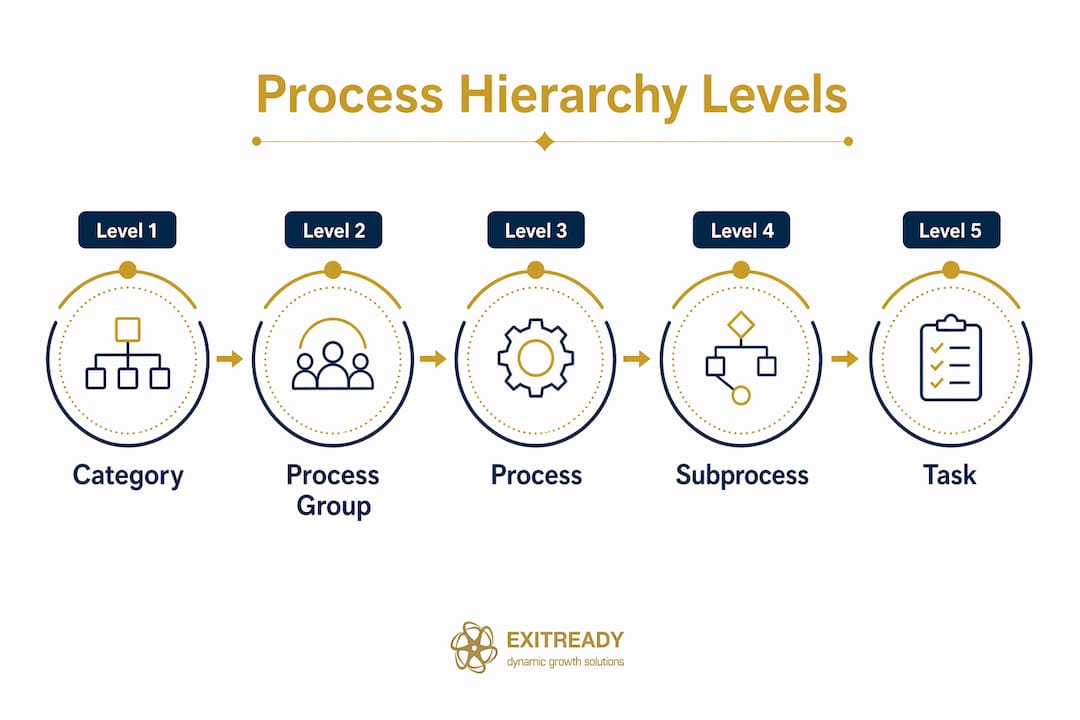
The parent-child relationship between levels is what makes the hierarchy useful. A process group is only as well-defined as the processes underneath it. If you cannot list the Level 3 processes that belong to a Level 2 group, the group is not yet defined, it is just a label.
The three core categories every hierarchy starts with
Before you assign a process to Level 1, you need to understand the three fundamental categories that sit at the top of any well-structured hierarchy. These categories appear consistently across frameworks, from APQC to the European Association of Business Process Management (EABPM).
-
Management processes govern how the organization operates. They cover corporate governance, strategic planning, performance monitoring, and risk management. These processes do not deliver a product or service directly to a customer; they set direction and keep the organization aligned. Examples include setting annual objectives, reviewing financial performance, and managing regulatory compliance.
-
Core processes are the ones that create direct value for customers. They form the primary value stream of the business. Purchasing, manufacturing, sales, marketing, and customer service all fall here. If a process stops and a customer immediately feels it, it is almost certainly a core process.
-
Support processes keep everything running behind the scenes. IT infrastructure, HR administration, accounting, and facilities management are classic examples. They do not touch the customer directly, but without them, core processes break down.
This three-category structure is the standard starting point for any business process model. It prevents the common mistake of treating every process as equally important, which leads to bloated hierarchies where a payroll run sits at the same strategic level as product development.
Getting these categories right at Level 1 shapes everything below. A company that misclassifies its support processes as core processes will misallocate resources and misplace accountability across the entire hierarchy.
What process hierarchies look like across real organizations
The structure of a hierarchy varies by organizational complexity, but the logic stays consistent. A mid-market manufacturing company might run a clean four-level hierarchy, while a global financial services firm may need six levels to capture the nuance of its regulatory and operational environment.
A mid-market example
A 200-person distribution company might organize its hierarchy like this: at Level 1, three categories cover Order Fulfillment (core), Finance and Administration (support), and Business Planning (management). Level 2 breaks Order Fulfillment into process groups: Inventory Management, Warehouse Operations, and Shipping and Logistics. Level 3 names specific processes within each group, such as “Receive and inspect inbound shipments.” Level 4 lists the activities, and Level 5 captures the task-level instructions a warehouse associate follows.

Departmental mapping
Different departments naturally fall into different categories. HR processes like recruiting and onboarding are support processes. Finance processes like budgeting and financial reporting are also support, though financial planning can have a management dimension. IT service management sits in support. Sales and customer delivery sit firmly in core. This mapping is not just academic; it determines who owns the process, what metrics apply, and where automation investment makes the most sense.
Hierarchy depth and automation
Deeper hierarchies tend to appear where automation is a priority. When you want to automate a task, you need Level 4 and Level 5 detail to define exactly what the system should do. Organizations that have systematized their business processes find that a well-structured hierarchy is the prerequisite, not the output, of successful automation.
Why a defined process hierarchy pays off
A process hierarchy is not a documentation exercise. It is a management tool with direct operational and financial consequences.
- Clarity of ownership. When every process has a named owner at the right level, accountability stops falling through the cracks between departments.
- Automation readiness. You cannot automate what you have not defined. A hierarchy gives your technology team the precise scope of what needs to be built or configured.
- Performance measurement. KPIs attach to processes, not to org chart boxes. A hierarchy tells you exactly which process a metric belongs to and who is responsible for it.
- Compliance and governance. Regulatory requirements map to specific process areas. A hierarchy makes it straightforward to identify which processes are in scope for an audit or a compliance program.
- Cross-functional communication. The hierarchy creates a shared language between business units and IT, reducing the translation errors that slow down projects and cause misaligned system implementations.
- Prioritization. When you can see all processes in one structured view, you can make deliberate decisions about where to invest improvement effort rather than reacting to whoever is loudest.
The strategic value of clear process ownership extends directly to business transformation and exit readiness. Buyers and investors look for documented, repeatable processes as evidence that a business can operate without its founder. A hierarchy is the architecture that makes that documentation coherent rather than a pile of disconnected SOPs.
How to define and implement a process hierarchy in your organization
Building a hierarchy from scratch sounds daunting. Done in the right order, it is methodical.
-
Start with your value chain. Identify the three to five high-level categories that describe what your organization does. Align these to your strategic goals, not to your current org chart. Your org chart reflects reporting lines; your value chain reflects how value flows to customers.
-
Map your process groups. Within each category, identify the major functional clusters. Aim for five to ten process groups per category. Use industry frameworks like the APQC PCF as a reference point, adapting them to your context rather than copying them wholesale.
-
Name your Level 3 processes. For each process group, list the specific processes that belong to it. Each process should be describable in a verb-noun phrase (“Manage supplier contracts,” “Conduct employee onboarding”). If you cannot name it that way, it is probably still a process group, not a process.
-
Decompose to activities and tasks only where needed. Not every process needs Level 4 and Level 5 detail on day one. Prioritize the processes that are candidates for automation, compliance documentation, or performance improvement. Aligning process groups to organizational goals first keeps the work focused.
-
Assign process owners at each level. Every level needs a named owner. Level 1 categories typically belong to C-suite or VP-level leaders. Level 3 processes belong to functional managers. Level 5 tasks belong to individual roles. Without this assignment, the hierarchy is a diagram, not a governance tool.
-
Validate with stakeholders. Walk the hierarchy through the people who actually do the work. They will catch misclassifications, missing processes, and naming inconsistencies that no framework document will reveal.
-
Iterate, do not over-engineer upfront. Start with three levels and expand as your needs become clearer. Organizations that try to build a six-level hierarchy in one project almost always stall. The right number of levels is the one that serves your current governance needs, with room to grow.
Pro Tip: Use a quality management framework like those covered in QMS implementation consulting to cross-reference your process categories against industry standards before finalizing your Level 1 structure. It saves significant rework later.
Common pitfalls include building the hierarchy around your current software systems (it should be system-agnostic), making it too deep too fast, and failing to assign real owners. A hierarchy that nobody owns becomes outdated within months.
The strategic value a process hierarchy creates for your organization
That connection between strategy and execution is where most mid-market companies break down. Leadership sets direction; the front line executes. But without a documented hierarchy, the translation between those two layers is informal, inconsistent, and fragile.
A well-maintained hierarchy does three things for organizational agility:
- It makes cross-functional process insight visible. The hierarchy overlays the org chart as a horizontal view, showing how work flows across departments rather than up and down reporting lines.
- It creates the conditions for delegation. When processes are documented and owned, leaders can hand off operational responsibility with confidence because the work is defined, not just assumed.
- It signals readiness to outside parties. Acquirers, investors, and partners assess operational maturity partly by whether a company can produce a coherent process architecture. A hierarchy is evidence that the business runs on systems, not on key individuals.
Dynamicgrowthsolutions’s AOS (Accelerated Operating System) framework builds directly on this principle. The AOS approach treats a documented process hierarchy as the foundation for business transformation, replacing owner dependency with self-sustaining operations that hold their value at exit.
Pro Tip: If your hierarchy currently lives only in one person’s head or in a single consultant’s slide deck, it is not yet a governance asset. The test is whether a new VP could understand your process structure within a week using only your documentation.
Avoiding over-complexity is just as important as building depth. Hierarchies that exceed five or six levels tend to collapse under their own weight. The administrative burden of maintaining them outpaces the governance value they provide. Keep the structure lean enough that process owners can actually use it.
How a process hierarchy differs from process maps and value streams
These three terms get conflated constantly, and the confusion causes real problems in implementation projects.
A process hierarchy is the structural index. It tells you what processes exist, how they relate to each other, and where they sit in the organization. It does not show how a process flows; it shows where it belongs.
A process map is a visual representation of how a specific process works, showing the sequence of activities, decision points, handoffs, and system interactions. Business Process Model and Notation (BPMN), the de facto standard for process diagrams, is a notation language used to create these maps. BPMN documents the detail within a hierarchy level; it does not define the hierarchy itself.
A value stream is a Lean concept that traces the end-to-end flow of value from raw input to customer delivery. It cuts across multiple process groups and departments, focusing on eliminating waste in the flow. A value stream map shows time, handoffs, and waste; a process hierarchy shows structure and ownership.
The practical relationship: your hierarchy tells you which processes exist and who owns them. Your process maps show how those processes work in detail. Your value stream analysis shows where the flow breaks down across process boundaries. You need all three, and they serve different audiences. The hierarchy is for governance and leadership alignment. Process maps are for operational teams and system implementers. Value stream maps are for continuous improvement initiatives.
Best practices for keeping your process hierarchy current
A hierarchy built once and never revisited becomes a liability. It misleads new employees, misaligns technology projects, and creates a false sense of documentation completeness.
Assign a process architecture owner. Someone needs to be accountable for the hierarchy as a whole, not just individual processes. In larger organizations, this is often a Business Process Management (BPM) Center of Excellence. In mid-market companies, it is typically a COO or a senior operations leader.
Tie updates to business events. Every time you launch a new product line, acquire a company, implement a new system, or restructure a department, the hierarchy should be reviewed. These events almost always change process ownership, add new process groups, or make existing ones obsolete.
Use version control. Treat your hierarchy like a living document with version numbers and change logs. When a process owner asks “why does this process exist here?”, you want to be able to answer with history, not just current state.
Audit annually at minimum. A yearly review of Level 1 and Level 2 is usually sufficient for stable organizations. Fast-growing companies may need quarterly reviews of the levels most affected by growth, typically core processes and the support processes that enable them.
Keep naming conventions consistent. Verb-noun process names (“Manage,” “Execute,” “Review,” “Develop”) applied consistently across all levels make the hierarchy navigable. Inconsistent naming is one of the fastest ways to erode trust in the structure.
The goal is a hierarchy that process owners actually use, not one that sits in a SharePoint folder and gets dusted off before audits. That requires making it accessible, keeping it accurate, and connecting it visibly to the decisions that matter.
How outputs and inputs flow between hierarchy levels
The parent-child relationship in a process hierarchy is not just organizational. It is also the mechanism through which inputs and outputs connect across levels.
At Level 1, a category receives a broad input (a customer need, a strategic objective, a regulatory requirement) and produces a broad output (a delivered product, a compliant operation, a financial report). That output does not appear from nowhere. It is the aggregated result of everything happening at Levels 2 through 5 below it.

At Level 2, each process group takes the category’s intent and translates it into a functional scope. The output of one process group often becomes the input to another. In an Order Fulfillment category, the output of Inventory Management (available stock) is the input to Warehouse Operations (pick and pack). The hierarchy makes these handoffs explicit.
At Level 3 and below, the input-output logic becomes precise enough to drive system design and performance metrics. A Level 3 process like “Process customer order” has a defined trigger (an order received), defined inputs (order details, inventory availability, customer credit status), and a defined output (a confirmed order ready for fulfillment). Every activity and task below it contributes to producing that output.
This flow logic is why the hierarchy is the prerequisite for any serious automation or ERP implementation. Systems need to know exactly what triggers a process, what data it consumes, and what it produces. A hierarchy that documents these relationships at each level gives your technology team a blueprint rather than a conversation. Organizations that scale systematically treat this input-output clarity as a non-negotiable foundation before any technology investment.
Ready to build a process hierarchy that actually drives growth?

Most mid-market companies have processes. Few have a documented hierarchy that connects those processes to strategic goals, assigns clear ownership, and holds up under the scrutiny of a buyer or investor. That gap is exactly what Dynamicgrowthsolutions’s AOS framework is built to close.
The AOS (Accelerated Operating System) gives you a proven structure for mapping your process architecture, assigning ownership, and building the documented playbooks that make your business operate without you at the center of every decision. The result is a company that scales on systems, not on heroics, and commands a premium at exit.
Explore business transformation best practices to see how Dynamicgrowthsolutions works with mid-market executives to build process hierarchies that hold enterprise value.
Key Takeaways
A business process hierarchy organizes every organizational activity into structured levels, linking strategic goals to operational tasks and enabling clear ownership, governance, and scalable growth.
| Point | Details |
|---|---|
| Standard hierarchy depth | Most organizations use four or five levels in their process hierarchies; complex enterprises may use up to seven or eight levels. |
| Three core categories | Management, Core, and Support processes form the foundation of every Level 1 structure. |
| APQC as the benchmark | APQC’s PCF defines 13 Level 1 categories, providing a cross-industry reference for hierarchy design. |
| Ownership drives value | Assigning named process owners at every level is what converts a hierarchy from a diagram into a governance tool. |
| Hierarchy vs. process map | The hierarchy defines structure and ownership; process maps (using BPMN) document how individual processes flow. |