

The business ceiling effect is the point where a company stops growing not because demand dried up, but because its own structure won’t let it go further. Owner dependency, undocumented processes, and systems gaps are the usual culprits. You can pour more money into marketing, hire more people, and push harder — and revenue still flatlines. As a business growth ceiling problem, it is fundamentally an operations design issue, not a demand problem.
Your first move: run a 30-day bottleneck audit. Track every decision that required your input for four weeks. If more than half route through you, the ceiling is structural.
Three quick signs your business has likely hit one:
- Revenue has plateaued for two or more quarters despite increased marketing spend
- You are the last approval step on delivery, pricing, or hiring decisions
- Customer experience varies depending on who handles the account
Key Takeaways
The business ceiling effect is an operational design problem, not a demand problem, and removing it directly raises both growth rates and exit valuation multiples.
| Point | Details |
|---|---|
| Define the ceiling first | A business ceiling is a structural limit from owner dependency, undocumented processes, or systems gaps, not a market problem. |
| Run the 30-day audit | Track every decision requiring your input for 30 days; if more than half route through you, the ceiling is confirmed. |
| Delegate at 85% readiness | Hand off processes when they are roughly 85% documented to avoid the perfection loop that keeps founders stuck. |
| Ceiling effects compress multiples | Founder dependency and missing KPI ownership are the top factors buyers use to justify lower valuation multiples. |
| Dynamicgrowthsolutions AOS path | The AOS operating system and ExitReady certification replace founder dependency with documented architecture and measurable exit readiness. |
Table of Contents
- What causes a business ceiling effect in mid-market companies?
- How do you know if your business has hit the ceiling?
- A prioritized action plan to lift the ceiling
- How a ceiling effect reduces your valuation and exit readiness
- When should you bring in outside help?
- What does a ceiling removal actually look like?
- Why owners underestimate the ceiling until it costs them
- Dynamicgrowthsolutions removes the ceiling with a proven operating system
- Sources
What causes a business ceiling effect in mid-market companies?
Most ceilings share a common origin: the founder became the operating system. When every significant decision routes through one person, the company’s throughput is capped at that person’s bandwidth. Adam Sowden’s analysis puts it plainly: removing the owner from personal delivery is not optional if you want to break the ceiling.
Beyond founder dependency, four other structural causes show up repeatedly in mid-market firms.
Undocumented processes. When knowledge lives in one person’s head, every departure or absence creates a gap. A manufacturer with no written SOPs for its most profitable product lines is one key-person exit away from delivery chaos.
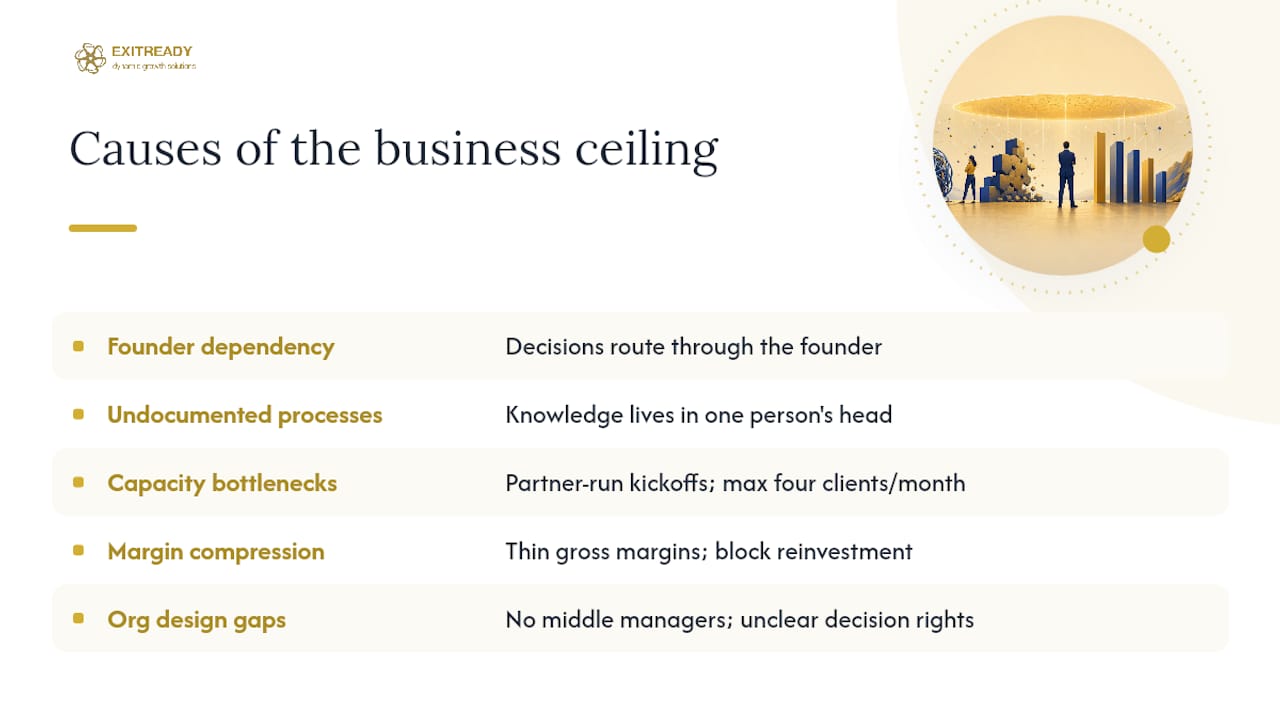
Capacity bottlenecks. A professional services firm that can only onboard four new clients per month because the partner personally handles kickoffs has a delivery ceiling, not a sales ceiling. The constraint is physical time, not market size.
Margin compression. Thin gross margins leave no room to reinvest in the people or systems that would remove the ceiling. When margins are squeezed, every fix looks like a cost rather than an investment.
Organizational design gaps. Missing middle managers, unclear decision rights, and no KPI ownership mean problems escalate upward by default. The founder absorbs complexity that should be handled two levels down.
Brad Sugars’ breakdown of scaling barriers makes a useful point: the systems and leadership that worked at $3M often become the constraints at $10M. What got you here genuinely does block what comes next.
Pro Tip: *Map every recurring decision in your business for two weeks. Categorize each one by who made it.
How do you know if your business has hit the ceiling?
The clearest signal is a divergence: marketing spend goes up, effort goes up, and revenue stays flat. But gut feel is not a diagnostic. You need numbers.
| Metric | How to calculate | Red-flag threshold |
|---|---|---|
| Revenue growth rate | (Current year revenue / Prior year revenue) – 1 | Below industry average for 2+ consecutive years |
| Revenue per employee | Total revenue / headcount | Declining or flat while headcount grows |
| Gross margin trend | (Revenue – COGS) / Revenue, tracked quarterly | Declining 2+ points year-over-year |
| Capacity utilization | Billable or productive hours / total available hours | Consistently above 85% with no relief plan |
| CAC/LTV ratio | Customer acquisition cost vs. lifetime value | CAC rising while LTV holds flat or falls |
| Founder time on delivery | Hours in delivery / total working hours | More than half of your week |
| Decision cycle time | Average days from request to resolution | Growing quarter-over-quarter |
For the 30-day bottleneck audit: pull your calendar and your team’s decision log. Identify every task or approval that required your direct involvement. Categorize by function: sales, delivery, finance, HR. Then ask which of those could have been handled by someone else with a documented process in place. That gap list is your ceiling map.
The key distinction most owners miss: if CAC is rising but delivery capacity is maxed out, the problem is operational, not a marketing failure. Scaling requires system design, not more effort. Use the business growth diagnostic to separate demand problems from structural ones before spending another dollar on growth.
A prioritized action plan to lift the ceiling
Quick wins (48–90 days). Identify the three decisions you make most often and write a one-page decision rule for each. Hand them off. The goal is not perfection; it is reducing the number of things that stop without you.
Medium-term fixes (3–9 months). Document your five core processes. Assign a KPI owner to each function. Build a weekly scorecard your leadership team reviews without you in the room. Standardize client handoffs so delivery quality does not depend on who is assigned.
Structural changes (6–18 months). Adopt a business operating system. The AOS (Accelerated Operating System) approach replaces founder-as-hub with documented architecture: clear decision rights, repeatable revenue processes, and leadership depth that holds without the founder present. Add RevOps alignment so sales, marketing, and delivery share the same pipeline data. Automate the repeatable work so your team’s capacity goes toward judgment, not administration.
On cost: quick wins cost mostly time. Process documentation and KPI systems typically run a moderate cost range with outside help. A full operating system implementation, including fractional executive support, generally requires a significant investment over 12–18 months, depending on company size and complexity.
Waiting for perfection is how founders stay stuck. An 85% ready process with a feedback loop beats a perfect process that never gets handed off.*
How a ceiling effect reduces your valuation and exit readiness
Buyers price risk. A business where the founder is the primary operator is a business where the buyer is acquiring a job, not an asset. That single factor compresses valuation multiples more than almost any other variable.
Specific risks buyers flag during due diligence:
- Single-person dependency on revenue relationships or delivery
- No repeatable, documented revenue process
- Gross margins that cannot absorb a leadership transition
- KPIs that exist only in the founder’s head
Large-sample analyses show that companies stall at predictable thresholds because the operating architecture needed to convert strategy into repeatable execution is missing. Fixing that architecture raises both growth rates and buyer confidence.
The financial upside of removing the ceiling is direct: operational independence raises EBITDA multiples. A business running on documented systems with distributed leadership commands a higher multiple than an identical revenue business where the owner is irreplaceable. The ExitReady framework is built around exactly this: resolving structural ceilings before a buyer’s due diligence team finds them.
When should you bring in outside help?
Three signals that the ceiling requires outside expertise rather than internal effort:
- You are spending more than 50% of your operational time in delivery rather than leadership
- Revenue has stalled for two or more years despite increased investment
- No one on your team currently owns a KPI with accountability for the outcome
When you do hire a consultant or fractional executive, ask these questions before signing anything:
- What specific deliverables will you produce in the first 90 days?
- How will we measure success, and what are the agreed metrics?
- What happens if targets are not met — is there a guarantee or remediation process?
- How does your work transfer to our internal team so we are not dependent on you?
- Can you show anonymized before-and-after data from comparable engagements?
Red flags to watch for: proposals with vague scope (“we will assess your operations”), success metrics defined as activities rather than outcomes, and any model where the founder remains the central routing node after the engagement ends. If the consultant’s plan does not explicitly reduce founder dependency, it is not solving the ceiling.
What does a ceiling removal actually look like?
A $12M professional services firm had grown from $4M to $12M over six years, then stalled for 18 months. The founder handled all major client relationships, approved every proposal, and was copied on most internal communications. Revenue per employee had declined for three consecutive years as headcount grew to absorb work the founder could not delegate.
| Metric | Before | After (18 months) |
|---|---|---|
| Revenue growth rate | Plateaued over a long period | Increased significantly year-over-year |
| Revenue per employee | Declining 3 years | Increased significantly |
| Founder time on delivery | Majority of working week | Reduced to a smaller portion |
| EBITDA margin | Low | Improved noticeably |
The key moves: a full process documentation sprint across the highest-revenue service lines, a delegated sales ownership structure, and AOS adoption to formalize decision rights and weekly leadership rhythms. Early in the process, the founder removed herself from many recurring approval steps. The operational fixes that increase repeatability produced higher revenue per employee and improved margins, which funded the next leadership hire.

Why owners underestimate the ceiling until it costs them
The hardest part of removing a business ceiling is not the process work. It is the identity shift. Most founders built their companies by being the best person in the room at the core skill. Being indispensable felt like a strength. At $2M, it was. At $10M, it is the ceiling.
The cultural fixes that actually move the needle are not complicated, but they require consistency:
- Define decision rights explicitly so problems stop escalating by default
- Reward outcome ownership, not activity or hours
- Build trust in your leadership team by letting them fail small and recover
The founders who break through fastest are the ones who reframe their job from “doing the work” to “building the system that does the work.” That shift is uncomfortable. It requires tolerating imperfection and watching someone else handle something you could do better. But a business that runs without you is worth dramatically more than one that runs because of you.
Pro Tip: Start the identity shift with one full week where you do not approve a single operational decision. Document what broke. That list is your first delegation roadmap.
Dynamicgrowthsolutions removes the ceiling with a proven operating system
Mid-market owners who have hit a growth ceiling need more than a framework PDF. They need a structured path from diagnosis to operational independence, with accountability built in.

Dynamicgrowthsolutions deploys the AOS (Accelerated Operating System) to replace founder-dependent operations with documented architecture, distributed leadership, and repeatable revenue processes. A first engagement starts with a proprietary operational assessment that maps your ceiling’s exact location, followed by a 30/90/365-day roadmap with fractional executive support where needed. The ExitReady certification process then prepares the business for a premium exit by resolving the structural gaps buyers penalize most.
Guaranteed-results programs mean you are not paying for effort; you are paying for measurable change. Start with the business transformation assessment to get a clear picture of where your ceiling sits and what removing it is worth.
Sources
The claims in this article draw on practitioner analysis and large-sample operational research. The founder operator trap analysis by Ken Lundin covers the $3M–$10M stall range and the delegation frameworks that break it. Adam Sowden’s owner trap piece explains why founder bandwidth becomes the company’s throughput ceiling. Brad Sugars’ scaling barriers breakdown documents how early-stage systems become late-stage constraints. The revenue ceiling as a design problem provides the architectural framing for why stalls happen at predictable thresholds. And Kim Emasu’s scaling analysis draws the critical distinction between a demand problem and an operations problem.
For owners ready to act, the Dynamicgrowthsolutions scalability checklist and the ExitReady assessment resources provide the next practical step beyond this article.
- The Revenue Ceiling Is a Design Problem — Why Most Companies Plateau at the Same Predictable Points
- The Founder Operator Trap: Why Your Strengths at $3M Become Liabilities at $10M – Ken Lundin
- The Owner Trap: Why Your Business Stopped Growing When You Did — Adam Sowden
- Business Growth Ceilings: 3 Dangerous Scaling Barriers
- Why Your Business Can’t Scale Past Its Current Revenue Ceiling