

Most business owners spend years building a company worth selling, then leave serious money on the table because they misunderstood one thing: timing. Understanding why exit strategy timing matters is not about picking the right calendar date. It is about aligning three forces simultaneously. Those forces are operational readiness, market conditions, and your personal goals. Get all three aligned, and you position yourself for a premium transaction. Miss even one, and buyers sense it immediately. The gap between a prepared exit and a reactive one can represent hundreds of thousands or even millions in final proceeds.
Table of Contents
- Key takeaways
- Why exit strategy timing matters more than most owners realize
- How early planning dramatically increases your valuation
- Reading market signals before your window closes
- Balancing personal readiness with business and market timing
- A practical framework for exit strategy decision points
- My perspective on timing as the unsung hero of exits
- Ready to time your exit right?
- FAQ
Key takeaways
| Point | Details |
|---|---|
| Start planning 3 to 5 years out | Industry consensus recommends a 3 to 5 year planning horizon to groom management, clean financials, and maximize valuation. |
| Preparation drives valuation premiums | Businesses with exit-ready operations can achieve 25 to 40% higher valuations than unprepared counterparts. |
| Market windows close fast | Peak M&A cycles attract competing buyers and higher offers. Missing them forces sellers into weaker buyer pools. |
| Personal timing is non-negotiable | Founder energy, life events, and post-sale plans must align with business and market readiness to avoid regret. |
| Decision points require a framework | Using operational, financial, and market checklists removes emotion from timing decisions and improves outcomes. |
Why exit strategy timing matters more than most owners realize
Timing an exit strategy is not a single decision. It is a convergence of four distinct readiness dimensions, and each one operates on its own timeline.
Operational readiness is the foundation. Buyers want to see clean, auditable financials for at least three years. They want documented processes, standard operating procedures, and a management team that does not collapse when the founder steps back. Buyers discount businesses with high owner dependency due to key person risk, and that discount can be substantial.
Market timing refers to sector-specific M&A activity. Every industry moves through acquisition cycles. When consolidation is active and multiple buyers compete for deals, premiums spike. When the cycle cools, buyers have more leverage. Watching sector M&A activity is as important as watching your own financials.
Financial timing means more than just having a profitable year. Buyers look for sustained earnings trends, stable margins, and high-quality recurring revenue. A single strong year raises red flags. Two or three consecutive years of growth, with margins holding steady, tells a compelling story.
Personal timing is the dimension most founders underestimate. Consider these questions honestly:
- Are you still energized by the business, or are you running on obligation?
- Do you have a clear picture of what your life looks like after the sale?
- Are you willing to stay involved for a 12 to 24 month transition period?
- Do you have a tax and estate plan in place to protect your proceeds?
Timing involves multi-dimensional factors that must align for a deal to maximize both valuation and post-sale satisfaction. When even one dimension is out of sync, buyers pick up on it during diligence, and the deal either stalls or reprices downward.
How early planning dramatically increases your valuation

Here is the number that should change how you think about this. A business earning $400,000 in seller’s discretionary earnings might sell for $1.0M to $1.2M without preparation, and up to $1.6M with exit-ready operations. The business itself did not change. The preparation did.
The importance of exit strategy planning is most visible in the numbers buyers assign to risk. Every operational gap, every undocumented process, every customer relationship that only exists in the founder’s head represents a risk that buyers price into their offer. Reduce those risks systematically, and you compress the buyer’s discount accordingly.
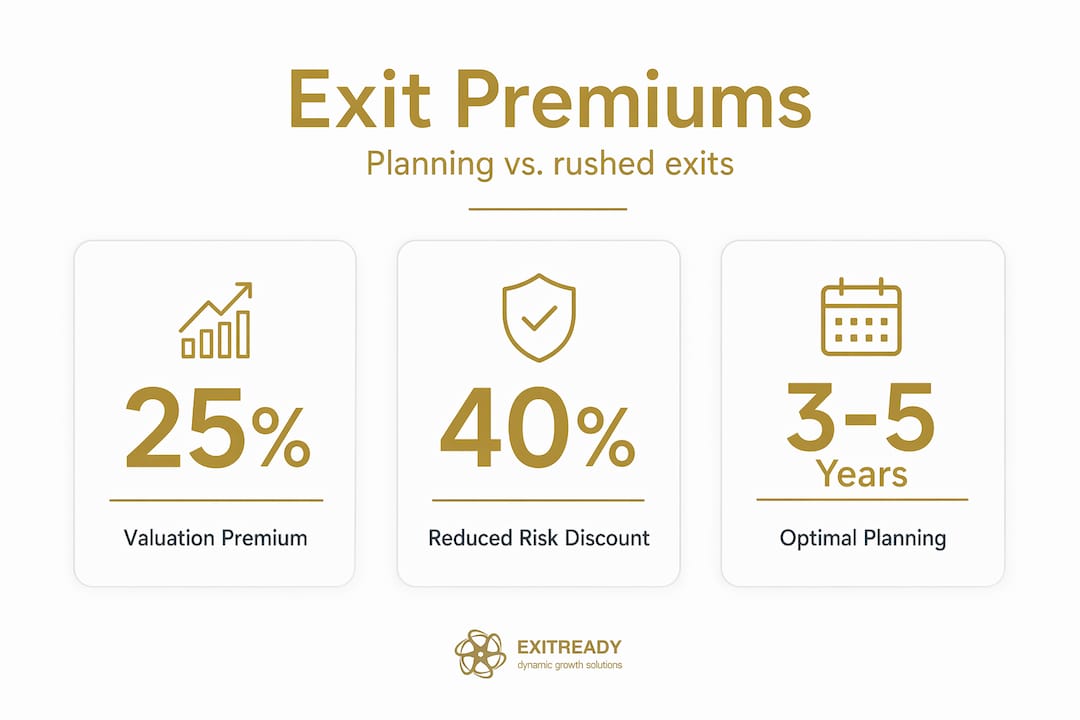
Industry consensus recommends starting exit strategy planning 3 to 5 years before the intended exit. That timeline is not arbitrary. It takes roughly 18 to 36 months to document processes and build systems that increase buyer confidence and reduce operational risk discounts. Add another year or two to establish the sustained financial trends buyers demand, and you understand why starting late is so costly.
Companies that approach the market with structured exit strategies achieve 25 to 40% valuation premiums and reduce operational costs by 20 to 40%. Those are not marginal gains. On a business valued at $5M, a 30% premium represents $1.5M in additional proceeds.
Pro Tip: Think of your exit preparation as building a second business inside your first one. The goal is to create a company that runs, grows, and generates predictable returns without you at the center of every decision. That business commands a completely different price.
The owners who achieve premium exits understand that sustained operational improvements across several quarters are what justify a premium valuation. A last-minute cleanup before going to market is visible to every experienced buyer and advisor in the room.
Reading market signals before your window closes
Market timing is where many mid-market owners get surprised. They wait until personal circumstances force a sale, only to discover the market has shifted. When you are ready to sell, the ideal scenario is for the market to also be ready to buy. That combination rarely happens by accident.
Peak valuation occurs during consolidation cycles when multiple acquirers compete for quality targets. When acquisition appetite is high, buyers accept higher multiples and more favorable terms. When the cycle turns, the same business sits longer on the market and attracts lower offers.
There are several market signals worth monitoring regularly:
- Competitor acquisitions: When your peers are being acquired at high multiples, your window is likely open. When acquisitions slow and the acquired companies are restructuring, the cycle may be cooling.
- Private equity activity in your sector: PE-backed roll-up strategies accelerate consolidation. If a PE firm is building a platform in your space, they need targets and are willing to pay for quality ones.
- Regulatory and technology shifts: A new regulation or technology disruption can either create urgency for acquirers or erode the value of your business model. Know which direction your industry is heading.
- Interest rates and credit markets: Buyers, especially PE firms, finance acquisitions with debt. When credit is cheap, buyers bid aggressively. When rates rise, deal multiples typically compress.
Building the flexibility to act quickly when market conditions peak requires operational readiness already in place. That is the connection most owners miss. You cannot prepare in six months what takes three years to build. Understanding optimal exit strategy timing means staying market-aware while building internal readiness in parallel, not sequentially.
Balancing personal readiness with business and market timing
The personal dimension of exit timing is where experienced advisors earn their fees, and where many owners make their most expensive mistakes.
Founders often fall into what advisors call the “one more year” trap. The logic sounds reasonable: one more year of growth, one more product launch, one more hiring cycle. The problem is that market appetite can contract faster than business growth, and a founder who keeps waiting can watch a premium market window close while chasing internal milestones.
Personal readiness also includes financial and structural planning that takes years, not months. For founders with international assets or multiple residencies, tax and residency alignment requires multi-year planning. Late attention to these issues can erode net proceeds significantly, even when the deal itself closes at a great price.
One of the most overlooked shifts a founder must make is psychological. Founders must shift their mindset and begin viewing the business as a standalone asset rather than an extension of their identity. That shift makes delegation easier, reduces owner dependency, and accelerates exit readiness across every dimension.
Pro Tip: Schedule an annual “exit readiness review” every January. Assess your personal energy levels, your financial preparedness post-sale, and how aligned you are with your life goals outside the business. Treat it like a board meeting for your own future.
The goal is synchronization. Your business should be operationally ready before the market peaks, and you should be personally ready before you sign anything. Getting two of the three aligned is common. Getting all three aligned at the same time is what separates premium exits from regrettable ones.
A practical framework for exit strategy decision points
Making a well-timed exit decision requires removing as much emotion from the process as possible. The following framework gives you a structured approach to assess your readiness across all three dimensions.
Operational readiness checklist
- Three or more years of clean, reviewed or audited financial statements
- A documented management team capable of running operations without daily founder input
- Written standard operating procedures for all core business functions
- Customer concentration below 20% for any single client
- Recurring revenue representing a significant portion of total revenue
Market readiness indicators
- Identify two or three recent transactions in your sector and note the multiples paid
- Track private equity activity in your industry quarterly
- Confirm your sector is not facing near-term regulatory or technology disruption
- Assess whether buyer appetite is currently expanding or contracting
Personal alignment questions
- Can you articulate what your life looks like 18 months after closing?
- Is your personal financial plan built around the expected net proceeds?
- Are you willing to accept an earnout structure if it maximizes total value?
Consider this comparison when weighing the decision to act versus delay:
| Scenario | Likely outcome |
|---|---|
| Operationally ready, market strong, personal alignment achieved | Premium valuation, competitive bidding, smooth transition |
| Operationally ready, market strong, personal misalignment | Deal closes but post-sale regret is common |
| Not operationally ready, market strong | Lower multiple, longer diligence, possible deal collapse |
| Operationally ready, market cooling | Longer time to close, fewer competing buyers, compressed multiples |
| Waiting for “one more year,” market peaks and retreats | Significantly lower proceeds, reactive exit on buyer terms |
The pattern is clear. Structured exit planning reduces the scenarios where timing works against you and puts you in control of which row of that table you land in.
My perspective on timing as the unsung hero of exits
I’ve spent years watching mid-market owners sell businesses they built over decades, and the pattern that shows up repeatedly is this: the owners who left the most money behind were not the ones who built inferior businesses. They were the ones who treated exit timing as an afterthought.
What I’ve learned is that timing is a discipline, not a moment. The founders I’ve seen execute truly premium exits started treating their businesses as transferable assets three to five years before they ever spoke to a buyer. They were documenting processes when it felt premature. They were building management depth when they could have kept control. They were monitoring when to execute exit strategy decisions the way a pilot monitors instruments, not waiting for a warning light.
The uncomfortable truth is that most owners do not start planning until something forces them to. A health event, a partnership dispute, a competitive threat. Reactive exits almost always underperform. The business is not positioned, the market is not analyzed, and the personal plan is not ready. Buyers know a motivated or pressured seller immediately, and they price their offers accordingly.
My honest advice: treat today as the first day of your exit preparation, regardless of how far away you think the actual exit is. The owners who execute brilliantly are the ones who are always ready, so when the market peaks or the right buyer appears, they can move with confidence rather than scramble.
— Andre
Ready to time your exit right?
If this article clarified why the importance of exit strategy extends well beyond picking a date, then you are already ahead of most mid-market owners. The next step is turning that clarity into a structured plan.

Dynamicgrowthsolutions works specifically with mid-market business owners who want to exit on their terms, at maximum value, without the chaos of a last-minute preparation. Through the exit planning program, owners receive a clear roadmap covering operational readiness, financial positioning, and market timing. Dynamicgrowthsolutions also hosts exclusive CEO mastermind events where business owners work through their exit timelines with peers and advisors who have completed this process. If you want to see exactly where your business stands today, the 360-ProfitDriver assessment uncovers the operational gaps that most affect your valuation before you ever approach a buyer.
FAQ
Why does exit strategy timing matter so much to valuation?
Timing determines whether buyers compete for your business or negotiate from a position of strength. Operational readiness, combined with a strong M&A market, can produce valuation premiums of 25 to 40% compared to unprepared or poorly timed exits.
How early should I start planning my exit strategy?
Industry experts recommend starting 3 to 5 years before your intended exit date. This window allows time to clean financials, build management depth, document operations, and establish the sustained earnings trends buyers require.
What are the biggest mistakes owners make with exit timing?
The most common mistake is waiting too long. Owners who engage advisors only 12 to 18 months before their intended exit date have almost no time to build the operational systems and financial track record that drive premium valuations.
How do I know when the market is right for my exit?
Monitor recent transaction multiples in your sector, track private equity roll-up activity, and watch interest rate trends. When competitors are being acquired at strong multiples and credit markets are favorable, your window is likely open.
Can personal timing really affect my sale price?
Yes. Buyers sense urgency in sellers and adjust their offers accordingly. A founder who appears pressured or unprepared for life after the sale gives buyers negotiating leverage. Personal readiness is a direct factor in how confidently you negotiate terms.