

Revenue growth stalls in mid-market businesses when the operating model stops scaling with the company. The root cause is rarely the market or the sales team. It is the architecture underneath: founder-dependent decisions, siloed revenue functions, and infrastructure that was never built to carry a $10M–$40M business. Understanding why revenue growth stalls mid-market is the first step toward fixing it. Approximately 70% of small businesses fail when transitioning to mid-market operating models, not because demand disappears, but because the internal systems cannot handle the load. This article breaks down the structural causes and shows what leaders can do about each one.
Why revenue growth stalls mid-market: the founder model ceiling
The most common bottleneck in mid-market growth is the founder acting as the operating system. Every decision, every key relationship, and every sales conversation runs through one person. That works at $1M. It breaks at $5M and collapses at $10M.
Founder bandwidth caps throughput once a business crosses the $3M–$5M revenue mark. The consequence is not just slower growth. Businesses that remain dependent on their founder sell at a 30–50% valuation discount compared to those with independent operations. That penalty is real and measurable.
The specific failure point is the shift from founder-led selling to a repeatable sales process. When the founder closes every deal, the company has no sales system. It has a talented individual. The moment that individual steps back, revenue drops. A repeatable process, by contrast, runs through documented stages, clear handoffs, and defined qualification criteria that any trained hire can execute.
- Decision rights are undefined. Managers escalate everything because no one knows what they are authorized to decide.
- Communication is informal. Critical context lives in the founder’s head, not in documented playbooks.
- Management infrastructure is absent. There are no operating cadences, no scorecards, and no accountability structures below the founder level.
- Delegation fails without systems. Handing off tasks without documented processes just moves chaos to a new person.
Pro Tip: Map every decision made in a typical week and categorize each one by whether it requires the founder or could be handled by a trained manager. That list is your delegation roadmap.
The fix is not hiring more people. It is building documented processes and decision rights that let the organization run without constant founder input. Dynamicgrowthsolutions calls this the shift from owner-as-operator to owner-as-architect.

How siloed revenue teams cause stalled growth
Revenue misalignment at the $10M–$25M stage is one of the most predictable and most ignored causes of stalled growth. Sales, marketing, and finance each track different numbers, report to different leaders, and optimize for different outcomes. The result is a company that looks busy but cannot forecast accurately or grow consistently.
The core problem is treating revenue as three separate departmental functions instead of one integrated operation. Sales chases bookings. Marketing chases leads. Finance watches margins. None of them share a single scorecard that connects pipeline to bookings to margin to cash flow. Without that connection, decisions get made on incomplete information.
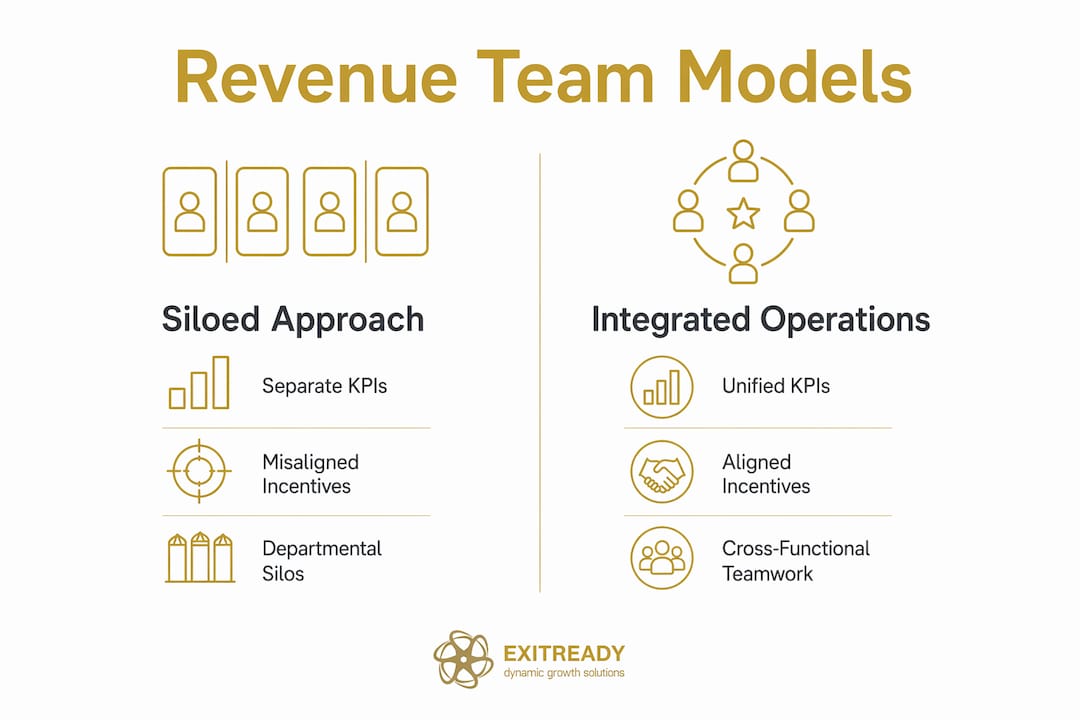
| Siloed approach | Integrated revenue operations |
|---|---|
| Sales, marketing, and finance track separate KPIs | Shared scorecard links pipeline, bookings, margin, and cash flow |
| Forecasting relies on gut feel and departmental estimates | Forecasting uses unified data with clear accountability |
| Incentives reward individual team metrics | Incentives align to company-level revenue outcomes |
| Handoffs between teams are informal and inconsistent | Handoffs follow documented SLAs with defined ownership |
Misaligned incentives make this worse. When sales reps earn commission on bookings regardless of margin, they discount aggressively. When marketing is rewarded for lead volume rather than qualified pipeline, sales wastes time on bad-fit prospects. These are not people problems. They are system design problems.
Revenue growth stalls from broken departmental silos, not from lack of demand. The market may be ready to buy. The internal machinery just cannot capture and convert that demand efficiently.
What infrastructure failures actually look like
Growth stagnation is an infrastructure integrity problem. That is not a metaphor. Without CRM integration, standardized sales handoffs, and operational playbooks, every new dollar of revenue costs more to generate than the last. Margins erode. The business works harder for less.
The technology stack is often the most visible symptom. Mid-market firms typically accumulate tools without connecting them. The CRM does not talk to the marketing platform. The finance system does not pull from the sales pipeline. No one has a complete picture of the customer lifecycle, so no one can identify where revenue leaks out.
Sales growth gets misread as revenue growth when hidden leakage drains profit behind the scenes. Aggressive discounting, high churn, and delivery strain all reduce the actual revenue captured from rising sales activity. A company can grow its top line and shrink its margins simultaneously.
- Paid channel dependency. Doubling paid ad spend to fix stalled revenue magnifies inefficiencies. It does not fix the structural gap.
- Weak organic foundations. Mid-market firms that invest in organic growth infrastructure, including programmatic SEO and CRM lifecycle stages, can drive 30–40% growth in organic traffic within a quarter.
- AI projects fail on bad data. Gartner estimates 60% of AI initiatives are abandoned because companies lack clean, connected data architecture before they invest in the technology.
- Missing feedback loops. Without structured retrospectives and performance data flowing back into the process, teams repeat the same mistakes at higher volume.
Pro Tip: Before investing in any new technology, audit whether your existing CRM data is clean, complete, and connected to your finance system. Technology built on bad data produces bad decisions faster.
Organic growth investments compound over time, reducing customer acquisition cost and improving EBITDA. Mid-market firms that under-invest in these foundations early pay a steep price when paid channels become too expensive to sustain growth. You can also explore hidden growth opportunities that most owners overlook when they focus only on top-line sales.
How rising costs compound mid-market growth challenges in 2026
External economic pressure does not cause growth stalls on its own. It accelerates the damage already done by internal failures. 51% of mid-market firms cite rising labor, energy, and material costs as their primary growth barrier in 2026. That same research shows 97% of mid-market leaders view inflation as a top concern this year.
| Cost pressure | Impact on growth |
|---|---|
| Rising labor costs | Reduces margin available for reinvestment in growth infrastructure |
| Energy and material inflation | Compresses delivery margins, limits pricing flexibility |
| Higher customer acquisition costs | Makes paid growth channels less viable without organic foundations |
| Interest rate environment | Increases cost of capital for growth investments |
The compounding effect is the real danger. A business with weak infrastructure and rising costs faces a double squeeze. Revenue growth requires reinvestment. Rising costs reduce the margin available for that reinvestment. The business stagnates not because it lacks ambition but because it lacks the financial visibility to make good decisions under pressure.
Visibility, strategy, readiness, and continuity drive mid-market growth more effectively than reactive cost-cutting. Leaders who build forecasting discipline and scenario planning into their operating cadence can absorb cost shocks without abandoning growth investments. Outsourced financial expertise, including outsourced accounting services, gives mid-market firms access to the financial visibility they need without the overhead of a full internal finance team.
How to overcome growth plateaus and build a scalable revenue engine
Overcoming a growth plateau requires changing the operating model, not just adding resources. The following steps reflect what mid-market leaders who successfully break through stalls actually do differently.
- Build a unified revenue scorecard. Connect sales pipeline, bookings, margin, and cash flow into one shared view. Every revenue leader should work from the same numbers.
- Transition from founder-led to process-led operations. Document the decisions, processes, and playbooks that currently live in the founder’s head. Assign decision rights to managers. Test whether the business can run for two weeks without founder involvement.
- Invest in organic growth foundations early. Programmatic SEO, CRM lifecycle tracking, and content infrastructure reduce customer acquisition cost over time. These are not marketing tactics. They are mid-market growth strategies that compound.
- Audit your tech stack for integration gaps. Identify where data breaks between systems. Prioritize connections between CRM, marketing, and finance before adding new tools.
- Build forecasting discipline. Scenario planning and rolling forecasts give leaders the visibility to make proactive decisions when cost pressures rise.
- Adopt a growth architecture framework. Growth architecture links strategy to execution through documented processes, feedback loops, and defined accountability. It is the operating layer between vision and results.
Pro Tip: Run a quarterly “revenue leak audit” across discounting practices, churn rates, and delivery margins. Most mid-market firms find 8–15% of revenue quietly disappearing through these channels before they look.
Effort alone is insufficient for sustainable revenue growth. Companies must build integrated systems and shared accountability. The operating model inflection point is where most mid-market firms either break through or plateau permanently.
Key Takeaways
Mid-market revenue growth stalls when founder-dependent operating models, siloed revenue teams, and weak infrastructure collide with rising external cost pressures.
| Point | Details |
|---|---|
| Founder dependency caps growth | Businesses relying on founder decisions sell at a 30–50% valuation discount and hit throughput ceilings early. |
| Siloed revenue teams destroy forecasting | Separate sales, marketing, and finance metrics create conflicting priorities and inaccurate revenue projections. |
| Infrastructure integrity drives margins | Missing CRM integration, playbooks, and handoff standards increase the cost of every new revenue dollar. |
| Rising costs compound internal failures | 51% of mid-market firms cite cost inflation as a top barrier, amplifying damage from weak operating models. |
| Systems beat effort | Sustainable growth requires documented processes, shared accountability, and integrated data, not more activity. |
The architectural problem most leaders refuse to see
Most mid-market leaders I work with are not lazy. They are working harder than anyone in the building. The problem is that effort applied to a broken architecture just produces faster failure.
The uncomfortable truth is that most growth stalls are self-inflicted. The founder built a great business by being indispensable. Then the business grew to a size where indispensability became the ceiling. The model that created success is now the thing preventing the next level.
What I find consistently underestimated is the cost of informal systems. Leaders assume that because things are “working,” the systems are fine. But working and scaling are different standards. A business can function on informal communication, undocumented processes, and founder judgment up to a point. Past that point, every new hire adds confusion instead of capacity.
The leaders who break through growth plateaus share one trait: they treat their operating model as a product that needs to be designed, tested, and improved. They do not wait for the plateau to become a crisis. They build the architecture before they need it. That proactive shift is the single biggest differentiator between mid-market firms that scale and those that stall.
— Andre
How Dynamicgrowthsolutions helps mid-market owners build past the plateau
Mid-market owners who recognize these patterns often know what needs to change but struggle to execute the shift while running the business at the same time.

Dynamicgrowthsolutions built the AOS (Accelerated Operating System) specifically for this inflection point. The AOS replaces founder dependency with documented playbooks, decision rights, and management infrastructure that lets the business run and grow without the owner in every room. Leaders who want to understand what a business operating system for owners actually looks like in practice can start there. For owners ready to assess where their business stands today, the business scalability checklist provides a clear starting point for identifying the gaps that are costing you growth right now.
FAQ
Why does revenue growth stall in mid-market companies?
Revenue growth stalls when founder-dependent operating models, siloed revenue teams, and weak infrastructure can no longer support the company’s scale. The cause is architectural, not a lack of sales effort or market demand.
What is the most common reason for stalled revenue at the $10M–$25M stage?
The most common cause is treating sales, marketing, and finance as separate functions instead of one integrated revenue operation. Misaligned scorecards and incentives prevent accurate forecasting and consistent growth.
How does founder dependency affect business valuation?
Founder-dependent businesses carry a 30–50% valuation discount because buyers price in the risk of the business collapsing without the founder. Documented systems and independent operations remove that discount.
How do rising costs affect mid-market revenue growth in 2026?
51% of mid-market firms identify rising labor, energy, and material costs as their top growth barrier. Cost inflation compresses margins and reduces the capital available for reinvestment in growth infrastructure.
What is the fastest way to start overcoming a growth plateau?
Audit where revenue leaks through discounting, churn, and delivery strain, then build a unified scorecard connecting pipeline, bookings, margin, and cash flow. Visibility precedes every other fix.