

An operational maturity model is a diagnostic framework that maps how consistently an organization runs its core functions, from manual and reactive to predictive and self-correcting. Its real value is speed: it turns vague frustration about “operational chaos” into a specific list of gaps, ranked by impact, with a rough timeline attached. Run the short assessment below and you’ll walk away with more than a label. You’ll have a starting point for the roadmap.
TL;DR:
- Most functions in mid-market businesses are at manual or documented stages, with measurable and predictive levels requiring 9 to 18 months of focused effort.
- Assessments should focus on concrete dimensions like process documentation, measurement, automation, and decision-making behavior, rather than abstract scores.
- Progression from chaos to predictability should follow a sequence: document processes, establish key metrics, automate low-judgment decisions, then implement forecasting, with governance essential at every stage.
- Leaving assessment gaps unaddressed, especially in decision throughput, risks regression and erodes operational improvements within 18 months.
- External guidance can help transform assessment findings into lasting operational systems, reducing owner dependency and strengthening cross-departmental accountability.
Table of Contents
- What Is an Operational Maturity Model?
- What Are the Stages of Operational Maturity?
- What Should You Actually Measure?
- How Do You Run a Quick Operational Maturity Assessment?
- How Do You Turn an Assessment Into a Roadmap?
- From Assessment to Business Operating System
- An Editorial Take on Maturity Models
- How Dynamic Growth Solutions Can Help You Move Up a Stage
- Frameworks Worth Consulting Next
- Sources
- FAQ
What Is an Operational Maturity Model?
An operational maturity model is a structured way to measure how repeatable, visible, and improvable a business function actually is, then use that measurement to decide what to fix first. It’s a diagnostic tool, not an aspirational checklist. The value comes from honest gap identification, not from chasing a score that looks good on a slide.
That distinction trips up a lot of leadership teams. They treat the model like a report card instead of a map, celebrating “Level 3” status without asking whether decision speed or cost actually improved. A maturity assessment only pays off when it changes what someone does on Monday morning.
Two framing conventions dominate the field:
- Four-level framing, popularized by Accenture’s operations maturity assessment, which surveyed 1,100 executives and sorts organizations into stable, efficient, predictive, and future-ready tiers.
- Five-level framing, used by the Business Process Maturity Model (BPMM) and CMMI-style appraisals, which runs from Initial through Innovating and requires satisfying lower-level criteria before a higher score counts.
Neither framing is more “correct.” Four-level models tend to suit fast executive conversations; five-level models suit formal process appraisals where auditors need granularity. Pick the one that matches how your organization already talks about performance.
What Are the Stages of Operational Maturity?
Most functions in a mid-market business sit somewhere between total improvisation and genuine predictability, and you can usually place a function on this ladder within a few minutes of honest conversation.
- Manual and reactive. Work lives in someone’s head. There’s no documented process, no measurement, and problems get solved by whoever happens to notice first.
- Documented and managed. Standard operating procedures exist, but the cadence for using them is inconsistent. People follow the doc when they remember to, and exceptions pile up.
- Measured and standardized. Key metrics get tracked on a dashboard, and reviews actually reference the numbers. This is where a function stops running on gut feeling.
- Optimized and predictable. Automation handles routine decisions, cycle times shrink, and improvement work happens on a regular rhythm rather than during a crisis.
- Predictive and future-ready. Forecasting and AI-assisted signals catch problems before they surface, and workflows self-correct without a person triggering every fix.
Microsoft’s Azure operational excellence maturity model lays out level-specific tactics for exactly this progression: release readiness at the lower levels, monitoring discipline in the middle, and automated remediation near the top.
Pro Tip: Don’t assess “the company.” Assess one function at a time, such as order fulfillment or customer onboarding, because most mid-market businesses have functions sitting at three different stages simultaneously.
The evidence that separates one stage from the next is rarely subtle. A function stuck at Stage 1 has no written process anyone can point to. A Stage 3 function has a dashboard someone actually opens before a Monday meeting. A Stage 4 function has cut its average response time and can show the trend line proving it.
What Should You Actually Measure?
A maturity assessment falls apart when it stays abstract, so the strongest models break the question into five concrete dimensions.
- Process: Is work documented, versioned, and followed consistently, or does it depend on who’s on shift?
- People and leadership: Does someone own this function, and is there a regular cadence for reviewing how it’s performing?
- Data and measurement: Do KPIs and service-level objectives exist, and is the underlying data clean enough to trust?
- Technology and automation: How much of the routine work runs through automation, monitoring, and documented runbooks versus manual handling?
- Culture and alignment: Do teams collaborate across department lines, or does each department optimize its own piece in isolation?
Instrumentation matters less than what happens after you look at it. A dashboard nobody acts on is decoration, not maturity. The better signal is decision throughput: how often a metric actually triggers a concrete action, a staffing change, a process tweak, a reallocated budget. A clean business process hierarchy makes this easier because it shows exactly who owns each decision point instead of leaving accountability implied.
How Do You Run a Quick Operational Maturity Assessment?
You don’t need a consultant in the room to get a useful first read. A reliable shortcut uses three questions per function, and if the honest answer to any one of them is “no,” that function sits at the level below whatever you assumed.
- Can you see the work? Is there a documented, current view of how this function actually operates, or does the real process live in someone’s inbox and memory?
- Can you measure it? Do you have a number that describes performance, cycle time, error rate, cost per unit, and can you produce it without a special request?
- Do you act on it? When that number moves in the wrong direction, does someone change something, or does it just get noted and forgotten?
Running this as a 10-minute assessment works best in a small group, not solo. Accenture’s research found the short version of this exercise, done properly, takes under 10 minutes per function, which is fast enough to run across five or six core processes in an afternoon.
To run it: pull the person who owns the function, ask the three questions out loud, and request one piece of evidence for each “yes,” a link to the documented process, a screenshot of the dashboard, an example of a decision the metric actually drove. Evidence separates real maturity from wishful thinking.
Two pitfalls show up constantly. First, optimistic self-assessment: owners round their own function up a level because admitting the truth feels like a personal failure. Second, skipping straight to automation before measurement exists, which usually means automating a broken process faster.
How Do You Turn an Assessment Into a Roadmap?
Sequence matters more than speed. Jump straight from manual chaos to automation and you’ll just accelerate the chaos, which is why the standard sequence runs documentation, then measurement, then optimization, then prediction, in that order.
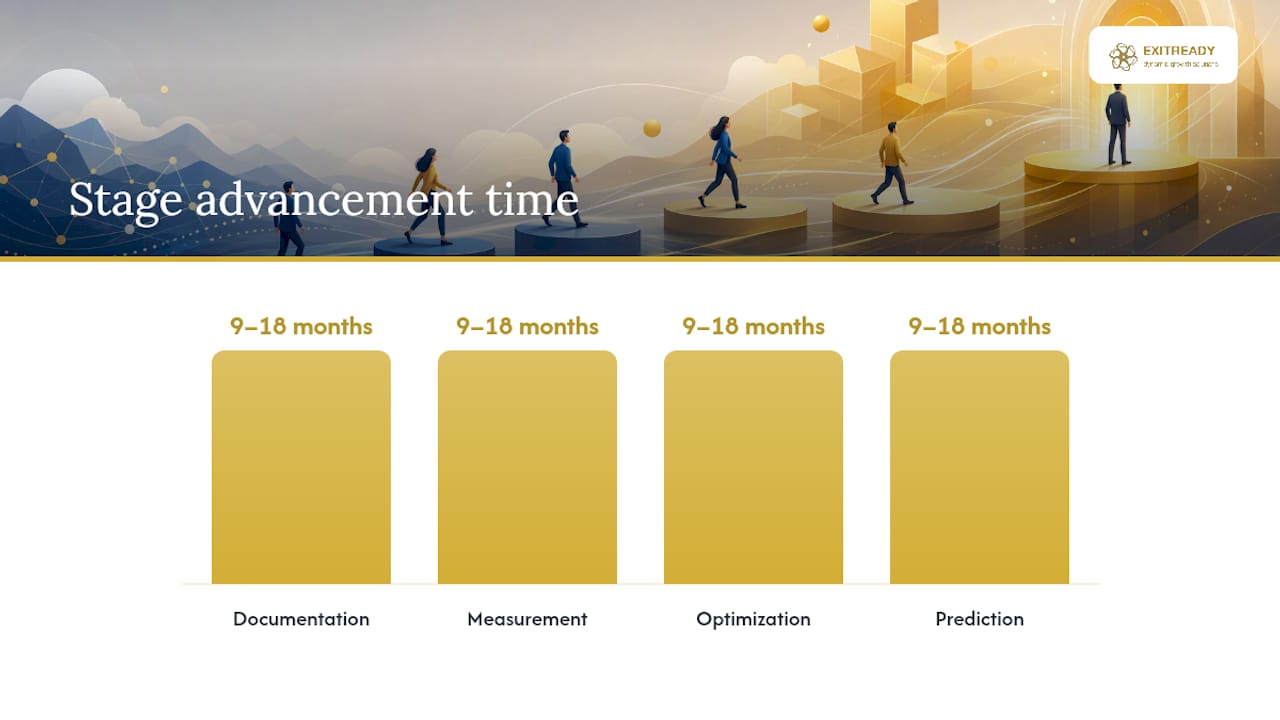
McKinsey’s Operational Excellence Index research found that organizations sustaining a mid-to-high management-system score for 18 months are meaningfully more likely to keep the gains rather than sliding back. That’s the real argument against rushing: a stage you didn’t earn tends to erode within a year and a half.
For a mid-market company, moving up one stage typically takes 9 to 18 months with dedicated effort. Jumping two stages is usually a multi-year program, and most companies bring in outside help to sustain the pace.
Priority actions by stage:
- Stage 1 to 2: Get processes written down and assign clear ownership before touching any tooling.
- Stage 2 to 3: Build the two or three KPIs that actually predict trouble, then put them in front of leadership on a fixed schedule.
- Stage 3 to 4: Automate the highest-volume, lowest-judgment decisions first, and shorten review cycles.
- Stage 4 to 5: Layer in forecasting and treat exceptions as data for the next model iteration, not one-off fires.
None of this locks in without governance. Leaders need to actually review the numbers, and that behavior belongs in executive business transformation practices, not left as an assessment artifact nobody revisits.
From Assessment to Business Operating System
An assessment tells you where the gaps are. Turning that into lasting change requires something more durable than a spreadsheet of findings, which is where a documented operating system earns its keep.
An Accelerated Operating System (AOS) approach converts assessment findings into playbooks: written, owned, and reviewed on a set cadence instead of revisited only when something breaks. Governance cadences replace the ad hoc “let’s check in when there’s time” habit that keeps functions stuck at Stage 2.
For mid-market leaders, the outcomes worth tracking are practical:
- Reduced owner dependency, so the business runs without the founder approving every exception.
- Cleaner handoffs between departments, because ownership and decision rights are written down instead of assumed.
- A documented operating model that survives a change in staff or leadership.
Outsourced or virtual staffing arrangements, increasingly common for scaling operations, can absorb some of the routine execution work once processes are documented well enough to hand off.
An Editorial Take on Maturity Models
Most maturity model content treats the assessment as the finish line. That’s backward. The assessment is the cheapest, fastest part of this whole exercise, and businesses that stop there have spent an afternoon producing a document that changes nothing.
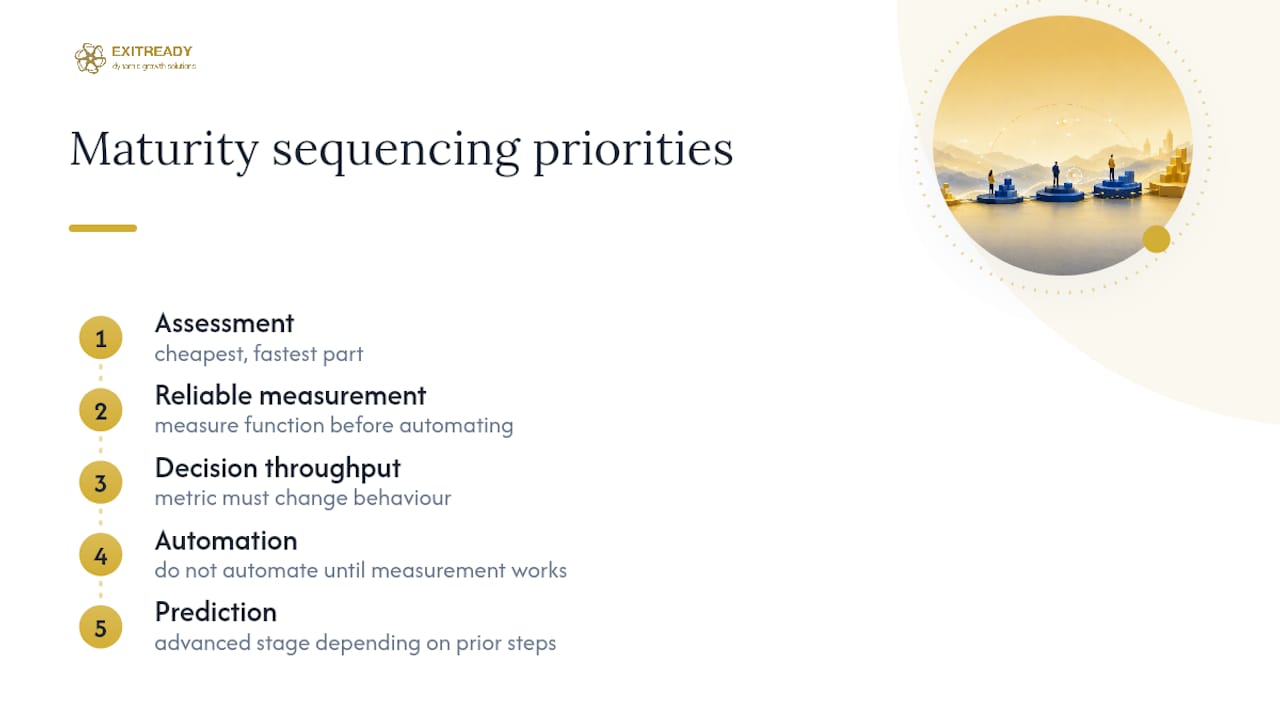
Where the conventional advice falls short is sequencing discipline. Everyone wants to talk about Stage 4 automation and Stage 5 prediction because that’s the exciting part, but a company that automates a function before it can reliably measure that function is just building a faster, more expensive version of the same mess. The BPMM’s insistence that you satisfy lower-level requirements before a higher score counts isn’t bureaucratic gatekeeping. It’s the one rule most self-assessments quietly ignore, and it’s exactly why so many “maturity initiatives” regress within a year.
What should a reader actually prioritize first? Not the label, not the score, the decision throughput. If a metric exists but nobody’s behavior changes when it moves, you don’t have a Stage 3 function. You have a Stage 2 function with a dashboard attached. Fix that gap before anything else, because everything downstream depends on it.
— Andre
How Dynamic Growth Solutions Can Help You Move Up a Stage
Reading the stages is easy. Closing the gap between where a function sits today and where it needs to be is the part most owners underestimate, especially once documentation has to turn into daily discipline across a whole leadership team. An Accelerated Operating System approach addresses that gap: assessments that identify which functions are stuck at Stage 1 or 2, documented playbooks that replace tribal knowledge, and certification milestones that prove the change actually stuck rather than just looking good in a review meeting.
If you’re weighing a do-it-yourself approach against outside help, the honest answer depends on internal bandwidth. A DIY assessment works fine for spotting problems. Converting those findings into governance cadences that survive a busy quarter, or a leadership change, is where most internal efforts stall. A guided engagement brings documented playbooks, delegation structures, and someone whose job is to keep the cadence running when the owner gets pulled into something else.
Start by exploring what a business operating system actually looks like for owners and see whether your current stage matches what you assumed.
Frameworks Worth Consulting Next
- Accenture for a fast executive-level self-assessment.
- Baldrige Excellence Framework® for a formal, criteria-based organizational appraisal.
- BPMM for process-level formal certification.
- Microsoft Azure for technical, IT-specific tactics.
- McKinsey OEI for benchmarking sustained performance.
Sources
- Accenture operations maturity assessment
- Microsoft Azure: operational excellence maturity model
- Baldrige Excellence Framework® (NIST)
- McKinsey: Today’s good to great — next-generation operational excellence
FAQ
What Are the 5 Levels of a Maturity Model?
The most common five-level structure, used by the BPMM, runs Initial, Managed, Standardized, Predictable, and Innovating, with each level requiring the practices of the one before it.
What Are the Four Types of Operating Models?
There’s no single universal list, but in operational maturity terms, Accenture’s research groups organizations into four progressive tiers: stable, efficient, predictive, and future-ready.
What Is a PMO Maturity Model?
A PMO maturity model applies the same logic, documentation, measurement, standardization, optimization, to how a project management office plans, governs, and delivers projects, rather than to a broader business function.
What Does Operational Maturity Mean?
Operational maturity describes how consistently a function or organization can see its own work, measure performance against clear metrics, and act on that data without depending on one person’s judgment.
How Long Does It Take to Improve Operational Maturity?
Moving up one stage typically takes 9 to 18 months of sustained effort, and jumping two stages is usually a multi-year program that often benefits from outside support.