

The owner bottleneck is defined as the condition where a business cannot operate, decide, or grow without the owner’s direct involvement. It is the single most common growth ceiling for mid-market companies, and it is entirely structural. 26% of small business owners name time management as their biggest challenge, and 53.5% regularly lose sleep over operational stress. Those numbers point to the same root cause: the owner is the system. To overcome the owner bottleneck in business, you must transfer decision ownership, not just delegate tasks. That distinction is the foundation of everything that follows.
How to identify the owner bottleneck in your business
The owner bottleneck shows up before you can fix it. Most owners feel it as a constant pull back into the business, a sense that nothing moves without their input. The industry term for this condition is “owner dependency,” and it describes any business where key decisions, approvals, client relationships, or specialist knowledge sit exclusively with the founder.
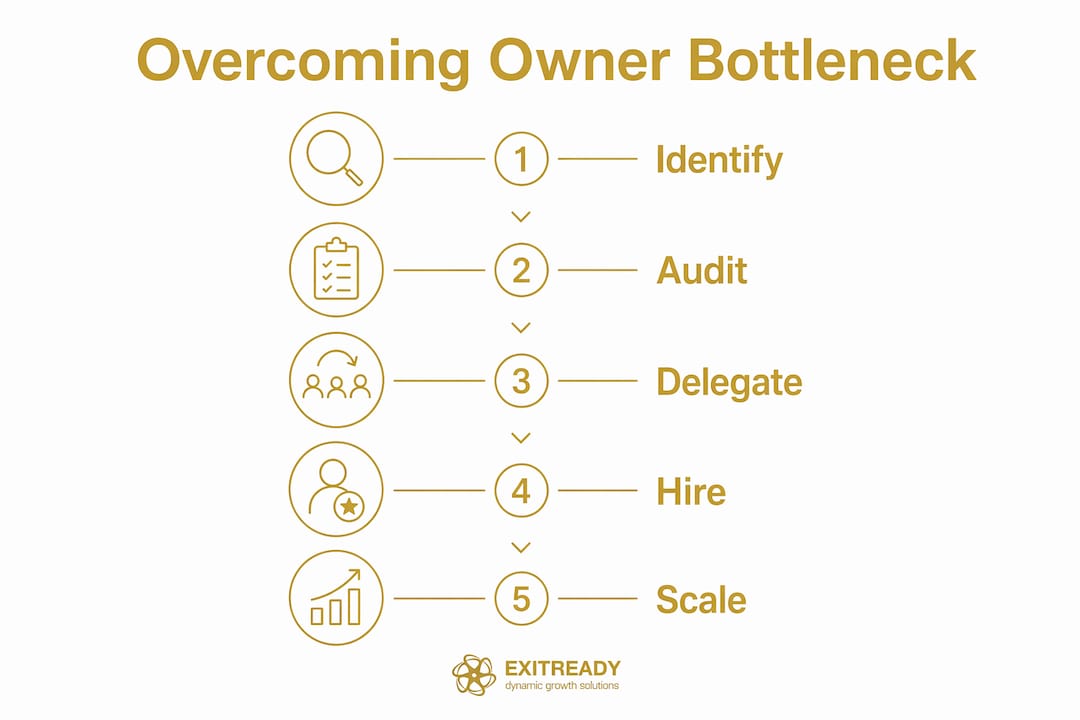
Run a time audit first
Time tracking is the most direct diagnostic tool available. Spend two weeks logging every task you touch, then categorize each one by whether it requires your judgment or could be handled by a trained team member. This exercise, recommended by operational efficiency practitioners, consistently reveals that the majority of owner time goes to tasks that do not require the owner at all.
- Log every task for 14 days. Use a simple spreadsheet or time-tracking app. Capture the task, time spent, and whether it required a decision only you could make.
- Sort tasks into three buckets. Owner-only (requires your unique authority or expertise), owner-preferred (you do it out of habit), and transferable (anyone with training could do it).
- Identify your bottleneck type. Common types include decision bottlenecks, approval bottlenecks, knowledge bottlenecks, client relationship bottlenecks, and sales bottlenecks. Each requires a different fix.
- Map recurring decisions. A decision-rights matrix lists every recurring decision in the business and assigns clear ownership. Without clear decision rights, employees defer everything upward, keeping you trapped even when tools and processes exist.
Pro Tip: Ask your team to flag every time they wait for you in a given week. The list will surprise you. It is a faster bottleneck map than any consultant can build.
The goal of this audit is not to feel guilty about your workload. It is to find the specific constraint that, once removed, frees the most capacity for your team and for you.

What tools and prerequisites do you need before delegating?
Delegation without structure creates chaos. Before you hand off any significant responsibility, three prerequisites must be in place: documented processes, a decision-rights matrix, and the right caliber of hire.
The decision-rights matrix
A decision-rights matrix is a written document that assigns authority for every recurring decision in the business, including escalation thresholds. It answers the question: “Who decides what, and when does it go up the chain?” Ownership transfer requires a written matrix with clear escalation paths to prevent work from snapping back to the owner.
Standard operating procedures come first
You cannot transfer what you have not documented. Standard operating procedures (SOPs) capture the “how” behind every critical task. Without them, the knowledge stays in your head, and every new hire or team member becomes dependent on you for context.
Key prerequisites before any ownership transfer:
- Written SOPs for every process you plan to hand off
- A decision-rights matrix with named owners and escalation rules
- A communication protocol so team members know when to act versus when to escalate
- A training plan that builds competence progressively, not all at once
The hire caliber problem
Hiring or promoting a senior or specialist who can overrule the owner on specific operational domains is the critical step most owners skip. Junior hires cannot absorb founder-level judgment. They will always defer to you, which means the bottleneck stays intact regardless of how many people you add. The “overrule test” is a useful frame: if your hire cannot credibly push back on your decision in their domain, they are not senior enough to own it.
Pro Tip: Before hiring for a bottleneck role, write down the three decisions you most want to stop making. Use those as the job description’s core competencies. If a candidate cannot demonstrate mastery of those three areas, keep looking.
Scaling is not just adding headcount. It requires infrastructure to manage complexity and maintain quality and culture as the organization grows.
What is the step-by-step process to transfer ownership and scale?
The Theory of Constraints, developed by Eliyahu Goldratt, provides the clearest framework for eliminating bottlenecks in any system. Applied to owner dependency, it runs in four stages: identify the constraint, optimize it, subordinate everything else to it, and then elevate it out of the system entirely.
- Name the bottleneck precisely. “I am the bottleneck” is not specific enough. Name the exact type: “All client proposals require my approval before sending.” Precision makes the fix obvious.
- Document the current process. Write the SOP for the bottlenecked task before you hand it off. This forces clarity and creates the training material your team needs.
- Build the ownership transfer document. This is a formal record that states who now owns the decision, what authority they hold, and what triggers an escalation to you. It is not a delegation memo. It is a transfer of authority.
- Train progressively. Start with shadowing, move to supervised execution, then to independent execution with review, and finally to full autonomy. Skipping stages is the most common reason ownership transfer fails.
- Run the two-week vacation test. The two-week vacation test proves successful ownership transfer if the business maintains full operations without your intervention for 14 consecutive days. If it cannot, the bottleneck is still intact.
- Audit for reversion. After 30 days, review your time log again. Owners frequently reclaim tasks unconsciously. Reversion is a behavior pattern, not a failure of the team.
The most common pitfall is treating ownership transfer as a one-time event. It is a process that requires reinforcement, feedback loops, and occasional correction. Owners working 50–80+ hours per week stay trapped as bottlenecks despite profitability because they focus on working harder rather than transitioning from operator to leader.
A useful internal resource for this transition is the Dynamicgrowthsolutions guide on working on your business, which details the leadership mindset shift required at each stage.
How does scalable infrastructure support growth beyond the bottleneck?
Removing yourself as the bottleneck creates space. Scalable infrastructure fills that space with systems that hold the business together as it grows. Without it, the bottleneck simply migrates to the next constraint.
Employees in organizations lacking clear systems spend 62% of their workday on routine tasks. That figure represents an enormous drag on team productivity and growth capacity. When you build documented workflows, clear role definitions, and predictable communication rhythms, that time shifts toward higher-value work.
Infrastructure versus expansion
| Approach | What it does | What it costs long-term |
|---|---|---|
| Expansion only | Adds headcount and revenue | Multiplies complexity without control |
| Infrastructure first | Builds systems before adding people | Reduces errors and rework at scale |
| Reactive leadership | Solves problems as they appear | Creates hidden costs that compound |
| Predictive alignment | Anticipates friction and designs around it | Builds operational discipline and margin |
Reactive leadership and disorganized workflows create hidden costs that multiply with growth. Treating scaling as infrastructure development rather than expansion alone is the mindset shift that separates businesses that grow profitably from those that grow chaotically.
47% of small businesses report stagnant or declining operational efficiency due to disconnected tools and internal friction. That inefficiency blocks cash flow predictability and limits the owner’s ability to plan strategically. Building scalable business infrastructure before you need it is far cheaper than retrofitting it during a growth crisis.
For owners building these systems from scratch, the scalable systems framework from Tech Business Development outlines why infrastructure investment pays off before headcount growth, not after.
Pro Tip: Build your infrastructure for the business you want in three years, not the one you have today. Systems that fit your current size will break at the next stage of growth.
Key Takeaways
Overcoming the owner bottleneck requires transferring decision authority through documented systems, senior hires, and structured ownership transfer, not just delegating tasks.
| Point | Details |
|---|---|
| Define the bottleneck precisely | Name the exact decision or task type creating the constraint before attempting any fix. |
| Document before delegating | Write SOPs and a decision-rights matrix before handing off any significant responsibility. |
| Hire for authority, not just capacity | Senior or specialist hires who can overrule the owner are the only ones who can absorb decision ownership. |
| Use the two-week vacation test | If the business cannot run for 14 days without you, the bottleneck is still active. |
| Build infrastructure before expanding | Systems that manage complexity must precede headcount growth to avoid compounding operational drag. |
What I have learned from watching owners break free
The owners who successfully remove themselves as the bottleneck share one trait: they treat it as a structural problem, not a personal one. The ones who struggle treat it as a trust problem. They say, “My team isn’t ready,” when what they mean is, “I haven’t built the system that would make them ready.”
The hardest part of this process is not the documentation or the hiring. It is the identity shift. Many owners built their companies on the strength of their personal judgment and execution. Being the person with all the answers felt like leadership. It was not. It was a ceiling.
I have seen owners hand off tasks without handing off authority, then wonder why work keeps bouncing back to them. Delegation without a decision-rights matrix is just a temporary reassignment. The work always finds its way home. The fix is not more trust. It is more structure.
The two-week vacation test is the most honest measure I know. If you cannot take two weeks off without the business degrading, you have not transferred ownership. You have just created a longer leash. That test should be your target, not your fear.
The signs of an owner-reliant business are almost always visible long before the owner admits them. The sooner you name the pattern, the sooner you can build your way out of it.
— Andre
How Dynamicgrowthsolutions helps owners build beyond the bottleneck
Dynamicgrowthsolutions works with mid-market owners who are ready to stop being the ceiling of their own companies. The AOS (Accelerated Operating System) replaces owner dependency with documented playbooks, decision-rights frameworks, and leadership structures that hold without the owner in the room.

The business transformation best practices program gives owners a structured path from operator to leader, with guaranteed results and access to a network of fractional executives and advisors. For owners who want to start with a clear picture of where they stand, the mid-market scalability checklist identifies the exact gaps between where your business operates today and where it needs to be for sustainable, owner-independent growth.
FAQ
What is the owner bottleneck in business?
The owner bottleneck is the condition where a business cannot make decisions, complete operations, or grow without the direct involvement of the owner. It caps growth at the owner’s personal capacity.
How do I know if I am the bottleneck in my business?
Track every task you touch for two weeks and categorize each by whether it requires your unique authority. If the majority of decisions and approvals flow through you, you are the bottleneck.
What is the difference between delegation and ownership transfer?
Delegation assigns a task while keeping authority with the owner. Ownership transfer assigns both the task and the decision-making authority, backed by a written decision-rights matrix and clear escalation rules.
How long does it take to overcome owner dependency?
The timeline varies by business complexity, but the two-week vacation test is the practical benchmark. If the business runs without your intervention for 14 consecutive days, the primary bottleneck has been removed.
Why do junior hires fail to fix the owner bottleneck?
Junior hires cannot absorb founder-level judgment. Without the authority or expertise to make domain-specific decisions independently, they defer upward and the bottleneck remains intact regardless of headcount.