

Scaling feels impossible for owners because their businesses are built around their personal capacity, not around systems that work without them. This is the core reason growth stalls. It is not a market problem or a sales problem. It is an operational design problem. Only 16% of companies successfully navigate scaling, largely because they attempt growth while still running on the manual systems built in their earliest days. That number tells you how rare it is to scale without deliberate structural change. Understanding why scaling feels impossible for owners is the first step toward fixing it.
What operational bottlenecks cause growth to stall in owner-dependent businesses?
Owner-dependent businesses hit a ceiling because the owner becomes the system. Every approval, every client decision, every process exception runs through one person. Founder Drift describes exactly this pattern: as founders absorb tasks their teams should handle, they unintentionally create a bottleneck that caps growth at whatever volume one person can personally manage. The business stops growing when the owner runs out of hours.
This is not a motivation problem. It is a structural one. When processes live in the owner’s head rather than in documented playbooks, no one else can execute them reliably. The result is a scaling ceiling that sits between certain revenue bands, not because demand disappears, but because the operation cannot handle more volume without the owner personally touching every output.
The warning signs appear early, but owners often misread them:
- Every major decision requires your sign-off, even routine ones
- New hires slow things down instead of speeding them up
- Revenue grows but so does your workload at the same rate
- Customers or staff escalate problems directly to you, bypassing your team
- You take a week off and things fall apart
Pro Tip: Map every decision you made last week. If more than 40% of them could have been made by a trained team member with a clear process, you have a documented bottleneck. That list is your first redesign priority.
Scaling also exposes weaknesses that were hidden at smaller sizes. A process that worked fine at $2 million in revenue breaks visibly at $5 million. Growth does not create new problems. It reveals the ones that were always there.
How does complexity outpace structure as businesses grow?
Growth multiplies coordination overhead faster than most owners expect. At ten employees, communication is informal and fast. At thirty, the same informal approach creates missed handoffs, duplicated work, and unclear ownership. Scaling introduces coordination friction that requires formal systems to manage. Gut instinct no longer suffices when five departments depend on each other to deliver one client outcome.

Operational debt compounds this problem. Every undocumented process, every undefined role, every workaround that “just works for now” adds to a growing liability. Growth without scalable infrastructure makes that debt more expensive to fix over time. Owners who delay building systems find that the cost of fixing them at $8 million in revenue is far higher than it would have been at $2 million.
The table below shows how structural needs shift as a business grows:
| Dimension | Small business stage | Scaling stage |
|---|---|---|
| Decision-making | Owner decides most things | Defined authority at each level |
| Process documentation | Informal, verbal, ad hoc | Written playbooks with clear owners |
| Performance tracking | Revenue and gut feel | Cascading KPIs tied to roles |
| Coordination | Direct owner communication | Structured handoffs and accountability |
| Management layers | Flat, owner-led | Role-defined layers with clear scope |
Adding management layers before defining core systems makes things worse, not better. Unstructured mid-layer growth adds cost and complexity without fixing the underlying gaps. The new managers inherit the same broken processes and produce the same bottlenecks at a higher salary.
Pro Tip: Before hiring a manager, write down the three core processes that manager will own. If you cannot write them clearly, the hire will create confusion, not capacity.
What mindset shifts do owners need to overcome scaling obstacles?
The psychological side of scaling is where many owners get stuck. The awareness paradox describes a specific trap: as your business grows, your internal standards rise faster than your ability to meet them. You become more aware of everything that is not working. That awareness feels like falling behind, even when you are actually advancing. The brain reads expanding responsibility as a threat, which produces exhaustion, distraction, and sometimes self-sabotage right before a breakthrough.
Tying self-worth to visible growth metrics accelerates burnout. Growth comes in waves, and plateaus are a normal part of the cycle. Owners who treat every flat quarter as a personal failure miss the fact that consolidation phases are where the structural work gets done. The quiet periods are not wasted time. They are when the systems that support the next wave get built.
The mindset shifts that matter most for overcoming scaling obstacles are practical, not philosophical:
- Stop measuring your value by your daily output. Measure it by what your business produces without you.
- Treat a growth plateau as a signal to build, not a reason to panic.
- Recognize that delegation into well-defined processes produces more capacity than adding headcount without structure.
- Separate your identity from your role. The business needs a designer of systems, not a permanent operator.
- Accept that scaling exposes existing weaknesses rather than creating new ones. Seeing them clearly is progress.
The owners who break through their revenue ceiling are not the ones who work harder. They are the ones who redesign how work gets done.
How to redesign your business for scalable growth and operational independence
Shifting from an owner-centric to a system-centric business is the core fix for the challenges of scaling a business. The transition requires deliberate design, not just delegation. Here is how to approach it:
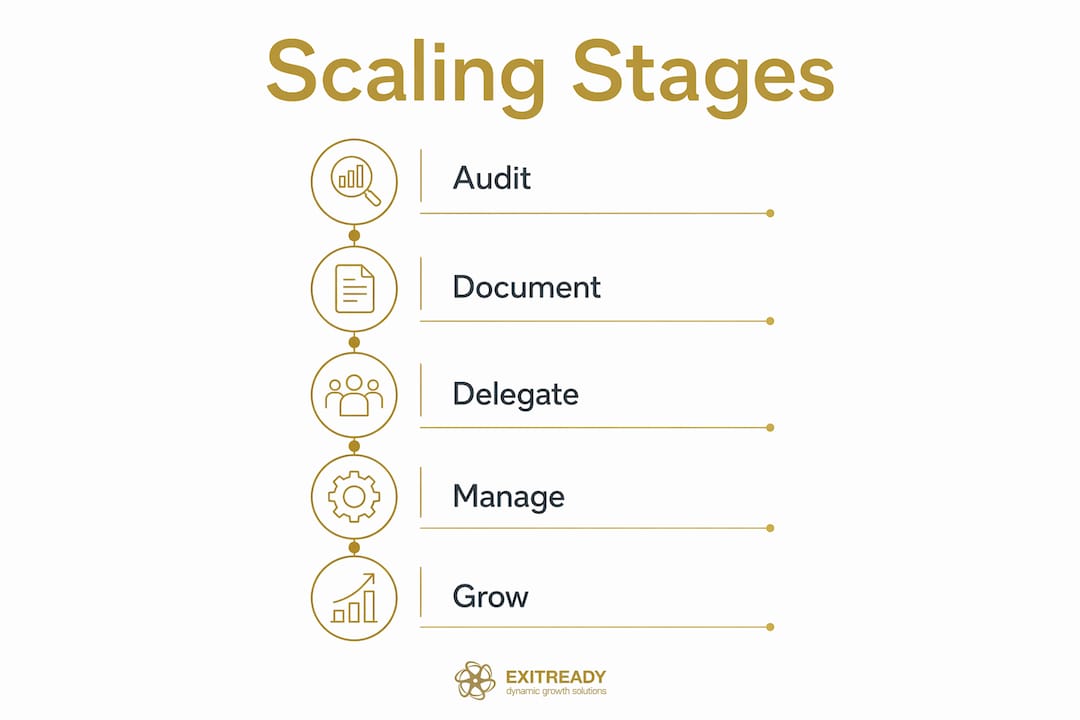
- Document every core process. Write down how each major function works, step by step, with the responsible role named. If a process only exists in your head, it cannot be handed off.
- Define decision authority at each level. Specify which decisions each role can make without escalation. This alone removes a significant portion of daily owner involvement.
- Build cascading KPIs. Connect company goals to department metrics to individual role targets. Every person should know what they are accountable for and how it connects to the bigger picture.
- Audit your role weekly. Track which tasks you personally completed. Categorize each one as “only I can do this” or “a trained team member with a clear process could do this.” Migrate the second category out of your schedule.
- Install a business operating system. A business operating system gives your company a repeatable structure for meetings, decisions, priorities, and accountability. It replaces informal coordination with a defined operating rhythm.
The comparison below shows the difference between a founder-dependent workflow and a system-centric one:
| Factor | Founder-dependent | System-centric |
|---|---|---|
| Process execution | Owner demonstrates each time | Documented playbook followed by team |
| Decision speed | Waits for owner availability | Decided at defined authority level |
| Onboarding new staff | Owner trains personally | Role-specific process guides used |
| Performance visibility | Owner checks in manually | KPI dashboards reviewed in cadence |
| Owner time in operations | High, daily involvement | Low, exception-based involvement |
Scaling a mid-market business systematically requires this kind of structural shift before adding resources. Hiring more people into a broken system produces more chaos, not more output. The scalability checklist from Dynamicgrowthsolutions gives owners a practical starting point for auditing where their current structure breaks down.
Key Takeaways
Scaling fails when businesses remain built around owner capacity rather than documented systems, and fixing that structural gap is the only reliable path to sustainable growth.
| Point | Details |
|---|---|
| Owner capacity caps growth | Founder Drift turns owners into bottlenecks that limit revenue regardless of market demand. |
| Complexity compounds without structure | Coordination friction and operational debt grow faster than informal systems can handle. |
| Mindset shapes the ceiling | Tying self-worth to metrics drives burnout; treating plateaus as build phases accelerates progress. |
| Systems replace dependency | Documented processes and defined decision authority let the business run without owner involvement. |
| Redesign before you hire | Adding people to broken processes multiplies problems; fix structure first, then scale headcount. |
What I have seen owners get wrong about scaling
After working with mid-market owners across a wide range of industries, the pattern I see most often is not a lack of ambition. It is a lack of permission. Owners do not give themselves permission to stop being the operator and start being the architect. They believe that staying involved is what keeps quality high. What it actually does is keep the ceiling low.
The most common misconception I encounter is that scaling is a hustle problem. Owners believe that if they just push harder, hire faster, or sell more, the business will break through. It rarely does. What breaks through is a business that has been deliberately redesigned so that its output is not limited by any one person’s time. That redesign is not glamorous. It is process documentation, role clarity, and decision frameworks. It is the work that feels administrative until you realize it is the only work that actually compounds.
The owners I have seen scale well share one habit: they treat their business as a product to be engineered, not a team to be managed. They ask “how does this work without me?” before they ask “how do I do this better?” That question changes everything. Sustainable scaling strategies always start with that shift in perspective, not with a new hire or a new market.
If you are feeling stuck right now, the frustration is a signal. It means your current design has reached its limit. That is not failure. It is the starting point for the next version of your business.
— Andre
How Dynamicgrowthsolutions helps owners break through scaling barriers
Dynamicgrowthsolutions works with mid-market owners who have hit the ceiling that comes with owner-dependent operations. The AOS (Accelerated Operating System) replaces informal, founder-driven workflows with documented systems, defined roles, and cascading accountability structures. Owners who apply it report reduced daily involvement in operations and measurable gains in business value. The 360-ProfitDriver analysis uncovers hidden revenue and identifies the structural gaps holding growth back. For owners ready to work on the business rather than in it, the EXITREADY CEO retreats and mastermind events provide a focused environment to build the systems and leadership approach that make scaling achievable.
FAQ
Why does scaling feel impossible for most owners?
Scaling feels impossible because most businesses are designed around the owner’s personal capacity rather than repeatable systems. When growth increases volume, the owner becomes the bottleneck and the business cannot expand beyond what one person can manage.
What is Founder Drift and why does it matter?
Founder Drift occurs when owners absorb tasks their teams should handle, turning themselves into operational bottlenecks. It creates a hard revenue ceiling that growth cannot break through without structural redesign.
How does operational debt block business growth?
Operational debt accumulates when processes go undocumented and roles stay undefined. Growth makes that debt more expensive to fix, because broken systems at scale produce more failures at higher volume and higher cost.
What is the first step to overcoming scaling obstacles?
The first step is auditing every decision and task the owner personally handles each week. Any task a trained team member could execute with a clear process should be documented and delegated immediately.
How does a business operating system help with scaling?
A business operating system replaces informal coordination with a defined structure for decisions, meetings, priorities, and accountability. It removes owner dependency by giving every role a clear process to follow without escalation.