

Add-backs are adjustments to EBITDA that remove one-time, nonoperating, or owner-specific costs to show normalized, run-rate earnings. When they are conservative and backed by documentation, they support a credible valuation. When they are aggressive or unsupported, they invite buyer skepticism and can cost you the deal price you are hoping to defend.
TL;DR:
- Adding back owner-specific expenses requires documentation proving market rates or fair market value, or else the adjustment may be challenged.
- Only include nonrecurring items like legal settlements and disaster repairs if you attach proper invoices or settlement documents demonstrating their one-time nature.
- Business operation processes and owner-related spend must be documented beforehand through standardized systems to justify add-backs and speed up due diligence.
- Aggressive or unsupported add-backs, such as reclassified recurring expenses or unsubstantiated adjustments, risk delaying sale or reducing valuation.
- Add-backs do not impact tax payable but should be carefully supported to meet SEC or buyer expectations and avoid future price disputes.
Table of Contents
- Understanding add-backs and why normalization matters
- Common add-backs owners actually get approved
- How to calculate adjusted EBITDA step by step
- Documentation that makes add-backs stick
- Why buyers push back and how the SEC views these adjustments
- Applying a structured operating system to make add-backs defensible
- Tax implications when adjusting EBITDA for add-backs
- An honest take on how far to push adjusted EBITDA
- How Dynamic Growth Solutions helps you prepare defensible numbers
- Primary sources and further reading
- Sources
- FAQ
Understanding add-backs and why normalization matters
An add-back exists to answer one question: what would this business actually earn under a normal owner, in a normal year? You start with net income, add back interest, taxes, depreciation, and amortization to get EBITDA, then layer on the adjustments that strip out anything nonoperational or one-time to reach adjusted EBITDA. According to Wall Street Prep’s normalized EBITDA guide, the sequence matters because each step isolates a different distortion, from financing decisions to accounting noncash items to discretionary owner behavior.
Normalization matters because buyers and lenders price a business off a multiple of EBITDA, and a distorted number produces a distorted valuation. Lenders underwriting debt coverage want a figure that reflects what the business will actually generate going forward, not what it earned under unusual circumstances last year.
- EBITDA answers “what did operations generate,” and add-backs answer “what will they generate going forward.”
- Adjusted EBITDA becomes the base for the valuation multiple, so every dollar you add back carries into enterprise value.
- Buyers still build a full quality of earnings picture around EBITDA because cash flow, not the adjusted number alone, is what services debt and funds growth.
Common add-backs owners actually get approved
Some add-backs sail through diligence. Others get challenged line by line. The difference usually comes down to evidence, not the category itself.
- Owner and related-party compensation. Buyers accept an add-back for excess owner salary only when you can show what a market-rate replacement would cost, using comparable job postings or compensation surveys as Wall Street Prep recommends.
- Nonrecurring items. Legal settlements, M&A advisory fees, and disaster repairs qualify when you attach the invoice or settlement document and show the expense truly will not recur.
- Personal expenses run through the business. Vehicles, travel, and life insurance premiums are addable when clearly personal and modest in scale. Large or recurring “personal” expenses draw scrutiny.
- Related-party lease adjustments. If the business pays above or below market rent to an entity the owner controls, you can normalize to fair market value with a broker opinion or comparable lease data.
- Stock-based compensation, restructuring, and impairments. Investopedia notes that treatment of these items varies widely and draws the most analyst scrutiny of any add-back category, so they need the clearest paper trail.
Pro Tip: If you cannot produce a document supporting an add-back within a day, assume a buyer’s advisor will flag it and negotiate the price down instead.
Red flags that erode credibility fast: reclassifying the same cost under two labels, adding back expenses that clearly recur annually, and adjustments with no attached evidence at all.
How to calculate adjusted EBITDA step by step
The formula itself is simple. The discipline is in what you allow through.
- Start with net income, add back interest, taxes, depreciation, and amortization to reach EBITDA.
- Layer on defensible add-backs: excess owner compensation, one-time fees, nonoperating write-downs, and documented personal expenses.
- Annualize partial-year items and remove anything that is genuinely a one-off, not a recurring cost that simply varied in size.
Say a business reports EBITDA and you identify defensible add-backs such as excess owner pay, a one-time legal settlement, and a related-party rent adjustment. Adjusted EBITDA increases accordingly. At a valuation multiple, this difference can significantly move enterprise value, which is why buyers scrutinize each line rather than accepting a lump adjustment.
A quality of earnings review typically reworks reported EBITDA once working capital and capital expenditure needs are layered in, according to Mercer Capital’s quality of earnings analysis, because a capital-intensive business converts EBITDA to cash differently than a low-capex one. See our breakdown of how exit valuation multiples work for how the multiple itself gets set.
Documentation that makes add-backs stick
An add-back without paperwork is an assertion, not an adjustment. Buyers, lenders, and their advisors expect a package, not a spreadsheet with a few extra lines.
- A management memo tying each add-back to the specific general ledger line and the source document behind it.
- Invoices, payroll reports, signed contracts, and fair market value comparables for anything related to leases or compensation.
- Job descriptions and market compensation data when the add-back involves replacing an owner’s role.
- A diligence-ready index so a buyer’s advisor can trace every adjustment back to its evidence in minutes, not days.
Businesses that assemble this before going to market tend to move faster through diligence, since Wall Street Prep points out that well-packaged adjustments reduce price disputes precisely because the buyer’s team spends less time chasing down support. For a structured approach to building the document room itself, see our exit-ready documentation playbook.
Why buyers push back and how the SEC views these adjustments
Aggressive add-backs backfire in two ways: they slow diligence while advisors verify every claim, and they signal that the seller’s numbers need extra scrutiny elsewhere too. Double-counting the same cost across categories or relabeling a recurring expense as one-time are the fastest ways to lose credibility.
For public companies, the SEC’s Regulation G and Item 10(e) of Regulation S-K require that non-GAAP measures like adjusted EBITDA be reconciled to the nearest GAAP figure and presented without giving the adjusted number undue prominence. The rules also caution against excluding charges likely to recur within two years without clear disclosure. Private company sellers are not bound by SEC rules, but buyers and their advisors often apply the same reconciliation discipline in diligence anyway.
- Keep every add-back conservative and reconciled line by line to the GAAP starting point.
- Benchmark owner compensation and lease terms against independent market data, not internal estimates.
Pro Tip: Prepare your adjustment schedule as if a skeptical buyer’s advisor will read it first, because they usually do.
Applying a structured operating system to make add-backs defensible
Documentation problems are usually operations problems in disguise. A business run without documented processes rarely has the payroll detail, contracts, or expense mapping an add-back needs.
An operating system like AOS standardizes how costs get tracked and categorized before diligence ever starts, which is what turns a scattered expense list into a defensible schedule. A ProfitDriver Analysis™ builds on that by producing prioritized cost schedules, mapping owner-related spend against market benchmarks, and assembling the evidence packs buyers expect to see.
- Standardized cost tracking that separates operational spend from owner-discretionary spend as it happens, not after a sale is announced.
- A forensic map of owner compensation and personal expenses run through the business, benchmarked against replacement cost.
- A prebuilt evidence index (job descriptions, payroll data, contracts) ready before a buyer’s advisor asks for it.
Owners preparing for a sale can pair this with an exit readiness assessment to see where documentation gaps still exist.
Tax implications when adjusting EBITDA for add-backs
Add-backs change how a business looks to a buyer, but they do not change what the business actually paid in taxes. Adjusted EBITDA is a valuation and analytical construct, not a tax filing figure, and the IRS does not recognize it as a basis for anything.
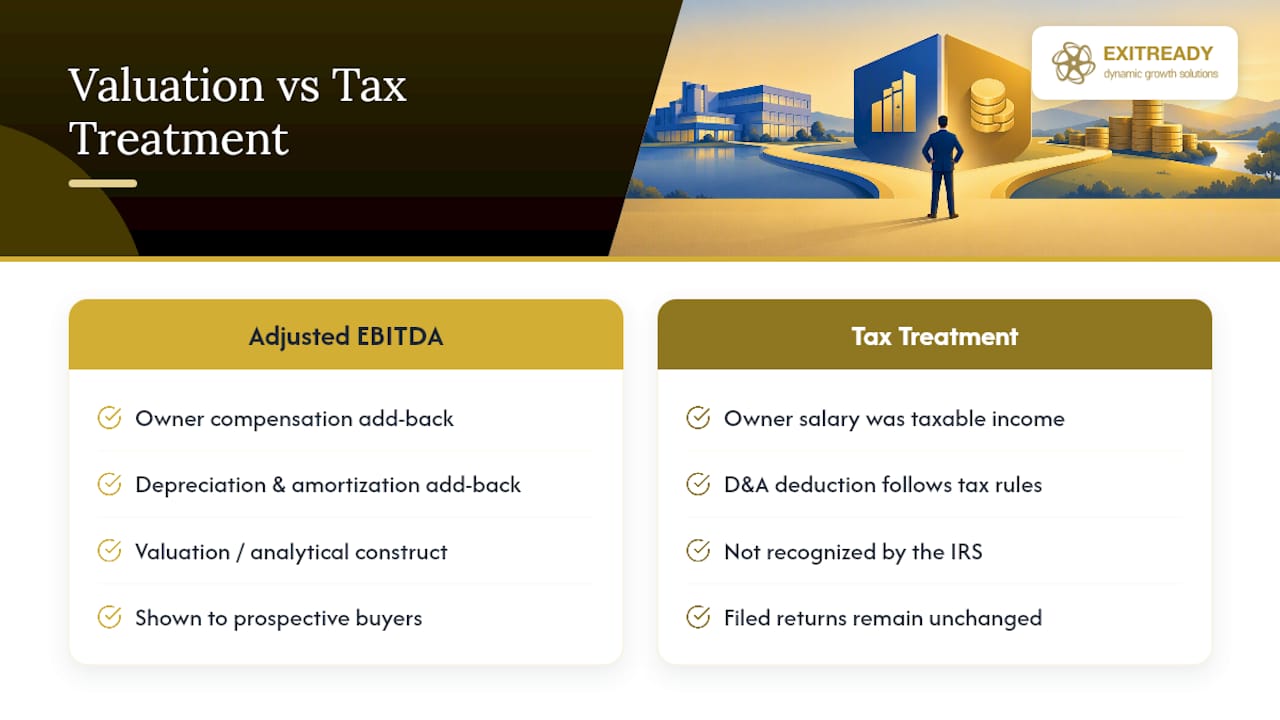
That distinction matters in a few practical ways. If you add back owner compensation as “excess” for valuation purposes, that salary was still taxable income to the owner and a deductible expense to the business in the year it was paid. Reclassifying it for a buyer’s benefit does not trigger an amended return or change prior tax treatment.
Depreciation and amortization add-backs deserve particular care, since accelerated methods like bonus depreciation can shrink taxable income sharply in the year an asset is placed in service, which shows up as a larger D&A add-back than a straight-line method would produce. Owners weighing how bonus depreciation timing affects their reported numbers should review current bonus depreciation rules before finalizing a schedule, since the timing of the deduction can shift both the tax bill and the add-back size year to year.
A buyer’s tax advisor will also look at whether add-backs create a mismatch between the adjusted EBITDA presented and the tax returns filed, since large unexplained gaps between the two often prompt deeper diligence questions.
An honest take on how far to push adjusted EBITDA
The instinct to maximize every possible add-back is understandable and usually counterproductive. Buyers discount aggressive schedules faster than they discount modest EBITDA, because an unreliable number costs more in negotiation than a lower but trusted one.
A five-step check for the next 30 to 90 days:
- Pull every add-back from the last two years and attach a source document to each one.
- Benchmark owner compensation against real market data, not a guess.
- Remove any adjustment you could not defend to a skeptical stranger.
- Build a one-page reconciliation from net income to adjusted EBITDA.
- Review related-party leases and contracts for fair market value gaps.
— Andre
How Dynamic Growth Solutions helps you prepare defensible numbers
Building a diligence-ready EBITDA schedule takes more than a spreadsheet exercise, it takes systems that generate the evidence automatically. Our ProfitDriver Analysis™ maps owner-related spend and cost drivers against market benchmarks, while AOS documents the operational playbooks that replace guesswork with a governance trail buyers can verify quickly.

- ProfitDriver Analysis identifies and prioritizes cost schedules tied to real operating data.
- AOS standardizes documentation so add-backs are supported before a buyer ever asks.
- The result is a diligence-ready evidence pack and a governance playbook, not a last-minute scramble.
| Service | What it produces |
|---|---|
| ProfitDriver Analysis™ | Prioritized cost schedules and owner-spend mapping |
| AOS Value Creation Partnership | Documented playbooks and ongoing cost governance |
If you want a structured review of where your numbers stand before a sale process starts, start with our Growth Readiness Score Card.
Primary sources and further reading
- SEC final rule on non-GAAP measures, including Regulation G and Item 10(e) requirements.
- SEC Financial Reporting Manual, Topic 8 on non-GAAP disclosure.
- Mercer Capital’s quality of earnings deck and Wall Street Prep’s normalized EBITDA guide.
Sources
- Final Rule: Conditions for Use of Non-GAAP Financial Measures (SEC)
- Quality of Earnings Analysis (Mercer Capital)
- Normalized EBITDA | Formula + Calculator (Wall Street Prep)
- Adjusted EBITDA (Investopedia)
FAQ
What does “add-backs” mean?
Add-backs are adjustments made to a company’s reported earnings, typically EBITDA, to remove one-time, nonoperating, or owner-specific costs. The goal is to show what the business would earn under normal, ongoing operations rather than under unusual circumstances from a particular year.
What are some examples of add-backs?
Common examples include excess owner compensation above market rate, one-time legal settlements or M&A fees, personal expenses like vehicles or travel run through the business, and related-party rent adjusted to fair market value. Each one needs supporting documentation such as invoices, contracts, or compensation benchmarks to hold up in diligence.
What is an addback in finance?
In finance, an addback is any expense removed from reported earnings because it does not reflect the ongoing, normal cost of running the business. Analysts and buyers use addbacks to move from reported EBITDA to adjusted EBITDA, which becomes the base figure for a valuation multiple.
Should you add back stock-based compensation to EBITDA?
Treatment of stock-based compensation varies and draws close scrutiny from buyers and analysts, according to Investopedia’s overview of adjusted EBITDA. Some buyers accept the add-back for noncash treatment, while others view it as a real cost of retaining talent and resist removing it entirely, so it should be documented and disclosed rather than assumed.
One Response