

You improve your cash conversion cycle (CCC) by pulling three levers: collect from customers sooner (lower days sales outstanding), turn inventory faster (lower days inventory outstanding) and pay suppliers on a deliberate schedule (higher days payable outstanding). The formula is CCC = DSO + DIO − DPO, and every day you remove frees cash that is currently sitting in your operations. For an owner planning a sale, it also does something less obvious: it lowers the working capital a buyer will ask you to leave in the business.
This guide shows where mid-market companies usually stand, how to find the days worth chasing, and how to make the gains stick without you personally chasing invoices.
TL;DR
- CCC = DSO + DIO − DPO. Lowering it releases cash without new debt or new sales.
- Receivables are usually the fastest lever: same-day invoicing and automated reminders are the two moves with the best published evidence.
- Inventory and supplier terms take longer, but they often hold the biggest dollar amounts.
- A shorter, steadier cycle lowers the working capital target in a sale and is rewarded by buyers.
- Gains fade unless the process is documented and owned by someone other than you.
Table of Contents
- What the cash conversion cycle measures
- What a good cash conversion cycle looks like
- Step one: find your real numbers
- A worked example
- Lever one: collect faster (DSO)
- Lever two: turn inventory faster (DIO)
- Lever three: manage payables deliberately (DPO)
- Why buyers care about your cycle
- Making the gains last
- Our perspective: the cycle is an ownership problem
- Where we can help
- FAQ
- Sources
What the cash conversion cycle measures
The cash conversion cycle tells you how many days cash is tied up between paying for inputs and getting paid by the customer. J.P. Morgan describes it as a measure of cash flow efficiency: how long cash is locked in operations before it can be reinvested. It names the same three levers as above: inventory holding time, receivables and payables.
The three components:
- DSO (days sales outstanding): average days from invoice to payment.
- DIO (days inventory outstanding): average days inventory sits before it is sold.
- DPO (days payable outstanding): average days you take to pay suppliers.
A service business with no inventory has a two-part cycle: DSO minus DPO. A distributor or manufacturer runs all three. A lower number is generally better, but a negative CCC is not a goal for every company. It is common where customers pay at the point of sale and suppliers extend long terms.
What a good cash conversion cycle looks like
There is no single good number. It depends on your industry, your customers’ payment habits and your inventory model. Still, benchmarks help you decide whether you have a problem.
- One 2025 benchmark report puts the median U.S. small business CCC at about 42 days. It adds that e-commerce often sits near or below zero, while construction and professional services frequently run past 70 to 90 days because clients pay late. That report also cites top-performing firms reaching DSO of 30 days or less.
- Among large companies, the picture is mixed. J.P. Morgan’s 2024 Working Capital Index reported that the CCC for S&P 1500 companies rose by 2.4 days in 2023, with most firms reporting longer DSO.
- A 2026 roundup of receivables data notes that the top 1,000 firms improved their CCC by 4% to 37 days and that the gap between top and median DSO is 18 days.
The practical read: compare yourself to your own industry peers and, more importantly, to your own trend over the last eight quarters. A cycle that is creeping up by a few days a quarter is a warning even if the absolute level looks fine.
Step one: find your real numbers
Most owners know their revenue and margin to the dollar and their DSO only roughly. Spend a morning on this before you change anything.
- Pull trailing twelve-month figures for revenue, cost of goods sold, average receivables, average inventory and average payables.
- Calculate each component and the total. Use the same method every period so the trend means something.
- Segment DSO by customer. Averages hide the five customers who pay 40 days late and drag the rest.
- Age your receivables into current, 31 to 60, 61 to 90 and 90-plus buckets. The over-60 bucket is where the cash is stuck.
- Convert days to dollars. One day of DSO equals annual revenue divided by 365. One day of DIO or DPO is annual cost of goods sold divided by 365.
That last step is what gets leadership’s attention. “Cut DSO by eight days” is abstract. “Release $438,000” is a project.
A worked example
The numbers below are illustrative, not a client result. Take a hypothetical distributor with $20 million in revenue and $13 million in cost of goods sold.
| Component | Today | Target | Change | Cash effect |
|---|---|---|---|---|
| DSO | 52 days | 44 days | −8 | about $438,000 (8 × $54,795 daily revenue) |
| DIO | 60 days | 50 days | −10 | about $356,000 (10 × $35,616 daily COGS) |
| DPO | 35 days | 42 days | +7 | about $249,000 (7 × $35,616 daily COGS) |
| CCC | 77 days | 52 days | −25 | about $1.04 million |
Those targets are modest on purpose. An operating-partner playbook for private equity sets similar goals for a first year: roughly eight days off DSO through collections automation, ten off DIO through demand forecasting and several added to DPO. Treat them as a starting range, then test against your customers and suppliers.
Lever one: collect faster (DSO)
Receivables are where most mid-market companies should start. The changes are internal, they cost little, and they do not depend on a supplier agreeing to anything.
Invoice the day the work is done
Every day an invoice sits unsent is a day added to DSO before the customer even sees a due date. The benchmark report cited above attributes an average 12-day DSO reduction to same-day e-invoicing. That is a vendor-published figure, so treat it as directional, but the logic is sound: you cannot be paid for an invoice that has not been sent.
Tie invoicing to an operational trigger (shipment confirmed, milestone signed off, timesheet approved) rather than to a month-end batch.
Automate reminders and escalation
The same report credits automated payment reminder workflows with about 8 fewer DSO days than manual follow-up. A simple cadence works: a reminder a few days before the due date, one on the due date, then escalating contacts at 7, 15 and 30 days past due, with a named person at your company for each step.
Fix terms at the source
- Shorten standard terms for new customers, for example from net 45 to net 30.
- Offer a small early-payment discount only where its cost is lower than the cost of the cash it frees.
- Require deposits or progress billing on long projects. This is the single biggest fix in construction and professional services, where cycles run longest.
- Collect tax and payment details at onboarding. If you also pay contractors, getting a W-9 up front avoids payment holds later, and this guide to automating W-9 collection and TIN matching walks through how to do it before IRS notices become a problem.
- Write credit limits down and give someone the authority to pause shipments on a customer who is past due.
Lever two: turn inventory faster (DIO)
Inventory is the slowest lever and often the largest. Capital sits on shelves for months, and the fixes touch sales, purchasing and operations at once.
What tends to work:
- Forecast demand by SKU, not by category. Aggregate forecasts hide slow movers.
- Rationalize the long tail. In one published CPG working-capital playbook, a 12-month target cut DIO by 34 days through SKU rationalization and smaller purchase orders.
- Buy smaller, more often, where suppliers’ minimums and freight allow it.
- Set reorder points from actual lead times, and review them quarterly.
- Liquidate dead stock on a schedule. Cash recovered at a discount today beats a write-off in two years.
Be careful about stockouts. Cutting inventory below what your service level requires costs you sales, and that defeats the point.
Lever three: manage payables deliberately (DPO)
Stretching suppliers is the lever most likely to backfire. Paying late without telling anyone damages relationships, can cost you early-pay discounts and may raise prices or tighten terms next year.
Better approaches:
- Renegotiate terms with your largest suppliers in exchange for volume commitments or forecast visibility.
- Pay on the due date, not before it. Many companies pay early by habit, which hands away free float.
- Use payment tools such as purchasing cards where the rebate and the extra weeks of float outweigh any surcharge.
- Compare discounts to cost of capital. A 2% discount for paying 20 days early is worth taking if your financing costs are lower than the equivalent annualized rate.
The goal is a predictable schedule your suppliers can plan around, not the longest possible one.
Why buyers care about your cycle
If an exit is on your horizon, the cash conversion cycle matters twice. First, the cash you release is yours. Second, working capital shapes what you receive at closing.
In most deals, the buyer and seller agree on a working capital target, often called the peg. If the business delivers less than the target at closing, the price drops dollar for dollar. A long, volatile cycle means a higher target and more of your cash trapped in the business. We cover how this plays out in our guide to the working capital peg, and our working capital adjustment checklist lists the line items that most often cause disputes.
There is also a valuation effect. A Stratford Analytics paper reports that a 10-day reduction in the cash conversion cycle correlates with an average 0.15x lift in the MVIC/Sales multiple. It is a correlation across a data set, not a promise for your company, but it matches what buyers say: predictable cash conversion lowers their risk.
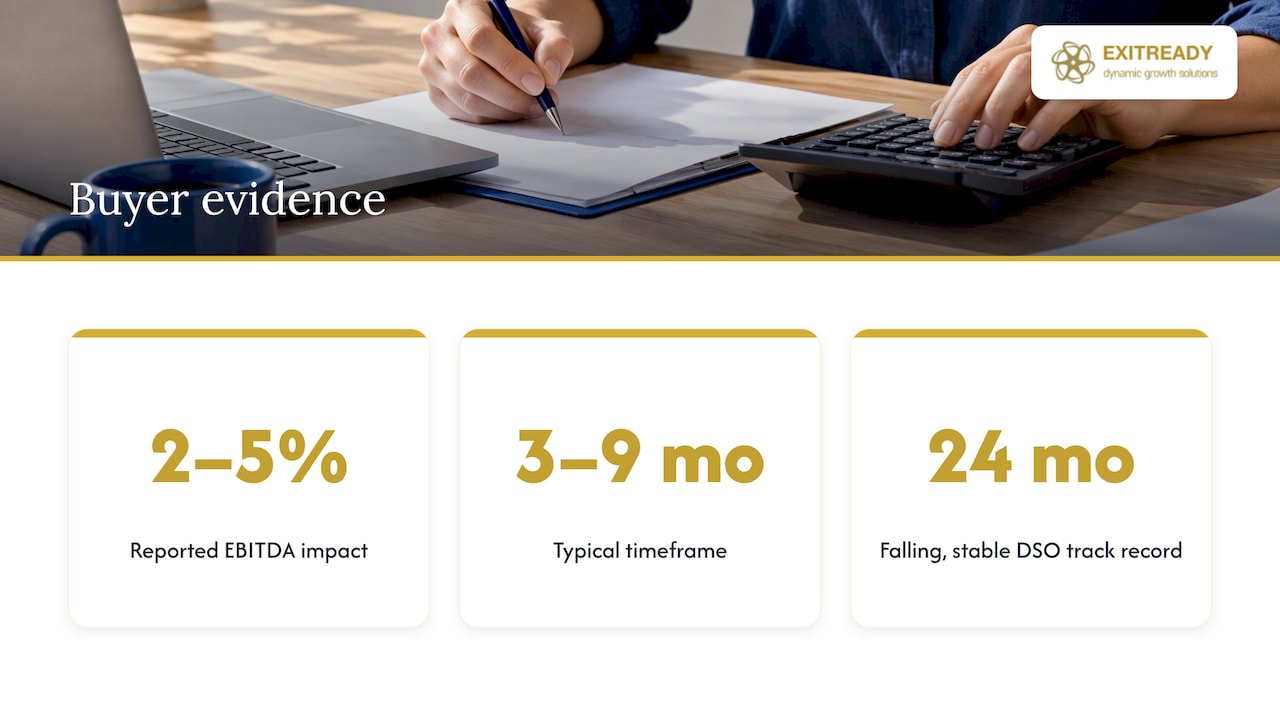
Operational improvements of this kind also show up in earnings. Research on private equity operations attributes a 2 to 5% EBITDA impact to accelerated cash conversion, typically within 3 to 9 months. Give a buyer’s team 24 months of falling, stable DSO and they will treat it as a quality-of-earnings positive rather than a one-quarter trick. Be careful with one thing: a sudden collections push or delayed supplier payments right before closing is something diligence teams look for and reverse.
Making the gains last
The most common failure is not a bad plan. It is a good plan that depends on one person, usually the owner, remembering to follow up. Six months later invoices go out late again.
Three habits prevent that:
- Document the process. Who sends the invoice, when, and what happens at day 7, 15 and 30 past due. Write it as a playbook anyone can follow.
- Assign owners and a weekly metric. DSO, aging over 60 days, inventory turns and DPO belong on one dashboard that someone other than you reviews every week.
- Tie it to incentives. Sales teams who close on poor terms create the receivables problem. Include collected cash, not just booked revenue, in the way you measure them.
Our pieces on why operational efficiency drives profit and implementing Fortune 500 processes in a smaller company go deeper on building this discipline.
Our perspective: the cycle is an ownership problem
When owners ask us about cash conversion, they usually ask about software or terms. We start somewhere else: who owns each day of the cycle?
In the mid-market companies we see, invoices go out late because the person who knows the job is complete is not the person who bills. Inventory drifts up because purchasing is rewarded for discounts, not turns. Payables are paid whenever the controller gets to them. None of this is a tools problem. It is a symptom of a business that runs on the owner’s memory and judgment.
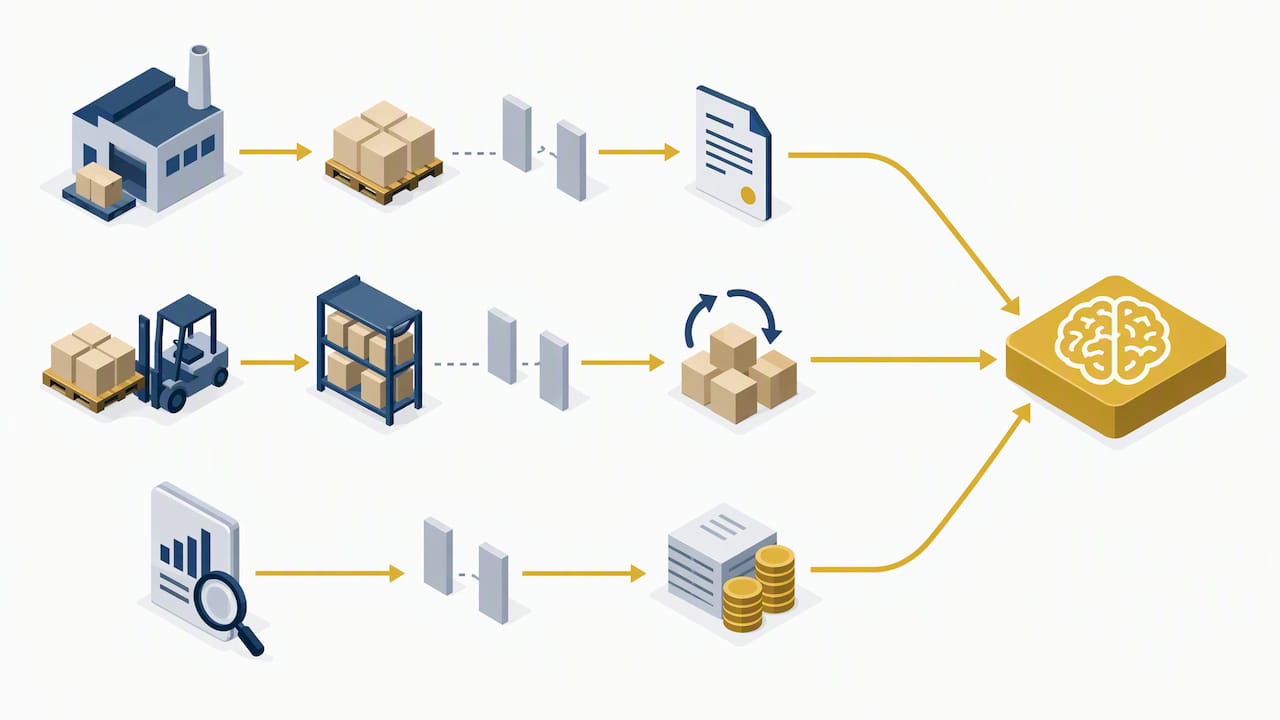
That is why we begin with a diagnostic before we propose anything. We want to see where the days actually sit, by customer, by product line, by step in the process, before recommending a fix. A generic list of best practices does not tell you that three customers account for most of your overdue balance, or that your slowest step is an approval nobody remembers adding.
Then we document. A collections cadence written down, with named owners and a weekly number, keeps working when the owner is on vacation or, eventually, gone. That independence is what buyers pay for. A cycle that improves only while the owner is watching is not an improvement a buyer will credit.
— Andre
Where we can help
If you want an outside diagnostic of where your cash is stuck and a documented plan to free it, we can help. Our Sprint programs are fixed-scope engagements: the Growth Sprint is $7,500 to $10,000 one-off, and the Performance Sprint is $15,000 to $20,000 one-off. For a broader look at readiness for a sale, start with the Growth Readiness Score Card or schedule a strategy call.
FAQ
How many days is a good cash conversion cycle?
It depends on your industry. A reported median for U.S. small businesses is about 42 days, but e-commerce can be near or below zero and construction or professional services often run 70 to 90 days or more. Benchmark yourself against peers in your sector and against your own trend.
Is a lower cash conversion cycle always better?
Usually, but not at any cost. Cutting inventory too far causes stockouts, and squeezing suppliers can raise your prices or damage relationships. Aim for a shorter, steadier cycle that your customers and suppliers can live with.
Which lever should I pull first?
Start with receivables. Faster invoicing and automated reminders are inside your control, cost little and show results in a few weeks. Inventory and supplier terms take longer and need more coordination.
How long does it take to see results?
Invoicing and collections changes often move DSO within a quarter. One benchmark report suggests operational interventions yield measurable results in 6 to 12 months, with inventory changes at the slower end.
Sources
- Understanding & Optimizing Your Cash Conversion Cycle, J.P. Morgan
- Small Business Cash Conversion Cycle Benchmarks 2026
- Increasing Efficiency: Working Capital Index 2024, J.P. Morgan
- 30+ Accounts Receivable Statistics for 2026, Billed
- Net Operating Working Capital: PE Guide + Formula, Uplevered
- Working Capital Management for Scaling CPG Brands
- Working Capital Tighteners That Buyers Reward, Stratford Analytics
- Private Equity Operational Alpha in 2025