

Pricing power is a company’s ability to raise prices without losing the customers who matter most, because they perceive the offer as worth more than its cost. Businesses with real pricing power protect their margins during inflation, competitive pressure, or demand shifts, and they raise prices sustainably instead of discounting to win deals. This article breaks down what drives it, how to measure it, and a practical roadmap you can test over the next six to twelve months.
TL;DR:
- Pricing power depends on meaningful customer differentiation and is segment-specific, not just market-wide elasticity.
- Measuring pricing power involves tracking price realization, margin gaps, discount leakage, and retention after price changes.
- Strengthening pricing power requires value-based pricing, customer segmentation, creating switching costs, and aligning sales incentives with margin.
- Building ongoing pricing discipline involves segment tests, regular reviews, and embedding pricing rules into sales processes.
- Improving pricing power by each point can support roughly a four-point increase in relative price without increasing churn.
Table of Contents
- What pricing power means and why it’s often misunderstood
- Factors that influence pricing power
- How pricing power differs from price elasticity
- How to measure pricing power in practice
- Benefits of stronger pricing power
- A prioritized playbook to build pricing power
- Operationalizing pricing power: a roadmap for mid-market leaders
- Pricing power as a value-creation lever for owners
- How Dynamic Growth Solutions helps you capture pricing power
- Sources
- FAQ
What pricing power means and why it’s often misunderstood
Pricing power comes from meeting a customer need, functional or emotional, better than the alternatives do. It is not the same as charging whatever the market will bear or exploiting a captive buyer. A company with genuine pricing power earns higher prices because customers perceive a meaningful difference, not because they lack a choice.
A few things pricing power is not:
- An excuse for arbitrary premium pricing with no underlying value story.
- The same thing everywhere in your business: it varies by segment, product line, and stage of the customer lifecycle.
- Permanent once achieved: a strong renewal segment can still have weak pricing power at the acquisition stage.
Getting this baseline right matters before you touch a single price. Without it, price increases read as opportunistic rather than earned, and customers respond accordingly.
Factors that influence pricing power
Several levers determine how much pricing power a business actually has, and most of them are within a leadership team’s control.
- Brand equity: a brand perceived as meaningfully different can support higher relative prices without triggering churn.
- Differentiation and scarcity: a product or service with few substitutes, or a limited supply, naturally commands stronger pricing.
- Switching costs and customer experience: integrations, data lock-in, and strong service relationships make customers less price-sensitive.
- Segmentation and price architecture: charging different segments differently, by tier or usage, captures more value than one flat price.
- Regulatory or supply-side constraints: licensing, patents, or limited supplier access can restrict competitors and support pricing.
Pro Tip: Map each lever against your top three customer segments before deciding which one to invest in first: differentiation efforts aimed at the wrong segment rarely move pricing at all.
How pricing power differs from price elasticity
Price elasticity measures how much demand changes when price changes, typically expressed as the percentage change in quantity demanded per percentage change in price. Pricing power is not the inverse of elasticity across your whole market: it is low elasticity within a specific, well-defined segment. A company can have weak pricing power with price-shopping buyers and strong pricing power with buyers who value a specific integration or outcome.
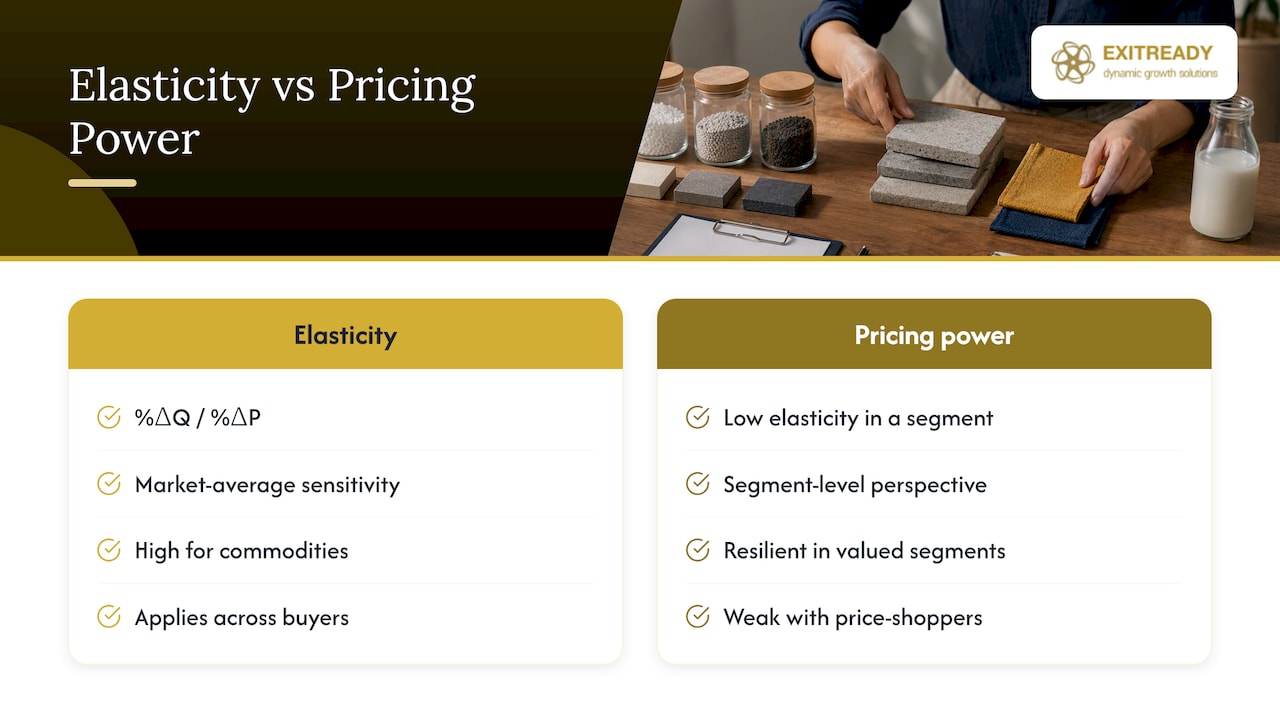
A commodity supplier competing purely on price faces high elasticity almost everywhere: raise the price and volume drops fast. A vendor with a differentiated, hard-to-replace offer can raise prices in the segment that values that difference while leaving commodity-minded buyers to shop elsewhere. Confusing average market elasticity with segment-level pricing power is one of the most common mistakes in pricing decisions.
How to measure pricing power in practice
You do not need a data science team to start measuring this. A handful of metrics and light tests, run consistently, reveal where pricing power actually sits in your business.
- Track price realization: the gap between list price and what customers actually pay after discounts.
- Review margin by segment: not just by product line, since the same product can carry very different margins across customer types.
- Watch discount leakage: how often and how deeply sales teams discount to close deals.
- Monitor churn after price moves: a small, targeted price increase followed by stable retention is a strong pricing power signal.
- Run structured win/loss analysis: consistently asking buyers why a deal was won or lost, rather than asking about price directly, is an underused way to build empirical willingness-to-pay data over time.
Pair these with small A/B price tests or pilots in a single segment before rolling any change out broadly. A customer profitability analysis that breaks margin down by customer, not just by product, usually surfaces the clearest signal of where pricing power already exists.
Benefits of stronger pricing power
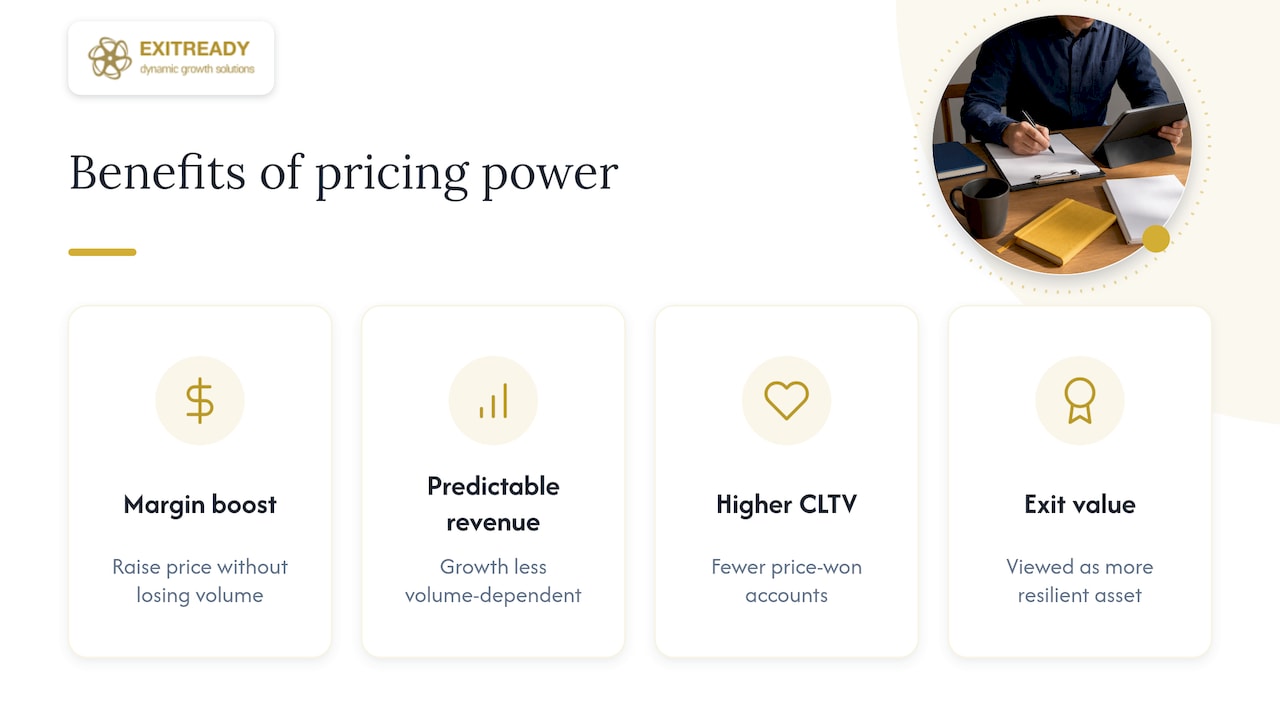
The payoff for building pricing power shows up across the income statement, not just in the price list. Margin protection is the most direct effect: a business that can raise prices without losing volume improves operating profit faster than cost cutting typically allows. Revenue also becomes more predictable, since growth no longer depends entirely on adding new volume in a competitive market.
Stronger pricing power reduces reliance on discounting, which compounds over time into better customer lifetime value, since fewer accounts are won on price alone and more are won on fit. For owners planning an eventual sale, this matters even more directly: a business with demonstrated pricing power, rather than volume-dependent growth, tends to be viewed as a more resilient asset by buyers evaluating exit multiples.
A prioritized playbook to build pricing power
Building pricing power is a sequence, not a single initiative. This order works for most mid-market businesses starting from scratch.
- Adopt value-based pricing: quantify the economic value your offer creates for a customer, in dollars or hours saved, and set price as a defensible share of that value rather than a markup on cost.
- Segment customers and choose a price architecture: decide where tiering, usage-based pricing, or outcome-based pricing fits your buyers best, since one architecture rarely fits every segment.
- Invest in meaningful difference: product features, service levels, and how you communicate value all shape whether customers see your price as justified.
- Create switching costs: SLAs, integrations, and shared data with customers increase retention and reduce price sensitivity over time.
- Enable your sales team: give reps value calculators and deal-scoring tools, and align compensation to margin rather than raw deal volume.
- Build testing and governance: pilot changes in one segment, define an approval workflow for exceptions, and set a regular cadence for pricing review.
A few notes worth keeping in mind as you work through this list:
- Start in the single segment where you create the most economic value, then expand outward, instead of rolling out a big-bang change.
- Update your value story, a case study or a before-and-after metric, before any price increase so customers perceive the value shift first.
Sales enablement is often the step that gets skipped, and it is also where most value-based pricing programs quietly fail. Value-based pricing implementations often fall short at the sales handoff: companies frequently realize only part of a planned price increase because discounting and deal practices at the point of sale leak margin back out. Equipping reps with value calculators and tying compensation to margin, not just closed volume, is one of the more reliable fixes. Separately, empirical research on B2B pricing finds that investing in value quantification capability and sales negotiation training meaningfully increases the profitability impact of a value-based pricing program.
Pro Tip: Run your first price test on renewal customers with strong usage data before touching new-logo pricing: the retention signal tells you far more than a new-customer conversion rate does.
Operationalizing pricing power: a roadmap for mid-market leaders
Turning this into an operating routine, rather than a one-time project, is what separates businesses that sustain pricing gains from those that see them erode within a year.
- Start with a diagnostic: identify your top 20% of customers by revenue and run a structured win/loss review to find where willingness to pay is highest.
- Build a minimum viable value model using three quantified value drivers, then pilot a price change in one segment over the next six to twelve months.
- Embed pricing rules directly into sales workflows: deal scoring, discount approval thresholds, and margin visibility at the point of quote.
- Set a quarterly pricing review with a cross-functional team so pricing decisions don’t default back to whoever discounts fastest.
Each additional point of pricing power lets a brand support roughly a four-point increase in relative price without triggering churn to cheaper alternatives. That is the kind of margin cushion a documented diagnostic process, like a ProfitDriver review, is built to uncover before you commit to a price change.
Pricing power as a value-creation lever for owners
Most mid-market owners treat pricing as a once-a-year exercise instead of a system, and it shows up directly in exit valuations later. The usual mistake is raising prices without first rebuilding the value story, which invites churn instead of margin. The fix is fast: run a short diagnostic on your top customers and win/loss patterns before you touch a single number.
— Andre
How Dynamic Growth Solutions helps you capture pricing power
Turning a pricing insight into a repeatable margin gain is where most owners run out of time, not ideas. Our ProfitDriver Analysis™ diagnostic identifies where your price realization is leaking and which customer segments already show strong willingness to pay. From there, the AOS Value Creation Partnership embeds pricing governance, approval thresholds, and review cadence directly into how your business runs, so gains don’t quietly erode after quarter one.
If you want a faster, structured starting point, the Growth Sprint, Performance Sprint, or Enterprise Sprint programs pair a diagnostic with hands-on execution over a fixed engagement. Explore the Sprint programs to see which fits your current stage.
Sources
FAQ
Does the .99 pricing trick actually work?
Charm pricing is a psychological tactic distinct from pricing power, which depends on perceived value rather than price presentation. It can influence perception at the point of sale, but it does not substitute for the differentiation and value quantification that sustain higher prices over time.
What are the 5 C’s of pricing?
Definitions vary across sources, but a common version includes cost, customers, competition, channels, and context as the factors shaping a pricing decision. These act as a checklist rather than a formula, and pricing power itself depends more on customer perception than on any single “C.”
What are the main pricing strategies businesses use?
Common approaches include cost-plus pricing, competition-based pricing, penetration pricing, premium pricing, value-based pricing, and usage-based or tiered pricing. The right choice depends on product economics, customer segments, and how differentiated the offer is, which is why most pricing power strategies rely on more than one model across a portfolio.
Can you give an example of pricing power?
A brand with strong, meaningfully differentiated positioning can raise its relative price without customers switching to cheaper alternatives, an effect Kantar’s brand research ties directly to measured pricing power scores. A software vendor with deep product integrations and switching costs shows the same pattern: renewal pricing holds even as new-customer pricing faces more competition.
How is pricing power different from having a monopoly?
Pricing power comes from customers choosing to pay more because they perceive real value, while a monopoly comes from having no competing alternative available at all. A business can lose pricing power the moment its value story weakens, even without a new competitor entering the market.