

The right business playbook structure has seven layers: company overview, operating model and capabilities, process landscape, team playbooks, an SOP index, tools and templates, and a governance layer. That last layer is where most playbooks fail. Assign one named owner per process group, anchor a RACI matrix to your process maps, set a review cadence, and track maturity from ad hoc to optimize. Get this right and a mid-market company runs on documented systems instead of the owner’s memory.
TL;DR:
- Most playbooks fail at the governance layer without assigning one owner per process group, setting review cadences, and tracking maturity from ad hoc to optimized.
- Clear structure includes a company profile, operating model, responsibilities, process landscape, SOP index, tools, and KPIs, linked through a consistent page template.
- Owners should be role-based, authority-empowered, with RACI matrices built around roles, not individuals, and reviewed periodically based on process risk and change frequency.
- A practical 90-day rollout starts with mapping critical processes, assigning owners, reviewing, and then expanding to less risky areas; starting small ensures better adoption.
- Regular KPI tracking, quarterly audits, and disciplined review cycles prevent playbooks from becoming outdated, supporting operational scaling and investor diligence.
Table of Contents
- What Is a Business Playbook, and Why Does Its Structure Matter?
- What Are the Core Components of a Business Playbook?
- Playbook vs. Process Documents vs. SOPs: What’s the Difference?
- What’s a Practical Business Playbook Template You Can Use Today?
- How Do You Assign Owners and Build a RACI That Actually Works?
- What’s a Realistic 90-Day Rollout for a New Playbook?
- How Do You Know If Your Playbook Is Actually Working?
- How Does Dynamicgrowthsolutions Apply This Structure Through AOS?
- Where Most Playbooks Break, and What to Fix First
- How Dynamicgrowthsolutions Can Build This With You
- Sources
- FAQ
What Is a Business Playbook, and Why Does Its Structure Matter?
A business playbook is the coordination document that tells someone who does what, when, and how a decision gets made. It sits above process documents and SOPs, and it exists for two distinct users: leadership, who needs the company playbook to see priorities and org design, and frontline teams, who need team playbooks to run their function without asking the owner every time.
Mid-market firms lean on playbooks for four jobs in particular:
- Onboarding new hires without a month of shadowing.
- Delegating decisions the owner currently makes alone.
- Coordinating handoffs between sales, operations, and finance.
- Surviving buyer or investor diligence, where undocumented processes read as risk.
Structure is the difference between a playbook that gets used and one that gets built once and forgotten. A playbook without a consistent structure turns into a junk drawer of screenshots and Slack links, and nobody can find what they need under pressure. It also gets confused with two things it is not: a business plan (which is forward-looking and financial) and an SOP (which is a single task, executed step by step). Keep those distinctions clear from page one, or the whole document collapses into an unmaintainable mess within two quarters.
What Are the Core Components of a Business Playbook?
Every credible business playbook example, regardless of industry, converges on the same skeleton. The HubSpot business playbook framework and most operations-focused templates agree on these components, even when the labels differ slightly:
- Company profile. Vision, mission, strategic priorities, and the handful of target metrics leadership actually watches.
- Operating model and capability architecture. The repeatable capabilities the business must execute well, distinct from a one-time strategic initiative.
- Organizational responsibilities. Not just an org chart. A decision-rights map showing who can approve what, at what dollar or risk threshold.
- Process landscape. Top-level (L0) and process-group (L1) groupings, each linking down to the actual process documents.
- SOP index. A catalog of task-level, repeatable procedures, indexed by process group so they’re findable, not buried.
- Tools and templates. The software, spreadsheets, and artifacts each function actually touches day to day.
- KPI hierarchy and decision forums. Which metrics roll up to which meeting, and who’s in the room when a number goes red.
Clear operating model design across governance, capability architecture, and operating rhythm is what turns strategy into repeatable execution. Skip that layer and you get a document full of good intentions that nobody can act on, because structure without governance just produces interpretation. Every team fills the gaps differently, and within a year you have five versions of “how we do sales” floating around in five heads.
Playbook vs. Process Documents vs. SOPs: What’s the Difference?
This is the question that trips up almost every leader building their first playbook, and it’s also one of the most searched. The short answer: a playbook answers who and what, a process document answers how the work flows, and an SOP answers exactly how to do one step, right now.
A playbook is coordination documentation. It tells a new sales manager which process group they own and who they report to. A process document maps the actual flow between functions, including the handoffs where things usually break. An SOP, sometimes called a runbook in technical contexts, contains the granular commands, screenshots, and click-by-click instructions a specific task requires. That runbook-versus-playbook distinction matters because conflating them is the single most common structural mistake in this space.
The fix is a linking discipline, not a merging discipline:
- Keep SOPs out of the playbook body. Link to them instead of pasting them in.
- Give every playbook page a link map field pointing to its related process docs and SOPs.
- Reserve full SOPs for tasks that are repeatable, high risk, or done by someone new to the role.
- Write SOPs with one action per step, and use screenshots or diagrams for anything with more than five steps.
Pro Tip: If a page in your playbook is longer than two screens of scrolling, it’s probably an SOP wearing a playbook’s clothes. Split it and link it instead.
For teams that want a deeper walkthrough on the SOP layer specifically, Dynamicgrowthsolutions’ guide to building SOPs covers the step-level mechanics this section only sketches.
What’s a Practical Business Playbook Template You Can Use Today?
Here’s a top-level table of contents you can paste directly into Notion, Confluence, or a shared drive folder structure. This is the organizational playbook template layer, the skeleton every team-level playbook should hang off of.
- Company Overview
- Strategy & Priorities
- Operating Model
- Capability Map
- Process Landscape
- Team Playbooks (Sales, Operations, Finance, Customer Success, etc.)
- SOP Index
- Tools & Templates
- Governance & Metrics
- Change Log
Every individual page inside that structure, whether it’s a team playbook page or a process summary, should carry the same set of fields. Consistency here is what makes the document searchable instead of a pile of one-off formats:
- Purpose: what this page exists to accomplish.
- Scope: what’s included and explicitly what’s excluded.
- Owner (role, not name): the accountable position.
- Audience: who this page is written for.
- Inputs / outputs: what comes in, what goes out.
- Key steps: a summary, linking out to the full SOP.
- KPIs: the two or three metrics that tell you this process is healthy.
- Link map: related process docs, SOPs, and tools.
- Last reviewed / next review date.
- Change log: what changed, when, and why.
Two quick examples show how this plays out. A sales playbook page for “Qualify Inbound Lead” would list the Sales Development Rep role as owner, define scope as leads under $50,000 in annual contract value, link to the CRM scoring SOP, and track a KPI of qualification-to-meeting conversion rate. A customer success playbook page for “Quarterly Business Review” would name the Customer Success Manager as owner, define scope as accounts above a renewal-risk threshold, link to the QBR deck template, and track account health score movement as its KPI. Same fields, different content, same skeleton.
How Do You Assign Owners and Build a RACI That Actually Works?
Governance is the layer that separates a playbook people trust from a playbook that quietly rots. Effective governance assigns exactly one named owner at the process-group, or L1, level, not at the individual task level and not shared across three managers who each assume someone else has it covered.
Owner responsibilities need to be explicit, and so does authority. An owner who can flag a broken process but can’t approve a fix is an owner in name only, and that mismatch between ownership and mandate is one of the more common failure modes in process governance.
RACI matrices, when built correctly, make ownership operational instead of theoretical. A few non-negotiable rules:
- Build the RACI around roles, never individual names, so it survives turnover.
- Assign exactly one Accountable per row. Two accountable parties means zero accountable parties in practice.
- Anchor every RACI row to a specific step in a documented process map, not to a vague function name, which is what makes each cell actually actionable instead of decorative.
Review cycles are where maturity gets tracked over time. Set the cadence by risk and change frequency, a compliance-critical process might get reviewed quarterly, while a rarely touched administrative task might get an annual look. Every review should close with one of three verdicts: confirmed (still accurate), updated (minor corrections made), or flagged (needs a full redesign).
Maturity tracking typically moves through four stages: ad hoc, documented, managed, and optimized. A heat map plotting every L1 process group against these stages gives leadership a single view of where governance investment should go next, rather than spreading improvement effort evenly across processes that don’t equally deserve it.
What’s a Realistic 90-Day Rollout for a New Playbook?
You don’t need a year-long initiative to get a working playbook in place. A 90-day roadmap built on three pillars, ownership, review cycles, and maturity tracking, is enough to produce something teams actually use.
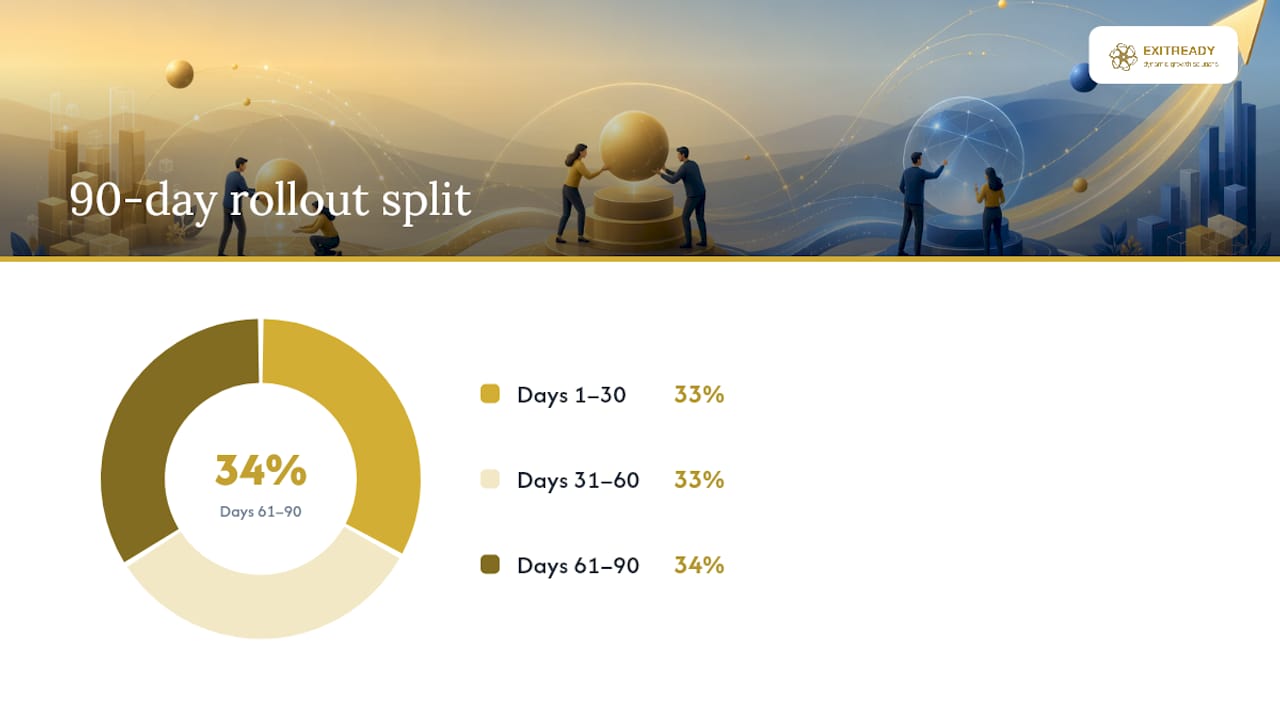
- Days 1 to 30: Map or validate your process landscape. Pick the 5 to 10 most critical L1 groups (the ones that would hurt the most if the owner disappeared for a month) and assign a named owner to each. Rate current maturity honestly. Pick a documentation tool that supports version history and ownership tagging.
- Days 31 to 60: Run the first review cycle on those critical groups. Record a verdict for each one. Update the documents that need it, and route anything flagged into an improvement backlog instead of letting it sit unresolved.
- Days 61 to 90: Extend ownership to the remaining process groups. Publish the maturity heat map to leadership. Lock in permanent review cadences and the KPIs that will track playbook health going forward.
Pro Tip: Don’t try to document everything at once. Start with one or two team playbooks where the owner-dependency risk is highest, prove the process works, then scale it. A playbook that starts small and gets used beats a comprehensive one that never launches.
Teams in operationally heavy industries can see this play out concretely. A 90-day supply chain playbook build follows the same phased logic: map the critical processes first, assign ownership, then scale coverage once the first layer proves out.
How Do You Know If Your Playbook Is Actually Working?
A playbook that nobody measures is a playbook that quietly goes stale. Track a small set of KPIs instead of trying to instrument everything:
- Process accuracy: the percentage of reviewed processes that get a “confirmed” verdict versus “flagged.”
- Time to onboard: how long it takes a new hire to run a process independently.
- Flagged processes per quarter: a rising count signals the business is changing faster than documentation keeps up.
- Cycle time improvement: measured before and after a process redesign.
Run a lightweight audit on your critical process groups every quarter, checking that owners are still assigned, review dates haven’t slipped, and the link maps still point to live documents rather than dead pages. Publish the resulting maturity heat map to leadership so investment decisions get made with data, not gut feel, about which processes need attention.
Not every flagged process deserves a full redesign project. A process with a minor documentation gap gets a tactical update. A process that’s flagged repeatedly, or one where the cost of failure is high (customer-facing, compliance-related, revenue-critical), earns a proper redesign with a project owner and a timeline.
How Does Dynamicgrowthsolutions Apply This Structure Through AOS?
A proprietary business operating system built around governance logic emphasizes that a playbook without enforced ownership is just documentation that ages badly. The Operating Model Inflection framework maps directly to the governance layer described above: it defines decision rights and capability architecture before touching org charts, which keeps structure from becoming a guessing game.
The system assigns process ownership and review cadences using one-owner, RACI-anchored logic, applied across a company’s full process landscape rather than a handful of pilot groups. The target outcome across client engagements is consistent: reduced owner dependency and a business that can pass diligence without the founder narrating every process from memory.
Teams not ready to bring in outside help can still borrow the AOS logic directly:
- Run a readiness assessment against your own Growth Readiness Score Card before building anything.
- Assign owners to your five riskiest process groups this month, not next quarter.
- Set one review date per group and put it on a calendar leadership actually checks.
Where Most Playbooks Break, and What to Fix First
The biggest mistake I see isn’t a missing template. It’s over-detailing pages nobody will read, and it’s naming an owner with no real authority to fix what they find. Skipping review cycles is a close second. A playbook without a review date is a playbook that’s already out of date.
For this quarter, do three things: pick your five most critical process groups, assign one named owner to each with real authority, then run one review cycle before you touch anything else. If you find yourself past 15 process groups with no consistent governance model, that’s usually the point where outside structure earns its cost.
— Andre
How Dynamicgrowthsolutions Can Build This With You
Specialized consulting providers exist as alternatives to hiring full-time operational staff or managing DIY wikis, building governed playbook structures instead of leaving organizations to reverse-engineer RACI matrices and review cadences independently.
If you need the whole system built fast, the Growth Sprint, Performance Sprint, and Enterprise Sprint programs map directly onto rapid playbook rollout and governance implementation, scaled to how much of the process landscape you need documented. If governance and exit-readiness are the bigger priority, the Enterprise Assessment and AOS Value Creation Partnership diagnose your current maturity level before recommending anything, consistent with the evidence-based, diagnostic-first approach Dynamicgrowthsolutions applies to every engagement.
Either way, the starting point is the same conversation. Schedule a strategy call and walk through where your process landscape stands today, and which five process groups deserve an owner first.
Sources
- Insightful
- The Process Governance Playbook (ProcessCamp)
- RACI Matrix: How to build one properly (BA Copilot)
- Business playbook: how to create one (HubSpot)
FAQ
How Do You Structure a Business Playbook?
Structure it in layers: company overview, operating model and capabilities, process landscape, team playbooks, an SOP index, tools and templates, and a governance section with named owners and review dates. Each page should carry the same fields, purpose, scope, owner, KPIs, and a link map, so the whole document stays consistent as it grows.
What Is a Business Playbook?
A business playbook is a coordination document describing who does what, when, and how decisions get made across a company or team. It’s distinct from a business plan (forward-looking and financial) and from an SOP (a single task’s step-by-step instructions), and it typically serves onboarding, delegation, and buyer diligence.
Can You Give an Example of a Business Playbook?
A sales team playbook page might cover “Qualify Inbound Lead,” naming a Sales Development Rep as owner, linking to a CRM scoring SOP, and tracking qualification-to-meeting conversion as its KPI. Broader business playbook examples organize this way across every function, from customer success to finance.
What’s the Difference Between an SOP and a Playbook?
A playbook answers who and what at the coordination level; an SOP answers exactly how to execute one specific, repeatable task step by step. Playbooks link out to SOPs rather than embedding them, which keeps the top-level document readable while SOPs stay detailed enough for someone new to the task to follow.
Does Dynamicgrowthsolutions Help Build a Playbook Like This?
Yes. Dynamicgrowthsolutions builds documented playbooks and governance systems as part of its AOS engagements, including the Growth Sprint, Performance Sprint, and Enterprise Sprint programs and the Enterprise Assessment. Current pricing and program details are listed on the site.