

Start with a forensic vendor and subscription audit, an automation pilot in accounts payable, and a working-capital sweep on DSO and DPO. Those three moves typically produce the fastest, least-disruptive operating expense reduction for mid-market firms, often producing meaningful savings on addressable spend, without touching payroll or customer-facing capabilities. Skip the across-the-board percentage cut. It saves money on paper and costs you revenue capacity within a year.
TL;DR:
- Conduct a detailed analysis of operating expenses with a focus on variable and semi-variable costs using data from AP, procurement, and credit card statements to uncover quick savings.
- Prioritize low-disruption initiatives like vendor audits, AP automation pilots, and working-capital management before considering staffing or facilities restructuring for sustainable cost reduction.
- Implement a staged, governance-driven rollout with clear owners, success metrics, and rollback plans to maintain operational stability and employee trust during cost-cutting efforts.
- Track key KPIs such as recurring savings, OpEx ratio, overhead rate, and DSO/DPO together to ensure cost reductions are durable and do not harm customer experience or cash flow.
- Use a holistic operating-model redesign approach, embedding cost management into documented processes and delegated decision-making to sustain savings long-term.
Table of Contents
- What Counts as an Operating Expense, and How Do You Measure It?
- Which Cost-Cutting Strategies Actually Move the Needle?
- How Do You Roll Out Cost Cuts Without Breaking Operations?
- Which KPIs Prove Your Savings Are Real (and Sticking)?
- Why Do Across-the-Board Cuts Backfire on Growth?
- How Does Dynamic Growth Solutions Build OpEx Reduction Into AOS?
- What Actually Determines Whether Your Savings Stick?
- Ready to Turn Savings Into a Repeatable System?
- Where the Numbers in This Article Come From
- Sources
- FAQ
What Counts as an Operating Expense, and How Do You Measure It?
Before cutting anything, you need a baseline that separates what’s actually optional from what keeps the lights on. Most mid-market leaders think they know their cost structure until they try to categorize it line by line, and the exercise usually turns up surprises: duplicate software licenses, a facilities lease sized for a headcount that shrank two years ago, or a vendor contract nobody remembers negotiating.
Operating expenses split into three working categories. Cost of goods sold (COGS) covers direct costs tied to producing what you sell, materials, direct labor, manufacturing overhead. Fixed operating expenses stay flat regardless of volume: rent, insurance, base salaries, software licenses. Variable and semi-variable expenses move with activity, shipping costs, hourly labor, utilities, sales commissions, and this is the bucket with the most room for near-term optimization because it responds directly to volume and process changes.
Pull your data from more than the income statement. The P&L tells you totals; it doesn’t tell you why a number moved. Build your baseline from:
- Twelve months of accounts payable detail, sorted by vendor and category
- Corporate credit card statements, which catch the subscriptions and one-off purchases that never hit a purchase order
- Procurement records showing contract terms, renewal dates, and volume commitments
- Payroll and headcount reports broken out by department and function
Pro Tip: Pull the credit card statements before the AP ledger. Recurring software charges and small vendor subscriptions hide there far more often than in your formal procurement system, and that’s usually where the fastest wins live.
Two ratios do most of the diagnostic work once you have clean data. The overhead rate divides total overhead costs by total operating expenses (or by revenue, depending on what you’re benchmarking against), and it tells you how much of every dollar goes to running the business versus producing what you sell. The OpEx ratio, operating expenses divided by revenue, is the number most CFOs track quarter over quarter because it flexes with growth. A software company with high gross margins can run a lower ratio; a distribution business with thin margins on volume will naturally run higher.
Watch for three data pitfalls that derail this exercise before it starts. First, mixing cash-basis and accrual-basis numbers when comparing periods, which makes trends look worse or better than reality. Second, letting one-time expenses (a legal settlement, a relocation) distort your run-rate baseline, always strip those out separately. Third, categorizing a cost as “fixed” when it’s actually a fixed commitment you chose to renew, most software contracts and even some leases have more flexibility than the finance team assumes, because nobody has questioned them in years.
Which Cost-Cutting Strategies Actually Move the Needle?
Not every lever costs the same in disruption, and not every lever pays back at the same speed. The mistake most leadership teams make is treating a hiring freeze and a subscription audit as equally strategic decisions. They aren’t. One takes an afternoon and a spreadsheet; the other reshapes how work gets done. Sequence your efforts from lowest disruption and fastest payback to the changes that require real operating redesign.
-
Run a forensic vendor and subscription audit first. Pull every recurring charge, software license, and vendor contract and check it against actual usage. Forensic vendor audits routinely uncover billing errors, duplicate services, or outdated pricing tiers that get corrected within 30 days, producing savings with almost zero operational risk. Gartner has found that organizations applying disciplined software portfolio management, license reclamation, and vendor consolidation can achieve significant software cost savings, a number worth targeting if your last license review happened more than a year ago.
-
Pilot automation in accounts payable and invoicing before anywhere else. AP is usually the highest-volume, lowest-judgment workflow in the building, which makes it the safest place to test automation. Automated invoice capture and three-way matching reduce manual data entry, cut processing time per invoice, and shrink the error rate that generates costly rework. Run the pilot on one vendor category or one business unit for 60 days before expanding it company-wide.
-
Consolidate procurement and renegotiate from a position of volume. Fragmented purchasing, five departments each buying office supplies or IT hardware separately, kills your leverage with vendors. Centralize purchasing authority for categories above a defined dollar threshold, then use the combined volume to renegotiate pricing tiers, payment terms, and contract length. Ask your finance team to check vendor assurance documentation, AICPA’s SOC guidance covers the controls framework, before consolidating with any single supplier, since concentration risk cuts both ways.
-
Apply workforce levers before you touch headcount. A skills audit across your existing team almost always surfaces underused capacity, people doing work below their skill level while a real gap exists elsewhere. SHRM’s research on recruitment costs shows just how expensive reflexive hiring and firing actually is once you count sourcing, onboarding, and lost productivity during ramp-up. Redeployment and blended staffing, mixing full-time roles with contractors or fractional specialists for peak demand, preserve capacity while lowering your fixed run-rate. A workforce skills audit, done properly, also tells you where cross-training closes gaps faster than a new hire would.
-
Target a hiring freeze narrowly, not company-wide. Freeze backfills in departments with excess capacity or overlapping roles. Keep hiring open in functions directly tied to revenue growth or client delivery. A blanket freeze signals panic internally and often forces you to unfreeze selectively within two quarters anyway, which costs you credibility with the team.
-
Consolidate facilities and formalize hybrid work models. Space you’re not using every day is one of the most visible, most avoidable fixed costs on the books. BLS data shows roughly one in three workers in management and professional occupations teleworked as of late 2023. This baseline makes a strong case for right-sizing office footprint against actual daily attendance rather than headcount on paper. Pair any consolidation with an energy audit, lighting, HVAC scheduling, and equipment efficiency upgrades often pay back within 12 to 18 months.
-
Tighten DSO and DPO simultaneously. Reducing days sales outstanding accelerates cash coming in; extending days payable outstanding (within the terms your vendors will tolerate) keeps cash out a little longer. Run both levers together and you free up working capital without borrowing a dollar. Dynamic discounting, offering early-payment discounts to select customers, can pull cash forward faster than a collections call ever will.
-
Rationalize your SKU or service portfolio. Every product line or service offering that isn’t pulling its weight on margin is quietly consuming overhead, sales attention, and inventory carrying cost. Pricing governance, a formal review of discount authority and margin floors, usually surfaces more margin leakage than any single cost-cutting initiative on this list.
The order matters because trust compounds. A leadership team that delivers three quick, visible wins in the first 60 days earns the credibility to attempt the harder, slower moves, operating model redesign, portfolio rationalization, that actually sustain savings over multiple years.
How Do You Roll Out Cost Cuts Without Breaking Operations?
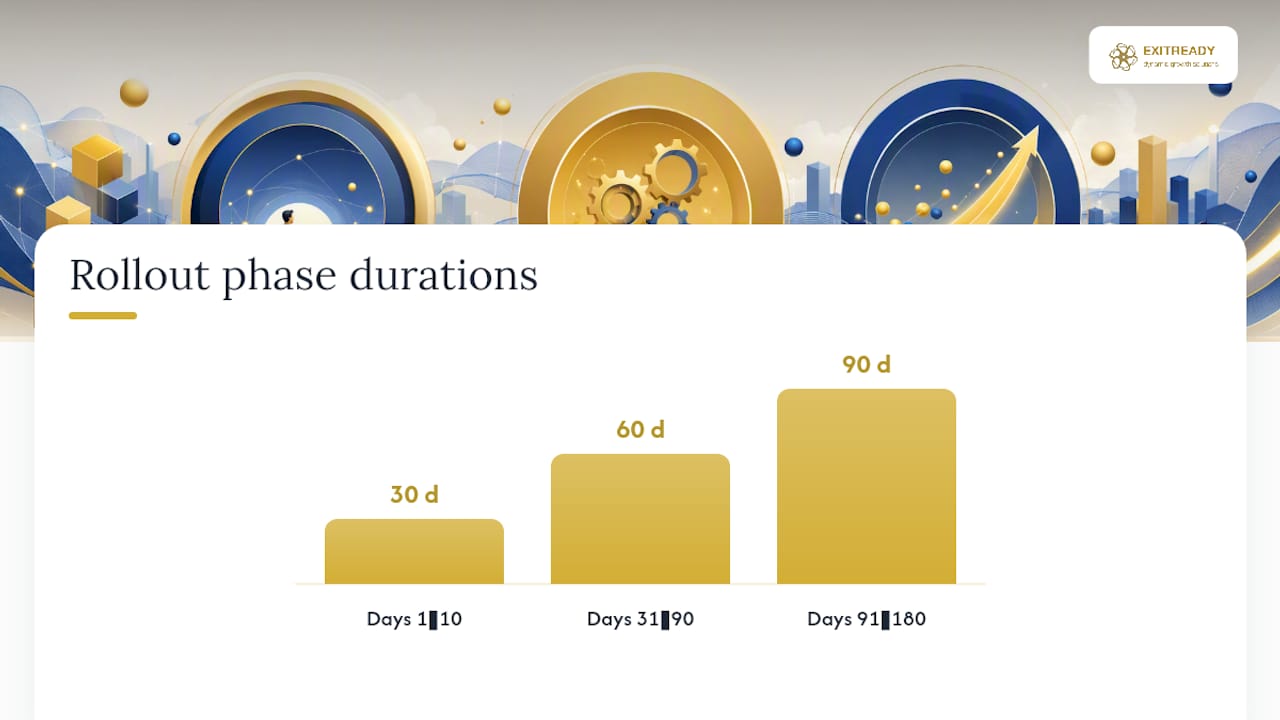
A cost-reduction program that skips governance turns into a series of disconnected initiatives that fade within two quarters. The fix is a staged rollout with named owners, defined success criteria, and a rollback plan for anything that touches customer-facing operations.
Days 1 to 30: Baseline and quick wins.
- Assign a single executive sponsor and a cost owner for each major category (vendors, facilities, workforce, technology).
- Complete the vendor and subscription audit; cancel or renegotiate anything with zero usage or duplicate function.
- Launch the AP automation pilot on one vendor category.
- Set the baseline OpEx ratio and overhead rate so you have a number to measure against later.
Days 31 to 90: Pilot and validate.
- Expand the AP automation pilot to a second department if the 30-day results hit your success criteria, typically a measurable drop in cost per invoice and processing time.
- Consolidate procurement categories above your dollar threshold and begin renegotiations.
- Run the workforce skills audit and map redeployment opportunities before opening any new requisitions.
- Build the first savings dashboard and present it to leadership.
Days 91 to 180: Scale and institutionalize.
- Roll automation out company-wide for validated processes.
- Execute facilities consolidation or hybrid-work policy changes based on actual space utilization data.
- Formalize a monthly cost governance cadence, one meeting, one dashboard, one owner per line item.
- Begin the operating-model redesign work for any function that quick wins couldn’t fix, this is where operating model redesign over a 90 to 180 day window starts to pay off.
Every pilot needs three things defined before it launches: scope (which team, which process, which time window), a success metric (cost per unit, cycle time, error rate), and a rollback trigger (what specific outcome tells you to pull the plug). Skipping the rollback plan is how well-intentioned automation pilots turn into six-month messes nobody wants to own.
Governance doesn’t need to be heavy to work. What it needs is consistency:
- One cost owner per category, accountable for tracking and reporting, not just executing
- A monthly review cadence with the same dashboard format every time, so trends are visible at a glance
- A clear escalation path when a savings initiative starts affecting service levels or delivery times
- A communication rhythm with employees that explains what’s changing and why, before rumors fill the gap
That last point matters more than most leadership teams admit. Employees who hear about cost cuts secondhand assume the worst, layoffs, and disengage before anything is even decided. A short, honest update at the 30 and 90-day marks, even a two-paragraph email from the CEO, keeps your team focused on execution instead of speculation. Frame it around what’s staying the same as much as what’s changing; that’s usually what people actually want to know.
Which KPIs Prove Your Savings Are Real (and Sticking)?
The number that matters most isn’t the headline savings figure, it’s whether that figure survives contact with the next two quarters. Plenty of cost-cutting initiatives look great on the announcement slide and evaporate by Q3 because nobody tracked the difference between a one-time reduction and a structural one.
Track five core metrics on a rolling basis:
- Absolute savings, split explicitly into one-time (a renegotiated contract’s first-year discount) versus recurring (a permanently lower run-rate)
- OpEx ratio, tracked quarter over quarter against your baseline, not just against the prior year
- Overhead rate, to confirm cost reductions are coming from overhead and not eroding your direct-cost efficiency
- Cost per invoice or transaction, the clearest signal that automation is actually working rather than just shifting labor around
- DSO and DPO, watched together so a win on one side doesn’t mask a slippage on the other
Automation and process benchmarking data referenced in Grant Thornton’s cost management analysis point to invoice processing cost as one of the more reliable early indicators that a cost program is producing durable results rather than a temporary dip.
Attribution discipline is where most savings programs quietly fall apart. When a vendor renegotiation saves you $40,000 in year one because of a signing credit, but only $15,000 annually after that, report both numbers. Leadership teams that only report the year-one figure set themselves up for an awkward conversation in month fourteen when the number drops and nobody remembers why.
Watch your leading indicators for damage just as closely as your savings numbers. A drop in customer service response times, a lengthening order-to-delivery cycle, or a spike in voluntary turnover in a department you just restructured are all signals that a cost cut is starting to cost you more than it saved. Track these alongside your financial KPIs, not in a separate report that nobody reads until the quarterly review.
A workable dashboard needs, at minimum: the initiative name, owner, target versus actual savings, one-time versus recurring classification, and a status flag tied to your rollback criteria. Review it monthly for the first two quarters, then quarterly once the program stabilizes. For the cash-flow side of this tracking, forecasting tools built around working-capital levers help connect DSO and DPO improvements directly to your cash position rather than leaving them as abstract ratios.
Why Do Across-the-Board Cuts Backfire on Growth?
Cutting every department’s budget by the same percentage feels fair and looks decisive in a board meeting. It’s also one of the most reliable ways to damage a business that still needs to grow. Deloitte’s research on cost optimization makes the case plainly: the shift finance leaders need to make is from blunt cost reduction to holistic cost optimization, protecting the capabilities that actually drive revenue while cutting what doesn’t. Bain’s work on zero-based cost management backs this up with numbers, disciplined zero-based redesigns can lower a company’s cost base by as much as 25% and, critically, tend to sustain those savings longer than across-the-board cuts because the cost base gets rebuilt rather than trimmed.
Use a simple decision framework for every line item under review:
- Keep anything directly tied to revenue generation, customer retention, or a regulatory requirement, no exceptions without executive sign-off
- Review anything with ambiguous ownership or unclear usage data, most software licenses and mid-tier vendor contracts fall here
- Cut anything duplicative, unused for 90+ days, or tied to a process that automation has already replaced
Two traps derail this process almost every time. The sunk-cost fallacy keeps legacy systems and long-standing vendor relationships alive well past their usefulness, because someone championed the original decision and nobody wants to admit it didn’t pan out. The headcount reflex, cutting people first because it shows up fastest on the P&L, usually backfires: eliminating roles without redesigning the underlying process just pushes the work onto remaining staff, creating hidden rework and burnout that costs you more within a year than the salary you saved.
Pro Tip: Before approving any headcount reduction, ask whether the role’s tasks have been redesigned or automated, not just reassigned. If the answer is “someone else will absorb it,” you haven’t cut a cost. You’ve deferred it and added interest.
When layoffs genuinely are the only lever left, protect institutional knowledge deliberately: document the departing employee’s processes before their last day, reassign client relationships with a formal handoff period, and consider phased transitions over abrupt exits wherever cash flow allows it.
How Does Dynamic Growth Solutions Build OpEx Reduction Into AOS?
Operating expense reduction is best treated as a byproduct of operating-model redesign, not a standalone cost-cutting exercise. The distinction matters. A vendor audit or a software cleanup delivers a one-time win. Rebuilding how work actually flows through the business, who owns what, which processes run on documented playbooks versus tribal knowledge, delivers a lower cost structure that holds.
The AOS (Accelerated Operating System) framework starts with an operational assessment that maps where owner dependency and undocumented processes are quietly inflating overhead, often in departments the leadership team assumed were running efficiently. From there, the typical engagement produces:
- A documented set of playbooks that replace informal, owner-dependent processes with repeatable systems
- A delegation plan that identifies which decisions and tasks can move off the owner’s desk immediately
- A ProfitDriver business analysis that surfaces hidden revenue leakage and cost-saving opportunities the standard P&L review misses
- A phased implementation roadmap sequenced to match the pilot-then-scale approach that protects operations during the transition
This approach preserves what a blunt cost-cutting exercise tends to destroy: institutional knowledge, customer experience consistency, and the operational capacity a business needs to keep growing while it’s also getting leaner. Owners who go through this process typically report the biggest shift isn’t the savings number itself, it’s getting hours of their week back because decisions that used to require their direct involvement now run through a documented system. Real business operating system examples show what that delegation structure looks like once it’s fully built out.
What Actually Determines Whether Your Savings Stick?
The research is pretty consistent on this point, and most leadership teams still get it backwards. Grant Thornton’s Q1 2026 CFO survey shows finance leaders moving away from broad cost-cutting and toward targeted discipline, and that shift isn’t caution. It’s a recognition that indiscriminate cuts have been tried, measured, and found wanting.
Where conventional advice falls short is treating cost reduction as an event instead of a capability. A one-time vendor renegotiation feels like progress, but if there’s no owner and no monthly cadence behind it, the savings erode within a year as new subscriptions creep back in and renegotiated terms quietly expire unnoticed.
What should come first isn’t the biggest number on the spreadsheet. It’s the baseline. You can’t tell the difference between a smart cut and a dangerous one without knowing exactly what each dollar of overhead is actually buying you in revenue capacity or customer retention. Get that visibility before you touch a single line item, and the sequence of quick wins, automation, and workforce redesign practically chooses itself.
— Andre
Ready to Turn Savings Into a Repeatable System?
Most cost-cutting advice stops at the spreadsheet: cancel this subscription, renegotiate that contract, freeze this headcount. This approach goes further by rebuilding the operating model underneath those numbers, so savings don’t quietly reverse once the initial push fades. The framework pairs an operational assessment with documented playbooks and a delegation plan, giving mid-market owners a system that holds the cost reduction in place instead of a one-time win that needs repeating every year.
This approach fits best for owners who’ve already tried the quick wins, a subscription cleanup here, a vendor renegotiation there, and want the deeper redesign that makes those savings permanent while freeing up their own time from day-to-day operational decisions. Expect an initial assessment that maps where overhead is hiding and where owner dependency is quietly driving costs up, followed by a phased plan built around your specific operating structure. Start by reviewing Dynamic Growth Solutions’ business transformation programs to see how the assessment process works and what a typical engagement covers before you commit to anything.
Where the Numbers in This Article Come From
The cost-optimization framing throughout this article draws on Grant Thornton’s Q1 2026 CFO survey, which tracks the shift from broad cost cuts toward targeted discipline among finance leaders. Deloitte’s cost optimization strategy research informs the argument for holistic, capability-preserving cost management over blanket reductions. The zero-based budgeting figures and redesign approach come from Bain & Company’s analysis of zero-based cost management. Facility and hybrid-work data references Bureau of Labor Statistics telework figures from late 2023. Additional context on software savings comes from Gartner’s guidance on license reclamation, and on workforce cost from SHRM’s recruitment cost research, both linked in the sections where their findings apply.
Sources
- Cost management in 2026 | Grant Thornton
- Cost optimization operations strategy | Deloitte
- The new case for zero-based cost management | Bain & Company
- BLS telework data
FAQ
What Are the Three Types of Operating Expenses?
Operating expenses split into cost of goods sold (direct production costs), fixed expenses (rent, insurance, base salaries that don’t change with volume), and variable or semi-variable expenses (utilities, commissions, shipping) that move with business activity.
How Do You Decrease Operating Costs Without Hurting Growth?
Start with low-disruption moves, vendor and subscription audits, AP automation pilots, and working-capital tightening, before touching headcount or facilities, and use a keep/review/cut framework so cuts target waste rather than revenue-driving capabilities.
What Does Expense Reduction Actually Mean?
Expense reduction means lowering the cost of running a business without cutting the capabilities that generate revenue, which is why finance leaders increasingly frame it as cost optimization rather than blunt cost cutting.
How Does Dynamic Growth Solutions Approach OpEx Reduction Differently?
Dynamic Growth Solutions builds expense reduction into a broader operating-model redesign through its AOS framework, using an operational assessment, documented playbooks, and a ProfitDriver analysis to make savings durable rather than one-time.