
A business operating system, or BOS, is either a management framework that sets your company’s rhythm of meetings, metrics, and documented processes, or a software platform that runs your finance and operations digitally. Most owners overcomplicate this decision. The Toyota Production System and the Danaher Business System are the classic enterprise-level BOS examples, while Scaling Up, the 4 Disciplines of Execution (4DX), and E-Myth’s systemization model serve small and mid-market firms better. Platforms like Microsoft Dynamics 365 Business Central sit in a third category entirely: software that centralizes data instead of setting culture.
If you’re running a small to mid-market company, start with a framework and document your three most critical processes before you spend a dollar on software. Here’s the quick map:
- Enterprise frameworks: Toyota Production System, Danaher Business System
- SME and mid-market frameworks: Scaling Up, 4DX, E-Myth, EOS-style models
- Software/platform examples: Dynamics 365 Business Central, emerging AI-driven operating platforms
- Hybrid approach: a documented framework paired with software support once processes stabilize
TL;DR:
- Most small and mid-market companies should start with a documented management framework before investing in software to ensure processes are clear and repeatable.
- Choosing between a management framework and an operational platform depends on owner dependency, company complexity, regulation, documentation, and IT readiness.
- Implementing a business operating system effectively requires a phased approach over roughly a year, starting with assessment, then documentation, pilots, and full scaling.
- Hybrid models that combine a leadership framework with software support after documenting processes tend to have higher adoption and longer-lasting results.
- A done-for-you solution like Dynamicgrowthsolutions’ AOS offers an integrated sequencing approach, including assessment, documentation, and exit-readiness certification, reducing internal development effort.
Table of Contents
- What Are the Best Business Operating System Examples?
- Is a Business Operating System a Framework or Software?
- How Do You Choose the Right BOS for Your Company?
- What Does a Realistic BOS Implementation Timeline Look Like?
- How Dynamic Growth Solutions’ AOS Applies This in Practice
- What Owners Consistently Get Wrong About Systemizing Their Business
- Getting Started With a Done-for-You Operating System
- Key Takeaways
- Sources
What Are the Best Business Operating System Examples?
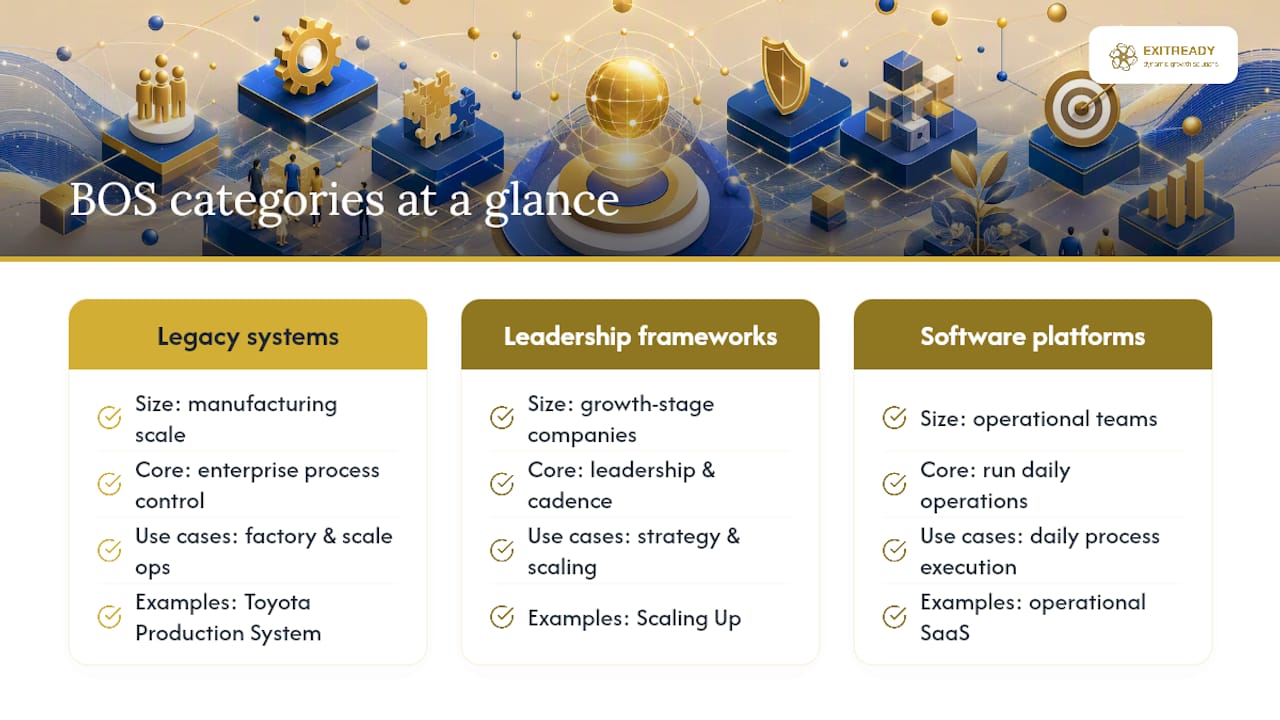
Every BOS example fits one of three buckets: legacy enterprise systems built for manufacturing scale, leadership frameworks built for growth-stage companies, or software platforms built to run daily operations. Knowing which bucket matches your problem saves you months of wasted evaluation.
Enterprise frameworks built for scale
The Toyota Production System is the original modern BOS, engineered around continuous improvement and waste elimination on the factory floor. Danaher Business System took a similar philosophy and applied it across a diversified industrial holding company, using standardized problem-solving tools across dozens of business units. Both are cited as the foundational reference points in how business operating systems are defined) as enterprise-wide collections of processes rather than single tools.
Neither was designed for a 40-person service company. They matter as historical proof that a documented, repeatable system beats ad hoc management, not as a template you copy line for line if you run a regional HVAC company or a boutique marketing agency.
SME and mid-market frameworks
This is where most readers of this article actually belong. Scaling Up (built on the Rockefeller Habits) organizes a company around four decisions: people, strategy, execution, and cash. It works well for founder-led businesses between 10 and 250 employees that have outgrown spreadsheets but aren’t ready for enterprise software.

The 4 Disciplines of Execution focuses narrower: pick a wildly important goal, track lead measures, keep a compelling scoreboard, and hold a weekly cadence of accountability. It’s less a full operating system and more an execution layer you can bolt onto an existing framework.
E-Myth, built from Michael Gerber’s systemization philosophy, targets a specific pain: owners who are the bottleneck in every decision. It pushes you to document how the business runs so it doesn’t depend on you personally showing up.
SME-focused frameworks like these share a common thread: leadership cadence, measurable KPIs, and documented process, scaled down from Toyota and Danaher’s industrial roots into something a 30-person company can actually run.
Software and platform examples
Dynamics 365 Business Central is the clearest mainstream example of BOS as software rather than philosophy. It centralizes finance, sales, service, and operations into shared dashboards, and it now layers in AI-driven agents that handle routine workflows, like matching invoices or flagging cash flow anomalies before a controller has to dig for them.
Newer entrants describe themselves as “AI operating systems,” a category still forming but worth watching if your bottleneck is data fragmentation rather than culture. These tools promise integration and speed but not alignment, and that distinction trips up a lot of buyers.
- Toyota Production System — ask: does my business have repeatable, physical production steps worth standardizing?
- Danaher Business System — ask: am I managing multiple business units that need a shared problem-solving language?
- Scaling Up — ask: do I need a structured way to align people, strategy, execution, and cash?
- 4DX — ask: do I have too many priorities and not enough follow-through?
- E-Myth — ask: does the business fall apart when I’m not in the room?
- Dynamics 365 Business Central — ask: is my data scattered across five disconnected tools?
Hybrid models
Some companies run a leadership framework like Scaling Up for culture and cadence, then implement Business Central or a comparable platform once their processes are documented well enough to configure software around them. That sequencing, not the tool choice itself, tends to separate the installs that stick from the ones that get abandoned within a year.
Is a Business Operating System a Framework or Software?
This is the single most common point of confusion in this category, and it costs owners real money when they get it backward. “Business operating system” describes two genuinely different things: a cultural and managerial framework, or a technical platform that runs your data. Wikipedia’s own entry on the topic treats both senses as legitimate, because both grew out of the same idea: replacing ad hoc management with a standardized, enterprise-wide system.
Framework-first makes sense when:
- The business is heavily owner-dependent and decisions bottleneck at the top
- Leadership meetings are inconsistent or rarely produce real accountability
- You’re trying to shift culture, not just move data faster
- Your processes aren’t documented anywhere a new hire could find them
Software-first (or parallel investment) makes sense when:
- You’re in a regulated industry where compliance tracking is unmanageable by hand
- Finance operations are complex enough that manual reconciliation eats real hours weekly
- You already run disciplined meeting cadences but your systems can’t keep up with volume
- Multiple locations or business units need real-time shared visibility
Technical experts are blunt about the failure mode here: software should support your operational philosophy, not create one. Buy an ERP system before your processes are documented, and you tend to get low adoption, expensive customization, and a tool nobody trusts because it was configured around guesses instead of reality.
Pro Tip: Pilot any new software against one already-stable process, like your sales handoff or your invoicing cycle, before you roll it out company-wide. If the software can’t handle a process you already run well, it won’t fix the ones you’re struggling with either.
How Do You Choose the Right BOS for Your Company?
Pick criteria before you pick a product name. Owners who start by demoing software or reading framework books in isolation end up choosing based on whoever pitched them best, not what actually fits their operation.
Score your company from 1 to 3 (1 being low need, 3 being high need) across these dimensions:
- Owner dependency — how much grinds to a halt if you take two weeks off?
- Company size and complexity — are you 15 people in one location or 200 across three?
- Industry regulation — does your sector require audit trails, licensing, or compliance documentation?
- Existing documentation — do written processes exist anywhere beyond someone’s memory?
- IT readiness — do you have the internal capacity to configure and maintain new software?
- Budget and timeline — can you commit real hours weekly for the next two quarters?
A total score above 12 usually points toward a heavier framework and software combination. A score under 8 usually means you need a framework alone, and you need it before anything else.
Before signing with any implementer, whether that’s a framework coach or a software vendor, ask three direct questions:
- Who owns the system’s uptime and ongoing maintenance once you leave?
- Who trains our team, and how long does that training actually take?
- What specific metric will tell us this worked within 90 days?
Watch for these red flags:
- Vague promises with no defined timeline (“you’ll see results eventually”)
- A “one-size-fits-all” playbook that never asks about your industry or size
- No measurable outcome tied to the engagement
- Pressure to sign before you’ve documented a single existing process
For finance-specific operations, a resource like Kelliworks’ guide to scalable accounting services is worth a look if outsourcing part of your finance function is one of the levers you’re weighing.
What Does a Realistic BOS Implementation Timeline Look Like?
Most owners want to skip straight to “install the system.” That’s the mistake. A phased rollout, run over roughly a year, is what separates BOS adoptions that actually change how the company runs from the ones that get a binder nobody opens again.
- Phase 0, Assessment (1 to 4 weeks): Identify the three to five processes most critical to revenue or customer experience, and assign clear ownership for each one.
- Phase 1, Design and playbook creation (4 to 8 weeks): Document those processes step by step, define the KPIs that measure them, and set your leadership meeting cadence.
- Phase 2, Pilot (30 to 90 days): Run the new system in one department first. Practitioner patterns consistently favor a short pilot window before wider rollout, because it surfaces gaps in the documentation while the stakes are still small.
- Phase 3, Scale (3 to 12 months): Train department leaders, layer in software support where volume actually justifies it, and consider formal certification once the system runs without you.
Quick wins that cost almost nothing: a weekly leadership huddle, one shared KPI dashboard everyone checks, and documented handoffs between departments so work doesn’t stall when someone’s out sick. Owners who want a fuller checklist for this stage can work through Dynamicgrowthsolutions’ business scalability checklist for mid-market growth.
| Phase | Timeline | Primary Output |
|---|---|---|
| Assessment | 1 to 4 weeks | Three to five critical processes identified and assigned |
| Design | 4 to 8 weeks | Documented playbooks, KPIs, meeting cadence |
| Pilot | 30 to 90 days | One department tested, metrics validated |
| Scale | 3 to 12 months | Leaders trained, software layered in, certification considered |
How Dynamic Growth Solutions’ AOS Applies This in Practice
Dynamicgrowthsolutions built the Accelerated Operating System, AOS, around this exact assess to design to pilot to scale sequence, adapted specifically for mid-market companies preparing for growth or a future exit. It starts with an operational assessment, moves into documented playbooks that replace owner-dependent decisions, and finishes with an exit-readiness certification that gives buyers confidence in the numbers.
- Assessment identifies owner-dependency gaps the same way Phase 0 above does, just formalized with a scoring model
- Playbooks map directly to the design phase, documenting processes so a new hire, not just the founder, can run them
- Certification and buyer network access extend past a typical BOS rollout into valuation preparation specifically
Systems that replace owner dependency with documented playbooks and validated KPIs don’t just run smoother day to day. They materially improve buyer confidence and the multiple a company commands at exit.
Dynamicgrowthsolutions discloses this plainly: AOS is a paid, done-for-you program, not a free framework you self-implement. For owners who want the structure this article describes but lack the internal bandwidth to build it themselves, it’s worth reviewing what a business operating system looks like from an owner’s perspective.
What Owners Consistently Get Wrong About Systemizing Their Business
Most owners treat a BOS like a purchase decision instead of a behavior change. They’ll buy the software, read the framework book, even hire a coach, and then keep making every decision themselves out of habit. The system doesn’t fail because the framework was wrong. It fails because nobody changed what they actually did on Monday morning.
The bigger blind spot is timing. Owners wait until they’re exhausted, or until they’re six months from wanting to sell, to start documenting how the business runs. By then you’re rushing playbooks that should have taken shape over a year, and buyers can tell the difference between a system that’s been tested and one that was built for the pitch deck. Start the assessment now, while you have the runway to actually pilot changes and fix what doesn’t work.
The owners who get this right are the ones who separate the cultural work from the tooling work early, then bring in outside structure once they know exactly what needs documenting.
— Andre
Getting Started With a Done-for-You Operating System
If you’ve read this far and recognize your company in the “owner-dependent, no documented playbooks” category, you don’t have to build the framework yourself from scratch the way a Scaling Up or E-Myth rollout usually requires. Dynamicgrowthsolutions runs AOS as a fully managed engagement: an operational assessment, documented playbooks built specifically for your business, and a certification track aimed at exit readiness and higher valuation, without you spending months piecing together a framework on your own.
This fits owners who scored high on dependency and low on documentation in the checklist above, and who want the sequencing done right the first time rather than learning it through a failed software rollout. It also suits owners with a specific horizon in mind, whether that’s a sale in two years or simply getting your time back sooner. Review Dynamicgrowthsolutions’ business transformation methodology and start with an assessment to see exactly where your business stands today.
Key Takeaways
Choosing the right business operating system means matching a framework or platform to your company’s actual bottleneck, then sequencing framework work before software investment.
| Point | Details |
|---|---|
| Define BOS correctly | Distinguish a management framework (Scaling Up, 4DX, E-Myth) from software platforms (Dynamics 365 Business Central). |
| Start with a framework | Document three to five critical processes before buying software, per common ERP adoption failures. |
| Score your fit | Rate owner dependency, size, regulation, and IT readiness from 1 to 3 to guide your choice. |
| Follow a phased timeline | Assess in weeks, design in two months, pilot for 30 to 90 days, then scale over a year. |
| Consider a done-for-you path | Dynamicgrowthsolutions’ AOS applies this same sequence through assessment, playbooks, and exit-readiness certification. |