
A management incentive plan (MIP) in private equity is the equity stake sponsors carve out to align and retain leadership, structured such that managers earn real upside only as enterprise value grows. The core tradeoff is time versus performance: pure time-based vesting protects retention but pays out even in a mediocre deal, while pure performance vesting maximizes alignment but adds volatility management may reject. Most workable plans blend both.
TL;DR:
- The size of the management incentive pool typically ranges from a modest percentage of fully diluted equity, with larger allocations for CEOs and in highly levered, talent-scarce deals.
- Most plans blend time-based vesting with performance metrics like MOIC or IRR, using operational KPIs when exit timing becomes uncertain.
- Equity instruments vary by structure, with profits interests for LLCs, stock options or RSUs for corporations, and phantom equity or SARs as non-dilutive alternatives, each with different legal and tax implications.
- At exit, vested awards are usually settled in cash or rolled into new equity, while unvested awards may accelerate, be forfeited, or be restructured; reset mechanisms help manage longer hold periods.
- Operational discipline and reliable reporting systems are crucial for MIP effectiveness, as unclear or unsupported KPIs undermine investor confidence and incentive value.
Table of Contents
- What Is a Management Incentive Plan in Private Equity?
- Which Equity Instruments Do MIPs Typically Use?
- How Should Vesting and Performance Metrics Be Structured?
- How Big Should the Management Equity Pool Be?
- What Happens to an MIP at Exit or Recapitalization?
- What Tax, Legal, and Governance Issues Should You Clear First?
- What Questions Should Sponsors and Managers Ask Before Signing?
- Why MIP Effectiveness Comes Down to Operational Discipline
- How Dynamic Growth Solutions Helps Portfolio Companies Get MIP-Ready
- Sources
What Is a Management Incentive Plan in Private Equity?
Sponsors typically set an MIP at or shortly after acquisition, while the capital structure is still being finalized and before management gets comfortable in new roles. The timing matters because the plan becomes the primary lever for keeping key executives through a hold period that often runs five to seven years.
The rationale is straightforward. Cash compensation in a leveraged deal is usually constrained, since free cash flow is servicing debt rather than funding raises. Equity fills that gap. CT Acquisitions describes an MIP as a pool of equity that vests over time or on performance and typically pays out at exit, which is a meaningfully different animal than a public-company long-term incentive plan.
- Public LTIPs pay out annually against liquid stock; private MIPs pay out once, at a liquidity event.
- Public LTIPs use broad market benchmarks; PE plans tie almost entirely to the sponsor’s own return targets.
- Public LTIPs assume ongoing grants; MIPs are usually a single pool sized at closing, occasionally topped up.
Which Equity Instruments Do MIPs Typically Use?
Entity structure drives the choice of instrument more than preference does. An LLC taxed as a partnership almost always uses profits interests, since they let executives receive future appreciation without triggering upfront taxable income. A corporation typically grants stock options or restricted stock units instead, because profits interests don’t exist as a legal concept outside partnership structures.
Some sponsors avoid issuing actual equity altogether and use phantom equity or stock appreciation rights (SARs), which mimic the economics of ownership through a cash payout without diluting the cap table or creating minority shareholder rights.
- Profits interests: tax-efficient for LLCs, but valuation and safe-harbor rules require careful drafting.
- Options/RSUs: familiar to corporate executives, straightforward at exit, but options require an exercise price and can expire worthless if the deal underperforms.
- Phantom equity/SARs: cash-settled, non-dilutive, easier to unwind, but offer no actual ownership stake or voting rights.
- Documentation burden: profits interests generally require more complex legal work upfront than phantom plans.
How Should Vesting and Performance Metrics Be Structured?
Goodwin’s analysis of its Private Equity Deal Database found that a majority of PE incentive plans blend time-based and performance-based vesting, with many allocating a significant portion of the award to performance components. That split is not accidental. Pure time vesting risks paying management for simply showing up; pure performance vesting risks losing a strong executive to a slower exit market that has nothing to do with their operating performance.
A common time-based structure uses a one-year cliff followed by monthly or annual ratable vesting over four to five years. Performance components typically hinge on MOIC or IRR at exit, though EisnerAmper notes that portfolio companies increasingly supplement those deal-level metrics with EBITDA, revenue, or operational KPIs as hold periods stretch and exit timing grows less predictable.
- Time-based tranche: retention anchor, usually the larger share early in the hold.
- Performance tranche: tied to MOIC/IRR thresholds, sometimes with tiered ratchets that increase the payout percentage above certain return multiples.
- Operational KPIs: increasingly used as a bridge metric when exit visibility is low, as highlighted in this cross-company AI benchmarking guide for aligning performance measurement.
Deloitte recommends keeping short-term cash incentive metrics distinct from long-term equity metrics, since overlapping the two means paying twice for the same result.
Pro Tip: If your plan pairs an annual EBITDA bonus with an exit MOIC hurdle built on cumulative EBITDA growth, check whether the same growth is getting rewarded twice. That double-dipping is the single most common drafting error in blended plans.
How Big Should the Management Equity Pool Be?
Pool size benchmarks vary by deal size and sector, but market data compiled by V7 Labs indicates that mid-market pools are commonly sized at a modest percentage of fully diluted common equity, with the CEO usually receiving the largest single allocation and the rest distributed across the C-suite and key operators.
Leverage, industry, and talent scarcity all push that number around. A highly levered deal in a talent-scarce sector (software, specialty healthcare) tends toward a larger pool because the sponsor has less room to compete on cash. A lower-leverage platform deal in a commoditized industry can often get away with a smaller one.
- Model the pool as a percentage of common equity, not enterprise value; the two numbers can look wildly different depending on debt load.
- Expect CEO allocations to run several multiples higher than the next-most-senior executive.
- Revisit sizing whenever a follow-on acquisition or recapitalization changes the capital structure materially.
What Happens to an MIP at Exit or Recapitalization?
Vested awards are typically settled in cash at closing, calculated against the same waterfall the sponsor and other equity holders use. Unvested awards either get accelerated, forfeited, or rolled into a successor entity’s equity plan if the buyer is another sponsor running a continuation structure.
Crystallisation, locking in a value for the award before the actual exit, gives management earlier certainty but forces the sponsor to fund a payout without the liquidity an actual sale provides. Goodwin’s guidance on extended holding periods lays out several reset mechanisms sponsors use when a deal runs longer than planned: top-up grants, amended performance hurdles, and sell-down or put options that let management realize partial liquidity without waiting for a full exit.
- Vested equity: cash-settled or rolled, per the deal’s rollover agreement.
- Crystallisation: earlier certainty for management, funding pressure for the sponsor.
- Resets/top-ups: keep incentives live through a longer hold, but dilute the original pool if not carefully capped.
What Tax, Legal, and Governance Issues Should You Clear First?
Tax treatment diverges sharply by instrument. Profits interests can qualify for favorable capital gains treatment if structured correctly under IRS safe-harbor guidance, while options and RSUs typically generate ordinary income at vesting or exercise. Valuation timing on any top-up grant matters too: issuing new units below fair market value risks imputed income for the recipient.
- Confirm profits interests satisfy safe-harbor conditions before granting.
- Time valuations for top-up awards to avoid phantom income exposure.
- Review forfeiture, change-in-control, and acceleration language line by line. Goodwin’s drafting analysis flags this as one of the most common sources of post-signing disputes.
Pro Tip: Ask your counsel to define “good leaver” and “bad leaver” explicitly, tied to specific triggering events, not vague language like “at the board’s discretion.” That ambiguity is where most departure disputes start.
What Questions Should Sponsors and Managers Ask Before Signing?
- Confirm the pool size, instrument type, and vesting split (time versus performance) in writing before the term sheet is finalized.
- Managers should ask: what happens to my unvested award if I’m terminated without cause, or if there’s a change of control before exit?
- Managers should ask: how is fair market value determined for tax purposes, and who pays if I’m required to buy in at a top-up round?
- Sponsors should ask: does the performance hurdle still reflect our current underwriting case, or has the exit thesis shifted since closing?
- Sponsors should ask: what’s our reset policy if the hold extends past the original plan, and how much dilution are we willing to absorb?
- Both sides should confirm reporting cadence: how often will KPI progress toward the incentive threshold actually be shared?
Why MIP Effectiveness Comes Down to Operational Discipline
The best-designed MIP fails if the underlying business can’t produce reliable numbers against its own metrics. A performance hurdle tied to EBITDA growth is only as credible as the reporting cadence behind it, and most mid-market companies don’t have one when the deal closes.
That’s where documented operating playbooks earn their keep. When KPI tracking, delegation, and reporting rhythms already exist, a performance-based MIP tranche measures something real instead of something aspirational. Advisory support that builds those systems before the plan is finalized gives management a fair shot at hitting hurdles the sponsor actually believes in, rather than negotiating around ones nobody trusts. A documented operating system turns a performance metric from a guess into a scoreboard both sides can read the same way.
— Andre
How Dynamic Growth Solutions Helps Portfolio Companies Get MIP-Ready
Some consulting firms work with mid-market companies to close the gap between an incentive plan’s paper metrics and the operational reality behind them, using frameworks to build KPI tracking and delegation systems that make performance hurdles measurable instead of aspirational.
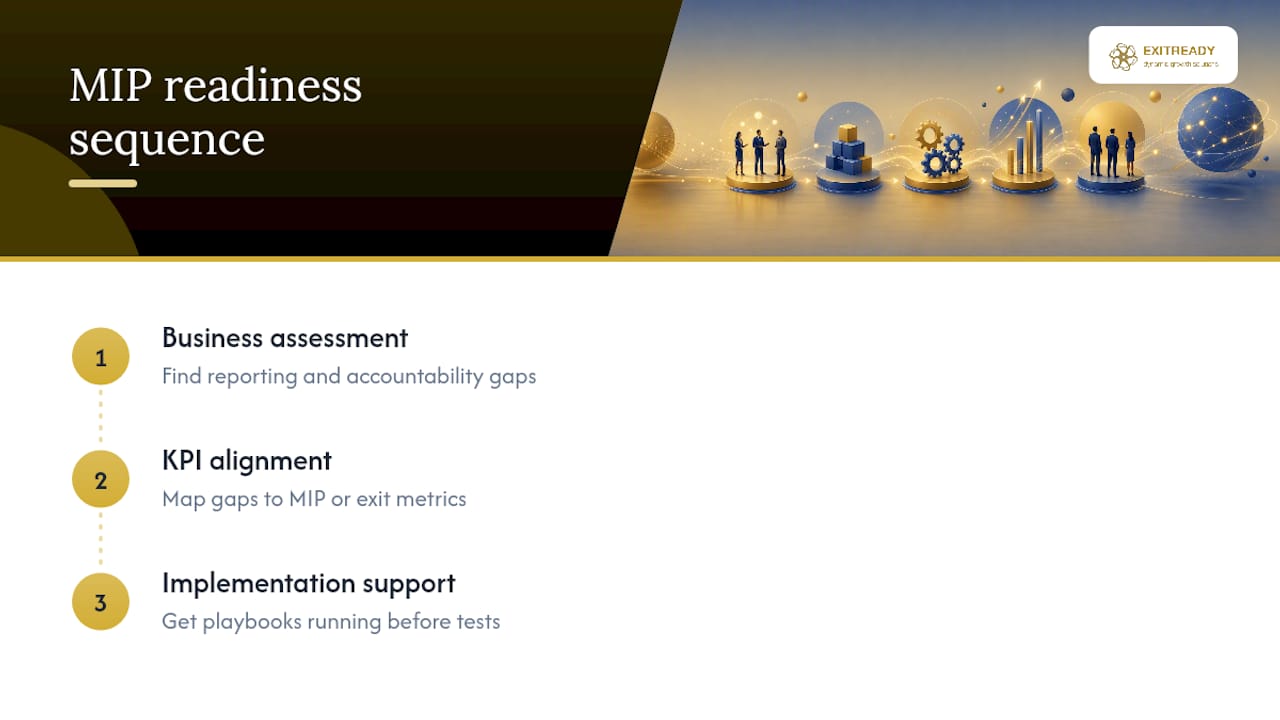
Engagements typically include steps such as business assessments to find where reporting and accountability gaps sit, KPI alignment work to match those gaps to the metrics the MIP or exit case depends on, and implementation support to get playbooks running before a sponsor or board expects results. That sequence matters most for companies heading into a hold period where performance-based vesting will actually get tested against real numbers.
If you’re evaluating whether your management team’s incentive metrics are backed by systems that can deliver them, start with the business scalability checklist for mid-market growth to see where the gaps sit before your next board meeting.
Sources
For deeper legal and market detail beyond this guide, the Goodwin analysis of vesting criteria breaks down deal database trends on vesting splits and ratchets. Deloitte’s human capital incentive design guidance covers avoiding metric overlap, and EisnerAmper’s equity compensation analysis addresses communication pitfalls that undercut plan value even when the economics are sound.
- Accelerating private equity value through human capital incentive plan design · Deloitte
- Incentive Equity: Vesting Criteria for Management Teams of PE-Backed Portfolio Companies · Goodwin
- Equity compensation in private equity: Driving value creation · EisnerAmper