
An operating model redesign succeeds when it realigns capabilities, decision rights, and governance to whatever the strategy now requires, and fails when it becomes a relabeling exercise for the org chart. The first move is not a workshop. It’s scoping a focused diagnostic and naming a single senior sponsor who owns the outcome. Design typically runs a few months; full implementation stretches across multiple years.
TL;DR:
- Successful operating model redesigns are driven by a focused diagnostic and strong senior sponsorship, not just workshops or org chart changes.
- Design principles must be explicit, capability-based, and include clear decision rights, with principled trade-offs to support scalable, customer-centric choices.
- The five-phase process involves strategic scoping, current-state assessment, capability-led future design, gap prioritization, and multi-year implementation with measured KPIs.
- Common pitfalls include goals disconnected from value, weak leadership alignment, neglecting talent, technology misalignment, underfunded transitions, and ignoring incentives.
- Building documented playbooks and applying disciplined sequencing more reliably leads to sustainable transformation than clever org chart changes or superficial reorganization.
Table of Contents
- What Is an Operating Model, and Why Do Leaders Redesign One?
- The Design Principles That Turn Strategy Into Real Choices
- A Five-Phase Framework for Redesigning the Operating Model
- Six Pitfalls That Derail Operating Model Transformation
- How to Measure Whether the Redesign Is Working
- A 90 to 180 Day Checklist for Getting Started
- How Dynamic Growth Solutions Applies This Through AOS
- Examples of Operating Model Redesigns That Actually Worked
- Why Discipline Beats Cleverness in Operating Model Design
- Start Your Operating Model Redesign With a Real Diagnostic
- Sources
What Is an Operating Model, and Why Do Leaders Redesign One?
An operating model is how a company actually works: the processes, decision rights, technology, and talent that turn strategy into daily execution. A target operating model (TOM) is the specific artifact leaders build to describe where that model needs to go. It’s the blueprint that translates strategy into the people, processes, technology, data, and governance required to run the business differently. A TOM is not an org chart with new boxes. It’s a working definition of future-state capabilities that everything else gets built around.
Leaders launch redesigns for a handful of recurring reasons:
- A strategy shift that the current structure can’t support (new markets, new products, new margin targets)
- Mergers or acquisitions that leave two operating models fighting each other
- Digital transformation that exposes how manual and fragmented core workflows really are
- Scaling past the point where founder or executive judgment can substitute for process
- Cost pressure that demands structural simplification, not another round of cuts
Design work is bounded and fast. Implementation is not, and treating the two as the same length of commitment is where budgets and patience run out early.
The Design Principles That Turn Strategy Into Real Choices
Every redesign eventually forces trade-offs: centralize or devolve, standardize or customize, build or buy. Without explicit guardrails, those decisions get made ad hoc by whoever is in the room. Bain’s research on operating model design recommends distilling strategy into a small set of specific, durable principles before any structural decisions get made, precisely so those trade-offs have a reference point.
A workable starting set:
- Design around capabilities, not existing departments or job titles.
- Put customer impact ahead of internal convenience in every close call.
- Make decision rights explicit and assign them to a role, not a committee.
- Push authority down where speed matters more than uniformity.
- Build workflows around the technology stack you’ll actually run, not the one you have.
- Standardize where scale creates value; localize where customer context does.
- Keep spans of control and layers tight enough to move information fast.
- Fund the transition, not just the target state.
- Make every principle testable against a real decision within a week of writing it.
Good principles are short enough to fit on one page and specific enough to settle an argument. If a principle could apply to any company in any industry, it’s not doing its job yet.
Pro Tip: Write each principle as a forced choice, not an aspiration. “We will centralize procurement for anything over $50,000” is a principle. “We value efficiency” is a mission statement.
A Five-Phase Framework for Redesigning the Operating Model
Most successful programs move through five distinct phases, each with its own owner and output.
- Strategic alignment and scoping. The sponsor confirms the business case, defines what’s in and out of scope, and sets success criteria before anyone touches an org chart.
- Current-state assessment. A capability map and a quick decision-rights audit expose where work is duplicated, stuck, or nobody’s job.
- Future-state design. Capabilities lead; governance, technology, and roles get built to serve them, following a capability-led approach to target operating model design rather than starting from headcount.
- Gap analysis and prioritization. Rank the gaps by strategic importance, size, and implementation risk, then group the work into sequenced waves with named owners and dependencies.
- Implementation and iteration. Roll out in waves, track a small set of KPIs, and review governance on a fixed cadence rather than assuming the design was right on day one.
Design (phases one through three) can move in a matter of months. Implementation, especially wave-based rollout across phases four and five, is a multi-year commitment that needs its own budget line, not a footnote in the design proposal. Building the phased framework into your broader strategy execution plan keeps the redesign from drifting once the initial workshops end.
Six Pitfalls That Derail Operating Model Transformation
Redesigns rarely fail because the diagram was wrong. They fail in execution, and the failure modes repeat across industries.
- Goals disconnected from business value. Fix it with value-driver trees that tie every design change to a specific KPI, not a vague efficiency claim.
- Weak senior alignment. Fix it by forcing the executive team to debate and sign off on design principles together, not in separate one-on-ones.
- Ignoring people and talent. Fix it with rigorous role definitions and a real selection process, not a reshuffle of existing titles.
- Treating technology as separate from the design. Fix it by building the tech and data architecture into the capability design from phase three onward.
- Underinvesting in the transition roadmap. Fix it with wave-based sequencing, named owners, and a funded transition budget.
- Ignoring transition risk and incentives. Fix it by tying leadership incentives directly to milestone delivery, not just final outcomes.
McKinsey’s research on operating model redesign finds that leadership alignment, real investment in people, and rewiring of core processes, not surface reorganization, are what separate redesigns that stick from ones that quietly revert within a year.
How to Measure Whether the Redesign Is Working
Pick a small number of KPIs tied directly to the value drivers behind the redesign: cost-to-serve or efficiency percentage, time to market, customer metrics like NPS, and capability maturity scores. A dashboard of 30 metrics gets ignored; a dashboard of six gets used.
- Review leading indicators weekly during active implementation waves.
- Review lagging value metrics quarterly with the steering committee.
- Map decision rights explicitly: who decides, who’s consulted, and where escalation goes when there’s disagreement.
- Revisit the TOM on a fixed annual cadence, or immediately after a material strategic shift, so it doesn’t quietly go stale.
Governance cadence matters as much as the metrics themselves. A KPI nobody reviews on a schedule is just a number sitting in a spreadsheet.
A 90 to 180 Day Checklist for Getting Started
- Confirm scope, name the executive sponsor, and finalize the steering committee.
- Commission a quick diagnostic covering a capability heatmap, a decision-rights map, and key technology dependencies.
- Run focused design workshops with the right roles in the room, not just senior leadership.
- Identify two or three quick wins that fund credibility for the harder waves ahead.
- Build the communication and stakeholder engagement plan before, not after, the first announcement.
Pro Tip: Fund the quick wins from the existing budget, not a new line item. A visible early result with no new spend attached builds more trust than a bigger promise later. Reviewing business transformation best practices before the first workshop helps leadership teams avoid re-litigating basics mid-program.
How Dynamic Growth Solutions Applies This Through AOS
An Accelerated Operating System approach can be built around the same phased logic: assessment, capability design, documented playbooks, and certification, aiming for operational independence and exit readiness rather than a prettier org chart.
The redesign only pays off once decisions and workflows survive without the owner in the room. A documented playbook is what makes that possible.
Mid-market leaders considering the AOS approach can review business operating system examples to see how the phases translate into working playbooks before committing to a full engagement.
Examples of Operating Model Redesigns That Actually Worked
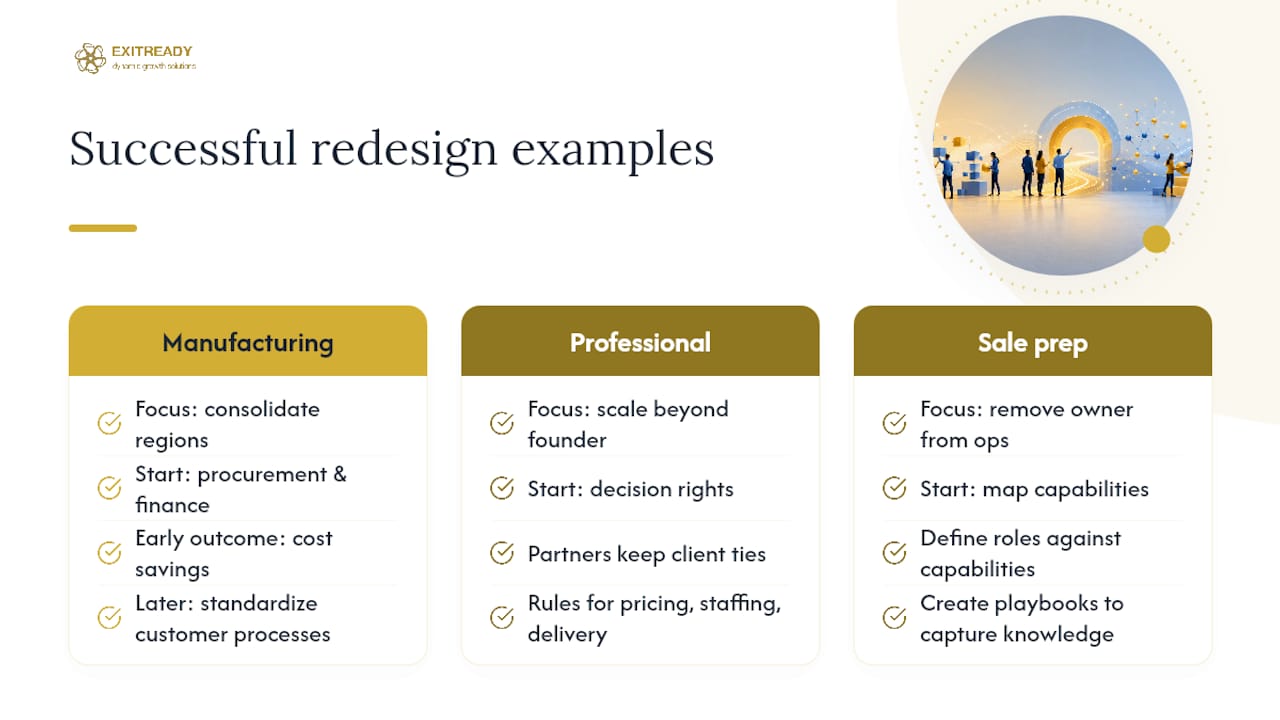
The pattern behind successful redesigns is consistent even when the industry isn’t. A manufacturing business that consolidates three regional operating models into one shared services structure typically starts with procurement and finance, the functions where duplication is easiest to prove and cost savings show up fastest. That early win funds the harder, slower work of standardizing customer-facing processes later.
A professional services firm scaling past its founder-led structure usually redesigns around decision rights first, not headcount. Partners keep client relationships, but pricing, staffing, and delivery decisions move to documented rules instead of individual judgment calls. That shift alone often does more for growth capacity than any new hire.
In mid-market businesses preparing for a sale or ownership transition, the redesign tends to center on removing the owner from daily operational decisions. Capabilities get mapped, roles get defined against those capabilities, and playbooks replace tribal knowledge. Buyers pay more for a business that runs without its founder, and that’s the outcome a capability-led TOM is built to produce.
None of these examples required a radical strategy change. They required the discipline to sequence the work, fund the transition, and hold leadership accountable to the same principles across every wave. That discipline, more than any specific structural choice, is what shows up in the businesses that come out the other side stronger.
Why Discipline Beats Cleverness in Operating Model Design
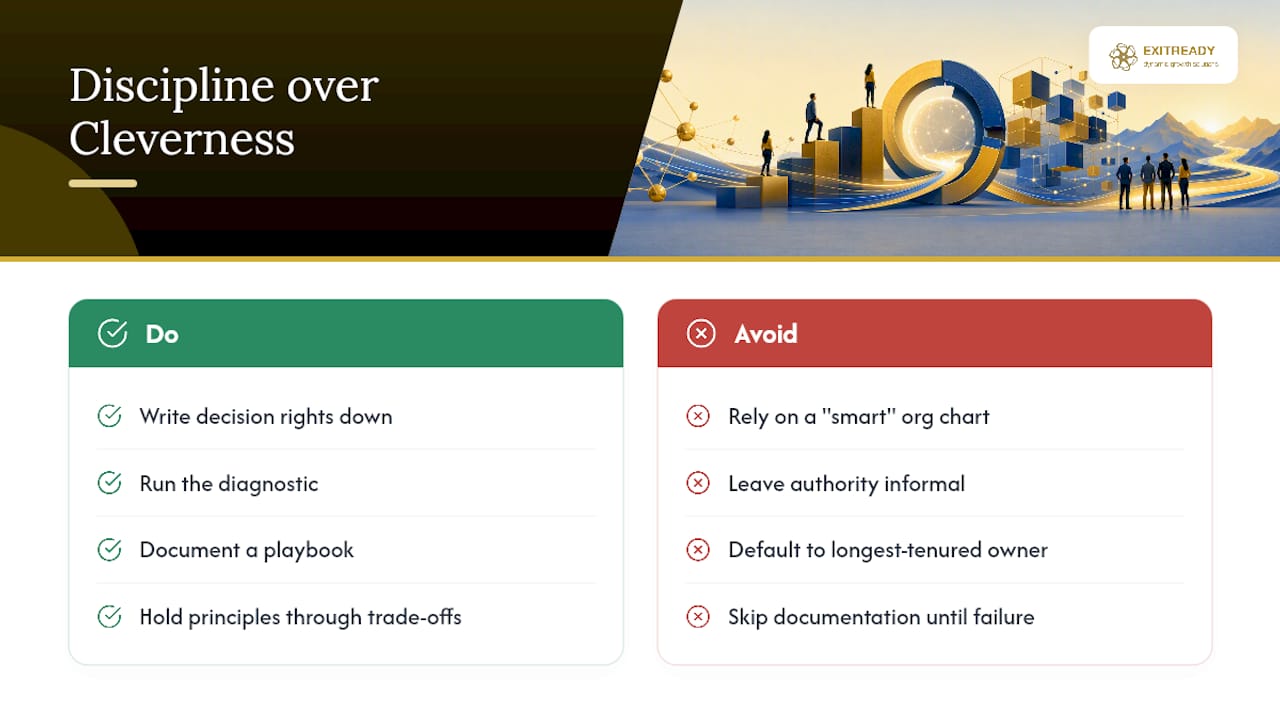
The businesses that get this right aren’t the ones with the smartest org chart. They’re the ones willing to write down decision rights nobody wanted to formalize, because informal authority always defaults back to whoever has been there longest. That’s usually the owner, and it’s usually the bottleneck.
A documented playbook feels like overkill until the day a key person leaves and the business doesn’t stall. That’s the actual test of whether a redesign worked. Run the diagnostic, write the principles down, and hold the line on them past the first hard trade-off.
— Andre
Start Your Operating Model Redesign With a Real Diagnostic
Most mid-market leaders don’t need another framework. They need someone to run the diagnostic, name the gaps, and build the playbook that makes the business run without them in every decision. The Accelerated Operating System is designed as a structured path from assessment to documented capability design to exit-ready certification, rather than a generic consulting deck that never gets implemented.
Unlike traditional consulting engagements that end with slide decks and leave execution to the client, some approaches include playbook-building and certification stages to help redesigns survive past the workshop phase. If you’re weighing whether your business is ready for this level of structural change, start with business transformation best practices for executives and request a scoped assessment from there.
Sources
- Target Operating Model (TOM): A Practical Guide | Capstera
- The new rules for getting your operating model redesign right | McKinsey
- Design principles for a robust operating model | Bain
- Fundamentals of the Target Operating Model | OC&C Strategy Consultants