
Business complexity is defined as the point where operational demands multiply faster than a leader’s capacity to manage them, causing performance decline and decision paralysis. Understanding how business complexity overwhelms owners is the first step toward fixing it. By mid-2026, the average owner manages 27 software platforms, 14 direct reports, and makes more than 300 operational decisions every week. That volume does not just create stress. It systematically degrades the quality of every decision made after the first few hours of the workday.
How business complexity overwhelms owners: the core drivers
Operational complexity does not arrive all at once. It accumulates through four distinct pressure points that compound each other over time.
Technology sprawl is the most visible culprit. When a business runs 27 disconnected software platforms, each tool creates its own data silo, maintenance burden, and training requirement. Owners end up spending time reconciling information across systems instead of acting on it.

Human coordination multiplies the load further. Every new hire adds communication loops, conflict resolution, onboarding time, and recurring meetings. Adding a fifth employee can increase coordination overhead by 40%, not just add a proportional workload. That number surprises most owners because they expect linear growth in effort, not exponential.
Process inconsistency creates a third layer of drag. When procedures are undocumented or applied differently across teams, owners become the default quality check. Every exception routes back to them.
Strategic overload closes the loop. A typical business runs 12 simultaneous initiatives with few completed. Spreading leadership attention across that many fronts means nothing gets the focus it needs to reach completion.
The combined result: owners spend approximately 40% of their week on coordination, training, and decision routing rather than work that actually moves the business forward. That is not a time management problem. It is a structural design problem.
How does complexity damage owner decision-making?
Decision fatigue is the direct cognitive cost of operational overload. The human brain does not process the 300th decision of the week with the same quality as the 10th. Judgment degrades, risk tolerance shifts, and creative thinking shuts down.
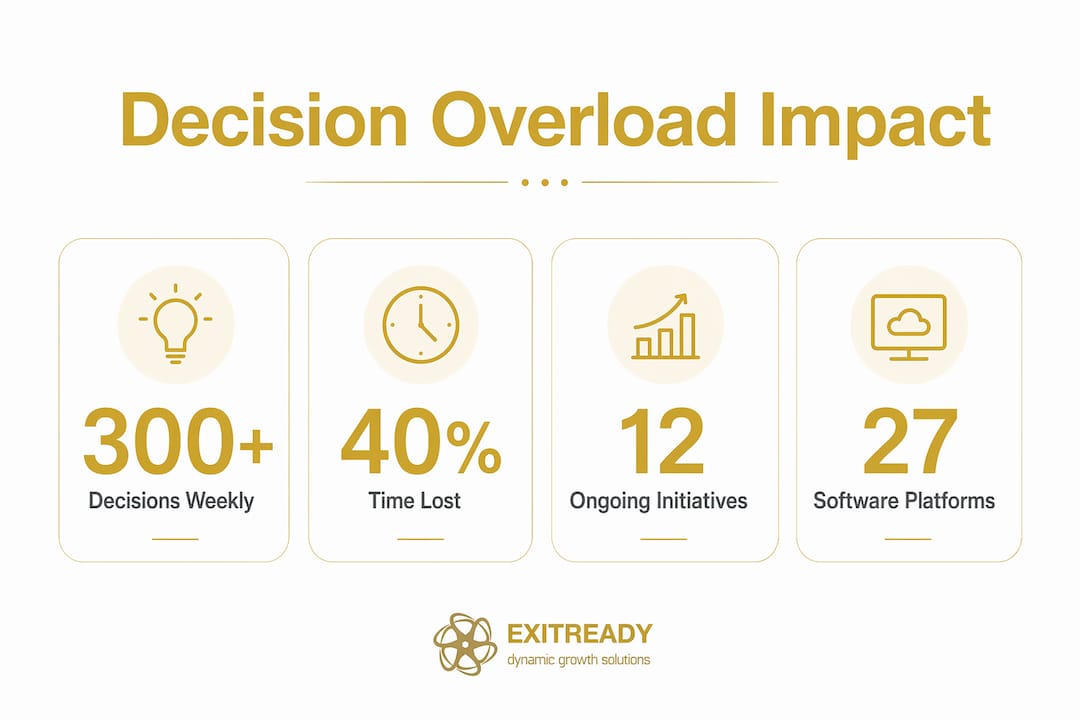
The World Economic Forum identifies stress intelligence as a critical leadership capability for exactly this reason. Stress intelligence is the ability to recognize how stress is altering your thinking in real time and to adjust before making a consequential call. Most owners have never been trained in it.
Sustained stress impairs memory, judgment, creativity, and risk assessment, creating a vicious cycle where poor decisions generate more problems, which generate more decisions. The owner becomes the bottleneck not because they lack capability, but because the business design forces every uncertainty to route through them.
“Decision fatigue should be understood structurally. The business design is the bottleneck, not the owner’s capability.”
Personal productivity tactics, such as time blocking, morning routines, or inbox management, do not solve this. They treat the symptom. The root cause is unstructured business systems that have no clear decision architecture. Until the system changes, the owner absorbs every gap.
Pro Tip: Track how many decisions you make before noon on a Monday versus a Friday afternoon. The gap in quality you notice is decision fatigue in action. Use that data to identify which decisions need to be delegated or systematized first.
What structural myths prevent owners from solving this?
The most damaging myth in mid-market businesses is that complexity is a people problem. Owners replace staff, hire better talent, or invest in leadership coaching, and the chaos persists. That is because the problem lies in decision routing and escalation deficits, not in individual employee performance.
Four structural traps keep owners stuck:
- No escalation rules. When teams have no clear criteria for what they can decide independently versus what needs owner input, everything escalates. The owner becomes a universal decision node by default.
- Informal systems that break at scale. Systems built on tribal knowledge and verbal agreements work at five employees. At fifteen, they collapse. The owner fills every gap personally.
- Hiring without systems. Adding headcount to an undocumented operation does not reduce complexity. It multiplies coordination overhead and creates new failure points without resolving the original ones.
- Cross-functional conflicts with no resolution path. When sales, operations, and finance have competing priorities and no documented process for resolving them, the owner becomes the referee for every conflict.
The founder bottleneck effect is the end state of all four traps combined. The owner is physically present in every critical function, not because they want to be, but because the organization has no other mechanism for making decisions. Learning to scale a mid-market business systematically requires replacing those informal mechanisms with documented ones before adding more people or technology.
What strategies actually reduce operational overwhelm?
Reducing complexity requires structural changes, not personal discipline. The following approaches address the root causes rather than the symptoms.
Build a decision architecture
A decision architecture defines who owns which decisions, what criteria trigger escalation, and what information is required before a decision reaches the owner. This single change removes the majority of unnecessary escalations. Owners who implement clear escalation rules report reclaiming significant blocks of focused time within the first 90 days.
Systematize your core processes
Onboarding, quality control, and sales processes are the three highest-leverage areas to document first. When these run from written playbooks rather than from the owner’s memory, new hires reach competence faster, quality becomes consistent, and the owner exits the daily execution loop. Dynamicgrowthsolutions’ AOS (Accelerated Operating System) is built specifically around this principle, replacing owner dependency with self-sustaining documented operations.
Reduce strategic initiatives to a focused few
Running fewer initiatives to completion beats running many initiatives to stagnation. A practical rule: limit active strategic priorities to three at any given time. Completing three initiatives creates momentum and organizational confidence. Stalling on twelve creates overhead without results.
Build organizational stress intelligence
Stress management training reduces psychological strain for managers, but individual coping alone is insufficient. Sustainable relief requires embedding systemic support into the organization’s structure. That means building teams that can absorb pressure without routing it upward, and creating decision-making frameworks under pressure that protect decision quality even during high-stress periods.
| Approach | What it addresses |
|---|---|
| Decision architecture | Eliminates unnecessary owner escalations |
| Documented process playbooks | Removes owner from daily execution loop |
| Focused initiative limits | Prevents strategic dilution and stall |
| Stress intelligence training | Protects decision quality under pressure |
| Structured escalation rules | Resolves cross-functional conflicts without owner involvement |
Pro Tip: Use the business scalability checklist from Dynamicgrowthsolutions to identify which of your current processes have no documentation. Those gaps are where your time is disappearing.
Key takeaways
Operational complexity overwhelms owners when business design forces every uncertainty through a single decision point: the owner. Structural systems, not personal effort, are the only lasting fix.
| Point | Details |
|---|---|
| Complexity is a system problem | Overwhelm signals a design failure in decision routing, not a personal capability gap. |
| Technology and coordination multiply load | Disconnected platforms and undocumented processes force owners into daily firefighting. |
| Decision fatigue degrades judgment | Stress impairs memory and risk assessment, making structural relief more urgent than personal coping. |
| Hiring without systems backfires | Adding staff to an undocumented operation increases coordination overhead, not capacity. |
| Focused initiatives outperform scattered ones | Completing three priorities beats stalling on twelve every time. |
What I’ve learned from watching owners hit the complexity wall
The owners I work with are not failing because they lack drive or intelligence. They are failing because they built their businesses on informal systems that worked brilliantly at small scale and then silently collapsed as the company grew. By the time they recognize the problem, they are already deep inside it.
The most common misconception I encounter is that the solution is personal. Owners believe they need to work harder, delegate better, or think more clearly. Those things matter at the margin. But when a business has no documented escalation rules, no written process playbooks, and no clear decision ownership, no amount of personal discipline closes that gap. The operating model inflection point is real, and crossing it requires structural change, not heroic effort.
What I find most encouraging is how quickly things shift once owners stop treating this as a mindset problem and start treating it as an engineering problem. Documenting the top ten recurring decisions and assigning clear ownership takes a weekend. The relief that follows can be immediate and significant. The business does not need to be perfect. It needs to be designed well enough that the owner is no longer the only load-bearing wall.
Sustainable growth comes from building an organization that functions without you in every conversation. That is not a luxury for large companies. It is the prerequisite for any mid-market owner who wants to grow, exit, or simply reclaim their time.
— Andre
How Dynamicgrowthsolutions helps owners reduce complexity
Owners facing operational overload need more than advice. They need a working system.
Dynamicgrowthsolutions works with mid-market owners to replace informal, owner-dependent operations with documented, self-sustaining systems through the AOS (Accelerated Operating System). The program covers decision architecture, process documentation, and strategic focus, applying Fortune 500 methodologies adapted for mid-market scale. Owners who want to understand where their complexity is concentrated can start with a business operating system assessment or review the business management systems framework to see how structural change translates into measurable growth and valuation improvement.
FAQ
What is business complexity for mid-market owners?
Business complexity is the condition where operational decisions, coordination demands, and process inconsistencies multiply faster than the owner’s capacity to manage them. It typically accelerates between 10 and 50 employees as informal systems break down.
How many decisions does the average business owner make weekly?
The average small business owner makes more than 300 operational decisions per week while managing 27 software platforms and 14 direct reports. That volume creates significant decision fatigue and degrades judgment quality over time.
Why does hiring more staff sometimes increase complexity?
Adding a fifth employee can increase coordination overhead by 40% when no documented systems exist. Without clear processes and escalation rules, each new hire creates new communication loops and failure points rather than reducing the owner’s load.
What is stress intelligence and why does it matter for owners?
Stress intelligence is the ability to recognize how stress is altering your thinking in real time and to adjust before making a high-stakes decision. The World Economic Forum identifies it as a critical leadership skill because sustained stress impairs memory, judgment, and risk assessment.
What is the fastest structural fix for decision overload?
Documenting escalation rules is the fastest fix. Defining which decisions team members own independently versus which require owner input eliminates the majority of unnecessary escalations and reclaims focused leadership time within weeks.