

Reactive business management is the practice of responding to problems, demands, and disruptions only after they occur, rather than anticipating and preparing for them in advance. MindTools describes this pattern as inherently hectic, stressful, and inefficient. In a genuine crisis, a reactive response is not just acceptable — it’s necessary. The damage comes when reactive decision making stops being a short-term tactic and becomes the default operating mode of the organization.
Four patterns define reactive management in practice:
- Leaders spend most of their day solving problems that already happened rather than preventing the next ones.
- Decisions get made ad hoc, without documented criteria or delegated authority.
- Workflows depend on one or two people (usually the owner or a senior manager) to function.
- Fixes are one-off patches rather than permanent process changes.
If any of those sound familiar, the rest of this guide is worth your time.
Key Takeaways
Chronic reactive management is a structural problem, not a leadership personality flaw — and it requires a structural solution: documented playbooks, delegated decision rights, and governance rhythms that run independently of any single person.
| Point | Details |
|---|---|
| Reactive vs. proactive defined | Reactive management responds after problems occur; proactive management anticipates and prevents them through documented systems. |
| When reactivity is appropriate | Genuine crises, safety incidents, and unforeseeable external shocks warrant reactive responses — contained, time-boxed, and followed by a post-incident review. |
| Cost of chronic reactivity | Persistent firefighting consumes leadership capacity, raises error rates, accelerates staff turnover, and depresses business valuation. |
| 30/60/90 roadmap | Start by delegating the top three recurring decisions; build playbooks and governance rhythms by day 60; measure leading indicators and systematize by day 90. |
| Dynamicgrowthsolutions AOS | The Accelerated Operating System installs documented playbooks, delegated decision rights, and governance rhythms to replace owner-dependent firefighting with scalable operations. |
Table of Contents
- What is reactive business management, and how does it differ from proactive management?
- How to tell if your organization is operating reactively
- Why chronic reactivity damages your organization over time
- When a reactive response is actually the right call
- How to shift from reactive to proactive management: a practical roadmap
- What operational systems reduce reactivity most effectively?
- Which metrics tell you whether your organization is still reactive?
- Working on the business, not in it: the mindset shift that makes everything else stick
- How the Accelerated Operating System (AOS) stops chronic reactivity
- Sources
What is reactive business management, and how does it differ from proactive management?
Reactive business management means the organization’s default response to operational demands is to wait until a problem surfaces, then mobilize to fix it. There is no standing process for anticipating failure, no documented playbook for the team to follow, and no early-warning system. The leader becomes the circuit breaker for everything that goes wrong.
Proactive management, by contrast, means building systems that identify risks before they become crises. HR Acuity notes that proactive management, when systemized, increases productivity, lowers costs, and strengthens decision-making across the organization. The key word is “systemized” — proactivity is not a personality trait; it is a repeatable practice built into how the business runs.
The table below contrasts the two approaches across the dimensions that matter most to mid-market leaders.
| Dimension | Reactive management | Proactive management |
|---|---|---|
| Decision timing | After the problem appears | Before the problem escalates |
| Resource allocation | Pulled from current priorities to fight fires | Planned and budgeted in advance |
| Typical trigger | Customer complaint, missed deadline, outage | Risk review, trend data, scheduled planning cycle |
| Leadership behavior | Owner or senior manager resolves personally | Documented process or deputy handles it |
| Organizational cost | High rework, overtime, and error rates | Lower rework; capacity directed at growth |
Three example pairs show how the difference plays out in real mid-market situations:
- Missed deadline: Reactive — the owner calls an all-hands meeting and manually reassigns tasks. Proactive — a project dashboard flags schedule risk two weeks out, and the project lead adjusts resources using a documented escalation protocol.
- Customer complaint: Reactive — a senior manager personally handles every escalation. Proactive — a tiered complaint-resolution playbook routes issues to trained frontline staff, with clear criteria for when to escalate.
- Sudden supplier outage: Reactive — the operations team scrambles to find an alternative vendor with no prior vetting. Proactive — a pre-approved backup supplier list and a supplier-risk review cadence mean the team activates a known option within hours.
Nulab’s research on reactive vs. proactive managers makes an important point: neither style alone fits every situation. The goal is not to eliminate reactive capacity but to favor proactivity as the default while retaining the ability to respond fast when a genuine surprise hits.
How to tell if your organization is operating reactively
You’re operating reactively if the majority of your leadership team’s time is consumed by problems that already happened rather than work that moves the business forward. That’s the diagnostic in one sentence. Below is a more granular checklist, grouped by category.
Leadership behaviors
- The owner or CEO is the final decision-maker on operational issues that should be handled by managers.
- Meetings are dominated by status updates and problem reports rather than strategic discussion.
- Leaders regularly cancel planned work to handle urgent requests.
- There is no structured time each week for forward-looking planning.
Process gaps
- No documented playbooks exist for the top 10 recurring operational scenarios.
- Fixes to recurring problems are one-off patches with no root-cause analysis.
- New hires take months to become productive because knowledge lives in people’s heads.
- Reactive change management is the norm: change gets implemented only after a crisis forces it, raising adoption and sustainability risks.
People and culture
- Staff regularly wait for direction rather than acting within defined authority.
- High performers burn out or leave because they spend most of their time in firefighting mode.
- Accountability is unclear — when something goes wrong, it’s not obvious who owns the fix.
Tools and data
- There is no operational dashboard that surfaces problems before they become crises.
- Incident data is not captured or reviewed systematically.
- Capacity and demand are managed by gut feel rather than tracked metrics.
How to triage your findings: Count the items that apply. One to three is normal operational friction. Four to six signals a pattern worth addressing in the next 90 days. Seven or more means chronic reactivity is already costing you growth capacity, and the organization needs a structured intervention.
Pro Tip: Start with the leadership behavior category. If the owner or CEO is the bottleneck on operational decisions, every other fix is temporary — the system will keep routing problems back to the top until decision rights are formally delegated.
Why chronic reactivity damages your organization over time
Chronic reactivity increases cost, raises error rates, accelerates staff turnover, and slows every strategic initiative the business is trying to run. These are not soft cultural concerns — they are measurable operational drags.
BetterUp’s research on reactive vs. proactive management finds that blending proactive planning with reactive adaptability improves both team morale and strategic results, and that proactive practices lower the frequency of avoidable crises. The inverse is equally true: organizations that never build proactive practices accumulate a compounding deficit of unresolved root causes.
Consider a mid-market distribution company with 80 employees and an owner who handles every major customer escalation personally. Each escalation takes 45 to 90 minutes. The owner fields six to eight per week. That’s roughly six to twelve hours of senior leadership time consumed by work that a trained customer success manager with a documented escalation protocol could handle in 20 minutes. Over a year, the owner loses 300 to 600 hours of strategic capacity — time that never gets spent on pricing strategy, talent development, or market expansion. The business stays flat not because the market is bad, but because the person responsible for growth is permanently occupied with yesterday’s problems.
The operational and cultural consequences of persistent reactivity include:
- Lost leadership capacity that never gets reinvested in growth.
- Higher error rates because fixes are rushed and undocumented.
- Delayed or abandoned strategic projects because urgent always beats important.
- Degraded team morale as staff spend more time in crisis mode than on planned, value-adding work.
- Reduced organizational resilience — when the owner is unavailable, the business stalls.
- Lower business valuation, because a buyer or investor sees an operation that cannot run without its current leadership.
Proactive management is directly associated with better morale and less staff burnout because teams operating within clear systems spend less time absorbing the anxiety of constant firefighting.
When a reactive response is actually the right call
Not every reactive response is a failure of management. There are situations where the right answer is to respond fast, not to wait for a planned process to catch up.
Appropriate scenarios for reactive management include:
- A genuine safety incident requiring immediate containment.
- An unforeseeable external shock — a natural disaster, a sudden regulatory change, a key supplier bankruptcy with no warning.
- A cybersecurity breach or data incident where speed of response limits damage.
- A sudden, significant customer defection that threatens near-term revenue.
The critical distinction is that these are narrow, time-bounded situations. A reactive response is appropriate when the event is genuinely unforeseeable and the cost of delay exceeds the cost of an imperfect fast decision. It is not appropriate as a substitute for planning in areas where the risk was knowable in advance.
Containment steps for reactive events:
- Isolate the issue to prevent it from cascading into adjacent systems or teams.
- Assign a single incident owner with clear authority to make decisions.
- Time-box the reactive phase — set a defined window (hours, not weeks) for the immediate fix.
- Communicate status to affected stakeholders on a regular cadence during the incident.
- Capture a brief post-incident record: what happened, what was done, what the root cause appears to be.
That last step is where most organizations leave value on the table. A post-incident review, even a 30-minute one, converts a reactive event into an input for proactive planning. High-performing teams keep short incident runbooks and a fast post-incident review loop, converting unplanned work into process improvements that prevent recurrence. The reactive event becomes the evidence base for the next playbook.
How to shift from reactive to proactive management: a practical roadmap
To shift from reactive to proactive, leaders must free their own time, document playbooks, build governance rhythms, measure leading signals, and develop deputies who can own operational decisions. That sequence matters — none of the later steps work if the leader is still the bottleneck on day-to-day operations.
Phase 1: Days 1–30 (Diagnose and free capacity)
- Run the diagnostic checklist from the previous section and score your organization honestly.
- Identify the top three recurring incidents that consume the most leadership time each week.
- For each of those three incidents, document a simple decision flow: what triggers it, who owns it, what the standard response is, and when to escalate.
- Formally delegate operational decision authority for at least two categories of recurring decisions to a named deputy.
- Block two hours per week on the owner’s or CEO’s calendar for forward-looking planning — and protect it.
Phase 2: Days 31–60 (Build the foundation)
- Extend playbook documentation to the next five to seven high-frequency operational scenarios.
- Stand up a simple operational dashboard that surfaces the metrics most likely to predict problems (see the metrics section below).
- Establish a weekly operational review meeting with a fixed agenda: what happened last week, what’s at risk this week, what decisions need to be made.
- Invest in management coaching for the deputies now holding delegated authority — documented playbooks only work if the people using them have the judgment to apply them.
- Capture post-incident reviews for every significant reactive event and feed findings back into playbooks.
Phase 3: Days 61–90 (Govern and measure)
- Add a monthly strategic review to the governance calendar, separate from the weekly operational review.
- Review playbook usage data — are the documented processes actually being followed, or are people still routing decisions upward?
- Set baseline measurements for the key reactivity metrics (unplanned work percentage, incident frequency, owner hours on operations).
- Identify one or two processes ready for further systematization and assign an owner to lead that work.
Longer-term systemization: The 90-day roadmap builds the foundation. Sustaining it requires an operating system — a structured set of documented processes, governance rhythms, and decision rights that runs independently of any single person. Dynamicgrowthsolutions’s Accelerated Operating System (AOS) maps directly to this roadmap: it uses documented playbooks, governance rhythms, and delegated decision rights to reduce owner-dependent firefighting and build the kind of operational independence that supports both growth and exit readiness.
Pro Tip: The fastest early win usually comes from documenting the single highest-frequency failure mode in the business — the one that pulls the owner in most often — and creating one decision flow for it. That single document, shared with the right deputy, can free four to six hours of leadership time per week within 30 days.
A mid-market professional services firm with 60 staff had one recurring failure mode: client onboarding delays caused by missing intake documents. The owner spent roughly three hours per week personally chasing clients and internal staff. After a two-hour documentation session, the team had a four-step onboarding checklist, an automated reminder sequence, and a named coordinator who owned the process. Within six weeks, onboarding delays dropped by more than half and the owner stopped touching the process entirely. The systematized process became a template for three other high-friction workflows.
What operational systems reduce reactivity most effectively?
Four systems produce the most immediate reduction in reactive firefighting for mid-market firms. Get these in place before adding anything else.
Documented playbooks and runbooks. A playbook is a written record of how a recurring situation should be handled: who owns it, what the standard steps are, and when to escalate. The first step is to document the top three to five recurring incidents. Systematized business processes give teams a reference point that doesn’t depend on a specific person being available.

RACI or decision matrix. Reactive organizations suffer from unclear ownership. A RACI (Responsible, Accountable, Consulted, Informed) matrix assigns clear roles for every major decision category. The first step is to map the 10 decisions that most often get routed to the owner and assign a non-owner accountable party for each.
Incident runbooks. Separate from general playbooks, an incident runbook is a step-by-step response guide for a specific failure scenario (server outage, key staff absence, supplier failure). The first step is to write a one-page runbook for the single most disruptive incident type the business has experienced in the past 12 months.
Capacity and demand dashboard. Most reactive decisions happen because no one saw the problem coming. A simple dashboard tracking workload, pipeline, and resource availability gives leaders a 2–4 week forward view. The first step is to identify the three metrics that most reliably predict overload or shortfall in your operation and start tracking them weekly.
For incident tracking, knowledge base management, scheduling, and KPI dashboards, mid-market firms typically use a combination of project management tools (for task and incident tracking), wiki-style knowledge bases (for playbook storage), and spreadsheet or BI tools (for operational dashboards). The specific tools matter less than the discipline of using them consistently.
For owner-dependent mid-market operations, prioritize the playbook library and the RACI matrix first. Both address the root cause of most reactive firefighting: unclear ownership and undocumented process. Everything else builds on that foundation.
Which metrics tell you whether your organization is still reactive?
Monitoring both input signals and outcome KPIs is the only reliable way to measure reactivity and validate that proactive practices are taking hold. Input signals tell you what’s happening now; outcome KPIs tell you whether it’s getting better.
| Metric | What it measures | Why it signals reactivity | Suggested cadence |
|---|---|---|---|
| Percentage of unplanned work | Share of team capacity consumed by unscheduled tasks | High unplanned work means the organization is being driven by events, not plans | Weekly |
| Incident frequency | Number of escalations or unplanned interventions per week | Rising frequency indicates root causes are not being addressed | Weekly |
| Owner hours on operations | Hours per week the owner spends on day-to-day operational decisions | High owner involvement signals undelegated authority and missing playbooks | Weekly |
| On-time delivery rate | Percentage of commitments met on schedule | Chronic lateness reflects capacity being diverted to firefighting | Monthly |
| Employee turnover rate | Annualized staff attrition | Elevated turnover often reflects burnout from sustained reactive culture | Quarterly |
| Post-incident review completion | Percentage of significant incidents that received a documented review | Low completion means reactive events are not being converted into process improvements | Monthly |
Leading indicators (tell you reactivity is building before it becomes a crisis):
- Rising incident frequency week over week.
- Increasing percentage of unplanned work as a share of total capacity.
- Owner hours on operations trending upward.
- Growing backlog of undocumented recurring processes.
Lagging indicators (confirm the damage after it has occurred):
- Employee turnover above industry norms.
- On-time delivery rate declining over a rolling quarter.
- Customer escalation volume increasing.
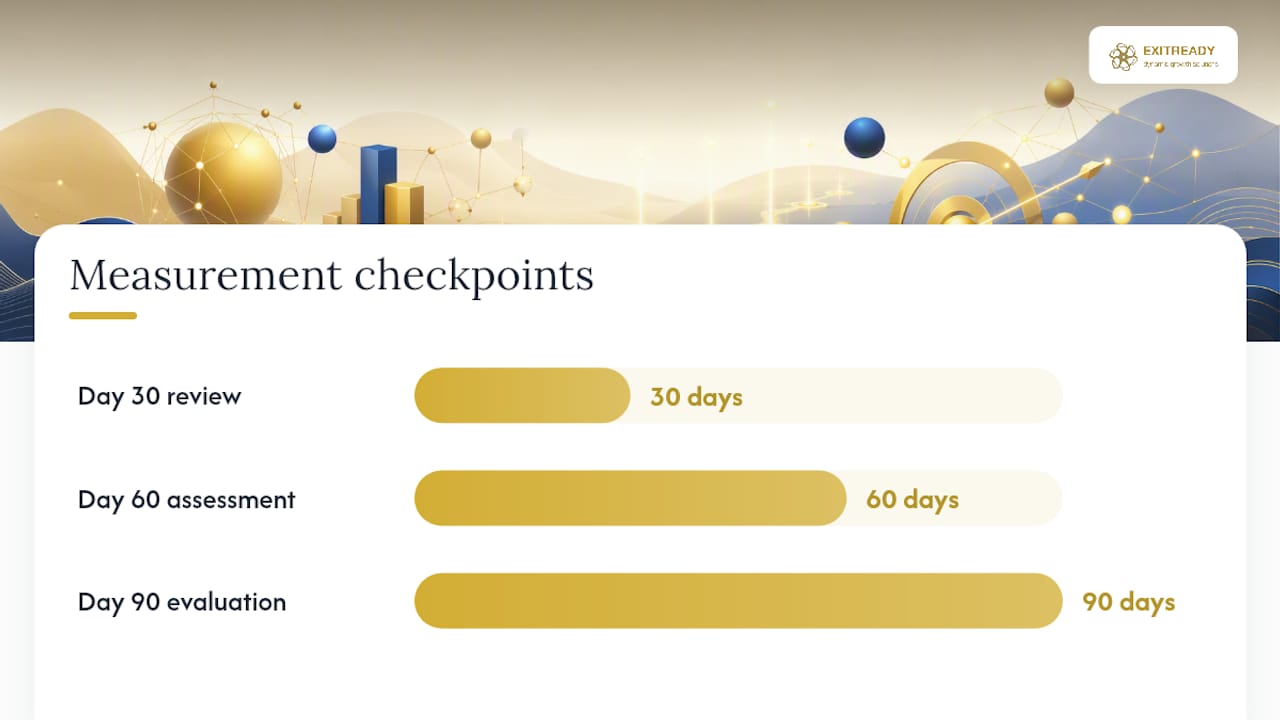
Setting a baseline and running 30/60/90 checks: In week one, measure each metric for the prior four weeks and establish a baseline. At day 30, compare current values to baseline and identify which metrics have moved. At day 60, assess whether the direction of change is consistent. By day 90, you should see measurable improvement in at least two leading indicators if the roadmap steps are being followed. CEO-level KPI governance provides a useful framework for embedding these metrics into a regular leadership review cadence.
Working on the business, not in it: the mindset shift that makes everything else stick
The core leadership shift required to sustain proactive management is moving from “doer of last resort” to system owner and talent multiplier. Every tactical step in the roadmap above fails if the leader keeps stepping back into the operational role whenever things get hard.
That shift requires specific behavior changes, not just intentions:
- Delegate decisions at the lowest competent level, and resist the pull to override when deputies make different choices than you would.
- Build a cadre of deputies who own defined operational domains, with the authority and information to act without escalating.
- Protect strategic time on the calendar as a non-negotiable commitment, the same way a client meeting would be protected.
- Reward documentation and process improvement explicitly — recognize the team member who writes the playbook, not just the one who heroically fixes the crisis.
- Treat every reactive event as a system failure to be analyzed, not a performance to be praised.
Governance rhythms are what make these behavior changes repeatable rather than aspirational. A weekly operational review (45–60 minutes, fixed agenda, led by a deputy) keeps the owner informed without pulling them into execution. A monthly strategic review (90 minutes, focused on 90-day priorities, risks, and resource allocation) protects the time for forward-looking work. Without those rhythms, the calendar fills with reactive demands and strategic work never happens.
Working on the business rather than in it is not a philosophical preference — it is the structural precondition for growth. A business that requires its owner to function is not a scalable asset; it is a job with overhead.
HBR-level thinking on organizational leadership reinforces that proactive management requires cultural work — transparency, psychological safety, and risk-sharing — so leaders can rely on early signals rather than waiting for visible crises. That cultural work starts with the leader modeling the behavior: sharing information, tolerating imperfect decisions made within the right process, and visibly spending time on strategy rather than firefighting.
How the Accelerated Operating System (AOS) stops chronic reactivity
Mid-market owners who have run the diagnostic checklist and recognize their organization in it face a practical problem: building the systems, playbooks, and governance rhythms described in this guide takes time and expertise that most leadership teams don’t have spare capacity for. That’s the gap the Accelerated Operating System (AOS) from Dynamicgrowthsolutions is built to close.

The AOS is a structured business operating system that installs documented playbooks, delegated decision rights, and repeatable governance rhythms into mid-market companies, replacing owner-dependent firefighting with self-sustaining operations. It maps directly to the roadmap in this guide: the 30-day diagnostic and delegation work, the 60-day playbook and governance build, and the 90-day measurement and systemization phase are all embedded in the AOS methodology.
Core benefits for mid-market owners:
- Documented playbooks that give teams a reference point for every high-frequency operational scenario.
- Formally delegated decision rights that remove the owner as the bottleneck on day-to-day operations.
- Governance rhythms (weekly operational review, monthly strategic review) that protect leadership time for strategy.
- Measurable KPIs and dashboards that surface reactivity signals before they become crises.
- Exit-readiness positioning: a business that runs on documented systems commands a higher valuation than one that depends on its owner.
Explore the Accelerated Operating System and the nine key benefits of operating system adoption to see how the methodology applies to your specific situation, or book a business assessment to get a structured diagnosis of where chronic reactivity is costing your organization the most.
Sources
- From reactive to proactive management | MindTools
- Proactive Management: How to Lead Your Team Effectively | HR Acuity
- Reactive vs proactive managers: How to lead without the stress | Nulab
- Reactive vs. proactive management: guide | BetterUp
- What Is Reactive Change Management? A Definitive Guide | Indeed