
A business operating manual is the master document that defines how your company runs, mapping its organizational structure, core processes, customer standards, and escalation protocols into a single authoritative reference. Most owners confuse it with a standard operating procedure (SOP) library or an employee handbook. Those are supporting documents. The operating manual is the structural map that holds everything together. Businesses that implement one reduce onboarding time by 70%, which signals something more significant: the company no longer depends on any single person to function.
Thank you for reading this post, don't forget to subscribe!What is a business operating manual and how does it differ from SOPs
A business operating manual is defined as a comprehensive document that describes how a business operates at the structural level, covering roles, workflows, standards, and governance. The industry term you will also encounter is operations manual, and both refer to the same concept. Where owners get confused is in treating it as a replacement for SOPs or policies. It is not.
Think of it this way. An operations manual provides the big-picture map of your business, while SOPs are the turn-by-turn directions for executing specific tasks. Your manual tells you that customer complaints are handled by the service team within 24 hours. Your SOP tells the service rep exactly how to log, respond, and escalate that complaint in your CRM. Both are necessary. Neither replaces the other.

The table below clarifies how these three documents relate to each other:
| Document | Primary focus | Level of detail | Who uses it |
|---|---|---|---|
| Operations manual | Business structure and workflows | High-level map | Owners, managers, new hires |
| Standard operating procedures | Step-by-step task execution | Granular instructions | Frontline staff, team leads |
| Policy manual | Rules, compliance, and conduct | Principles and boundaries | HR, legal, all employees |
Operations manuals focus on operational workflows and how work moves through the business, which is what enables scalability. A policy manual tells employees what they cannot do. An employee handbook explains benefits and culture. Your operations manual explains how the machine runs.
What are the core components of an effective operating manual
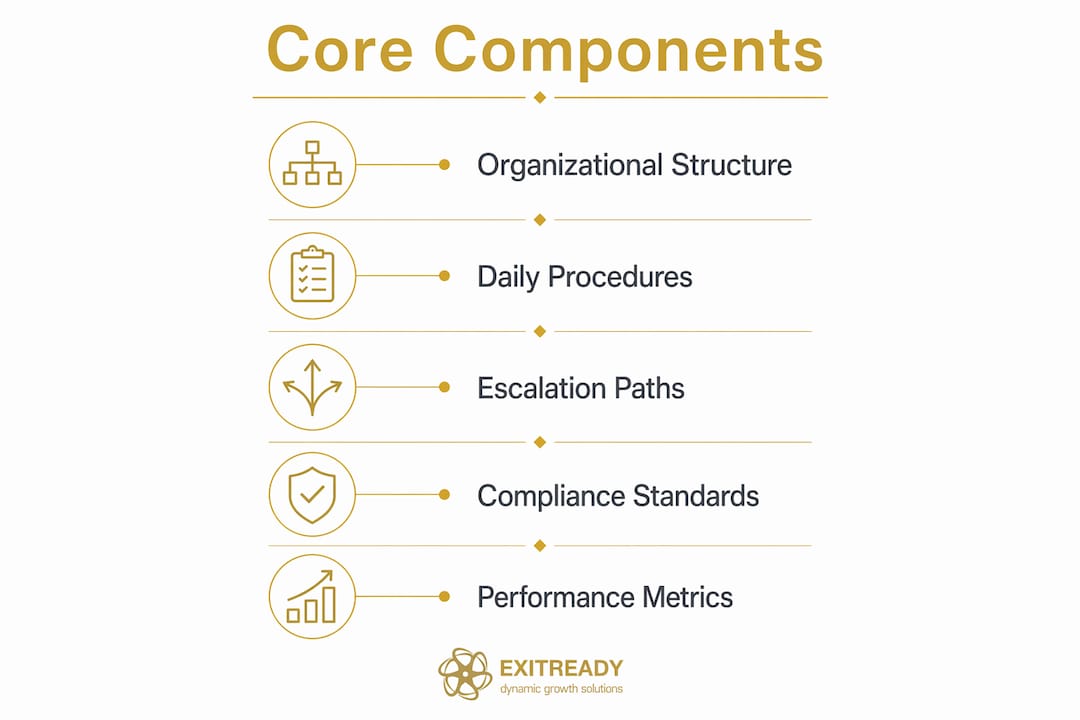
The components of a business manual determine whether it actually gets used or collects digital dust. A well-built manual covers six core areas.
- Organizational structure and roles: Who reports to whom, what each role owns, and where decision-making authority sits. This alone eliminates dozens of weekly questions.
- Daily, weekly, and monthly procedures: The recurring operational rhythms of the business, from opening protocols to financial reporting cycles.
- Customer service standards: Response time expectations, escalation paths, quality benchmarks, and how complaints are resolved.
- Health and safety protocols: Compliance requirements, emergency procedures, and incident reporting chains.
- Escalation procedures: Clear paths for when something breaks down, who gets notified, and what the resolution timeline looks like.
- References to SOP libraries: The manual points to where detailed task instructions live. It does not replicate them.
Core components include organizational structure, daily procedures, and escalation paths as non-negotiable elements. A manual missing any of these creates gaps that surface at the worst possible moments, usually when a key person is unavailable or when you are trying to onboard someone fast.
Pro Tip: Write each section of your manual as if a competent professional with general industry knowledge is reading it for the first time. If they would need to call you to clarify, the section is not finished.
How does an operating manual support scalability and business value
The practical benefits of a well-maintained operations manual go well beyond operational tidiness. They compound over time in ways that directly affect your company’s growth trajectory and market value.
The most immediate gain is speed. A 70% reduction in onboarding time means a new hire reaches productive output in days rather than weeks. For a growing business, that difference is measurable in revenue.
Consistency is the second gain. When every team member follows the same documented process, human error drops and customer experience stabilizes. You stop relying on tribal knowledge held by two or three long-tenured employees, which is a fragile foundation for any business trying to scale systematically.
The third gain is strategic. A documented manual multiplies business valuation by signaling to investors and acquirers that the business runs on repeatable systems, not on the owner’s personal involvement. This is the difference between a company worth a 3x multiple and one worth 6x or more.
“The manual shifts a company from owner-dependent to self-sustaining, creating freedom from bottlenecks.” This is not a philosophical point. It is a structural one. When your processes are documented, your business can operate, grow, and be evaluated without you in the room.
The fourth gain is freedom for you as the owner. When decisions no longer require your input because the manual defines the answer, you reclaim time for strategy, growth, and eventually, exit planning. Dynamicgrowthsolutions builds its entire AOS (Accelerated Operating System) around this principle: documented systems replace owner dependency and unlock enterprise value. You can explore how business systems create scalability in practice to see what that looks like at the mid-market level.
Common mistakes owners make when building an operating manual
Most owners who attempt an operating manual make the same set of mistakes. Recognizing them before you start saves months of wasted effort.
- Confusing the manual with an SOP library. The most common error is creating a bulky, unread document that duplicates every SOP in full. The manual should reference your SOP library, not absorb it. A 200-page manual that nobody opens is worse than no manual at all.
- Treating it as a one-time project. A manual written once and never updated becomes a liability. It gives staff false confidence in outdated procedures and creates compliance risk.
- Owner bottleneck in the creation process. When the owner is the only person who can approve or update the manual, the document stalls. Culture, especially owner bottlenecks, is the primary barrier to manual adoption. The fix is assigning ownership of each section to the relevant department head.
- Skipping the cultural adoption step. A manual that leadership does not model or reference in meetings will not be used by the team. Adoption is a behavior change, not a document distribution.
- Ignoring version control. Paper manuals and static PDFs become obsolete within months. Successful manuals are living, collaborative digital documents with version histories that teams can access and update in real time.
Pro Tip: Use a platform like Notion, Confluence, or Google Sites to host your manual. These tools support version control, access permissions, and inline comments, which makes collaborative updates a routine habit rather than a quarterly project.
The cultural dimension of manual adoption is underestimated. Research on workplace culture and leadership consistently shows that documented systems only take hold when leaders actively use and reference them. If you pull up the manual in your next leadership meeting to answer a question, your team will start doing the same.
How to create an operating manual step by step
Building a manual from scratch feels overwhelming until you break it into a sequence. Follow these steps in order and you will have a working draft within 30 days.
- Define scope and ownership. Decide which business functions the manual will cover and assign a section owner for each. Do not try to document everything at once.
- Write the company overview first. Start with your mission, organizational chart, and decision-making authority. This gives every subsequent section its context.
- Map core processes at the structural level. Describe how work flows through each department. Reference your existing SOPs rather than rewriting them. If SOPs do not exist yet, note where they need to be created.
- Document customer service standards and quality benchmarks. Define what good looks like in measurable terms: response times, resolution rates, satisfaction scores.
- Add emergency and escalation protocols. Every manual needs a clear answer to “what do we do when X breaks?” before X actually breaks.
- Set a review cycle. Quarterly reviews for fast-growing businesses, semi-annual for stable ones. Assign a specific person to own each review.
- Publish digitally and train the team. Host the manual on a platform your team already uses. Walk through it in onboarding and reference it in team meetings.
The table below summarizes the build sequence with key considerations at each stage:
| Step | Action | Key consideration |
|---|---|---|
| 1 | Define scope and assign owners | Avoid single-owner bottlenecks |
| 2 | Write company overview and org chart | Establishes authority and context |
| 3 | Map core processes with SOP references | Keep the manual structural, not granular |
| 4 | Document customer and quality standards | Use measurable benchmarks |
| 5 | Add escalation and emergency protocols | Cover failure scenarios proactively |
| 6 | Set review cadence | Quarterly or semi-annual minimum |
| 7 | Publish digitally and train staff | Adoption requires active modeling |
A manual clear enough that a competent professional can adapt without extensive training is the right calibration for detail. Too thin and it fails to guide. Too thick and nobody reads it. Aim for structural clarity with links to deeper resources. For examples of what systematized processes look like at scale, Dynamicgrowthsolutions has documented scalable business process examples that illustrate the right level of detail.
Key takeaways
A business operating manual is the structural foundation that makes a company scalable, transferable, and valuable independent of its owner.
| Point | Details |
|---|---|
| Manual vs. SOPs | The manual is a structural map; SOPs are the detailed task instructions it references. |
| Onboarding impact | A well-built manual reduces employee onboarding time by approximately 70%. |
| Valuation multiplier | Documented systems signal exit-readiness and directly increase business valuation multiples. |
| Living document rule | Manuals must be hosted digitally and updated on a defined review cycle to remain useful. |
| Owner bottleneck risk | Assigning section ownership to department heads prevents the manual from stalling in creation or updates. |
Why most owners get this backwards
I have worked with dozens of mid-market owners who built their first operations manual as a compliance exercise, something to show a buyer or a bank. That is the wrong starting point, and it produces the wrong document.
The owners who get the most value from their manuals build them as personal freedom tools. Every process you document is a decision you no longer have to make personally. Every standard you write down is a conversation you no longer have to have. The manual is not paperwork. It is the mechanism by which you remove yourself from the daily operation of your own business.
What I have observed consistently is that the businesses with the highest valuations at exit are not the ones with the best products. They are the ones where the operations manual is so clear that a new management team could run the company from day one without the founder. That is what buyers pay a premium for. That is what scalable business infrastructure actually looks like in practice.
The biggest pitfall I see is owners who treat the manual as a finished artifact rather than a living system. They spend three months building it, publish it once, and never open it again. Within a year it is obsolete. The discipline of quarterly reviews is not glamorous, but it is what separates a manual that drives real operational independence from one that sits in a shared drive nobody visits.
Start with your three most critical processes. Document them at the structural level. Assign ownership. Set a review date. That is a better first week than trying to build the whole thing at once.
— Andre
How Dynamicgrowthsolutions helps you build operational independence
Dynamicgrowthsolutions works with mid-market business owners who are ready to replace owner dependency with documented, self-sustaining systems. The AOS (Accelerated Operating System) provides the framework for building an operations manual that actually gets used, covering organizational structure, process mapping, delegation protocols, and valuation-ready documentation. If you are building toward a premium exit or simply want your business to run without you in every decision, explore the business operating system framework that Dynamicgrowthsolutions has developed for owners at your stage. For a broader view of how documented systems connect to sustainable growth, the business management systems page outlines the full program and what results look like.
FAQ
What is the difference between an operating manual and SOPs?
An operations manual is a structural map of how the business runs, covering roles, workflows, and standards. SOPs are the detailed, step-by-step instructions for executing specific tasks that the manual references.
How long should a business operating manual be?
There is no fixed length, but the manual should be structural rather than granular. A well-built manual avoids replicating SOP detail and focuses on organizational clarity, typically running 20 to 60 pages depending on business complexity.
How often should an operating manual be updated?
Fast-growing businesses should review their manual quarterly. Stable businesses can operate on a semi-annual cycle. Assigning section ownership to department heads makes updates a distributed habit rather than a single owner’s burden.
Does an operating manual increase business valuation?
A documented manual directly increases valuation by signaling to investors and acquirers that the business runs on repeatable, scalable systems rather than on the owner’s personal involvement, which reduces buyer risk and supports higher multiples.
What tools should I use to build and host an operating manual?
Platforms like Notion, Confluence, and Google Sites are well-suited for hosting a living operations manual. They support version control, access permissions, and collaborative editing, which prevents the document from becoming static and outdated.