

Time leverage means your business produces more output without requiring more of your hours. Specifically, it is the practice of using systems, people, and technology so that results scale independently of how many hours you personally work. Delegate recurring client reporting to a trained analyst and that task runs without you. Automate invoicing and your involvement drops to exceptions only. That is time leverage explained in its simplest form, and it is the central question behind what does time leverage mean in business.
Ask yourself these four questions right now:
- Do you handle tasks a trained team member could own with the right playbook?
- Does your business slow down or stop when you step away for a week?
- Are you spending more than two hours a day on work that does not require your specific judgment?
- Has revenue growth stalled because your calendar is the bottleneck?
If you answered yes to any of them, you need time leverage. The Pareto Principle tells you why: roughly 20% of your activities drive 80% of your results. The rest is a candidate for delegation, automation, or elimination.
Key Takeaways
Time leverage is the single most reliable way for a mid-market owner to grow revenue and reclaim capacity without adding personal hours.
| Point | Details |
|---|---|
| Define it precisely | Time leverage means using systems, people, and technology so output grows without more owner hours. |
| Sequence matters | Document before delegating, stabilize before automating — skipping steps pulls the owner back in. |
| Measure three metrics | Track owner-hours reclaimed, tasks offloaded per month, and revenue per owner-hour weekly. |
| Upfront cost is real | Training, SOP writing, and shadow periods are the price of durable leverage, not overhead waste. |
| Dynamicgrowthsolutions AOS | The Accelerated Operating System gives mid-market owners a structured path from operator to architect. |
Table of Contents
- How time leverage actually works at an operational level
- What you actually gain: benefits and ROI of time leverage
- The core levers you can pull starting this week
- A 6-step roadmap to create time leverage in your business
- Owner to architect: a practical playbook for mid-market firms
- Which tools help you build time leverage fast?
- Common mistakes owners make when trying to create time leverage
- Common misconceptions about time leverage
- How to spot time leverage opportunities in your daily operations
- Why most owners get time leverage wrong
- Dynamicgrowthsolutions helps mid-market owners build real operational capacity
- Sources
How time leverage actually works at an operational level
Time leverage breaks the direct link between owner-hours and business output. Without it, growth has a hard ceiling: you. With it, output can grow while your personal hours stay flat or fall.
There are five primary levers:
People leverage means training others to own recurring work. A client success manager who handles onboarding calls frees you for strategy. Systems and playbooks convert your knowledge into documented processes others can follow without asking you. Automation and technology replace human time on predictable, rule-based tasks. Process design eliminates unnecessary steps before you delegate or automate them. Productization packages your expertise into a repeatable offer so delivery does not depend on your direct involvement every time.
The distinction that matters most is between temporary time savings and structural leverage. Blocking your email for two hours saves time today. A documented SOP paired with a trained team member saves that same time every day, permanently.
Pro Tip: Most owners underinvest in the transition from operator to architect. The biggest gap is not knowing what to delegate — it is failing to document the work well enough for someone else to own it. Spend the first week writing, not delegating.
What you actually gain: benefits and ROI of time leverage
The business case for time leverage is straightforward. Every hour you reclaim from low-value work is an hour you can redirect toward the activities that grow revenue, build relationships, or improve your exit position.
Good time management at the company level produces on-time deliverables, higher-quality work, reduced stress, and measurable growth potential. These are not soft benefits. They translate directly into capacity, margin, and valuation.
Here is a simple framing: if your effective billing rate as an owner is $500 per hour and you reclaim 10 hours per week through delegation and automation, that is $5,000 per week in redirected capacity. Pointed at business development, that number compounds.
Within 3–12 months of implementing basic leverage steps, owners typically see:
- More capacity for high-value client work or strategic planning
- Faster delivery cycles because processes run without bottlenecks
- Higher team accountability because roles and expectations are documented
- Reduced single-person risk, which directly improves exit valuation multiples
- Lower stress from reactive firefighting
- A business that can operate and grow without your daily presence
That last point is the one buyers pay a premium for.
The core levers you can pull starting this week
Delegation is among the highest-leverage activities available to any owner. But it is one of six levers worth understanding before you prioritize.
| Lever | Effort to Implement | Time to ROI | Scalability | Owner Involvement After Setup |
|---|---|---|---|---|
| Delegation | Medium | 4 weeks | High | Low |
| Playbooks/SOPs | Medium | 6–12 weeks | Very High | Very Low |
| Automation | Low–Medium | 2–6 weeks | Very High | Very Low |
| Outsourcing | Low | 1–3 weeks | Medium | Low |
| Batching/Time-blocking | Low | Immediate | Medium | Medium |
| Productization | High | 3–6 months | Very High | Low |
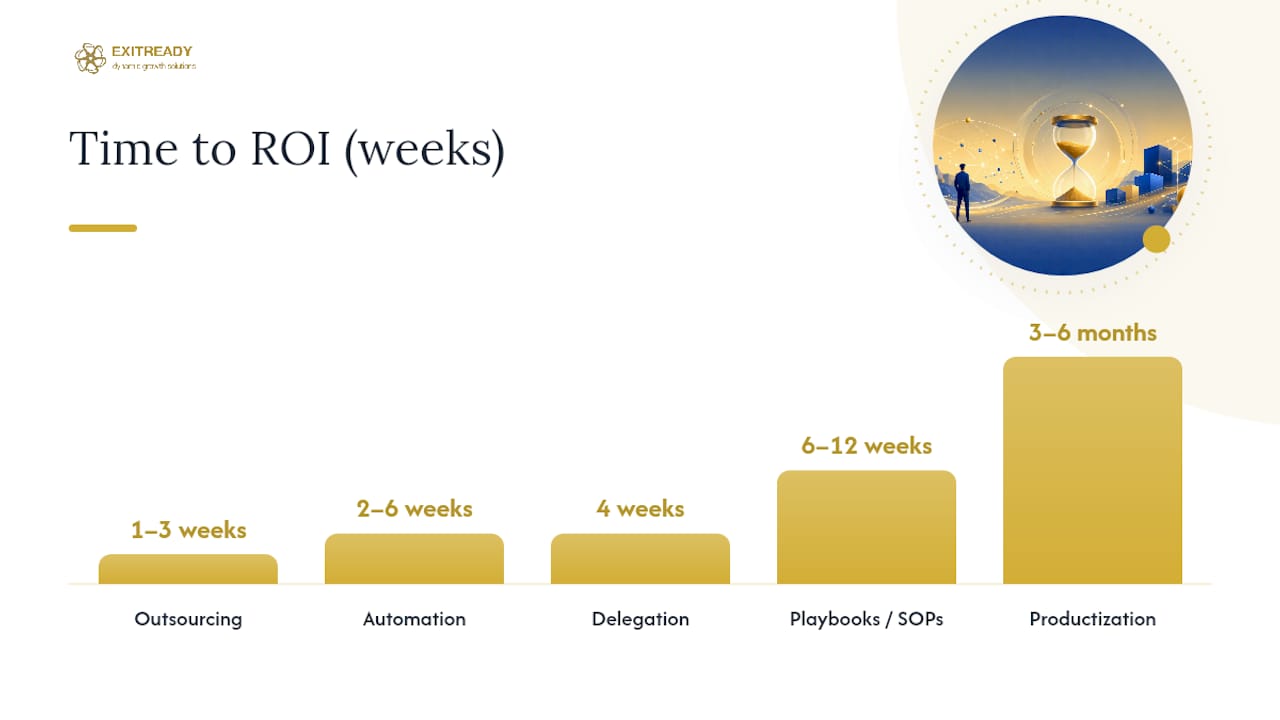
Delegation transfers ownership of a recurring task to a trained team member. Start with one task, write a one-page handover document, and run a two-week shadow period before full transfer.

Playbooks and SOPs convert your tribal knowledge into repeatable instructions. Start with templates rather than blank documents. A one-page SOP with a checklist and a decision tree covers most recurring tasks.
Automation handles rule-based work without human input. Low-code tools like Zapier or Make let you connect apps and automate data entry, notifications, and approvals in hours, not weeks. These are quick wins with very low ongoing owner involvement.
Outsourcing moves non-core functions to specialists. Finance, HR admin, and content production are common starting points. The key is a clear scope of work and defined output standards before you hand anything over.
Batching and time-blocking protect your highest-value hours. Group similar tasks (calls, email, approvals) into fixed windows so context switching does not fragment your day. Reducing context switching is one of the fastest ways to reclaim productive time.
Productization is the longest investment but the highest payoff. When your service delivery runs on a documented system rather than your personal judgment, you can scale delivery without scaling your hours.
Pro Tip: Combine a quick win (automate one workflow this week) with a capacity-building project (write one SOP per week for 90 days). The quick win builds momentum; the SOP library builds the foundation.
A 6-step roadmap to create time leverage in your business
A staged approach works better than trying to change everything at once. Start by recovering time, then delegate, then systemize, then automate.
Step 1: Audit your time. Track every task for two weeks using a time tracker like Clockify or Toggl. Time audits reveal where your hours actually go and which tasks are candidates for delegation or automation. Checklist: log every task by category, flag tasks below your pay grade, identify the three biggest time drains.
Step 2: Prioritize high-impact work. Apply the 80/20 rule to your task list. Protect those hours. Checklist: rank tasks by revenue impact, flag low-impact recurring tasks, block two hours daily for owner-only strategic work.
Step 3: Delegate and train. Pick one recurring task and assign it to a team member. Write a one-page handover document. Run a shadow period, then transfer ownership. Checklist: select the task, write the handover doc, set a two-week check-in cadence.
Step 4: Document playbooks and SOPs. Before you delegate the next task, document it. One SOP per week for 90 days builds a library that makes your business trainable and transferable. Checklist: use a standard template, include decision rules, add a quality checklist at the end.
Step 5: Automate and outsource. Once a process is documented, automate the rule-based steps. Outsource non-core functions with a clear scope of work. Checklist: identify one automatable workflow, connect it with a low-code tool, define output standards for any outsourced function.
Step 6: Measure and iterate. Track owner-hours reclaimed per week, tasks offloaded per month, and revenue per owner-hour. Review monthly. Checklist: set a weekly 15-minute review, track three core metrics, adjust delegation or automation based on results.
Pro Tip: Build a simple dashboard: track owner-hours on high-value work vs. low-value work each week. When that ratio flips to 70/30 in favor of high-value work, your leverage is working.
Two useful measurement cadences: weekly, track hours reclaimed and tasks delegated; monthly, track revenue per owner-hour and the number of processes running without your direct input.
Owner to architect: a practical playbook for mid-market firms
The mindset shift from operator to architect is where most mid-market owners stall. Harvard Business Review’s research on time management consistently points to founder attachment to operational detail as the central constraint. It is not a skill gap. It is a perspective gap.
The playbook has four components:
Roles and delegation hierarchy. Define three levels: tasks only you can do (strategic decisions, key relationships), tasks a trained senior team member can own, and tasks any trained employee can handle with a good SOP. Apply an escalation rule: nothing reaches you unless it has been attempted at the level below first.
Training cadence. New task owners get a written SOP, a shadow period of one to two weeks, and a 30-day check-in. After 90 days, the task is fully theirs.
Acceptance criteria. Every delegated task has a defined output standard. “Good enough” is not a standard. A specific deliverable, a deadline, and a quality checklist are.
Review rhythm. Weekly team check-ins, monthly SOP reviews, and a quarterly delegation audit keep the system current.
Consider a mid-market professional services firm with 22 employees whose owner was spending 30 hours per week on client reporting, proposal writing, and internal approvals. After a 90-day playbook implementation, those functions moved to a senior account manager and an operations coordinator. The owner reclaimed roughly 20 hours per week, redirected that time to business development, and closed two new accounts within the following quarter. The business did not slow down. It accelerated.
Dynamicgrowthsolutions’s Accelerated Operating System (AOS) is built around exactly this playbook: documented roles, delegation hierarchies, and structured training cadences that replace owner dependency with self-sustaining operations.
Pro Tip: Run a quarterly “delegation audit.” For every task you still own, ask: could a trained team member handle this with the right SOP? If yes, it is a leverage opportunity you have not taken yet.
Which tools help you build time leverage fast?
Practical tool stacks let owners pilot leverage changes within 30–90 days. Here are the categories that matter most, with one recommended example per category:
- Time trackers (Clockify, Toggl): run a two-week audit before making any delegation or automation decisions. Use the data, not your gut.
- Project management (Asana, ClickUp): centralize task ownership, deadlines, and accountability so nothing lives in your inbox.
- Workflow automation (Zapier, Make): connect your apps and automate data entry, notifications, and approvals without writing code.
- SOP and documentation (Notion, Tettra): store playbooks where your team can find and update them. A Google Doc no one can find is not a system.
- Calendar blocking (Calendly, Google Calendar with time-block templates): protect your high-value hours before anyone else fills them.
- Outsourced talent (Upwork, Toptal): access fractional specialists for finance, marketing, and operations without a full-time hire.
- Communication rhythm tools (Slack with structured channels, Loom for async video): reduce the number of meetings that require your live presence.
For a ready-to-use template, build a 7-column time audit spreadsheet: Task name, Category (strategic/operational/admin), Time spent per week, Could someone else own this? (Yes/No), Delegation candidate (Yes/No), Automation candidate (Yes/No), Priority to address (High/Medium/Low). Run it for two weeks and you will have a clear picture of where your leverage opportunities sit.
Owners concerned about the people side of this shift, including work-life balance and team well-being, should build delegation rhythms that protect team capacity, not just owner capacity.
Common mistakes owners make when trying to create time leverage
Most time leverage failures are not strategy failures. They are execution failures rooted in six predictable mistakes.
Treating delegation as an expense. Founders frequently block leverage by treating delegation as a cost rather than an investment. The training time, the SOP writing, the shadow periods: these are the price of durable leverage. Skip them and the delegation fails, which reinforces the belief that “it’s faster to do it myself.”
Automating before documenting. Automating a broken or undocumented process just makes the chaos faster. Document the process first, optimize it, then automate the stable version.
Poor handover standards. “Here’s what I need you to do” is not a handover. A written SOP, a quality checklist, and a defined escalation path are.
No acceptance criteria. Delegated work without output standards produces inconsistent results, which pulls the owner back in. Define what “done well” looks like before you hand anything over.
Ignoring team rhythms. Time audits paired with team rhythm alignment produce measurably better results than scheduling work without regard for when your team does their best thinking. Schedule high-complexity delegated work during peak performance windows.
Trying to do everything at once. Owners who attempt to delegate five tasks, write ten SOPs, and implement three automations simultaneously usually finish none of them. Pick one lever, execute it fully, then move to the next.
Write more before you delegate.
Common misconceptions about time leverage
Several beliefs about time leverage stop owners from pursuing it at all.
“I don’t have time to create leverage.” This is circular. The reason you lack time is precisely the reason to invest in leverage. The upfront cost is real, but it is finite. The ongoing return is permanent.
“My business is too complex to delegate.” Complexity is usually a documentation problem, not a genuine barrier. If you can explain a task to a new hire verbally, you can write it down. If you can write it down, someone else can own it.
“Automation will break things.” Low-code automation tools like Zapier handle millions of business workflows daily. Start with one simple, low-risk workflow (a notification trigger, a data entry task) and build confidence before automating anything critical.
“Delegation means losing control.” Documented SOPs, acceptance criteria, and a weekly review rhythm give you more visibility into how work is done, not less. The owner who reviews outputs weekly has more control than the one who does everything personally and never audits quality.
“Time leverage is only for large companies.” The 5 pillars of business leverage apply at every scale. A 10-person firm that automates invoicing and delegates client reporting has the same structural advantage as a 200-person firm that does the same thing. The tools are more accessible now than they have ever been.
How to spot time leverage opportunities in your daily operations
The signals are usually hiding in plain sight. Look for these patterns in your week:
Any task you do more than once a week on a predictable schedule is a delegation or automation candidate. If you can describe the steps in a numbered list, someone else can follow them.
Any decision that requires your approval but not your judgment is a bottleneck. Build a decision framework (if X, then Y) and let your team own the routine calls.
Any meeting you attend where your role is to receive information rather than make a decision is a leverage opportunity. Replace it with a written update or a dashboard.
Any tool you use manually that has an API or a Zapier integration is an automation waiting to happen. Automating routine tasks and redirecting owner time to high-impact activities is the fastest path to efficient scaling.
The business scalability checklist from Dynamicgrowthsolutions gives mid-market owners a structured way to map these opportunities across their entire operation, not just the obvious ones.
Why most owners get time leverage wrong
The conventional wisdom says: delegate more, automate more, and you will get your time back. That is true, but it misses the harder part.
Time leverage is not a productivity hack. It is an organizational design problem. The owner who delegates without documenting will get the task back within 30 days. The owner who automates without first stabilizing the process will automate the wrong thing. The owner who tries to build leverage while still being the hub of every decision has not changed the architecture. They have just added tools to the same broken structure.
What actually works is sequencing: document before you delegate, stabilize before you automate, and measure before you scale. The owners who build durable leverage treat the upfront investment in playbooks and training as a capital expense, not an overhead cost. That shift in framing changes everything about how they allocate their time in the first 90 days.
The time freedom strategies that produce lasting results are not about working less. They are about redesigning where your judgment is applied so the business can grow without you being the constraint.
Dynamicgrowthsolutions helps mid-market owners build real operational capacity
Mid-market owners who have read this far know what needs to change. The harder question is how to execute it without adding another project to an already full plate.

Dynamicgrowthsolutions works with mid-market business owners to implement the exact playbook described here: time audits, delegation hierarchies, documented SOPs, and automation frameworks, all structured through the Accelerated Operating System (AOS). The outcome is operational independence: a business that runs, grows, and scales without the owner being the bottleneck. If you want to see where your leverage gaps are, start with the business scalability checklist or book a direct assessment with the Dynamicgrowthsolutions team.
Sources
- Leverage
- Time management 101: how to manage time
- Time management (HBR)
- Time management techniques and strategies
- Time management tips for small business owners
- Leverage management: Definition, strategy and tips – TimeTrack Blog