

There is no single ideal span of control. The right number of direct reports depends on the manager’s role archetype, how standardized the work is, and how much individual-contributor work still sits on that manager’s plate. Map the role, measure supervisory burden, and adjust in a controlled pilot before rolling any change out wide.
TL;DR:
- Setting an appropriate span of control requires assessing role archetypes and work standardization, not applying a uniform number across the organization.
- The median span of control is about six direct reports, but ranges can extend from three to over 15 depending on work complexity and manager skills.
- Managers overseeing highly standardized work or with strong delegation skills can handle wider spans, while roles involving complex or interdependent tasks need narrower spans.
- Regular feedback and measurement of supervisory burden are essential to ensure spans remain effective and to prevent early signs of overload.
- Pilot testing span adjustments and pairing them with process standardization and capability development improve success and sustain organizational agility.
Table of Contents
- What span of control is and how to calculate it
- Benchmarks and what the research says
- Managerial archetypes and recommended span ranges
- Deciding factors: the criteria that change a span
- How to calculate supervisory burden and metrics to track
- Rightsizing spans: an 8-step implementation playbook
- Managing managers vs. supervising individual contributors
- Common pitfalls, red flags, and what to avoid
- Action checklist and quick templates HR can use now
- Expert perspective from Dynamic Growth Solutions
- Balancing efficiency and connection when changing spans
- How Dynamic Growth Solutions can help
- Sources
- FAQ
What span of control is and how to calculate it
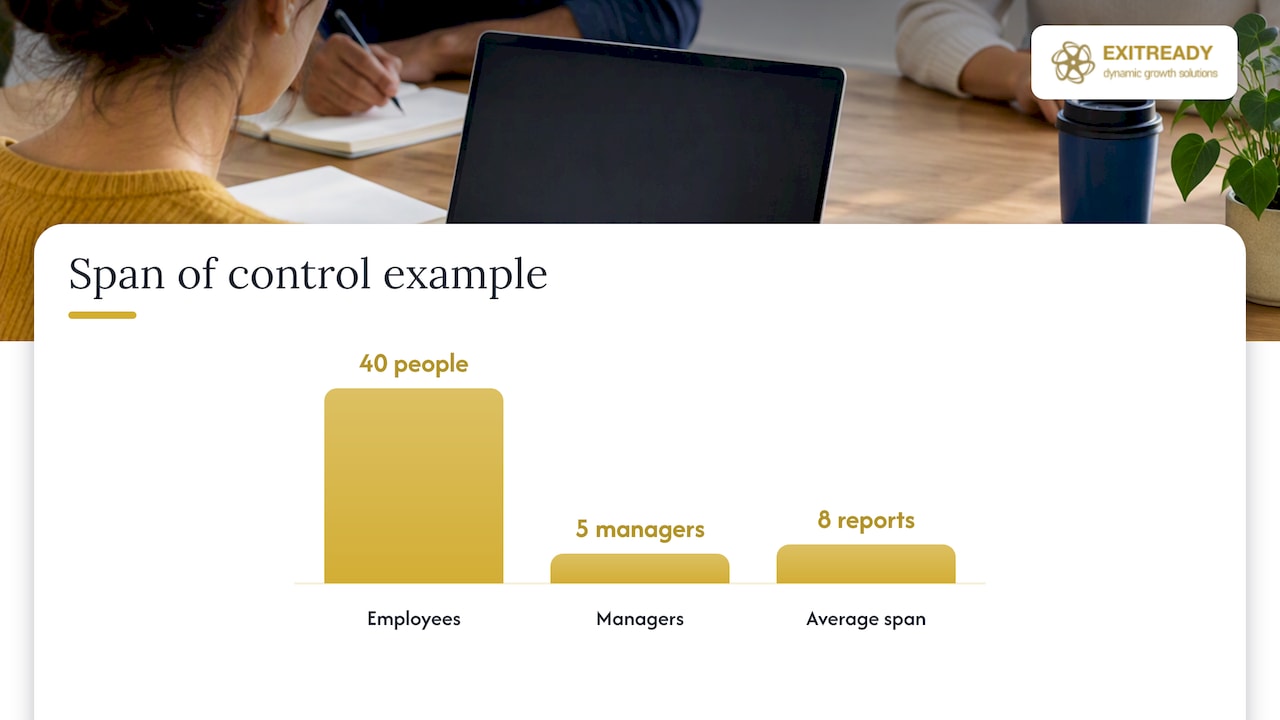
Span of control is the number of people who report directly to one manager. The basic formula is simple: direct reports divided by the number of managers overseeing them. A department with 40 employees and 5 managers has an average span of 8.
Dotted-line and matrix reports complicate the math. Count someone as a direct report only if the manager owns their performance review and day-to-day direction; otherwise, track them separately as an influence relationship rather than folding them into the ratio.
To run a quick calculation:
- Pull a current org chart or HRIS export of reporting lines.
- Separate solid-line reports from dotted-line or project-based relationships.
- Divide total solid-line reports by total managers at each level.
- Flag any manager above or below your target range for review.
Benchmarks and what the research says
The useful comparison point is a typical median span of control is about six direct reports, according to Gallup. That figure is a starting reference, not a rule, because the conditions around a manager change what a sustainable span actually looks like.
- Wider spans tend to hold up when managers are freed from individual-contributor work and have the right coaching skills, per Gallup’s research.
- Deloitte’s spans-and-layers framework recommends scoring supervisory burden across task standardization, complexity, interdependency, and required skills rather than copying a benchmark wholesale.
- McKinsey’s research finds defensible ranges running from about 3 direct reports up to more than 15, depending on role complexity and how standardized the work is.
Benchmarks also shift by function. A standardized customer service team supported by clear scripts and technology can sustain a far wider span than a research and development group doing highly interdependent, judgment-heavy work. Manager talent matters too: a skilled coach with strong delegation habits can carry more reports than someone still learning to let go of individual-contributor tasks.
Managerial archetypes and recommended span ranges
McKinsey defines five managerial archetypes, each suited to a different kind of work and a different span range. Matching a role to its archetype, rather than applying one company-wide number, is what makes a span defensible.
- Player/coach: a manager who still does meaningful individual-contributor work alongside supervising a small team, typically fitting a narrower span.
- Coach: focused mainly on developing people through regular feedback, often sustaining a moderate span when the work is less standardized.
- Supervisor: oversees routine, well-documented work and can typically handle a wider span because decisions are repeatable.
- Facilitator: coordinates across teams or projects more than directing daily tasks, with span driven by coordination complexity rather than headcount.
- Coordinator: manages highly standardized, process-driven work, often supporting the widest spans in the model.
To map a job description to an archetype, look at how much of the manager’s week goes to coaching versus doing versus coordinating, and how standardized the underlying work is. A role that mixes archetypes usually signals it needs to be split or clarified before a span target means anything.
Deciding factors: the criteria that change a span
A span target is only as good as the factors feeding it. Before setting a number, run through the conditions that actually move the right answer.
- Time allocation: how much of the manager’s week goes to individual-contributor work versus people leadership.
- Standardization: whether the team follows documented processes or handles constant exceptions.
- Work variety: how much each direct report’s day-to-day differs from the next person’s.
- Skill level: whether direct reports are experienced enough to need light-touch oversight.
- Interdependency: how much coordination the manager has to do across the team versus letting people work independently.
- Manager IC workload: whether the manager is still carrying client accounts, tickets, or production work alongside supervising others.
Standardized processes and reliable technology expand what a manager can realistically handle, because fewer decisions require the manager’s judgment. The opposite is also true: a manager who is still closing deals, writing code, or handling escalations needs a narrower span until that individual-contributor load comes down.
Pro Tip: Before widening anyone’s span, ask what percentage of their week is still spent on individual-contributor work. That number usually explains more than the org chart does.
How to calculate supervisory burden and metrics to track
Supervisory burden is the practical ceiling on how many people a manager can lead well. Deloitte recommends combining a few simple measures into one score rather than relying on headcount alone, and notes that managers with just one direct report often spend around 94% of their time on that single relationship, a clear sign of an inefficient reporting line.
Baselining this does not require heavy analytics. A short calendar audit, a brief manager survey, and a standard HRIS report cover most of what you need, a method also outlined by AIHR.
| Metric | What it captures | Collection method |
|---|---|---|
| Time allocation (% IC work) | Share of week spent on individual tasks versus leadership | Calendar audit |
| Weekly feedback coverage | Whether each direct report gets meaningful feedback weekly | Manager survey |
| Meeting load | Hours per week in one-on-ones and team meetings | Calendar audit |
| Span ratio | Direct reports per manager | HRIS report |
Weekly, meaningful feedback correlates strongly with engagement, according to Gallup, which makes feedback coverage one of the clearest guardrails: a manager who cannot sustain it at the current headcount has already hit their practical limit.
Rightsizing spans: an 8-step implementation playbook
Changing spans affects people’s day-to-day work and reporting relationships, so treat it as a managed project rather than a reorg memo.
- Secure a sponsor at the executive level who owns the guiding principles for the change.
- Map current spans and archetypes across the function using the calculation method above.
- Diagnose supervisory burden with the metrics table, flagging managers above or below target.
- Design the target state, assigning each role an archetype and a defensible span range.
- Pilot the change in one team or function for at least three months with clear engagement and performance KPIs, following the pilot structure McKinsey recommends.
- Communicate role changes clearly, including what shifts for affected managers and employees.
- Build manager capability through coaching and delegation training before spans widen further.
- Reassess on a governance cadence, using the same metrics to confirm the change held.
Rightsizing spans alongside process improvement and capability building has been associated with reductions in managerial layers and cost in the range of 10% to 15%, according to McKinsey’s research, though that outcome depends on pairing the span change with real training investment rather than simply removing layers.
Pro Tip: Run the pilot with a control group doing nothing differently. Without one, you cannot tell whether a result came from the new span or from something else entirely.
Standardizing the meeting rhythm that comes with a new span matters as much as the number itself; a consistent management meeting structure keeps wider spans from turning into missed check-ins.
Managing managers vs. supervising individual contributors
A manager overseeing other managers needs a different skill set than one overseeing individual contributors, and that difference should shape span decisions at each level. SHRM points out that managing managers calls for sponsoring, coaching, and delegation rather than direct oversight of daily tasks.
- A manager-of-managers should spend most of their time developing the managers beneath them, not reviewing the work of individual employees two levels down.
- Spans at this level often look narrower on paper but carry more coordination weight, since each direct report is themselves leading a team.
- Delegation authority has to be real, not nominal, or the manager-of-managers ends up re-deciding what their managers were already empowered to decide.
Clear delegation frameworks make this distinction concrete rather than aspirational, which matters once spans start changing at multiple levels at once.
Common pitfalls, red flags, and what to avoid
Span changes fail quietly before they fail visibly. Watch for the early signs rather than waiting for turnover numbers to confirm the problem.
- Missed or shortened one-on-ones are usually the first sign a span has gone too wide.
- Declining engagement scores on a newly expanded team often trace back to feedback frequency dropping off.
- Meeting overload for the manager signals the span is adding coordination cost instead of removing layers.
- Widening spans purely for short-term savings, without building delegation skills or standardizing the work first, tends to create the problems above within a quarter.
When red flags appear, narrow the span back or pause further rollout until the manager’s feedback cadence and time allocation recover.
Action checklist and quick templates HR can use now
A span review does not need a quarter of planning to start. These three templates get a working review moving this quarter.
- Build a one-page supervisory-burden scorecard scoring each manager 0 to 100 on time allocation, feedback coverage, and meeting load.
- Draft a pilot plan naming the team, the target span, the success metrics, and a single accountable owner.
- Set a 30/60/90 checklist for any manager whose span just changed, covering: feedback cadence at day 30, workload redistribution at day 60, and a full engagement and performance check at day 90.
Keep the scorecard simple enough to update monthly. The goal is an early warning system, not a permanent audit function, and it works best paired with the archetype mapping from earlier sections rather than as a standalone exercise.
Expert perspective from Dynamic Growth Solutions
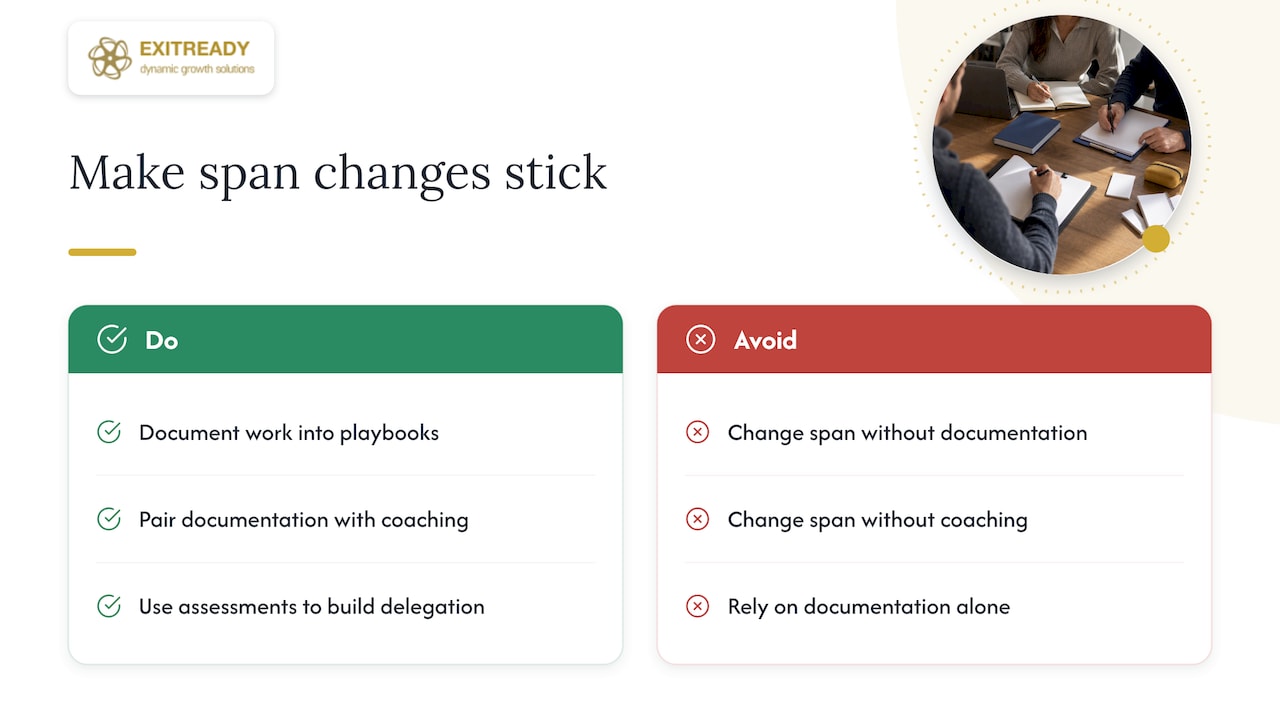
Rightsizing a span only sticks when the work underneath it is actually documented. The AOS framework is built around turning owner and manager knowledge into playbooks that a team can run without constant oversight, which is the same condition Deloitte and McKinsey point to when they describe standardization as the lever that makes wider spans sustainable.
Executive coaching and targeted assessments play a similar role from the people side: a manager who has not yet built strong delegation habits will struggle at a wider span regardless of how well the work is documented. Pairing documented processes with coaching addresses both halves of the supervisory-burden equation at once, which is why span changes attempted without either tend to regress within a few months.
Balancing efficiency and connection when changing spans
Widening a span makes sense when the work is standardized and the manager has already proven they can coach, not just supervise. It does not make sense as a cost-cutting move applied uniformly across a function with wildly different work types. Measure supervisory burden first, invest in manager capability where the data says it is thin, and only then adjust the number. A span that looks efficient on an org chart but breaks weekly feedback is not actually efficient.
— Andre
How Dynamic Growth Solutions can help
Getting spans right is one piece of a bigger operational puzzle, and most mid-market leaders do not have the bandwidth to document every process while also running the business. That is the gap AOS is built to close: a structured assessment identifies where supervisory burden is highest, and the resulting playbooks give managers the documented systems they need to carry a wider span without losing feedback quality or engagement.

An Enterprise Assessment maps your current management structure against the kind of supervisory-burden factors covered above, and the AOS Value Creation Partnership turns those findings into documented playbooks your managers can actually run. For a more concentrated engagement, the Growth Sprint and Performance Sprint options on the sprint programs page are built to diagnose and implement organizational changes like this in weeks rather than quarters. If you are ready to see where your own management structure stands, schedule a diagnostic conversation and start from an actual baseline instead of a guess.
Sources
- How to identify the right ‘spans of control’ for your organization | McKinsey
- Span of Control: What’s the Optimal Team Size for Managers? | Gallup
- Spans and layers for the modern organization | Deloitte
- How to manage managers | SHRM
FAQ
How do I calculate the span of control?
Divide the number of direct reports by the number of managers at that level, counting only solid-line reporting relationships. Separate dotted-line or matrix reports and track them apart from the core ratio so the number reflects real supervisory responsibility.
What is the 30-60-90 rule for managers?
There is no single standardized “30-60-90 rule” tied specifically to span of control. A common version used after a span change checks feedback cadence at 30 days, workload redistribution at 60 days, and a full engagement and performance review at 90 days.
What is the typical span of control?
A commonly cited reference point is a median of about six direct reports per manager, according to Gallup. The right span for a given role can range much wider, from roughly 3 to more than 15, depending on the manager’s archetype and how standardized the work is, per McKinsey.
What are the 5 C’s of performance management?
The “5 C’s” framing is not a term covered in the research referenced here, and definitions vary across sources. What the span of control research does support consistently is the need for clear role expectations, regular coaching, and weekly meaningful feedback as conditions for a manager to carry a larger team successfully.