

Quality of earnings measures whether a company’s reported profit is real, repeatable, and backed by actual cash, not accounting choices that flatter the numbers for one quarter. Buyers rely on a quality of earnings report to set a sustainable earnings baseline before pricing a deal, while sellers use the same analysis to package and defend their numbers before a buyer ever asks a hard question.
TL;DR:
- Calculate operating cash flow divided by net income; a ratio above 1.0 suggests cash backed earnings, while a persistent result below 1.0 flags risk.
- Buyers apply valuation multiples to normalized EBITDA, so unsupported add backs can be excluded and reduce the price, increase earnouts, or tighten escrow terms.
- Sellers should begin preparation a year before a planned sale, documenting add backs and keeping cash, receivables, and inventory reconciliations current.
- Engagements commonly take several weeks, and missing accounts receivable aging, inventory roll forwards, or cash flow bridges can prolong the review while records are rebuilt.
Table of Contents
- What quality of earnings means and how it differs from an audit
- Key components a QoE report examines line by line
- Buy-side vs. sell-side QoE: different goals, same report
- How QoE findings shape valuation and deal terms
- Common red flags that derail deals during QoE review
- Typical QoE process, timing, and document requests
- Owner checklist: steps that improve QoE outcomes
- How QoE insight shapes decisions outside a transaction
- Why QoE belongs in growth and value creation planning
- What improving earnings quality looks like in practice
- Treat QoE prep as value creation, not a compliance hurdle
- How we help owners get ready for QoE and exit
- FAQ
- Sources
What quality of earnings means and how it differs from an audit
Quality of earnings is a sustainability test. It asks whether this year’s profit is likely to repeat next year, or whether it leans on one-time gains, loose accruals, or revenue that will not show up again. The CFA Institute frames high-quality reporting as information that faithfully reflects economic reality, with sustainable earnings tied to core recurring operations carrying more weight in a valuation than earnings padded by unusual events.
An audit asks a different question entirely. It confirms that financial statements comply with accounting standards, not whether the underlying business will keep producing the same results. A company can pass an audit cleanly and still have weak quality of earnings if its profit depends on discretionary estimates or non-recurring items.
- A QoE review tests sustainability and cash backing, not just compliance with accounting rules.
- An audit opines on whether statements are fairly presented under GAAP, a narrower and different scope.
- Decision-useful reporting connects today’s earnings to tomorrow’s expected cash flow, which is what buyers actually price.
Key components a QoE report examines line by line
A QoE engagement works through a defined set of reconciliations rather than a general review of the financial statements. Reviewers typically move through these steps in sequence:
- Test revenue recognition practices and sales quality to confirm reported revenue reflects delivered goods or services, not timing shifts.
- Reconcile net income to operating cash flow to see how much of reported profit actually converts to cash.
- Examine accruals, reserves, capitalization policies, and any discretionary estimates that could inflate or smooth results.
- Scrutinize one-time items and proposed EBITDA add-backs for documentation and legitimacy.
- Build working capital roll-forwards and normalize adjustments to isolate the recurring run rate of the business.
A QoE ratio above 1.0 signals cash-backed earnings. The ratio, calculated as cash flow from operations divided by net income, is a quick screen reviewers use before deeper testing: a result above 1.0 suggests earnings are backed by cash, while a ratio below 1.0 is a common red flag that profit depends on accruals or non-recurring items. The SEC has emphasized that the statement of cash flows is central to understanding whether net income is actually backed by cash receipts, which is why this reconciliation sits at the core of every QoE engagement.
Buy-side vs. sell-side QoE: different goals, same report
The mechanics of a QoE review stay consistent, but the motivation behind commissioning one shifts depending on which side of the table you sit on.
- Buyers order QoE to find risk and establish a defensible, sustainable earnings baseline before committing to a price.
- Sellers increasingly order a sell-side QoE ahead of a sale to document recurring performance and resolve issues before a buyer finds them.
- Scope, confidentiality, and timing diverge: buy-side work tends to run deeper on risk areas flagged during negotiations, while sell-side due diligence is scheduled earlier and controlled more tightly by the seller’s advisors.
A seller who commissions their own QoE before going to market typically controls the narrative around add-backs and one-time items, rather than reacting to a buyer’s findings after the fact.
How QoE findings shape valuation and deal terms
QoE output feeds directly into the price a buyer is willing to pay and the terms attached to that price.
- Normalized EBITDA, built by validating each proposed add-back, becomes the earnings figure multiples are actually applied to, not the raw reported number.
- Working capital pegs, cash adjustments, and indemnity escrow terms are set based on what the QoE reveals about typical operating needs and risk exposure.
- Weak findings tend to produce predictable responses: a price discount, a larger earnout tied to future performance, or tighter representations and warranties in the purchase agreement.
An add-back that cannot be documented with supporting entries is usually excluded from normalized EBITDA entirely, which can shrink the multiple base significantly even when the headline revenue number looks strong. Owners who want a sense of which add-backs typically survive this scrutiny can review our breakdown of defensible EBITDA add-backs before negotiations begin.
Common red flags that derail deals during QoE review
Certain findings show up repeatedly enough that experienced buyers screen for them early.
- A QoE ratio consistently below 1.0, signaling that reported profit is not converting to cash.
- Revenue recognized ahead of delivery, paired with receivables or inventory growing faster than sales.
- Frequent one-time gains that recur every year, large discretionary accruals, or capitalization policies that shift between periods.
The RPC/CFA Institute study on earnings misrepresentation identifies aggressive revenue recognition, accrual manipulation, and misuse of one-time gains as the techniques analysts most often strip out when building a normalized EBITDA figure.
Pro Tip: Run your own cash-flow-to-net-income ratio a year before you plan to sell. A low number gives you time to fix the underlying issue instead of explaining it to a buyer’s advisor.
Typical QoE process, timing, and document requests
A QoE engagement generally follows a predictable sequence, though timing varies with company complexity and how prepared the seller is.
- Scoping call and an initial data request list covering financial statements, tax returns, and general ledger detail.
- Analysis phase: revenue testing, cash flow reconciliation, accrual review, and working capital roll-forwards.
- Draft report circulated for review, followed by buyer follow-up questions and clarifications.
- Final report delivery, often timed to support purchase agreement negotiations.
Engagements commonly run several weeks, faster when sellers arrive with clean reconciliations and slower when AR aging, inventory roll-forwards, or cash-flow bridges have to be rebuilt from scratch mid-process.
Owner checklist: steps that improve QoE outcomes
Owners who prepare their operations before diligence starts tend to see cleaner reports and fewer renegotiated terms.
- Document repeatable processes so performance looks like a system, not a result that depends on the owner’s daily involvement.
- Build an EBITDA bridge in advance with written justification for every proposed add-back, using a tool like the EBITDA bridge walkthrough as a working template.
- Tighten working capital controls and keep AR aging, inventory, and cash reconciliations current rather than reconstructed under deadline pressure.
We built the Accelerated Operating System (AOS) around the problem that businesses heavily dependent on their owners tend to produce weaker QoE findings, regardless of revenue strength. Our AOS program replaces that dependency with documented playbooks and delegated ownership of key functions, which is precisely the kind of operational evidence a QoE reviewer looks for when judging whether earnings will repeat.
Pro Tip: A reconciliation you can produce in an afternoon during diligence saves weeks of back-and-forth with a buyer’s advisory team.
How QoE insight shapes decisions outside a transaction
Quality of earnings analysis is not only a deal tool. Once an owner sees which parts of the business actually generate cash-backed, repeatable profit, that view tends to change how capital and attention get allocated internally. A product line that looks profitable on paper but depends on one large customer’s annual order, for example, carries a different risk profile than a smaller line with diversified, recurring revenue, even if the second line shows a lower margin.
Owners who adopt QoE-style thinking as a standing discipline, rather than a one-time deal exercise, often start reviewing accrual policies and discretionary estimates quarterly instead of only at year-end. That habit surfaces problems earlier: a customer concentration risk, a recognition policy drifting out of step with delivery timing, or inventory building faster than sales. None of those issues requires a transaction to matter. They affect whether the business can fund its own growth from operating cash flow or has to lean on financing to cover gaps that look like profit on the income statement but are not yet cash in the bank.
This operational lens also changes how management teams talk about performance internally. A monthly reporting package that reconciles net income to cash flow, rather than stopping at the income statement, gives leadership an earlier warning system for the kind of drift that eventually shows up as a QoE red flag years later.
Why QoE belongs in growth and value creation planning
Earnings quality and growth strategy are more connected than most owners assume. A business can grow revenue every year and still see its valuation multiple stagnate if that growth comes with declining earnings quality, heavier reliance on one-time contracts, or working capital that expands faster than cash generation.
Treating QoE as an ongoing planning input, not just a pre-sale exercise, means testing new revenue streams and major contracts against the same questions a buyer’s advisor would ask: Is this recurring? Is it backed by cash? Does it depend on judgment calls that could be challenged later? Building that filter into strategic planning tends to steer owners toward the kind of growth that compounds value rather than inflating a single year’s numbers.
Value creation planning that incorporates QoE thinking also tends to prioritize documentation and process work earlier, since reviewers consistently reward businesses where performance is explainable through systems rather than through one person’s institutional knowledge. That shift, systems over dependency, is often what separates a business that holds its multiple through diligence from one that sees it discounted.
What improving earnings quality looks like in practice
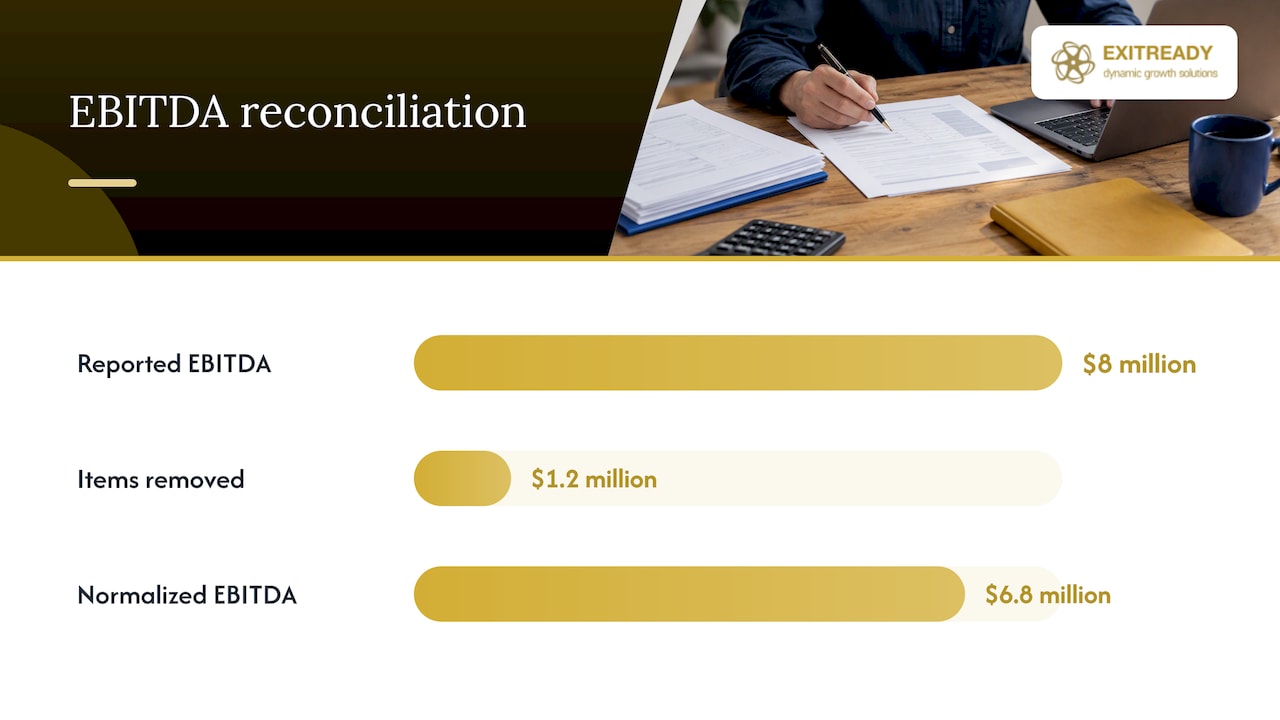
Consider a hypothetical mid-market services firm generating $8 million in reported EBITDA, where $1.2 million of that figure comes from one-time contract settlements and a loosely documented owner-expense add-back. A buyer’s QoE review strips both out, leaving normalized EBITDA closer to $6.8 million, a gap large enough to reshape the entire offer once a multiple is applied.
Now consider the same business a year earlier, if the owner had spent that year documenting recurring revenue contracts, tightening the justification behind every add-back, and building a clean cash-flow-to-net-income bridge. The reported $8 million might not have changed, but the proportion of it that survives QoE scrutiny would. A higher share of defensible, cash-backed EBITDA going into negotiations generally supports a stronger multiple and fewer concessions on earnouts or escrow, because the buyer’s advisor has fewer open questions to resolve.
The lesson generalizes beyond any single business: the work that improves quality of earnings, cleaning up documentation, tightening recognition policies, reducing reliance on one-time items, pays off in the multiple a business commands far more directly than top-line growth alone.
Treat QoE prep as value creation, not a compliance hurdle
The owners who come out ahead in diligence are not the ones with the cleanest story. They are the ones who spent a year before the process treating earnings quality as an operating discipline, which also tends to make the business easier to run and easier to hand off after close.
— Andre
How we help owners get ready for QoE and exit
Getting a business QoE-ready usually means fixing the same operational gaps that limit day-to-day performance: owner dependency, undocumented processes, and inconsistent financial reporting. We built AOS to close those gaps directly, replacing ad hoc decision-making with documented playbooks and delegated ownership so earnings hold up under scrutiny, whether that scrutiny comes from a buyer’s advisor or your own management team.
- Our ProfitDriver Analysis™ identifies where reported profit depends too heavily on judgment calls or one-time events.
- Our Enterprise Assessment and AOS Value Creation Partnership builds the documented systems reviewers look for when judging earnings sustainability.
- Owners managing their own reconciliations in spreadsheets can also work with our partners at Frac CFO for fractional cash-flow forecasting and modeling support.
| Step | What it addresses |
|---|---|
| ProfitDriver Analysis™ | Identifies earnings that depend on one-time items or weak documentation |
| AOS Value Creation Partnership | Builds documented systems that reduce owner dependency |
| Strategy call | Maps a preparation timeline before a sale or investment process begins |
If you are planning a sale or capital raise in the next year, the fastest next step is to schedule your strategy call and get a clear read on where your current numbers would hold up under a buyer’s review.
FAQ
What are the five earnings management techniques?
Definitions vary across sources, but commonly cited techniques include aggressive revenue recognition, accrual manipulation, improper use of one-time or non-recurring gains, shifting expenses between periods, and aggressive capitalization of costs that should be expensed. The RPC/CFA Institute study identifies several of these as the most common distortions QoE reviews adjust for.
What does EBITDA actually tell you?
EBITDA shows operating profit before interest, taxes, depreciation, and amortization, but it only becomes useful for valuation once it is normalized for one-time items and unsupported add-backs. A QoE review tests whether reported EBITDA is backed by cash and likely to repeat, which matters more to a buyer than the raw figure itself.
What is earnings management in simple terms?
Earnings management means using accounting choices, such as timing revenue, adjusting reserves, or classifying recurring costs as one-time, to make reported profit look better or more stable than the underlying business performance actually is. QoE reviews exist largely to identify and reverse these adjustments.
How long does a quality of earnings take?
Timing depends on company size and how prepared the seller is, but engagements commonly span several weeks from initial data request to final report. Sellers who arrive with current reconciliations for cash, accounts receivable, and inventory typically move through the process faster than those rebuilding records mid-engagement.
Sources
- Evaluating quality of financial reports — CFA Institute
- The statement of cash flows: improving the quality of cash flow information provided to investors — SEC
- Investing
- The Misrepresentation of Earnings — RPC / CFA Institute