

Performance-based consulting delivers measurable improvements in profitability, scalability, and exit readiness by replacing owner dependence with documented operating systems. Rather than offering generic advice, this model ties engagements to outcomes like higher EBITDA, lower key-person risk, and a business that runs without the founder in the room. We build and apply these systems through our AOS (Accelerated Operating System) framework, along with diagnostics like our ProfitDriver Analysis™, to turn operational discipline into a measurable valuation gain.
TL;DR:
- A single client generating more than 30% of revenue can stall or reprice a sale, so track diversification well before due diligence.
- Start roughly 1,000 days before a sale: establish diagnostics and scorecards within 90 days, then build documented processes and founder independent operations.
- Once an advisor is engaged, closing typically takes 6 to 12 months, with owners often involved for another 3 to 6 months afterward.
- Documented procedures alone do not prove delegation; assign decision owners, authority limits, and escalation triggers, then test whether staff decide routine issues without the founder.
- Pair leading measures such as delivery times and lead conversion with EBITDA margin and recurring revenue, reviewing weekly scorecards and monthly accountability meetings.
Table of Contents
- Why performance-based consulting matters to buyers and owners
- Core components of a performance-based consulting program
- Timeline, milestones, and what to expect before a sale
- How we implement performance-based consulting through AOS
- What measurable impact actually looks like in practice
- Strategic delegation frameworks that make the system stick
- Why operational transformation deserves strategic priority, not a side project
- If you want measurable results: programs and next steps
- FAQ
- Sources
Why performance-based consulting matters to buyers and owners
Most owners discover the real cost of their own indispensability only when they try to sell. A buyer does not pay a premium for a founder’s hustle. They pay for systems that keep running after the founder leaves the building. When a business cannot function without its owner making every call, that key-person risk gets priced into the offer, often as a lower multiple or an earnout tied to the founder staying on.
Structured management practices change that calculus. Research from Harvard’s international empirics of management finds that firms using documented processes, consistent performance monitoring, and clear target-setting tend to be larger, more profitable, and more productive than those without them. That is not a coincidence buyers overlook. Quality of Earnings reviews and management interviews are built specifically to surface whether a business depends on one person or operates on a system.
Two due-diligence risks come up constantly:
- Owner dependence: when the team defers every decision to the founder, buyers read it as fragility, not loyalty.
- Customer concentration: a single client representing more than 30% of revenue is a common flag that can stall or reprice a deal, according to Cornell research on structured management.
Buyers often treat customer concentration above 30% from one client as a material due-diligence risk, which makes revenue diversification a measurable target rather than a vague aspiration.
Core components of a performance-based consulting program
A performance-based engagement is not a binder of recommendations. It is a sequence of diagnostics, documentation, and accountability mechanisms, each producing a number you can track.
- Diagnostic baseline: a ProfitDriver-style analysis identifies which levers (pricing, cost structure, customer mix, operational drag) are actually moving EBITDA, so effort goes where it pays off.
- Playbook creation: standard operating procedures get documented for the roles and decisions that currently live only in the owner’s head, starting with the functions most tied to revenue and client delivery.
- KPI stack: leading operational metrics (on-time delivery, cycle time, lead conversion) are paired with outcome metrics (EBITDA margin, recurring revenue percentage) so teams see cause and effect.
- Cadence and accountability: weekly scorecards and monthly reviews assign ownership for each metric, replacing informal check-ins with a rhythm that holds regardless of who runs the meeting.
- Delegation and succession: decision rights move from the owner to named roles, with a documented escalation path, which is the step that actually produces founder-optional operations.
Our guide to exit-ready business systems walks through eight practical examples of this kind of documentation in action.
Pro Tip: Start documentation with the one process that would cause the most damage if you disappeared for a month. That is almost always the highest-leverage playbook to write first.
Timeline, milestones, and what to expect before a sale
Preparation takes longer than most owners assume. Advisors commonly recommend starting roughly 1,000 days before a target sale date, about three years, which gives enough runway to build a management team and document systems without rushing the process.
A realistic milestone path looks like this:
- 90 days: baseline diagnostic complete, highest-risk playbooks drafted, first KPI scorecard in use.
- 12 months: majority of core processes documented, customer concentration trending down, management team taking ownership of weekly metrics.
- 36 months: founder-optional operations in the functions that matter most to a buyer, consistent KPI history to show trend, not just a snapshot.
Once formally engaged with an advisor, a professional sell-side process typically runs 6 to 12 months from engagement to close, with many deals requiring an additional 3 to 6 months of owner involvement after closing. Businesses that enter that process with documented systems and a broader buyer pool are in a stronger position to negotiate terms than those presenting a founder-dependent operation for the first time. Our exit planning guide covers how to sequence these milestones against a sale timeline.
How we implement performance-based consulting through AOS
An accelerated operating system is designed to take an owner from diagnostic to documented, delegate-ready operations in a structured sequence rather than an open-ended retainer.
- Assessment first: every engagement starts with an Enterprise Assessment or a Growth Readiness Score Card to establish where owner dependence, customer concentration, and operational inconsistency currently sit.
- Sprint programs matched to the goal: Different sprint programs suit varying needs: focused operational wins in a shorter window, rebuilding core processes and KPI tracking, or larger organizations tackling multiple business units.
- ProfitDriver Analysis™: this diagnostic isolates which profit levers (pricing, mix, cost) deserve priority before any playbook work begins, so resources go to the highest-impact fixes first.
- AOS Value Creation Partnership: for owners targeting a premium exit, this longer engagement layers delegation frameworks, governance cadence, and certification work on top of the sprint foundation.
Deliverables from an AOS engagement typically include documented SOPs for priority functions, a role-based KPI scorecard, and a certification outcome owners can present to buyers or advisors as evidence of operational maturity. Our exit readiness assessment page details what that diagnostic covers before any program begins.
What measurable impact actually looks like in practice
The pattern that shows up across performance-based engagements is consistent: a business enters with concentrated decision-making and inconsistent reporting, and over a defined period, operational metrics start moving in a documented, trackable way. A sales team that previously relied on the owner closing every major deal transitions to a documented pipeline process with defined ownership at each stage. A finance function that reported numbers quarterly, with little consistency, moves to a weekly scorecard that both the team and a prospective buyer can review without the founder narrating context.
What changes is not the ambition of the plan but the discipline of measurement. Firms adopting structured management practices tend to show stronger productivity and profitability outcomes over time, and the same logic applies inside individual engagements: the businesses that track leading and outcome KPIs consistently are the ones that can point to a trend line, not just a single good quarter, when a buyer asks for proof. Our scaling framework outlines how that trend-building process typically unfolds across functions, from operations to customer retention.
Strategic delegation frameworks that make the system stick
Documentation alone does not create a founder-optional business. Delegation does, and it needs structure to hold under pressure. A workable framework assigns three things to each critical decision: who owns it, what authority they have without checking back with the owner, and what triggers an escalation.
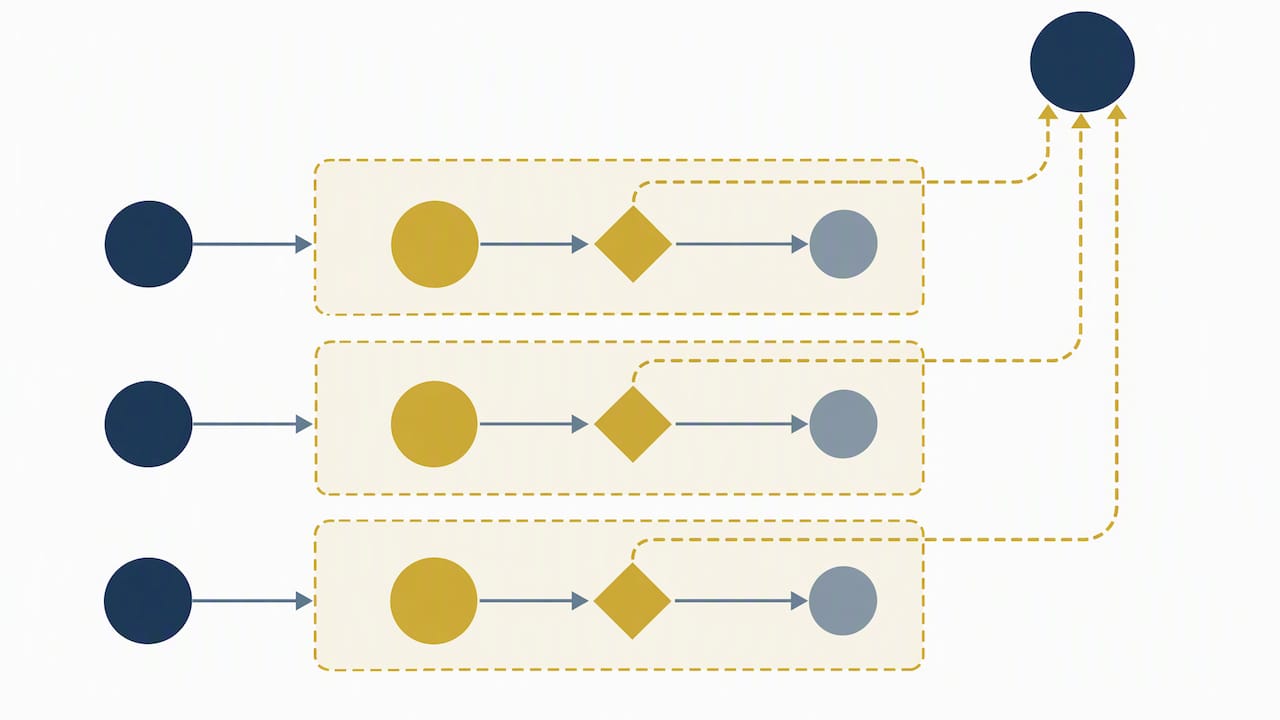
Research on management practices notes that buyers frequently interview teams without the owner present specifically to test this. If staff consistently defer routine questions upward, it signals that delegated authority exists on paper but not in practice, a gap that reduces deal value during diligence. Fixing it means more than an org chart update. It requires documented decision rights, a defined approval threshold for spending or hiring, and a cadence where delegated leaders report outcomes rather than ask permission.
Our guide on building a business that runs without you breaks this down by function, starting with the roles most owners hold onto longest: sales, key client relationships, and financial oversight. Those three areas are also the ones buyers probe hardest, which makes them the right starting point for any delegation plan rather than an afterthought handled late in the process.
Why operational transformation deserves strategic priority, not a side project
Owners tend to treat systems work as something to get to once the business slows down. It rarely slows down, and waiting is the mistake. A business built on hard work instead of documented design confuses effort with enterprise value, and that confusion gets expensive the moment a buyer starts asking questions the founder cannot delegate someone else to answer.
My practical advice: start with an objective diagnostic scorecard before committing to any program. It tells you honestly where owner dependence and reporting gaps sit, instead of guessing. Treat the next 1,000 days as a build phase, not a waiting period, and prioritize the risks a buyer will actually test, not the ones that feel most urgent day to day.
— Andre
If you want measurable results: programs and next steps
Turning these principles into practice is faster with a structured path instead of trial and error. There are several entry points depending on where one is starting from.
- Quick operational wins: a Growth Sprint or Performance Sprint addresses specific bottlenecks in a defined, time-boxed engagement.
- Full exit-readiness path: the AOS Value Creation Partnership combines diagnostic, documentation, and delegation work aimed at premium exit outcomes.
- Baseline first: the ProfitDriver Analysis™ identifies your highest-impact profit levers before you commit to a program.
| Starting point | Best fit | Where to begin |
|---|---|---|
| Need faster operational fixes | Time-boxed sprint | Growth Sprint, Performance Sprint |
| Building toward a sale | Full partnership | AOS Value Creation Partnership |
If your buyer-facing positioning also needs work alongside your internal systems, a partner resource on category design is worth a look for owners rebuilding how their business presents to the market. When you are ready to talk specifics, start with our application form or reach out through our contact page.
FAQ
What does performance-based consulting actually mean?
Performance-based consulting ties an engagement to measurable business outcomes, like improved profitability, scalable operations, and reduced owner dependence, rather than billing for hours or generic advice. It typically starts with a diagnostic, moves through documented playbook creation, and ends with KPI tracking that shows progress over time.
How much does performance-based consulting cost?
Pricing varies by scope and depth. Our Growth Sprint runs 7500-10000 $ one-off, our Performance Sprint runs 15000-20000 $ one-off, and Elite 1-on-1 Coaching is 3200 $ per month; other programs, including the Enterprise Sprint and AOS Value Creation Partnership, are priced on request based on scope.
What KPIs matter most in a performance-based engagement?
A useful KPI stack pairs leading operational indicators, like on-time delivery or lead conversion rate, with outcome indicators tied directly to EBITDA margin and recurring revenue percentage. Tracking both together shows whether operational changes are actually translating into financial results, not just activity.
How long does it take to become exit-ready?
Advisors commonly recommend starting around 1,000 days, roughly three years, before a target sale to build documented systems and a capable management team. Once formally engaged in a sale process, closing typically takes 6 to 12 months, with some post-close owner involvement common afterward.
Why does customer concentration matter so much to buyers?
A single client representing more than 30% of revenue is a common flag that buyers treat as a material risk during due diligence, since losing that client could sharply affect future earnings. Reducing concentration through diversified sales efforts is a measurable target worth tracking well before a sale process begins.
Sources
- The 1,000‑Day exit plan — Axial
- IBBA / M&A Source Market Pulse executive summary
- International empirics of management — Harvard CID
- Cornell News: Structured management practices fare better