

A no-shop clause bars a seller from soliciting, discussing, or negotiating alternative acquisition offers for a fixed window, usually 30 to 90 days. It exists so the buyer’s money spent on diligence and legal fees doesn’t fund a bidding war they lose. For sellers, it means giving up leverage temporarily, often in exchange for deal certainty, and sometimes on the hook for a termination fee if they break it.
TL;DR:
- No-shop clauses typically last 30 to 60 days, but many are drafted as binding even if the rest of the deal is non-binding, creating enforceability traps.
- These clauses usually restrict solicitation, initiation of new contact, information sharing, and substantive negotiation of competing bids, often requiring notification of unsolicited offers.
- Superior proposal and fiduciary out provisions allow boards to respond to significantly better bids, while go-shops provide limited post-signing testing of the market, though they rarely lead to higher bids.
- Negotiating shorter durations, clear exclusions, and capped breakup fees can significantly reduce the risks associated with no-shop clauses for sellers.
- The duration and scope of exclusivity are more impactful on deal safety than price negotiations, especially given the limited effectiveness of go-shop provisions.
Table of Contents
- No shop clause explained: where it shows up and how binding it gets
- The moving parts: what a no-shop actually prohibits
- Superior proposals, fiduciary outs, and the go-shop alternative
- No-shop vs. go-shop: what they do differently
- Negotiating a no-shop: what sellers can actually push for
- What happens if someone breaches a no-shop
- A sample clause and what to redline
- Why exit readiness changes the exclusivity math
- The clause everyone underestimates until it costs them
- Sources
No shop clause explained: where it shows up and how binding it gets
No-shop language typically appears in three places: the letter of intent (LOI), the term sheet, and the definitive merger agreement. Most of a term sheet is deliberately non-binding, a way to lock in price and structure before lawyers draft the real contract. The no-shop provision is the exception. Buyers almost always insist it be drafted as binding, even inside an otherwise non-binding document, which catches sellers off guard when they assume they can keep talking to other suitors informally.
That gap between “non-binding deal” and “binding exclusivity” is one of the most common traps in early-stage negotiations, according to practitioner commentary on term sheet enforceability. A few things to check before signing anything:
- Does the document explicitly say the no-shop section survives even if the rest is non-binding?
- What’s the exact start and end date, or is it tied to a milestone like signing the definitive agreement?
- Does the clause cover just “solicitation,” or does it also block responding to inbound interest?
Buyers ask for this protection because due diligence is expensive, and no acquirer wants to fund a process that becomes free market research for a competitor.
The moving parts: what a no-shop actually prohibits
Strip the legal phrasing away and a no-shop clause usually restricts four things, layered on top of each other rather than standing alone.
- Solicitation. The seller cannot actively shop the business, contact other buyers, or authorize an investment bank to do so.
- Initiation of contact. Even without actively “shopping,” the seller can’t open new conversations that lead toward a competing offer.
- Information sharing. Data rooms, financials, and customer lists stay closed to any other prospective buyer during the window.
- Negotiation. The seller can’t engage substantively with a rival bid, even one that shows up unprompted, without triggering notice obligations first.
Most clauses also require the seller to notify the buyer, often within 24 to 48 hours, if an unsolicited offer arrives. Carve-outs matter here. A well-drafted clause excludes conversations already underway before signing, names any parties expressly excluded from the restriction, and leaves room for actions required by law or regulation. Skip these details and a seller can end up boxed in by language broader than the deal ever intended.
Superior proposals, fiduciary outs, and the go-shop alternative
Exclusivity isn’t absolute. Most no-shop clauses carve out room for a seller’s board to act if something significantly better shows up, and this is where the language gets technical fast.
- A superior proposal is typically defined as a bid that’s financially better and reasonably capable of closing, not just a higher number scribbled on a napkin.
- Accepting or even engaging with one usually triggers a formal procedure: written notice to the original buyer, a matching-rights period, and board approval documented in minutes.
- Public-company boards often insist on a fiduciary out, language confirming that no contract can force directors to ignore a legal duty to shareholders, since superior-proposal exceptions and fiduciary outs are now standard in most negotiated deals.
- Some agreements swap strict exclusivity for a go-shop or narrower window-shop period, giving the seller limited time post-signing to actively test the market.
These mechanisms exist because courts and shareholders expect boards to chase real value, not just honor a handshake.
No-shop vs. go-shop: what they do differently
The two structures solve different problems, and mixing them up in negotiation is a common mistake.
- Timing. A no-shop locks the seller down before or at signing. A go-shop opens a defined window afterward, giving the seller a second chance to test the market even after committing to a buyer.
- Scope. No-shops are defensive, protecting the buyer’s investment in diligence. Go-shops are offensive, letting the seller (or its board) prove it got the best price.
- Real-world limits. Go-shops sound like a safety net, but empirical research on go-shop mechanics found they produced higher competing bids only about 13% of the time in earlier deal samples. Match rights and tightly drafted “excluded party” definitions have made the tactic weaker over time, and additional commentary on go-shop effectiveness describes the provision as often symbolic rather than a genuine market test.
Private equity buyers and public-to-private deals use go-shops most often, largely because directors need a defensible record that they checked the market before recommending a deal.
Negotiating a no-shop: what sellers can actually push for
Owners rarely get to strike a no-shop entirely, but they can shrink its bite. Here’s where to focus:
- Cap the duration. Push for 30 to 60 days rather than open-ended language, and tie any extension to specific buyer milestones, not automatic renewal.
- Condition exclusivity on performance. Make the no-shop expire if the buyer misses financing commitments or diligence deadlines, a tactic practitioner guidance on seller protections recommends specifically because it creates reciprocal pressure on the buyer to move fast.
- Draft narrow carve-outs. Name any strategic partners or existing conversations that stay outside the restriction, in writing, before signing.
- Cap the breakup fee. If a termination fee applies, negotiate it as a percentage of deal value with a hard dollar ceiling, not an open-ended damages exposure.
- Preserve the fiduciary window. Even in private deals, insist on language allowing the board or owner group to respond to a materially better offer.
Pro Tip: Ask your attorney to redline the no-shop section before touching price or valuation. Buyers expect pushback on exclusivity terms far more than they expect it on the multiple, and it costs you nothing to ask.
What happens if someone breaches a no-shop
Breaking a no-shop rarely ends in a courtroom drama. It usually ends with a check.
- Termination fees are the most common remedy, a pre-negotiated dollar amount the seller owes if it walks for a competing deal.
- Reimbursement of costs covers the buyer’s legal and diligence spend even without a full breakup fee.
- Injunctive relief lets a buyer ask a court to block the seller from closing with someone else, though this is used sparingly and mostly as leverage.
Termination fees can get enormous at scale. In the Microsoft acquisition of LinkedIn, LinkedIn would have owed a $725 million breakup fee had it walked away for a competing buyer, a figure that shows how seriously large strategic buyers price in exclusivity. Mid-market deals scale far smaller, but the mechanics are identical: a fixed fee, a notice procedure, and a matching-rights period before the seller can act on a better offer.
A sample clause and what to redline
A stripped-down version of typical language looks like this:
Before signing anything close to this, check for:
- Duration. Is it a fixed date or tied to a milestone that could slip?
- Exclusions. Are named parties or pre-existing talks carved out explicitly?
- Notice window. How fast must the seller disclose an unsolicited offer, and to whom?
- Superior-proposal procedure. Does it specify matching rights and a board-approval process?
- Remedies. Is the termination fee capped, and does injunctive relief language leave room for a fiduciary response?
Three alternative phrasings worth proposing: shorten “90 days” to “60 days,” add “excluding parties listed in Schedule A” after the solicitation restriction, and insert “provided the Board determines in good faith such action is required to comply with its fiduciary duties” ahead of any superior-proposal carve-out.
Why exit readiness changes the exclusivity math
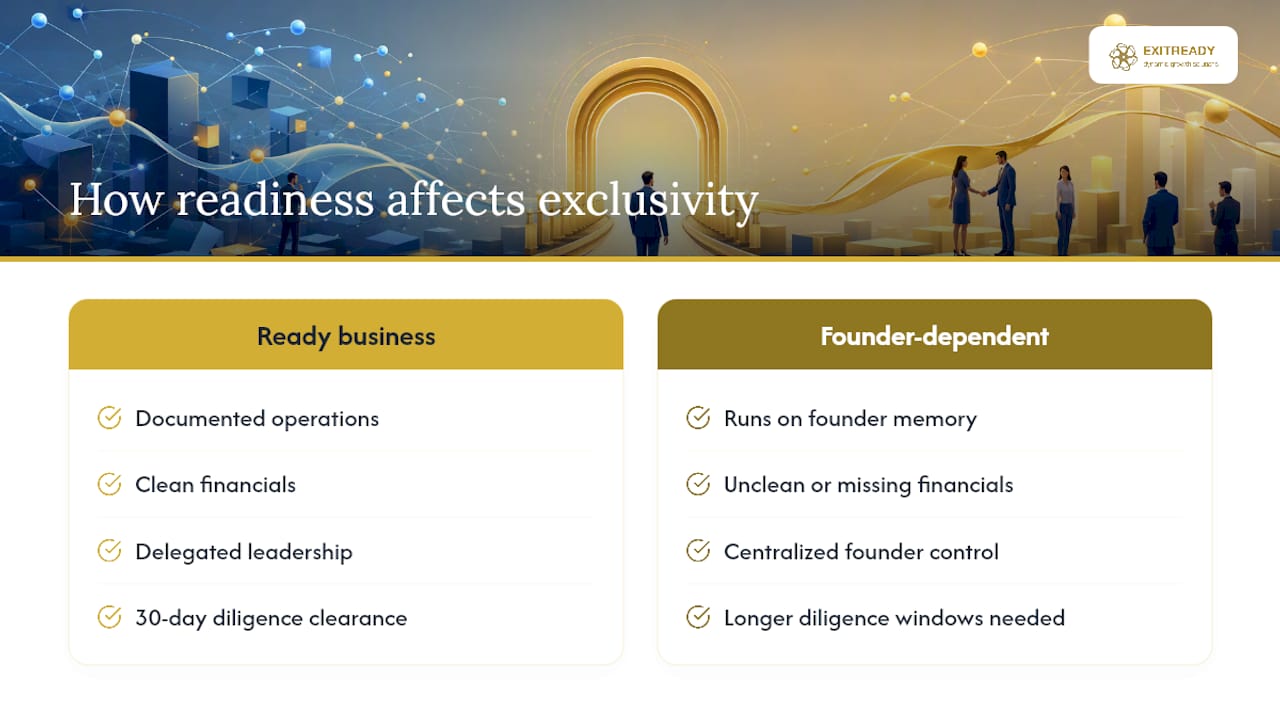
A short no-shop window feels risky mainly when a business isn’t ready to move fast under scrutiny. Owners with documented operations, clean financials, and delegated leadership can clear diligence inside 30 days without panic, which makes a tight exclusivity term far less dangerous to accept. Businesses running on founder memory instead of written playbooks need longer windows just to survive the buyer’s checklist, which is exactly the leverage buyers exploit when they draft these clauses.
Dynamicgrowthsolutions works with mid-market owners on exactly this gap, using documented operating systems that shrink diligence timelines before a term sheet ever gets signed. If you’re heading into a negotiation, a readiness assessment is a faster starting point than guessing how a buyer will react to your current state, and coordinating early with legal and financial advisors keeps the no-shop language from becoming the most expensive line in the deal.

The clause everyone underestimates until it costs them
Most owners spend their negotiating energy on valuation and walk past the no-shop section like it’s boilerplate. That is backwards. Price gets negotiated in the open, with comparable deals and market data to argue from. Exclusivity terms get buried in section 7 of a term sheet, and by the time a seller notices the duration or the fee structure, they’ve often already signed.
The go-shop data makes this even clearer. If go-shops only produced better bids in roughly 13% of studied cases, treating one as a safety net is wishful thinking, not strategy. The real protection isn’t a contractual escape hatch that rarely gets used. It’s not signing an exclusivity period longer than your business can actually survive under a microscope. A 90-day no-shop is a very different risk for a company running on founder memory than for one with documented systems and a leadership team that can answer diligence questions without the owner in the room. Negotiate the clause like it matters, because financially, it often matters more than the multiple everyone argues about first.
— Andre