

A leadership succession plan is a documented, multi-year system that identifies critical roles, builds successor pools, and turns readiness into something you can actually measure, not just hope for. It replaces panic-driven scrambling with a tested pipeline. Start this week: map your top three critical roles and write a 90-day emergency memo naming who takes over each one if the person in it disappears tomorrow. Everything else in this guide builds on that one move.
TL;DR:
- Building a succession pipeline requires identifying multiple credible candidates per critical role and conducting objective assessments before publicly naming any successors.
- A comprehensive plan should include gap analysis, development through rotations and coaching, and continuous monitoring of readiness scores and succession metrics.
- Leaders must establish and regularly update documented operating systems and playbooks for key processes to ensure smooth transitions and reduce owner dependency.
- The succession plan should be actively tested via emergency drills and successively scaled with clearer timelines, from a 5-year build to immediate 90-day emergency steps if needed.
- Ownership of succession planning lies with the board, CEO, and CHRO, with communication carefully managed to protect sensitive stakeholder relationships during transitions.
Table of Contents
- Why Leadership Succession Planning Matters More Than You Think
- The Step-by-Step Succession Planning Framework
- Which Leadership Roles Need a Succession Plan First?
- How Do You Develop Future Leaders Once You’ve Identified Them?
- How Long Should a Leadership Succession Plan Take?
- Who Owns Succession Planning in Your Organization?
- What Metrics Show Your Succession Plan Is Working?
- A Sample Succession Plan Template You Can Copy Today
- How AOS Turns Succession Plans Into Something You Can Actually Test
- What Leaders Get Wrong About Succession Planning
- How Dynamic Growth Solutions Helps You Build a Real Succession Plan
- Sources
- FAQ
Why Leadership Succession Planning Matters More Than You Think
Most leaders treat succession planning as paperwork for the far future. That’s backward. Succession is a resilience mechanism that protects revenue, valuation, and client trust the moment a key leader leaves, whether by choice, illness, or a competitor’s offer.
The math is unforgiving. A business that can’t produce a credible next-in-line during due diligence takes a valuation discount, because buyers price in the risk of the founder or executive walking away. Internally, a botched handover shows up as missed targets, client attrition, and a leadership team scrambling to answer questions nobody prepared for.
Boards and CHROs are catching on that succession has to be a continuous, data-driven capability rather than a scramble that starts when someone announces they’re leaving. Three signals indicate whether your plan is working:
- Bench depth: multiple credible candidates per critical role, not one designated heir
- Readiness scores: objective ratings from assessments, not gut feel from the outgoing leader
- Emergency handover tests: a successor has actually run the role for a stretch, unsupervised, and the business didn’t blink
The Step-by-Step Succession Planning Framework
Effective succession planning follows a sequence, not a checklist you fill out once a year. A validated six-step framework links business strategy to workforce planning, then moves through gap analysis, talent pool identification, development, implementation, and ongoing monitoring. Here’s how that plays out on a real timeline.
- Link strategy to workforce needs. Start by asking where the business is headed in five years and which leadership capabilities that future requires. A plan built around today’s org chart will be obsolete before it’s tested.
- Run a gap analysis. Compare current bench strength against future need, role by role. Most mid-market companies discover they have zero ready successors for at least one lifeblood position.
- Identify talent pools. Name two or three internal candidates per critical role, plus a shortlist of external options for roles with no internal bench. Single-heir thinking is the single biggest structural weakness in most plans.
- Develop successors deliberately. Assign rotations, stretch projects, and coaching tied to specific competency gaps, not generic leadership training.
- Implement and communicate. Roll out the plan in a sequenced order that protects sensitive relationships (more on that below).
- Monitor and update. Review readiness quarterly and revise the plan as people, roles, and strategy shift.
Deliverables change depending on how much runway you have:
- 5-year horizon: build the full pipeline architecture. This is the ideal window, yet only 8% of boards actually plan CEO succession five or more years out, which means most organizations are working with far less margin than they think.
- 3-year horizon: focus on management depth and financial readiness, meaning your second tier of leaders can run their functions without daily oversight and your books can survive scrutiny.
- 12-month horizon: shift to active successor training and a communication sequence for the board, staff, and key clients.
- Emergency horizon: an interim plan, always current, naming who steps in tomorrow morning if a leader is suddenly gone.
Three steps are non-negotiable regardless of horizon: clean financial reporting enough to survive a quality-of-earnings review, a second tier of management that actually owns decisions, and a communication sequence that doesn’t leak sideways before the right people hear it directly. Skip any of these and the rest of the plan is theater.
Which Leadership Roles Need a Succession Plan First?
Not every role deserves the same level of succession investment. Prioritize what people in the field call “lifeblood” roles: positions where a sudden departure would immediately disrupt revenue, client relationships, or core operations. That’s usually the CEO, the head of sales, and whoever holds the operational knowledge nobody else has documented.
Rank roles by two factors: business impact if the seat goes empty, and how hard the role would be to backfill externally. A role with high impact and low backfill difficulty (say, a well-documented finance director position) needs less urgency than a high-impact, low-documentation role like a founder who still personally closes every major deal.
Once you’ve ranked roles, build pools instead of picking single heirs. Progression research recommends an opt-out pipeline approach: identify multiple candidates per seat and let weaker fits self-select out through rotations and stretch assignments, rather than betting the business on one chosen successor from day one. Map candidates across roles too. The person developing into your VP of Operations might also be a viable backup for the COO seat in three years.
Assessment tools make this objective instead of political:
- Competency models that define what excellence looks like in each role, independent of who currently holds it
- 360-degree feedback pulling input from peers, direct reports, and clients, not just the boss’s opinion
- Behavioral assessments like Lumina Spark, which map working style and decision tendencies against role demands
- Simulation-based evaluation, putting candidates through realistic decision scenarios before you hand them the real thing
Pro Tip: Run assessments before you announce anyone as a “successor.” Once a name gets attached to a role publicly, objectivity in later evaluations tends to disappear.
How Do You Develop Future Leaders Once You’ve Identified Them?
Identifying a successor pool means nothing if you don’t build actual capability inside it. The strongest leadership development program designs deliver readiness through direct experience, not classroom theory.
The highest-impact interventions tend to be the same handful, applied consistently:
- Job rotations across functions, so a finance-track successor understands operations before they’re asked to run the whole company
- Stretch P&L assignments that put real budget accountability in a candidate’s hands years before they’d get it by default
- Executive coaching targeted at specific gaps an assessment surfaced, not generic leadership skills
- Shadowing the current role holder through board meetings, client negotiations, and crisis calls
- Action learning projects where a candidate solves a live business problem and presents results to leadership
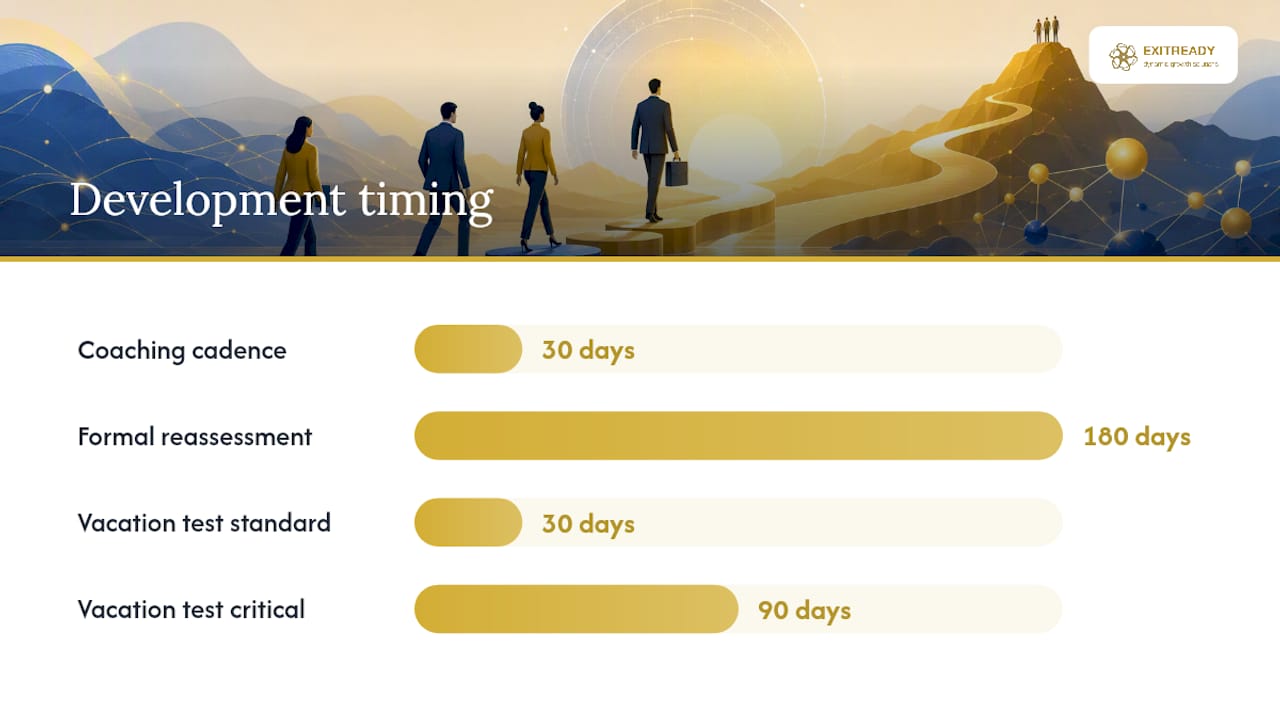
A workable development plan states clear objectives per candidate, milestones tied to actual dates, and a coaching cadence, monthly check-ins at minimum, with formal reassessment every six months.
The most useful readiness test is also the simplest: the vacation test. Send the current role holder away for 30 days, fully unreachable, and let the successor run the position with real authority. Extend it to 90 days for the most critical seats. If the business runs smoothly and the successor makes sound calls without daily rescue calls, you have a genuinely ready leader. If it falls apart, you’ve found the gap while the stakes are still low.
How Long Should a Leadership Succession Plan Take?
Start as early as you possibly can. A five-year runway is the ideal, giving you room to build real bench depth rather than a rushed handoff. A three-year window still works if you focus hard on management depth and financial readiness. Twelve months is tight but workable if a departure is already on the calendar. And an emergency plan should exist at all times, regardless of how far out your main timeline runs, because departures don’t wait for convenient timing.
Watch for these readiness signals rather than trusting a calendar alone:
- Documented SOPs for every critical function, not tribal knowledge sitting in one person’s head
- Successors with real P&L ownership, meaning they’ve made budget decisions with consequences, not just sat in on planning meetings
- Financials clean enough to survive due diligence, since messy books undermine confidence in any transition, internal or external
If a departure accelerates unexpectedly, use an interim appointment protocol: name a temporary leader with clearly bounded authority, set a 90 to 180 day review point, and communicate explicitly that the appointment is interim, not automatic promotion. That framing prevents resentment if the permanent choice ends up being someone else; for legal and ownership transfer integration into succession planning, consult a New Jersey Estate Planning Attorney.
Who Owns Succession Planning in Your Organization?
Succession planning fails most often because nobody actually owns it. The board sets overall risk tolerance and approves the CEO succession framework specifically. The CEO owns succession for their direct reports and champions the process visibly, since leaders need to be seen driving this, not delegating it entirely and disappearing. The CHRO or HR leader runs the operational machinery: assessments, development tracking, and documentation.
Review the plan on a fixed cadence, quarterly for critical roles, annually for the broader pipeline, and record accountability in a single shared document the board can access, not scattered notes across different leaders’ files.
Communication sequencing protects the plan from damage. Move in this order:
- Board and top leadership team first, in a controlled setting with full context
- The successor candidates themselves, privately, before any public signal
- Broader staff, once the transition plan is firm enough to answer real questions
- Clients and key partners, timed close to the actual transition so speculation doesn’t fill the gap
Sensitive stakeholder groups (long-tenured executives who were passed over, major clients tied personally to the outgoing leader) deserve one-on-one conversations before any group announcement.
What Metrics Show Your Succession Plan Is Working?
A plan without metrics is a hope, not a system. Track a small set of numbers consistently rather than drowning in vanity dashboards:
- Readiness score per critical role, based on assessment results, not opinion
- Bench depth: number of viable candidates per lifeblood position
- Successor retention: are the people you’re developing actually staying?
- SOP coverage: percentage of critical functions with documented, current procedures
- Development milestone completion: are coaching and rotation plans actually finishing on schedule?
Build the dashboard simply, a shared spreadsheet or a basic HR system view works fine for most mid-market companies. Review it quarterly with the leadership team and annually with the board.
Here’s the number that should worry you: just 8% of boards plan CEO succession more than five years out. Trigger an external search the moment internal readiness scores stall for two consecutive review cycles with no credible internal path forward.
A Sample Succession Plan Template You Can Copy Today
You don’t need software to start. A one-page template per critical role gets you moving immediately, and you can replicate it across every lifeblood position in the business.
| Field | Example entry |
|---|---|
| Role | VP of Operations |
| Critical competencies | Vendor negotiation, cross-team coordination, budget ownership |
| Successor pool | 2 internal candidates, 1 external contact on file |
| Development actions | Stretch P&L project, quarterly coaching, shadow board meetings |
| Timeline | Readiness target |
| Owner | CHRO, reviewed with CEO monthly |
| KPIs | Readiness score, P&L milestone completion, retention |
For the emergency version, compress this into 90-day steps: name an interim lead within week one, transfer key passwords and vendor contacts within week two, and schedule a 30-day check-in to confirm the interim leader has what they need. Pair that with a 12-month development goal, closing the specific competency gap the interim period exposed.
Once you’ve built one template, the format scales. Duplicate it for every role on your critical list, and review all of them together during your quarterly cadence so gaps in one role don’t get lost while you’re focused on another.
How AOS Turns Succession Plans Into Something You Can Actually Test
Most succession plans die in a binder because nobody documented how the business actually runs. That’s the real gap between having a plan and having one that survives contact with reality: the operating knowledge has to live in playbooks, not in one person’s head.

A documented operating system builds redundancy directly into the business rather than bolting succession on as a side project. When every core process, from sales handoffs to financial close, has a written playbook, a successor can step into a role and follow the system instead of guessing at institutional memory. That’s the same principle behind reducing owner dependency in exit-readiness work: the business needs to run on documented systems, not on any single person’s presence.
Placement across the timeline matters. Assessments belong at the front end, identifying gaps before development spending starts. Playbooks get built during the 3-year and 12-month horizons, when roles are stable enough to document accurately. Readiness dashboards run continuously, feeding the quarterly review cycle.
- Document decision authority explicitly, not just tasks
- Build playbooks for the top 20% of processes that drive 80% of operational risk
- Test every playbook with a real handover, not a written review alone
Pro Tip: If a process only exists as a conversation you’d have to have with a new hire, it isn’t documented yet. Write it down before you call it a system.
What Leaders Get Wrong About Succession Planning
Waiting is the mistake I see most often, and it’s rarely a knowledge gap. Leaders understand succession matters. They just assume there’s more runway than there actually is, and the 8% figure on five-year planning tells you how widespread that assumption is.
The second blind spot is emotional, not strategic: over-relying on a single heir because it feels simpler than building real optionality. A pool of three developing candidates is harder to manage than one obvious successor, but it’s the difference between a plan and a bet.
The third is underdocumentation. Leaders who’ve run a function for a decade don’t realize how much of what they do lives only in their head until someone else tries to do the job and can’t.
Start your 90-day checklist now: name your top three critical roles, identify at least two candidates per role, and write the emergency memo. Bring in outside help once you’re past the basics and need objective assessment data or a documented operating system, that’s usually the point where internal bandwidth runs out faster than the plan needs it to.
— Andre
How Dynamic Growth Solutions Helps You Build a Real Succession Plan
Dynamic Growth Solutions gives you what a binder full of good intentions can’t: a documented system that makes succession testable, not theoretical. If your plan currently lives in someone’s head, the Enterprise Assessment and AOS Value Creation Partnership start by diagnosing exactly which roles and processes carry the most owner dependency, then build the playbooks that turn that knowledge into something a successor can actually follow.
For leaders who need faster traction on a specific readiness gap, the Growth Sprint, Performance Sprint, or Enterprise Sprint engagements target focused 90-day outcomes rather than a slow-moving overhaul. And if the bottleneck is specifically about developing a named successor’s judgment under pressure, Elite 1-on-1 Coaching works directly with that individual on the decisions they’ll eventually own alone.
Start with the Enterprise Assessment to see exactly where your succession gaps sit before committing to a full engagement.
Sources
- More and better options: strengthening long-term CEO succession planning — Harvard Law School Forum on Corporate Governance
- How the best boards approach CEO succession planning — PwC
- Succession planning — U.S. Office of Personnel Management (OPM)
- Business Succession Planning Steps: 8-Step Plan for Owners — CT Acquisitions
FAQ
What Are the 5 D’s of Succession Planning?
Definitions of the “5 D’s” vary across sources, and no single authoritative version applies universally across industries. The more consistently validated approach, used throughout this guide, is the six-step framework from the Office of Personnel Management: link strategy, analyze gaps, identify pools, develop successors, implement, and monitor.
What Are the 5 Steps of Succession Planning?
Most frameworks compress into identifying critical roles, assessing current bench strength through gap analysis, building successor pools, developing candidates through rotations and coaching, and implementing with ongoing monitoring. The OPM framework treats this as six connected steps rather than five isolated ones, since strategy alignment has to happen before gap analysis makes sense.
What Is an Example of a Leadership Succession Plan?
A working example is a one-page template per critical role listing the role’s core competencies, a successor pool of two or three candidates, specific development actions like stretch assignments or coaching, a target readiness timeline, a named owner, and KPIs like readiness score and retention. The emergency version compresses this into a 90-day sequence: name an interim leader, transfer operational access, and schedule a 30-day review.
What Are the Key Trends in Succession Planning Going Forward?
The clearest shift is away from one-time, event-based succession toward continuous progression systems that build optionality through multiple candidates per role rather than a single designated heir. Boards are also leaning harder on objective, data-driven assessments and documented operating systems, like AOS-style playbooks, to make readiness measurable instead of assumed.
How Much Does a Leadership Succession Assessment Cost?
Pricing for Dynamic Growth Solutions’ Enterprise Assessment and AOS Value Creation Partnership is available on request through the AOS page. Focused readiness engagements like the Growth Sprint and Performance Sprint are listed on the Sprint Plus page.