

A good leadership offsite agenda is built around three to five decisions, not a list of topics. It gives each decision a method, an owner and a time slot. It protects space for the conversation your team has been avoiding, and it ends with a written record of who does what by when. Below is a full two-day agenda you can adapt, the time split behind it, and the prep that decides whether the days pay off.
TL;DR
- Start with outcomes: define what would prove the offsite worked 30 days later, then admit only topics that can be framed as decisions.
- Cap the agenda at 3 to 5 strategic decisions, with no more than two high-stakes topics per day.
- Split a two-day agenda roughly into strategy (30 to 35%), team health and avoided conversations (20 to 25%), and unstructured time (15 to 20%), with the rest for framing and commitments.
- Send pre-reads at least a week ahead, use silent starts, and consider an outside facilitator so the CEO can take part as a team member.
- Close with a decision log, named owners, 90-day milestones, a “what we are not doing” list and a booked 30-day check-in.
Table of Contents
- Why most offsite agendas fail before the first session
- Set the scope: three to five decisions
- The time split that works for two days
- A sample two-day leadership offsite agenda
- Pre-work that makes the room productive
- Facilitation: protect dissent and the quiet voices
- How to close: the most dangerous hour
- Our perspective: an offsite is a systems test
- Where we can help
- Adapting the agenda
- Common mistakes to avoid
- FAQ
- Sources
Why most offsite agendas fail before the first session
Most leaders assume that getting the team out of the building produces a better conversation. It rarely does. According to Harvard Business Review’s guidance on planning a leadership offsite, the most common failure is formlessness: a loose agenda that produces pleasant, aimless talk and no change in the business.
The fix is design. Off-Sites that Work argues that the strategy offsite is the most important meeting executives attend all year, yet few teams can say theirs delivers. Its authors treat the offsite as a place for rigorous strategy conversation, not a junket for team building or vague direction setting.
So before you open a calendar or book a venue, answer one question: what has to be true 30 days after we get back? The Offsite Co. suggests planning an offsite like product work. Define the outcomes first. If a topic cannot be framed as a specific decision that affects future work, it does not earn time on the agenda.
Set the scope: three to five decisions
Write your candidate topics on a list. Then rewrite each as a decision with a deadline and an owner.
| Topic as people first state it | Decision it should become |
|---|---|
| “Pricing” | Do we raise prices for our top tier by Q1, and who owns the rollout? |
| “Hiring and org structure” | Do we add a COO-level role this year, or promote from within? |
| “Growth strategy” | Which two of our five growth bets get funded, and which are paused? |
| “Team communication” | What are our rules for escalating disagreements, and who enforces them? |
The HBR guidance puts the working limit at 3 to 5 decisions. A useful rule of thumb from the same research: no more than two major, high-stakes topics per day, because decision quality drops as cognitive load climbs. If your list has eleven items, you do not need a longer offsite. You need to cut.
Set a timeline that fits the size of the group. For large groups, the HBR piece suggests starting 6 to 9 months ahead and locking objectives and decisions 6 to 8 weeks before the date. A smaller team can compress this, but not by skipping the decision list.
The time split that works for two days
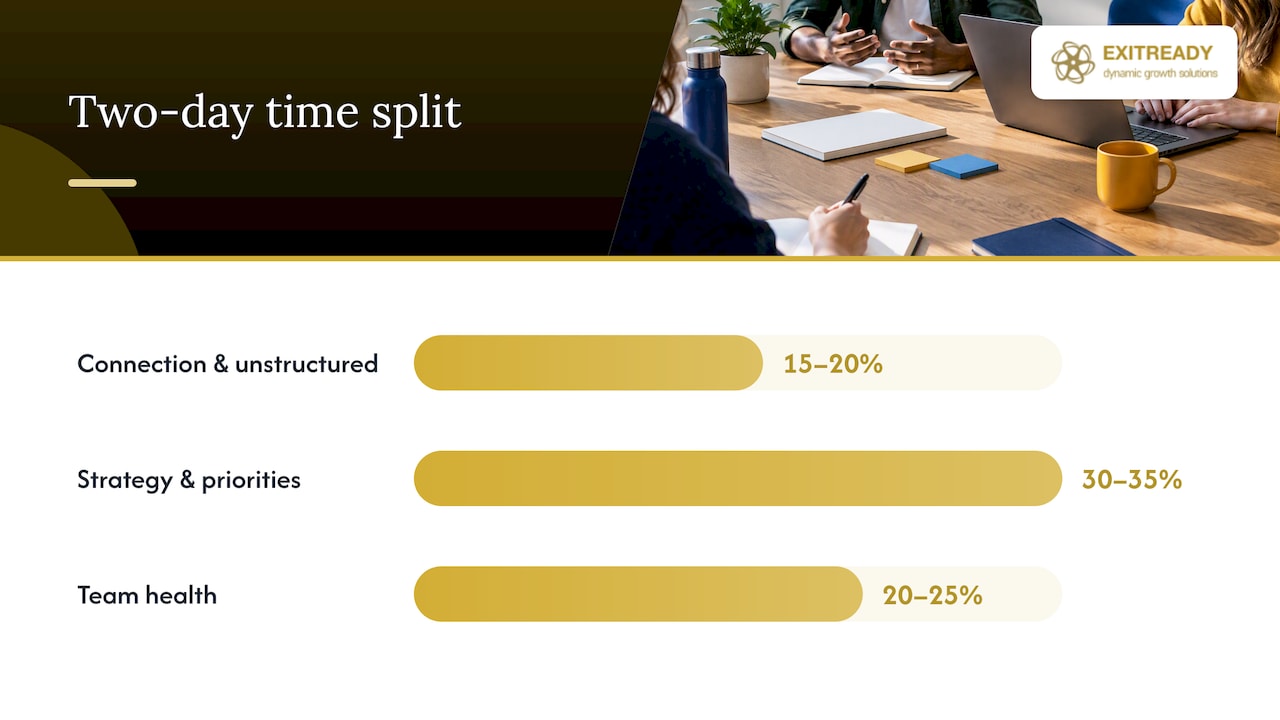
A two-day agenda needs a deliberate balance. Chris Dyer’s leadership retreat guide describes a split that holds up well in practice:
| Block | Share of total time |
|---|---|
| Connection and unstructured time (meals, walks) | 15 to 20% |
| Strategy and priorities | 30 to 35% |
| Team health and avoided conversations | 20 to 25% |
| Opening frame and final commitments | The remainder |
Two points on this table. First, the unstructured share is not slack. The same source notes that teams who protect long, non-business dinners report higher trust and better alignment, because that is where spontaneous insight tends to surface. Second, the team-health block is as important as strategy. Expert guidance from The Offsite Co. says a productive agenda pairs strategic work (direction, priorities, resources) with structured conversations about team health, decision-making norms and tensions the team has been dodging.
Before you cut sessions to fit, check how much leadership time you are actually spending in meetings. A simple time audit like the 168-hour exercise can show whether two full days away is realistic or whether four half-day sessions across the year would serve you better.
A sample two-day leadership offsite agenda
Times assume an 8:30 a.m. start. Adjust to your team, but keep the order: frame, decide, face the hard conversation, commit.
Day 1: Frame, diagnose and make the first decisions
| Time | Session | Output |
|---|---|---|
| 8:30 to 9:15 | Opening: the one outcome, ground rules, how decisions will be made | Shared definition of success |
| 9:15 to 10:15 | Silent start: each leader writes their top constraints and opportunities, then shares | Unfiltered list of views |
| 10:15 to 10:30 | Break | |
| 10:30 to 12:30 | Decision 1: the highest-stakes strategic call, with the pre-read data on the table | Decision, owner, first milestone |
| 12:30 to 1:30 | Lunch away from the room | |
| 1:30 to 3:00 | Priorities: rank and trade off, including what gets paused | Ranked list with explicit tradeoffs |
| 3:00 to 3:15 | Break | |
| 3:15 to 4:45 | Decision 2: resources and sequencing | Decision, owner, first milestone |
| 5:00 to 6:00 | Walk or free time | |
| 7:00 onward | Dinner with a no-business rule | Trust, not tasks |
Day 2: The honest conversation, then commitments
| Time | Session | Output |
|---|---|---|
| 8:30 to 9:00 | Recap of Day 1 decisions, quick confirmation | Locked decisions |
| 9:00 to 11:00 | Team health: how we debate, decide and escalate; the topic we avoid | Agreed norms, named tensions |
| 11:00 to 11:15 | Break | |
| 11:15 to 12:30 | Decision 3 (and 4, if it is small): structure or role questions | Decision, owner |
| 12:30 to 1:30 | Lunch and a walk | |
| 1:30 to 3:00 | What we are not doing, and the 90-day plan | Exclusions list, milestones |
| 3:00 to 4:00 | Activation: decision log, owners, communication to the wider company, 30-day check-in booked | Visible written record |
Notice what is missing: back-to-back slide presentations. Chris Dyer’s guide stresses that an offsite is for work on the business, not a conference. If someone needs to present data, send it as a pre-read and use the room for argument and choice.
Pre-work that makes the room productive
The agenda starts a week or more before anyone travels. The HBR guidance recommends distributing pre-read materials at least one week ahead: financial trajectories, market threats, competitive analysis and the data behind each decision. Keep it short enough that people actually read it.
The Offsite Co. adds that teams who complete structured pre-work, such as surveys and objective framing, report materially higher satisfaction with decision quality than teams who arrive cold. A practical pre-work pack:
- A one-page statement of the three to five decisions, each with its owner.
- A data pack: last four quarters of revenue and margin, pipeline, key customer or talent risks.
- A short anonymous survey: where is the team misaligned, and what are we not saying?
- One question each leader answers in writing before arrival: “What would you change if this were your company alone?”
Facilitation: protect dissent and the quiet voices
Use silent starts
Loud-first bias is real. When the most senior or most talkative person speaks first, everyone else adjusts. The Offsite Co. recommends silent starts: each participant writes their view individually before the group discusses it. It costs ten minutes and changes the entire conversation.
Design for minority opinions
Research from Harvard Business School on top management team effectiveness points to the risk of conforming to consensus too early. Leaders face task environments where information is unevenly spread, so they need processes that bring everyone’s information into the open. In practice, add a dedicated slot before each decision where someone argues the opposing case, or where the quietest person speaks first.
Decide who runs the room
An internal facilitator is part of the power structure and may struggle to surface hidden tension. The Offsite Co. makes the case for outside facilitation on high-stakes offsites, in part so the CEO is not the one who inadvertently shuts down dissent. Bob Frisch’s work in Off-Sites that Work makes a similar point: the CEO should take part as a team member, not as the final referee.
How to close: the most dangerous hour
Energy fades at the end, and that is when most offsites lose their value. Best Meeting Planner’s executive offsite template recommends building an activation plan into the last session rather than promising to follow up later.
Before anyone leaves the room:
- Write the decision log: each decision, one named owner, and a 90-day milestone.
- List what you are not doing. Leaving without clarity on exclusions is a sign of failure, because alignment on what you will drop matters as much as priorities.
- Book the 30-day check-in in everyone’s calendar.
- Agree what each leader tells their team, and when.
The HBR guidance suggests circulating the written outcomes within 48 hours. Do it the same day if you can, while the details are fresh.
Our perspective: an offsite is a systems test
We work with mid-market owners, and we see the same pattern. The offsite is rarely the real problem. The real problem is that decisions depend on the owner, so the team arrives hoping the founder will settle everything on Day 2. A well-built agenda exposes that dependency in a useful way.
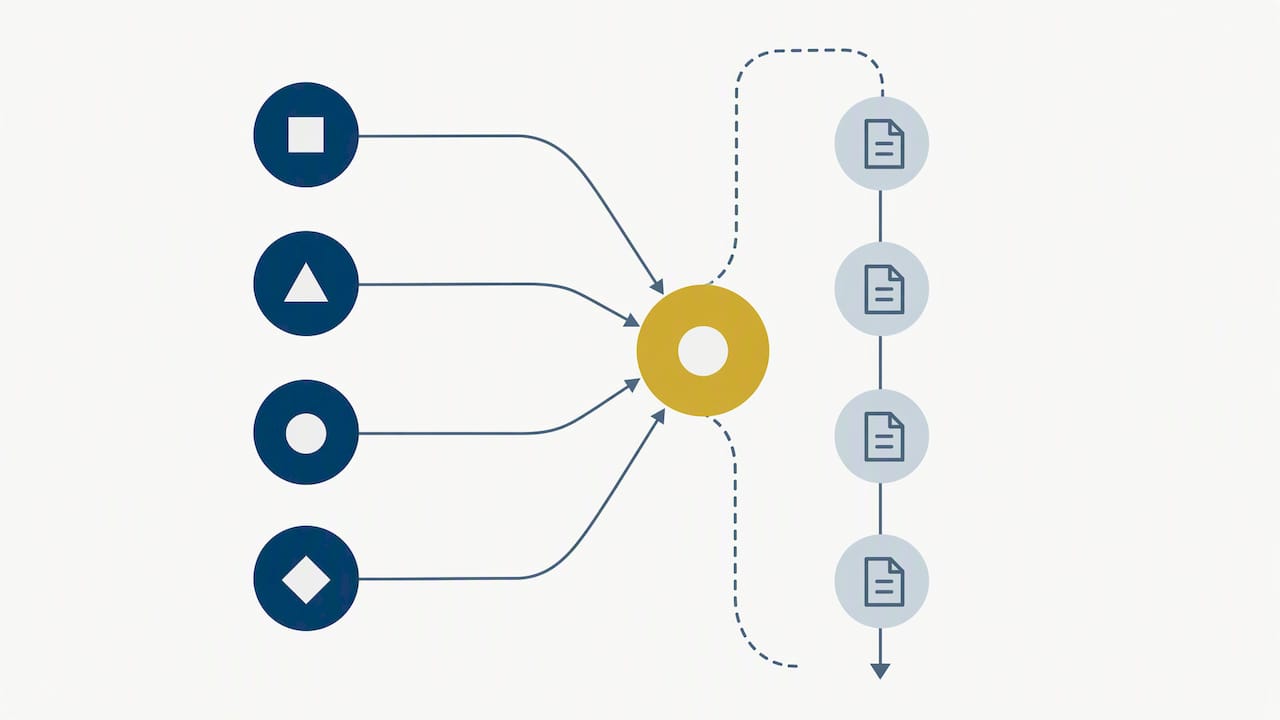
Our view is that an offsite should leave behind systems, not just inspiration. A decision log with owners is the start of one. A recurring management cadence is the next step, which is why we pair this kind of session with a standing management meeting agenda that picks up where the offsite leaves off. If your team’s alignment is the deeper issue, a leadership alignment workshop may be the better first step than a full strategy offsite.
We also push owners on one habit: speak last. If the owner states a view first, the team’s honest answers disappear. Our diagnostic-first approach comes from the same logic: understand the business before prescribing anything, so recommendations fit the company instead of a generic template.
— Andre
Where we can help
If you are a mid-market owner who wants an outside structure for the offsite and the 90 days after it, our Growth Sprint and Performance Sprint programs are built for focused, time-boxed work. The Growth Sprint is $7,500 to $10,000 one-off, and the Performance Sprint is $15,000 to $20,000 one-off. For owners who want to talk through fit first, you can schedule a strategy call. For ongoing peer exchange, we also run CEO mastermind events.
Adapting the agenda
One-day version
Keep one major decision, one team-health session and the full closing hour. Cut the second priority session and shorten the lunch to 45 minutes, but keep the silent start.
Quarterly half-day sessions
If your issue is follow-through rather than direction, several short sessions may beat one long one. Use each to review the decision log, retire what is done, and take one new decision.
Larger leadership groups
Above ten people, break into small groups for the priority-ranking work and report back to plenary. Plan earlier, since the HBR guidance suggests up to 6 to 9 months for large groups.
Common mistakes to avoid
- Filling every hour. Unstructured time is part of the design.
- Treating the venue as the strategy. Rigor in the design matters more than the location.
- Letting the agenda run as a series of presentations.
- Skipping the avoided conversation because it is uncomfortable.
- Ending on a high without a decision log.
FAQ
How long should a leadership offsite be?
Two days suits a new strategy or a realignment of the team. For regular reinforcement, several half-day sessions through the year can work better. The right length depends on the number of decisions: with a cap of two major topics a day, three to five decisions need roughly two days.
What should be on an executive offsite agenda?
Five blocks cover most needs: a framing opening, strategy and priorities, a team-health conversation, owned decisions, and an activation close. Add unstructured time for meals and walks. Leave out long presentations and send data as pre-reads.
Should the CEO facilitate the offsite?
Usually not. The CEO is more useful as a participant who speaks last and invites dissent. An outside facilitator can manage group dynamics and surface tensions an internal person may avoid.
How do we follow up after the offsite?
Publish a decision log with owners and 90-day milestones within 48 hours. Schedule a 30-day check-in before the team leaves. Review the log in your regular management meeting so decisions keep moving.
Sources
- Planning an Offsite for Your Leadership Team? Ask These 5 Questions (HBR)
- Off-Sites that Work (HBR Store)
- Leadership Offsite Planning (The Offsite Co.)
- Leadership Retreat Agenda (Chris Dyer)
- Executive Strategy Offsite Template (Best Meeting Planner)
- A Dynamic Model of Top Management Team Effectiveness (Harvard Business School)