

The most reliable way to mitigate key person risk is to move what one person knows, decides and controls into systems that the rest of the company can run. Insurance, retention bonuses and succession plans each help. But they cover the consequences or the timing of a loss. They do not remove the dependency itself.
This guide is for owners and leadership teams of mid-market companies. It covers how to find your exposure, how to reduce it step by step, where insurance fits, and what a buyer sees when they look at your business.
TL;DR
- Key person risk is not only about the owner. It covers anyone whose sudden absence would materially hurt revenue, operations or client relationships.
- Reduce the dependency first with documented processes, cross-training and delegation. Use insurance only to fund the gap while you transition.
- Size any policy to a defined financial loss, such as lost margin, replacement cost and temporary leadership, not to how important the person feels.
- Successors who already know the company’s systems and relationships tend to recover better than outsiders who do not.
- A company that runs without its key people is easier to finance, hand over and sell.
Table of Contents
- What key person risk actually is
- Find your single points of failure
- Put a dollar figure on the exposure
- Six ways to reduce the dependency
- Where key person insurance fits
- What buyers and lenders see
- A 90-day starting plan
- Our perspective
- How we can help
- FAQ
- Sources
What key person risk actually is
Key person risk is the economic exposure a company faces if it loses someone whose skills, leadership or relationships are essential to its success. Federal Reserve supervisory guidance frames it this way: it is not limited to owners, and it includes any employee whose sudden absence would materially impair revenue, operations or client relationships.
In a mid-market company, the usual suspects are:
- The founder-owner who still approves pricing, holds the top accounts and settles every escalation.
- The top salesperson whose customers buy from the person, not the brand.
- The operations or finance lead who is the only one who understands how the month-end close, scheduling or pricing model really works.
- The technical specialist who built the product, the integration or the process and never wrote it down.
The loss does not have to be a death. Illness, burnout, a competing offer, a divorce or a two-month sabbatical expose the same weakness. Most owners discover the dependency on the day they take a real vacation.
Find your single points of failure
Before you fix anything, map where the risk sits. A one-hour exercise with your leadership team is enough to start.
- List every critical function. Sales, delivery, pricing, hiring, finance, key vendor relationships, regulatory filings, IT access.
- Name who does each one, and who could do it tomorrow. If the second name is blank, you have a single point of failure.
- Score each gap on two questions. How fast would revenue or delivery suffer if this person vanished for 90 days? How long would it take to rebuild the capability?
- Check the relationships. For your top ten customers, count how many people at your company they know and trust. One is a red flag.
- Check the access. Passwords, bank authority, licenses, contracts and vendor logins held by one individual belong on the list.
The output is a short ranked list. Start at the top. Do not try to fix all of it at once.
Put a dollar figure on the exposure
A number turns a vague worry into a decision. Valuation analysis for a key person should include lost contribution margin during the transition, recruiting and onboarding expenses, temporary leadership costs and any financing exposure tied to that individual. There is no generic formula, so the assessment is partly judgment. Write down your assumptions so you can defend them.
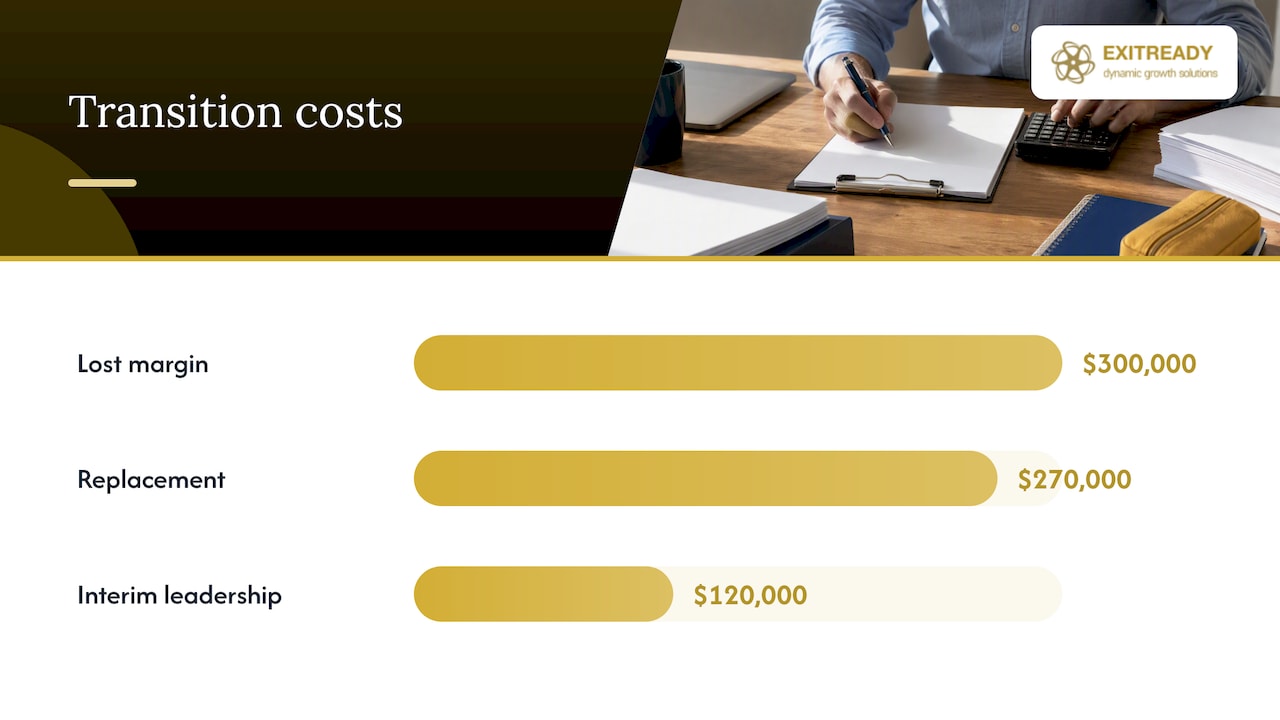
Replacement is usually the largest line. One 2025 study puts the total cost of replacing a qualified specialist at up to 150% of annual salary, and most of that comes from lost productivity and downtime, not recruiter fees. If you want a worked method for the hiring side of the calculation, this finance-ready approach to calculating the cost of a bad hire is a useful companion.
A simple worked example, with invented numbers for illustration only:
| Cost line | Assumption | Estimate |
|---|---|---|
| Lost margin | Six months of reduced output on a $4M account base | $300,000 |
| Replacement | 150% of a $180,000 salary | $270,000 |
| Interim leadership | Fractional or contract executive for six months | $120,000 |
| Total | $690,000 |
The point is not the total. It is that each line is a separate, defensible estimate you can use to decide how much to spend on prevention and how much to insure.
Six ways to reduce the dependency
1. Document the work as playbooks
Write down how the critical work is done: the steps, the decision rules, the exceptions, the people to call. Record the “why” behind a decision as well as the “what”. A good test is whether a capable new hire could run the process from the page alone.
Research on the sudden death of CFOs found that firms with stronger internal controls and documented reporting processes suffer fewer adverse events after a sudden loss. A policy on paper does not help if the knowledge lives only in one head. For concrete formats, see our examples of exit-ready business systems.
2. Cross-train until roles are interchangeable
Practitioners describe the goal as interchangeable teams: competencies spread evenly instead of concentrated in narrow experts. The same study reports that firms with strong knowledge management and cross-training saw close to zero negative effect on internal R&D productivity when a collaborator left, compared with firms that relied on single experts.
In practice: pair each critical role with a named backup, rotate the backup through live work every quarter, and let them make real decisions, not just observe.
3. Share the client relationships
Introduce a second and third person to every major account. Hold joint calls, give them real roles in the service, and have the owner step back in stages. Customers who know three people at your company do not leave when one of them does.
4. Delegate decisions, not just tasks
Most owner dependency is a decision bottleneck. Define which decisions the team may make alone, within what dollar limits, and which ones must come to you. Review the list every quarter and move items off your side. This is the fastest way to give the owner their time back.
5. Plan the succession before you need it
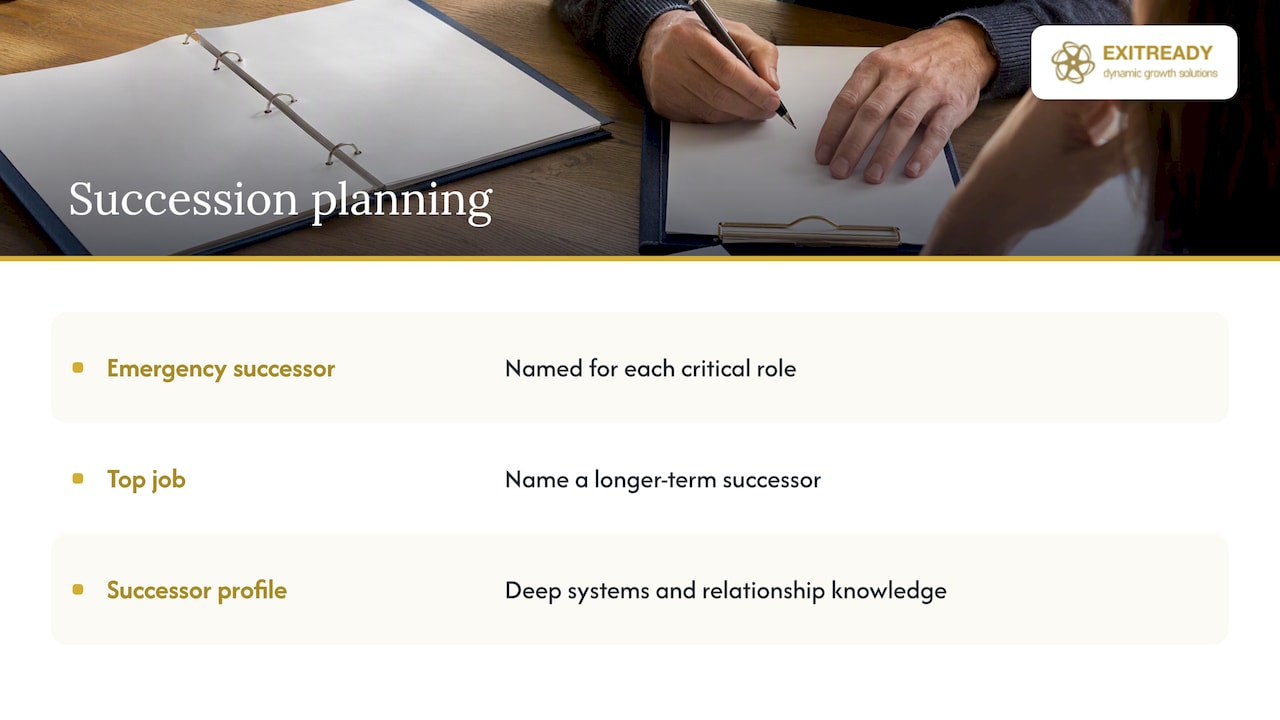
Name an emergency successor for each critical role, and a longer-term successor for the top job. Research on the sudden death of an SME’s CEO-owner shows the successor’s profile matters. Successors with high firm embeddedness, meaning deep knowledge of the company’s operating systems and internal relationships, consistently outperform those without it, whether they are family or external hires. So the question is less “who has the title?” and more “who knows the playbook?”
Our guide to a leadership succession plan covers how to test whether a plan would hold under pressure.
6. Retain the people you cannot afford to lose
Retention is risk mitigation too. Review pay, equity or deferred-compensation options, and career paths for the people on your ranked list. Ask them directly what would make them stay. It costs far less than the replacement figures above.
Where key person insurance fits
Key person life insurance pays the business if a critical person dies. It is useful, but it is a liquidity tool. As one advisory firm puts it, insurance provides liquidity, not continuity: cross-training, documented processes, shared client ownership and succession planning reduce the underlying risk, while a policy only funds the consequences. Another planner notes it works best alongside a buy-sell agreement and succession planning.
How to size it
Do not insure the person’s “importance” or your company’s entire value. Insure the defined financial loss from your exposure table: the cash needed to bridge the gap until a successor is functional. That is the approach in the regulatory guidance on business-owned life insurance, which treats insurance as a risk management tool and not an investment.
Tax and lender points to check
- Premiums are generally paid with after-tax dollars, so there is no deduction when the business is the beneficiary. The death benefit is usually received income-tax-free if the notice and consent formalities are met, per this small-business insurance guide.
- Buying an existing policy can trigger the transfer-for-value rule under IRC Section 101(a)(2), which can make part of the benefit taxable. Talk to a CPA or tax attorney before any transfer.
- If you borrow through the SBA, lenders often require key person coverage as collateral on 7(a) and 504 loans for owner-operated businesses. Price it into the loan application early, since a collateral assignment can be a condition of closing. The assignment directs the death benefit to the loan balance first and does not change ownership.
A licensed insurance advisor and your CPA should confirm the structure for your situation. Disability coverage for the same person is worth asking about at the same meeting, because the likelier event is often illness, not death.
What buyers and lenders see
A buyer values transferable earnings. If revenue depends on one person’s relationships or judgment, the buyer sees risk and prices it, usually through a lower multiple, an earn-out or a long transition requirement on the owner. The goal of planning is to make the company’s value transferable instead of concentrated in one individual, which is also how bank examiners view the role of insurance versus succession planning.
The same fixes that protect you from a sudden loss also prepare you for a sale. If a sale is on your horizon, read why owner exit preparation starts early and use our business exit readiness assessment guide to see which gaps a buyer would find first.
A 90-day starting plan
| Timeframe | Action | Result |
|---|---|---|
| Days 1 to 15 | Map critical functions, name backups, rank gaps | A one-page exposure list |
| Days 15 to 30 | Estimate dollar exposure for the top three people | Numbers to guide spend |
| Days 30 to 60 | Document the top three processes; introduce second contacts on top accounts | First playbooks, shared relationships |
| Days 60 to 90 | Set decision limits; review retention; meet advisor on insurance and buy-sell terms | Delegation rules, a funded bridge |
Repeat the cycle each quarter. The list shrinks, and so does the owner’s calendar.
Our perspective
We work with mid-market owners who built something valuable and then discovered it could not run without them. The pattern is consistent. The owner is the bottleneck, the knowledge is informal, and the first serious conversation about risk happens during a crisis or a buyer’s due diligence.
Our view is that key person risk is an operating problem before it is an insurance problem. That is why our approach, the AOS (Accelerated Operating System), starts with a diagnostic and then builds documented playbooks and delegation systems around what the diagnostic finds, instead of applying a generic template. The aim is a company whose value does not walk out the door with any one individual, including the owner.
A policy is a sensible safety net. But if the business cannot function without one person’s tacit knowledge, the policy only pays for the problem. Fix the system first, then insure what remains.
— Andre
How we can help
If you want a structured way to find and close these gaps, start with our AOS Enterprise Assessment, a diagnostic of how dependent your operations are on specific people. For a focused push on one problem, our Sprint programs are published at $7,500 to $10,000 one-off for the Growth Sprint and $15,000 to $20,000 one-off for the Performance Sprint. If you would rather work through it with a senior advisor, Elite 1-on-1 Coaching is $3,200 per month. You can also apply directly.
FAQ
What does key person risk mean?
It is the financial exposure a company faces if it loses someone whose skills, leadership or relationships are essential to its success. It applies to owners, executives, top sellers and technical specialists alike.
Is key person insurance worth it?
It can be, when the business would face a real cash gap and a lender, partner or investor depends on its survival. It funds the transition but does not replace the person’s knowledge, so it works best alongside documentation, cross-training and a succession plan. Ask a licensed advisor to size it to a defined loss.
Are key person insurance premiums tax deductible?
Generally not when the business is the beneficiary. The death benefit is usually received income-tax-free if the required formalities are met, but exceptions such as the transfer-for-value rule exist. Confirm the details with a tax professional.
What is a good example of key person risk mitigation?
Pairing a top account manager with a named backup, then moving the account’s history, pricing rules and decision points into a written playbook. Within a quarter, the backup can run the account without the original manager.
Sources
- Federal Reserve SR 04-19: Interagency statement on life insurance purchase and risk management
- Building an Interchangeable Team of Employees in Each Structural Department of the Company
- How resilient are firms’ financial reporting processes to the sudden loss of a CFO?
- The king is dead, long live who? Succession after the CEO-owner’s sudden death
- Key Person Insurance: How Much Coverage Does a Business Actually Need?
- Key Person Insurance: Protecting Your Business From a Sudden Loss
- Key Person Life Insurance: SBA Requirements Explained