

How buyer networks actually work for sellers
Buyer networks are interconnected groups of internal stakeholders and external influencers who collectively shape purchasing decisions before a seller ever enters the conversation. For mid-market owners looking to scale or exit, understanding this structure is not optional. Sellers who engage the full network, rather than chasing a single decision-maker, earn earlier visibility, stronger trust, and faster deal cycles.

The core mechanism is straightforward. A buyer network combines people inside the purchasing organization (executives, practitioners, IT, finance) with people outside it (consultants, peer communities, industry analysts, and now AI agents). These groups share information, form opinions, and build shortlists independently. By the time a seller gets a call, the network has often already narrowed the field.
Key benefits for sellers who engage buyer networks effectively:
- Extended reach into accounts that cold outreach would never penetrate
- Trust built through peer validation rather than vendor claims
- Faster shortlisting when verified performance data is already in the network
- Reduced information asymmetry through curated evaluation intelligence
- Stronger positioning for exit when buyers see a well-documented, operationally independent business
Dynamicgrowthsolutions’ Accelerated Operating System (AOS) and the EXITREADY program are built specifically to prepare mid-market sellers for this kind of network scrutiny, replacing owner dependency with documented systems that hold up under buyer due diligence.
The modern buyer network is bigger and more complex than you think
The scale of today’s B2B buying network catches most sellers off guard. Forrester’s 2025 research shows that 73% of B2B purchases involve three or more departments, with an average of 13 internal participants and 9 external participants in each decision. That is not a committee. That is a network.
A significant majority of buyers expect to use generative AI to support their buying processes., according to Forrester research. AI is now the first stop for research, not a vendor’s website.
External influencers, including peers, consultants, and industry analysts, shape buyer thinking before a provider is even on the radar. Most B2B buyers conduct independent research using peer communities and AI tools before contacting any vendor. Sellers who wait to be contacted are already behind.
The practical implication: your narrative must be clear, consistent, and structured so AI systems can interpret it accurately. If your business story is buried in a PDF or locked behind a gated form, generative AI cannot surface it, and you will not appear on the shortlist.
How to engage buyer networks as a seller
Winning in a buyer network requires a shift from direct sales to what Forrester calls influence orchestration. You are not selling to one person. You are building awareness and credibility across every ring of the network simultaneously.
Practical steps for sellers:
- Map the network rings. Identify decision-makers (executives), influencers (practitioners and operations managers), enablers (IT and procurement), and integrators (external consultants). Each ring needs different messaging.
- Address practitioner concerns directly. Practitioner stakeholders can veto a purchase even when a VP approves it. Their daily workflow concerns must be answered before they ever escalate your name upward.
- Build AI-readable digital assets. Structure your website, case studies, and capability statements so generative AI can extract and relay accurate information about your business.
- Activate peer and community channels. Peer networks, user groups, and professional communities shape early-stage buyer opinions. Presence in those spaces builds trust that vendor marketing cannot replicate.
- Use Dynamicgrowthsolutions’ AOS framework to document your operational systems, making your business story verifiable and consistent across every network touchpoint.
Pro Tip: Don’t treat external consultants and integrators as obstacles. They act as kingmakers for executives who need third-party validation before signing. Build relationships with them before a deal is on the table.
Why operational readiness determines your credibility in buyer networks
A buyer network does not just evaluate your product or service. It evaluates your business. Operational transparency, documented processes, and reduced owner dependency are what separate sellers who get shortlisted from those who get passed over.
“Operational systems improve information transparency and reduce owner dependency, which are the two factors most directly tied to buyer confidence in mid-market transactions.” — Dynamicgrowthsolutions, AOS framework
The AOS, Dynamicgrowthsolutions’ proprietary operating system, embeds documented playbooks and systematic processes into a business so that buyers can evaluate it without relying on the owner’s personal involvement. This matters enormously in exit scenarios, where buyers discount businesses that cannot function without the founder. Sellers who have completed the EXITREADY program enter buyer networks with verified operational data, which compresses due diligence timelines and builds confidence across every stakeholder ring.
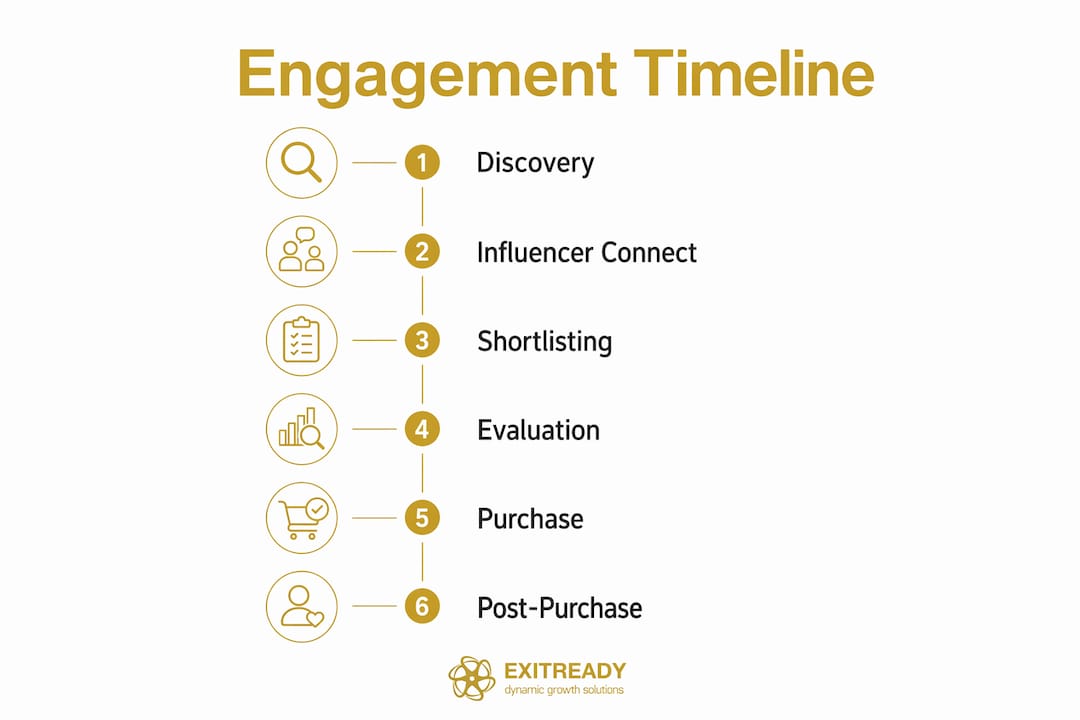
What the buyer network engagement timeline looks like
Understanding the stages of buyer network engagement helps sellers position themselves at the right moment rather than reacting too late.
Key milestones across the engagement journey:
- Discovery phase: Buyers use AI tools and peer communities to build an initial awareness of available sellers. Your digital presence and peer reputation determine whether you appear here.
- Independent research phase: Buyers conduct research independently using verified supplier data, peer reviews, and compliance records. Self-reported capabilities carry less weight than third-party validation.
- Shortlisting phase: Buyer networks surface pre-vetted sellers matched by capability and geography. Sellers with verified performance data and clean compliance records get prioritized.
- Evaluation phase: Supplier intelligence, including performance history and peer review data, drives decisions faster than traditional RFI processes.
- Onboarding and contract phase: Buyer networks compress cycle time by providing onboarding infrastructure that cuts time-to-active-contract once a seller is selected.
- Post-purchase phase: The buying network does not dissolve after a deal closes. Renewal, expansion, and advocacy decisions run through the same network, so relationship management continues.
Sellers who enter the process at the shortlisting phase have already missed the most influential moments. The goal is to be present and credible during discovery.
Types of buyer networks relevant to mid-market sellers
Buyer networks take different forms depending on the industry and the type of transaction. Knowing which type you are operating in shapes your engagement approach.
- Enterprise procurement networks: Large corporations use centralized platforms to manage supplier discovery, evaluation, and onboarding. Sellers must maintain verified profiles with performance data and compliance certifications to be surfaced.
- Private equity and M&A advisor networks: For sellers pursuing an exit, these networks connect business owners with financial buyers, strategic acquirers, and advisors. Operational readiness and documented financials are the entry criteria.
- Industry-specific peer communities: Vertical communities in sectors like manufacturing, healthcare, and professional services function as informal buyer networks where peer recommendations carry significant weight.
- Technology partner ecosystems: In B2B software and services, integration partners and consultants form networks that influence purchasing decisions by validating compatibility and implementation success.
- Professional advisor networks: Accountants, attorneys, and fractional executives often serve as trusted advisors who shape buyer decisions. Sellers who build relationships with these advisors gain access to qualified buyers before a formal process begins.
Key criteria for evaluating a buyer network before you engage
Not every buyer network is worth your time. Before committing resources, evaluate each network against these criteria:
- Verified participant quality: Does the network vet its buyers, or is it an open directory? Verified buyer profiles reduce wasted outreach.
- Data transparency: Can you see performance benchmarks, peer reviews, and compliance data for other sellers in the network? Transparency signals a healthy ecosystem.
- Relevance to your industry and deal size: A network built for enterprise software procurement will not serve a mid-market manufacturing seller well.
- AI and digital infrastructure: Does the network surface sellers through AI-driven matching, or does it rely on manual search? AI-enabled networks compress discovery timelines.
- Post-transaction relationship support: Networks that support renewal and expansion decisions deliver more long-term value than transactional platforms.
- Access to strategic buyers: For exit-focused sellers, the network must include financial and strategic acquirers, not just procurement teams.
Risks and pitfalls sellers should watch for in buyer networks
Buyer networks create real advantages, but they also introduce risks that sellers often underestimate.
Information asymmetry cuts both ways. Networks reduce asymmetry for buyers by surfacing verified data, but sellers who have not maintained clean operational records, accurate compliance documentation, or consistent peer reviews will be exposed quickly. A gap between your self-reported capabilities and your verified data is a deal-killer.
Practitioner veto power is real. Buying decisions are multi-threaded across practitioners, IT, executives, and consultants. A mid-level operations manager can block a purchase that a VP has already approved. Sellers who focus only on executive relationships leave the deal vulnerable at the practitioner level.
Neglecting the post-purchase network is a missed opportunity. The same network that drove the initial purchase shapes renewal and expansion decisions. Sellers who disengage after closing lose the advocacy that drives referrals and repeat business.
Over-reliance on a single network channel creates concentration risk. If your visibility depends entirely on one platform or one advisor relationship, a single change in that network can remove you from consideration entirely.
Key Takeaways
Buyer networks function as distributed ecosystems where sellers who engage every stakeholder ring with verified, AI-readable information consistently outperform those who target only the final decision-maker.
| Point | Details |
|---|---|
| Network scale is larger than expected | Forrester 2025 data shows an average of 13 internal and 9 external participants per B2B purchase decision. |
| AI shapes discovery before seller contact | 95% of buyers plan to use generative AI in their buying process; sellers must maintain clear, AI-readable digital narratives. |
| Operational readiness drives buyer confidence | Documented systems and reduced owner dependency, as built through AOS, directly improve buyer trust and compress due diligence. |
| Practitioner veto power changes engagement priorities | Mid-level practitioners can block purchases even after executive approval; addressing their concerns is non-negotiable. |
| Dynamicgrowthsolutions prepares sellers for network scrutiny | The AOS and EXITREADY program give mid-market owners the verified operational data and documented processes buyer networks require. |
The buyer network shift most sellers are still ignoring
The conventional wisdom in mid-market exits is that you find a buyer, you pitch, you negotiate. That model describes maybe 20% of how deals actually get done now. The other 80% starts in a network conversation the seller was never part of.
What strikes me about the Forrester data on buying networks is not the size of the numbers. It is the implication. When 13 internal people and 9 external people are involved in a purchase, the seller who only has a relationship with the CEO is, by definition, invisible to most of the decision. That is not a sales problem. That is a positioning problem, and it requires a fundamentally different kind of preparation.
The sellers who will win exits and scale deals over the next few years are the ones who treat their business as a product that must perform under network scrutiny, not just under one-on-one due diligence. That means documented operations, clean compliance records, and a digital presence that AI can actually read and relay accurately. The EXITREADY framework exists precisely because most mid-market businesses are not built to survive that level of scrutiny without preparation.
Dynamicgrowthsolutions gives mid-market sellers a real edge in buyer networks
Most mid-market owners enter buyer networks with a great business and a weak presentation of it. Dynamicgrowthsolutions closes that gap. Through the AOS and the EXITREADY program, owners replace owner-dependent operations with documented, verifiable systems that hold up under the multi-stakeholder scrutiny that modern buyer networks demand.

The result is a business that buyers can evaluate confidently, advisors can recommend credibly, and AI systems can surface accurately. Whether you are preparing for a premium exit or positioning for a growth partnership, the business operating system framework gives you the verified operational foundation that buyer networks reward. For owners ready to take that step, the AOS Entrepreneur Application is the place to start.