

A strategic buyer is defined as a company that acquires another business to gain specific operational, market, or competitive advantages rather than purely financial returns. Unlike private equity firms or financial buyers, strategic buyers pay for synergies. That distinction matters because strategic buyers pay a 15–30% price premium over financial buyers when they see immediate revenue or cost synergies such as cross-selling opportunities or supply chain consolidation. For mid-market owners, learning how to attract strategic buyers for your business is the single most effective way to maximize exit value. The process requires preparation, a disciplined outreach approach, and a clear narrative built around what your business gives the buyer, not just what it earns on its own.
What do strategic buyers look for in a business?
Strategic buyers are highly selective. They are not browsing the market for deals. They are solving a specific problem: entering a new market, acquiring a technology, or eliminating a competitor. Strategic buyers prioritize fit over pure financial returns, which means your EBITDA alone will not close the deal.
The four criteria that consistently drive strategic buyer interest are:
- Strategic fit. Your business must complement the buyer’s existing operations in a clear, demonstrable way. A regional distributor acquiring a logistics company to cut delivery costs is a textbook example of fit. If you cannot articulate the fit in one sentence, neither can the buyer’s board.
- Operational maturity. Buyers discount businesses that lack documented systems or rely too heavily on the founder. They perceive those businesses as integration risks. A business that runs without the owner present is worth more than one that collapses when the owner takes a vacation.
- Synergy potential. Revenue synergies include cross-selling into the buyer’s customer base or gaining access to new distribution channels. Cost synergies include eliminating duplicate functions, consolidating vendors, or integrating supply chains. Quantify both types before any buyer conversation begins.
- Cultural compatibility. Strategic buyers absorb your team. If your culture clashes with theirs, integration fails and value evaporates. Buyers with corporate development experience know this and will probe for it during early conversations.
Pro Tip: Map your business against the buyer’s annual report or investor presentations. If your capabilities solve a gap they have publicly acknowledged, you have a ready-made synergy argument.
How to prepare your business to attract strategic buyers
Preparation is not a two-week exercise before you go to market. The owners who attract the best strategic buyers spend 12–24 months building the conditions that make their business undeniable. The following steps define that preparation.
-
Build documented, owner-independent operations. Every core process needs a written playbook. Sales workflows, delivery systems, customer onboarding, and financial reporting must all function without you in the room. Dynamicgrowthsolutions’ AOS (Accelerated Operating System) is built specifically for this purpose, replacing founder dependency with documented, repeatable systems that buyers can evaluate and trust.
-
Strengthen your management team. A buyer acquiring your business is also acquiring your leadership. If your CFO, VP of Sales, or operations lead would leave after the deal closes, that is a red flag. Retain key managers with incentive structures tied to the transaction outcome.
-
Construct a compelling value story. A synergy-focused narrative is critical to attracting serious strategic interest. Generic pitch decks describe what a business does. A value story explains what the buyer gains. Include specific revenue synergy projections, proprietary technology advantages, or market position data that the buyer cannot replicate organically.
-
Clean up your financials. Three years of audited or reviewed financials, normalized for owner compensation and one-time expenses, are the baseline expectation. Buyers will recast your numbers anyway. Presenting clean, well-organized financials signals professionalism and reduces friction during due diligence.
-
Benchmark against market standards. Use professional advisors and market entry research to understand how your business compares to recent transactions in your sector. Knowing your position in the market helps you price expectations realistically and identify gaps to close before going to market.
Pro Tip: Start your exit preparation process at least 18 months before your target sale date. Buyers notice when a business has been hastily packaged.
How do you find and engage strategic buyers effectively?

Finding the right buyers requires a structured process, not a broadcast. Effective strategic buyer engagement starts with building a targeted buyer map. Outreach to 15–40 high-fit prospects is the standard range, with direct warm outreach to 5–10 key targets typically generating 1–3 serious conversations. That ratio is not discouraging. It reflects how selective and capacity-constrained strategic buyers are.
The buyer map should include four categories of potential acquirers:
- Direct competitors who would gain market share or eliminate a threat by acquiring you
- Customers who might prefer to own your capability rather than buy from you
- Suppliers looking to move downstream and capture more margin
- Adjacent players in related industries who see your business as an entry point into your market
Once the map is built, the outreach process requires discipline. The table below outlines the staged disclosure approach that protects your business while advancing conversations.
| Stage | Information shared | Purpose |
|---|---|---|
| Initial contact | Blind teaser (no company name) | Gauge interest without exposing identity |
| NDA signed | Confidential information memorandum | Provide financials and business overview |
| Management meeting | Detailed operations and team access | Allow buyer to assess integration fit |
| Letter of Intent | Full due diligence access | Confirm terms before deep disclosure |
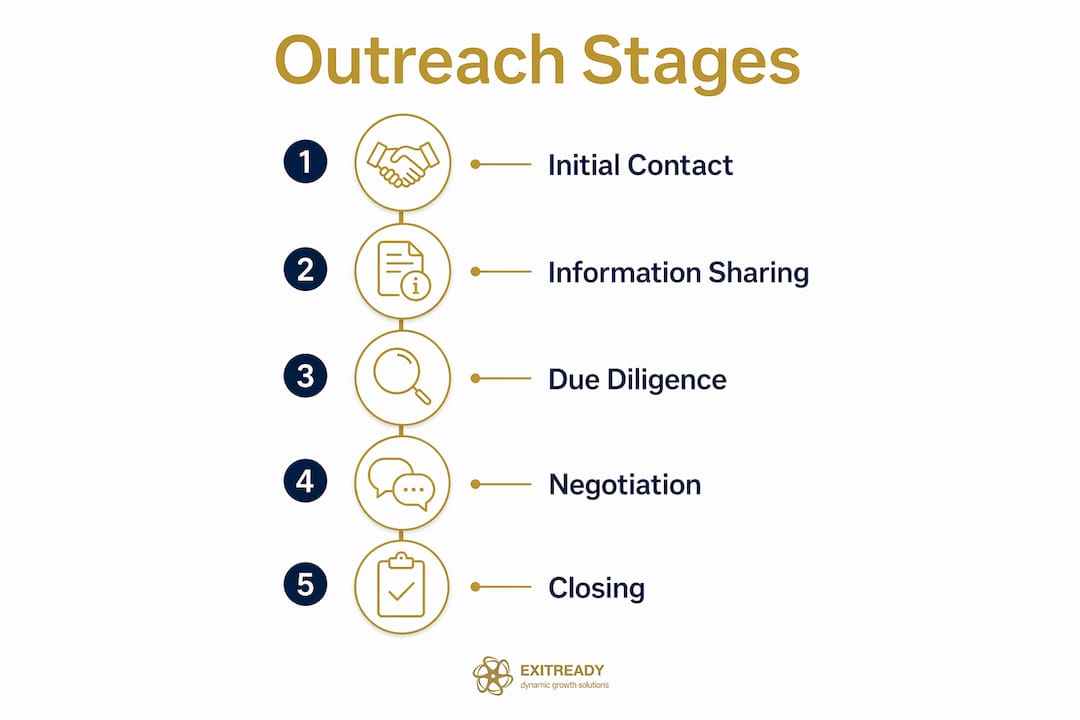
Staged disclosure protects sensitive information until credible offers emerge. This matters because a strategic buyer is often also a competitor. Sharing your customer list or pricing model before an NDA is signed is a competitive risk you cannot undo.
A well-controlled buyer outreach process balances confidentiality and competition. Both elements are necessary to surface the highest bids without exposing the business to unnecessary risk.
How do you negotiate maximum value with strategic buyers?
Negotiation with strategic buyers is not a single conversation. It is a process that unfolds over months, and the owners who capture the highest prices treat it as such.
-
Run a parallel process with financial buyers. Parallel negotiation with both buyer types typically results in a 10–25% higher total exit value compared to negotiating with a single buyer type. Financial buyers establish a price floor. Strategic buyers provide premium upside through synergy realization. Without both in the room, you have no leverage.
-
Quantify synergies in dollar terms. Telling a buyer that your customer base “complements” their existing accounts is not enough. Show them the math. If your 500 accounts represent $4 million in cross-sell revenue at their average contract value, say that. Specific numbers make synergy arguments credible and defensible in board presentations.
-
Manage timeline expectations. Strategic buyers typically take 6–12 months from first contact to a signed Letter of Intent. That timeline reflects internal approval processes, corporate development cycles, and board sign-off requirements. Sellers who push for speed often lose the deal. Patience is a negotiating asset.
-
Plan integration communication early. Strategic buyers worry about what happens after the deal closes. Proactively addressing integration plans, key employee retention, and customer communication reduces their perceived risk and strengthens your negotiating position.
Pro Tip: Never accept a Letter of Intent from a single strategic buyer without first testing the market with at least two or three financial buyers. The price floor you establish protects you if the strategic deal falls apart.
Key takeaways
Attracting strategic buyers requires operational maturity, a synergy-focused narrative, disciplined outreach, and a parallel negotiation process that creates genuine competitive tension.
| Point | Details |
|---|---|
| Strategic buyers pay more | They offer a 15–30% premium over financial buyers when clear synergies exist. |
| Operational maturity is non-negotiable | Documented systems and reduced founder reliance lower integration risk and raise valuation. |
| Build a targeted buyer map | Focus outreach on 15–40 high-fit prospects across competitors, customers, suppliers, and adjacent players. |
| Use staged disclosure | Protect sensitive data by releasing information in phases tied to buyer commitment level. |
| Run parallel processes | Engaging financial and strategic buyers simultaneously creates leverage and raises total exit value by 10–25%. |
What I have learned about attracting strategic buyers
The owners who get the best outcomes from strategic buyers are not the ones with the highest revenue. They are the ones who spent years building a business that does not need them to function. That sounds simple. It is not.
Most mid-market owners I have worked with arrive at the exit conversation having built something genuinely valuable, but packaged in a way that terrifies buyers. The owner is the sales team. The owner holds the key customer relationships. The owner makes the operational decisions. A strategic buyer sees that and immediately starts discounting the price because the risk of losing the owner is the risk of losing the business.
The second mistake I see consistently is treating the synergy story as an afterthought. Owners assume buyers will figure out the value on their own. They will not. Corporate development teams are evaluating dozens of targets. If your pitch deck does not spell out the synergy in the first ten minutes, you are competing on price alone, and that is a race to the bottom.
The third thing worth saying plainly: patience is not optional. Strategic buyers’ longer buying cycles mean you need to start building relationships 12 months before you plan to go to market. The owners who treat buyer outreach as a relationship-building process, not a transaction, consistently close better deals. Start early. Build the story. Let the process create the competition.
— Andre
How Dynamicgrowthsolutions helps owners prepare for strategic buyers
Preparing a business to attract serious acquisition interest takes more than good intentions. It takes documented systems, a clear financial story, and access to the right advisors and networks.

Dynamicgrowthsolutions works with mid-market owners to build the operational foundation and exit narrative that strategic buyers expect. Through the AOS program, owners replace founder dependency with documented processes that hold up under buyer scrutiny. The EXITREADY events bring together owners, advisors, and buyers in a structured environment designed to accelerate exit readiness and open real conversations. For owners who want a deeper look at their business’s current position, the 360-ProfitDriver analysis identifies hidden revenue and operational strengths that directly improve buyer attractiveness. The next step is knowing where you stand before the buyer does.
FAQ
What is a strategic buyer in an M&A transaction?
A strategic buyer is a company that acquires another business to gain operational, market, or competitive advantages rather than purely financial returns. They typically pay more than financial buyers because they can realize immediate synergies from the acquisition.
Why do strategic buyers pay more than financial buyers?
Strategic buyers pay a 15–30% premium because they capture value through synergies such as cross-selling, supply chain consolidation, or market expansion that financial buyers cannot access. That additional value justifies a higher purchase price.
How many strategic buyers should I target in an outreach process?
A targeted list of 15–40 high-fit prospects is the standard starting point, with direct warm outreach to 5–10 key targets. That approach typically generates 1–3 serious conversations worth pursuing.
How long does it take to close a deal with a strategic buyer?
Strategic buyers typically take 6–12 months from first contact to a signed Letter of Intent. Sellers should begin exit planning and buyer outreach at least 12 months before their target market launch date.
What is the biggest mistake owners make when selling to strategic buyers?
The most common mistake is failing to build a documented, owner-independent operation before going to market. Buyers discount businesses where the founder is the business, treating that dependency as a direct integration risk.