

A delegation of authority matrix is a role-based rulebook that maps decision types (contracts, purchases, hires, write-offs) to the specific roles allowed to approve them, along with the dollar or risk threshold at which approval kicks in. The fastest path to a working one: pick 6 to 10 decision types that already cause bottlenecks, plug them into a simple template, and pilot it this quarter instead of building a 200-line version nobody uses.
Success on that pilot looks like:
- Fewer escalations landing on the owner’s or CEO’s desk
- Measurable drops in approval turnaround time
- A clean audit trail showing who approved what, and why
Start narrow. A focused scope on high-impact decision types gets adopted faster than a sprawling one that sits in a shared drive untouched.
Key Takeaways
A delegation of authority matrix works because it replaces name-based, ad hoc approvals with role-based thresholds that survive personnel changes and reorganizations.
| Point | Details |
|---|---|
| Start narrow | Pilot 6 to 10 high-impact decision types like contracts and procurement before expanding. |
| Use roles, not names | Assign approval rights to titles so the matrix survives promotions and departures. |
| Set risk-aligned thresholds | Base dollar bands on exposure and non-financial conditions, not round numbers alone. |
| Test before publishing | Run 10 to 15 real scenarios and track exception rate, turnaround time, and audit mismatches. |
| Assign ownership and cadence | A named owner and scheduled reviews keep the matrix current after reorgs and role changes. |
| Consider guided implementation | Dynamicgrowthsolutions builds delegation frameworks into a documented operating system for mid-market owners seeking faster adoption. |
Table of Contents
- What Is a Delegation of Authority Matrix and Why Build One?
- What Fields Belong in a DOA Matrix?
- How Do You Build a Delegation of Authority Matrix Step by Step?
- How Should You Set Thresholds and Choose a Delegation Level Model?
- What Does a Copy-Ready DOA Matrix Template Look Like?
- How Do You Test and Roll Out a New Delegation Matrix?
- Who Owns the Matrix and How Often Should It Be Reviewed?
- What Are the Most Common Mistakes When Building a DOA Matrix?
- Why Most Mid-Market Delegation Efforts Stall Before They Start
- Get Help Designing a Delegation Matrix That Actually Gets Used
- Frequently Asked Questions
- Sources
What Is a Delegation of Authority Matrix and Why Build One?
A delegation of authority (DOA) matrix is a document, usually a table, that assigns approval rights for specific categories of business decisions to defined roles rather than named people. It answers one question repeatedly across an organization: who is allowed to say yes, and up to what limit?
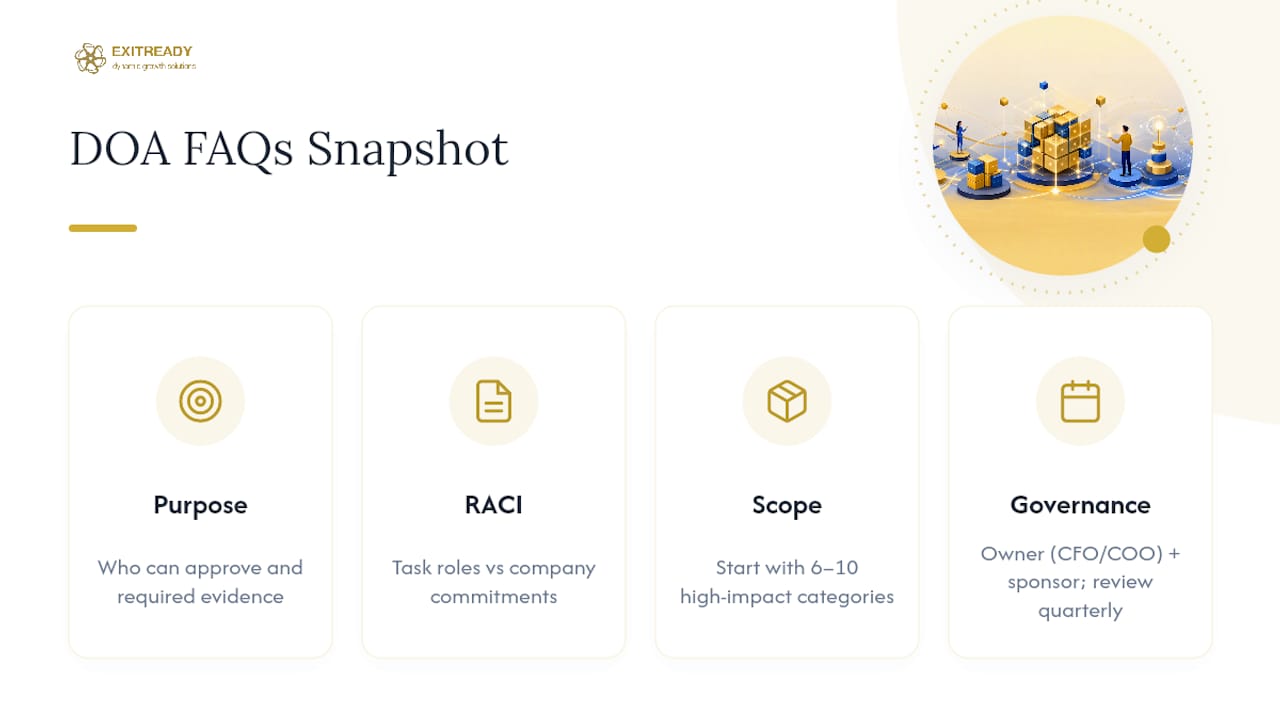
People often confuse this with a RACI chart. They solve different problems. RACI clarifies who is Responsible, Accountable, Consulted, and Informed on a project or task. A DOA matrix governs financial and legal commitment authority, specifically who can bind the company. Mature organizations run both, but if you only have time for one, build the DOA matrix first. It stops the bleeding.
The business case is straightforward:
- Decisions stop stalling in an owner’s inbox waiting for a signature
- New hires and managers know their limits on day one, without asking
- External auditors and buyers see a governed decision process instead of tribal knowledge
- Role changes and reorganizations no longer require rewriting who can approve what
A well-scoped matrix, built around decision categories rather than departments, transfers cleanly across reorganizations because the rule lives with the decision type, not the org chart.
What Fields Belong in a DOA Matrix?
Every practical matrix needs the same skeleton, regardless of company size. Miss one of these fields and you get ambiguity, which is exactly what the matrix exists to remove.
- Decision type or category. Contracts, procurement, capital expenditure, hiring, write-offs, pricing exceptions. Group by the decision itself, not by which department happens to touch it.
- Approver role. Use position titles like “VP of Operations” or “Regional Controller,” never a person’s name. Include a fallback owner for when the primary approver is out.
- Threshold and conditions. A dollar figure is the obvious trigger, but add non-financial conditions too: entity scope (does this apply to all subsidiaries?), time limits (does the authority expire?), and counterparty risk (new vendor versus existing).
- Required evidence. What documentation has to exist before the approval counts? A signed quote, a legal review memo, a background check.
- Exception path. Who gets looped in when a request falls outside the standard rule?
- Redelegation rule. Can the approver hand this off, and to whom, and for how long?
Formal delegation systems built for government and university use codify description, limitations, redelegation rules, and source of authority as the four non-negotiable components of any delegation record. Borrow that structure even for a five-person leadership team.
Pro Tip: Write the approver field as a role, not a name, from day one. The moment someone gets promoted or leaves, a name-based matrix is instantly wrong. A role-based one just keeps working.
How Do You Build a Delegation of Authority Matrix Step by Step?
Building this matrix is a design exercise, not a paperwork exercise. Skip the scoping work and you end up with a document that looks thorough and gets ignored.
- Pick your initial scope. Start with contracts, procurement, payments, and capital approvals. These four domains create most of the cost and legal exposure in a mid-market business, and narrowing the initial scope to high-impact decision types is what actually gets a matrix used instead of shelved.
- Name roles, not people. Draft every approver field using titles. If your org chart is thin, use functional labels like “Finance Lead” until titles solidify.
- Set risk-aligned thresholds. A $5,000 marketing spend and a $5,000 legal settlement carry different risk even at the same dollar figure. Thresholds should reflect exposure, not just amount.
- Pull in stakeholder input before you finalize anything. Finance flags spending controls. Legal flags contract risk and liability language. HR flags hiring and termination authority. IT flags data and vendor security requirements. Operations flags what actually happens on the ground when a purchase order gets stuck for three days.
- Draft, circulate, revise. Send the draft matrix to the people who will actually use it before you publish it. Silent objections surface as workarounds later.
- Pilot with 10 to 15 real scenarios. Run actual decisions from the last quarter through the draft matrix and see where it breaks.
- Iterate based on what the pilot exposes. Every gap the pilot finds is a threshold, a missing role, or a missing evidence field. Fix it, then move to full rollout.
A matrix categorized by decision type instead of department also survives your next reorg without a rewrite, since the rule sits with the transaction, not the reporting line.
How Should You Set Thresholds and Choose a Delegation Level Model?
Thresholds should track risk exposure, not just the size of a number. A $10,000 recurring software renewal and a $10,000 one-time settlement with a new counterparty carry different risk profiles even though the dollar figure matches. Build your bands around that distinction, not around round numbers that feel tidy on a spreadsheet.
Illustrative bands that mid-market leaders often adapt:
| Threshold Band | Typical Approver | Common Condition |
|---|---|---|
| Under $3,000 | Team Lead / Manager | Existing vendor, budgeted line item |
| — | Department Head | New vendor or unbudgeted spend flagged for review |
| — | VP / Controller | Legal review required for non-standard contract terms |
| — | CEO / Board Committee | Capital approval, multi-entity impact |
Beyond dollar figures, consider cumulative limits (no more than $50,000 in approvals from one role per quarter) and time-bound delegation (a covering manager gets approval authority temporarily while the primary approver is on leave).
For naming how much authority actually transfers, borrow an established model rather than inventing your own vocabulary. Delegation level frameworks like Hyatt’s 5-level model and Appelo’s 7-level Delegation Poker give teams shared language, ranging from “do exactly what I say” to full delegation with no check-in required. Naming the level explicitly, for instance “Level 4: decide and inform,” removes the ambiguity that causes most delegation friction. Pick one model and use its exact terminology across every row of the matrix.
What Does a Copy-Ready DOA Matrix Template Look Like?
A working template needs six columns and nothing more at the pilot stage. Complexity can come later, once the basic version proves itself.
This six-field structure is deliberately simple enough to copy directly into a shared spreadsheet.
Two worked rows show how it functions:
- Routine purchase under threshold: Decision type is “office equipment purchase,” threshold is “under $3,000,” requester is “Office Manager,” approver role is “Department Head,” required evidence is “two vendor quotes,” exception path is “Controller.” This never leaves the department.
- Vendor contract with non-standard terms: Decision type is “vendor contract,” threshold is “any amount with non-standard liability clause,” requester is “Procurement Lead,” approver role is “General Counsel plus CFO,” required evidence is “redlined contract and legal memo,” exception path is “CEO.” The non-standard term, not the dollar amount, is what pulls this into a higher tier.
For companies with multiple entities or subsidiaries, add an “entity scope” column so a threshold set for the parent company doesn’t accidentally apply to a foreign subsidiary with different regulatory exposure.
How Do You Test and Roll Out a New Delegation Matrix?
Test before you publish. A matrix that looks complete on paper often breaks on contact with a real decision, and it is far cheaper to find that out in a pilot than after a vendor dispute.
- Run 10 to 15 real scenarios through the draft matrix. Useful test cases include a contract renewal with a price increase, an urgent operational purchase outside normal hours, a new vendor with nonstandard payment terms, a write-off that sits right at a threshold boundary, and a temporary authority handoff during someone’s leave.
- Flag every scenario where two people disagree on who should approve. That disagreement is the matrix telling you a rule is unclear.
- Brief managers directly, don’t just email the document. A short live walkthrough with real scenarios sticks better than a policy PDF nobody opens.
- Update your SOPs and approval workflows to reference the new roles. If you use a workflow tool, encode the thresholds there so evidence capture happens automatically instead of relying on someone remembering to attach a document.
- Track three numbers for the first 90 days: exception rate (how often requests fall outside the matrix), approval turnaround time, and audit mismatch rate (approvals that lack the required evidence field).
Pro Tip: If your exception rate stays above 15 percent after 90 days, the matrix’s thresholds are wrong, not the team’s compliance. Adjust the bands before you push harder on training.
Who Owns the Matrix and How Often Should It Be Reviewed?
A matrix without an owner decays within a year. Assign one person, usually the CFO or COO, plus an executive sponsor who can force updates when people resist.
- Trigger an update whenever a role changes, a reorg happens, or a new legal entity gets added. Don’t wait for the scheduled review to catch these.
- Set a scheduled cadence on top of that: a light monthly check for obvious gaps, a quarterly review of thresholds against actual spend patterns, and a full annual rewrite.
- Log every exception in a running register, not in email threads that disappear. That register becomes your evidence during an audit.
- Require a documented reason any time authority gets redelegated temporarily, and set an automatic expiration date on that redelegation.
Formal government delegation systems rely on serial numbering, signature blocks, and controlled publication precisely so a delegation can be traced back to when it was granted and by whom. A mid-market company doesn’t need that level of bureaucracy, but the underlying discipline, knowing exactly when a rule changed and who signed off, is what makes the matrix defensible during a financial audit or a buyer’s due diligence review. This is also where a decision rights framework helps clarify ownership boundaries before you formalize the review cadence.
What Are the Most Common Mistakes When Building a DOA Matrix?
Most failed matrices die from the same handful of design errors, and each one has a straightforward fix.
- Over-scoping the first version. Teams try to cover every decision type in the company on launch day. Fix: narrow to the four or five domains causing the most pain right now, and expand later.
- Delegating authority without giving matching evidence access. A manager gets sign-off rights on vendor contracts but no access to the legal review template. Fix: align every authority grant with the tools and evidence access it requires.
- Writing approver names instead of roles. The matrix breaks the day someone leaves. Fix: role-based design from the first draft, no exceptions.
- Skipping the review cadence. The matrix gets published once and never touched again, and within 18 months half the roles no longer exist. Fix: assign an owner and put review dates on the calendar before you launch.
Pro Tip: If you’re not sure whether you’ve over-scoped the pilot, count your rows. More than 15 decision types in a first draft is almost always too many for a team that has never worked with a DOA matrix before.
Why Most Mid-Market Delegation Efforts Stall Before They Start
Most owners who attempt this build a matrix that’s technically correct and practically dead on arrival. The document has every field, every threshold, every approver role, and nobody uses it after week three. The reason is almost never the template. It’s that authority got documented without the operational system around it, so approvals still route through the owner out of habit, not necessity.
Inside an accelerated operating system built for mid-market transformation, a DOA matrix isn’t a standalone artifact. It’s one layer of a documented playbook that also covers who owns which process, what evidence gets captured, and how decisions get audited. Businesses that pair the matrix with that broader system see the pattern show up in fewer escalations reaching the owner, cleaner handoffs during leadership transitions, and a valuation story that buyers can actually diligence instead of taking on faith.

That last point matters more than founders expect. A buyer evaluating a mid-market company treats “the owner approves everything” as a red flag on the cap table, not a strength.
Get Help Designing a Delegation Matrix That Actually Gets Used
Building the template is the easy 20%. The harder work is getting finance, legal, and operations to agree on thresholds, then training managers to actually follow the matrix instead of routing around it out of habit. That’s where most DIY attempts quietly fail, three months in, when the owner is still the de facto approver on everything over $500.

Dynamicgrowthsolutions builds delegation of authority frameworks as part of a broader documented operating system, not as a one-off spreadsheet exercise. If your team has the bandwidth and internal alignment to design and pilot the matrix yourselves, use the template above and run your own 10 to 15 scenario test. If you’d rather have a system designed around your actual decision volume, entity structure, and exit timeline, with the thresholds, evidence rules, and review cadence built in from the start, a consulting engagement closes that gap faster than trial and error. Review the business transformation best practices built into that process and start a conversation about where your delegation gaps are costing you the most time right now.
Frequently Asked Questions
What is a delegation of authority matrix used for?
It defines which roles can approve specific business decisions, at what dollar or risk threshold, and what evidence is required before that approval counts.
How is a delegation of authority matrix different from a RACI chart?
A DOA matrix governs who can financially or legally commit the company, while a RACI chart clarifies task responsibility on a project. Most mature organizations use both.
How many decision types should a first DOA matrix cover?
Start with 6 to 10 high-impact categories like contracts, procurement, payments, and capital approvals rather than trying to document every decision type at once.
Should thresholds be based only on dollar amounts?
No. Non-financial conditions like counterparty risk, entity scope, and time limits matter as much as the dollar figure, and two identical amounts can carry very different risk.
Who should own the delegation matrix once it’s published?
Assign a single owner, typically a CFO or COO, plus an executive sponsor who can enforce updates when roles change or a review is overdue.
How often should a delegation of authority matrix be reviewed?
Update it immediately after role changes or reorganizations, and run a scheduled review at least quarterly, with a full rewrite annually.
Sources
- How to Build a Delegation of Authority Matrix: Step-by-Step
- Principles of delegation of authority and protocol
- Delegation Of Authority Matrix Template For Teams – The Workhint Blog
- GSA Delegations of Authority Manual
- Delegation skills are the difference between a manager who scales and one who becomes the bottleneck.