

Building self-sustaining company operations means creating systems, teams, and processes that run effectively without your constant involvement. Founder-dependent businesses sell for 20–40% less than comparable owner-independent ones, because buyers price in the risk of losing the person who holds everything together. The good news is that achieving operational independence is a deliberate architectural project, not a personality trait. The framework known as the Sovereignty Stack breaks this project into five concrete layers. Dynamicgrowthsolutions has helped mid-market owners work through exactly these layers to reduce owner dependency, increase enterprise value, and create self-sufficient operations that hold up under pressure.
What are the core components of self-sustaining company operations?
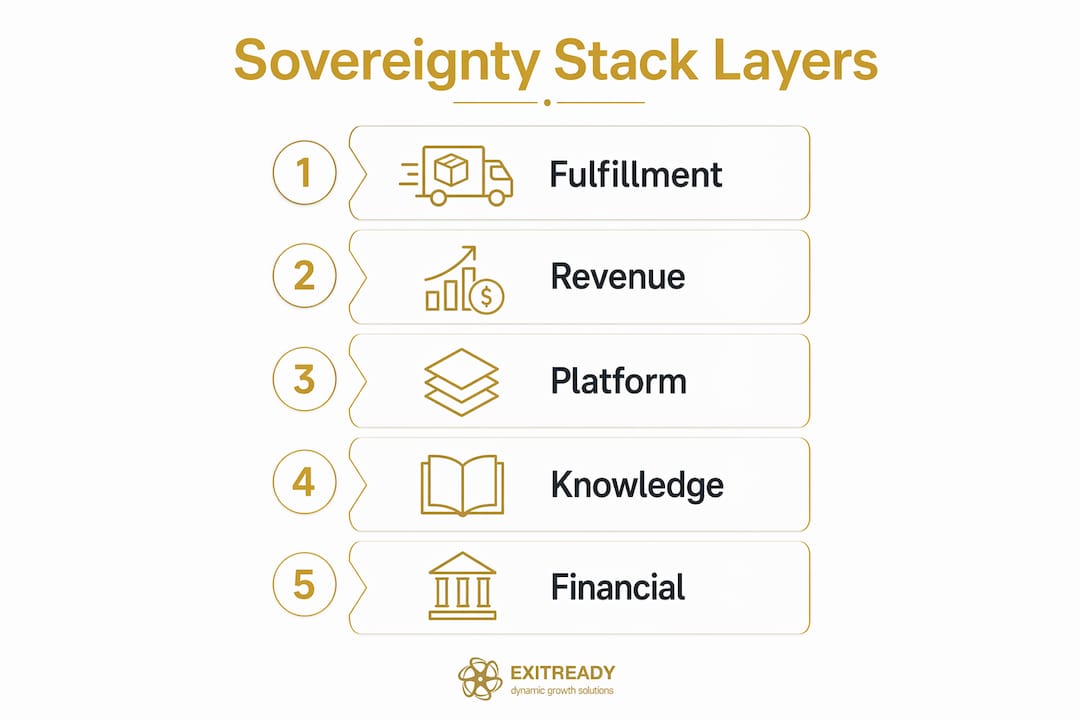
Operational sovereignty requires deliberate decisions across five business layers, not just a new software subscription. Each layer removes a specific way the founder becomes a bottleneck.
The five-layer Sovereignty Stack
- Fulfillment independence. Your delivery process runs on documented standard operating procedures (SOPs), not tribal knowledge held by you or one key employee. Any trained person can replicate the outcome.
- Revenue system independence. Lead generation, sales follow-up, and client onboarding follow a repeatable process. Revenue does not spike or collapse based on how much time you personally spend selling.
- Platform sovereignty. Your business does not depend on a single vendor, channel, or tool that could disappear or change terms overnight. Redundancy is built in.
- Knowledge infrastructure. Pricing logic, delivery methodology, and decision criteria are documented and accessible. Buyers and new hires can understand how decisions get made without asking you.
- Capital independence. The business funds its own growth through cash flow discipline rather than requiring founder loans or emergency injections.
The layer most owners skip is knowledge infrastructure. They document workflows but leave pricing rationale, escalation logic, and client communication standards inside their own heads. That gap is exactly what a sophisticated buyer or a new general manager will find first.
| Sovereignty Layer | Common failure point | Fix |
|---|---|---|
| Fulfillment independence | Key-person delivery dependency | Write SOPs for every repeatable service step |
| Revenue system independence | Owner-driven sales only | Build a documented sales process with assigned roles |
| Platform sovereignty | Single-channel revenue | Diversify lead sources and vendor relationships |
| Knowledge infrastructure | Undocumented decision logic | Create pricing guides, escalation trees, and playbooks |
| Capital independence | No cash reserve policy | Maintain a 90-day liquid reserve |
How can you empower your team to manage recurring decisions?
A self-managing team does not happen by hiring better people. It happens by giving your current people clear authority, defined metrics, and a system for escalating only the decisions that genuinely need you.

Build roles around outcomes, not tasks
Every role on your team should have three to five key performance indicators tied to business outcomes, not activity metrics. A customer success manager owns retention rate and net promoter score, not “number of calls made.” When people own outcomes, they make decisions to protect those outcomes without waiting for your approval.
Implement a decision threshold rule
Small businesses that use a decision delegation framework report significant reductions in owner bottlenecks. A practical version: any recurring expense below $500 is approved by the department lead without escalation. Vendor changes below a defined contract value follow the same rule. You only see exceptions. This single change eliminates dozens of weekly interruptions.
- Define your decision categories: recurring expenses, vendor changes, client accommodations, hiring decisions.
- Set a dollar or impact threshold for each category.
- Assign the decision authority to a named role, not a person.
- Document the rule in your operations playbook so it survives staff turnover.
- Review escalations monthly and push the threshold higher as trust builds.
Build a communication cadence that does not need you
High-performing autonomous businesses run on predictable planning cycles: weekly team meetings for tactical alignment, quarterly priority reviews, and annual goal-setting. Async updates through a shared dashboard replace the informal “quick questions” that eat your day. You attend the weekly meeting as a reviewer, not a problem-solver.
Pro Tip: Apply leadership coaching frameworks to your senior team leads. Structured coaching builds the judgment they need to handle edge cases without pulling you in.
What role can AI and automation play in creating autonomous operations?
AI does not replace your team. It handles the high-volume, low-judgment work so your team focuses on decisions that actually require human thinking.
Map tasks before you automate them
The first step is a task audit. List every recurring task in your business and score it on two dimensions: volume (how often it happens) and judgment required (how much context or nuance it needs). Tasks that are high volume and low judgment are your automation targets. Tasks that are low volume and high judgment stay with people.
- High-volume, low-judgment targets: outbound sales emails, appointment reminders, invoice follow-ups, social media scheduling, CRM data entry.
- Medium-judgment tasks: initial lead qualification, customer FAQ responses, basic reporting summaries.
- High-judgment tasks: pricing negotiations, client escalations, hiring decisions, strategic pivots.
Deploy AI agents for repeatable operations
AI agents can manage repeatable sales outreach and operations tasks within one week of setup. Platforms built for multi-agent deployment handle outbound emails, CRM updates, scheduling, and Slack-native reporting with escalation rules that surface only exceptions to you. The cost is accessible: full AI team platforms run under $150 per month for solo and small-team founders.
Successful AI implementation is iterative. The initial setup requires founder time for configuration, and ongoing weekly tuning keeps delegation accurate. Do not expect a set-and-forget result in week one. Expect a functional system by week four and a reliable one by month three.
Pro Tip: Book a free AI strategy call with Dynamicgrowthsolutions to map which tasks in your specific business are ready for AI delegation right now.
How do you manage cash flow to support growth without outside funding?
Financial discipline is the foundation of effective operational sustainability. Without it, every operational crisis pulls you back into daily management.
Use a 13-week cash flow forecast
A 13-week cash flow forecast detects cash gaps early enough for a proactive response. You see a shortfall coming in week nine, not week nine itself. That lead time lets your finance lead adjust payables, accelerate collections, or pause discretionary spending without your direct involvement.
Build a 90-day liquid reserve
Businesses with 90 days of liquid reserves avoid founder re-engagement during downturns. The reserve acts as a buffer that lets your team handle a slow month or an unexpected expense without calling you. Fund the reserve from operating cash flow, not a credit line.
| Financial practice | Why it matters | Who owns it |
|---|---|---|
| 13-week cash flow forecast | Detects gaps before they become crises | Finance lead or CFO |
| 90-day liquid reserve | Prevents founder re-engagement during slow periods | Finance lead with board visibility |
| Value-based pricing review | Protects margins without cost competition | Sales lead and owner |
| Cash conversion cycle audit | Speeds up receivables, extends payables | Finance and operations |
Price on value, not cost
Cost-based pricing ties your revenue directly to your input costs and leaves no room for margin growth. Value-based pricing ties your price to the outcome you deliver for the client. When your pricing logic is documented in your knowledge infrastructure layer, your sales team can hold price without escalating to you on every deal.
Key Takeaways
Self-sustaining company operations require five documented sovereignty layers, a decision-empowered team, AI automation for high-volume tasks, and cash flow discipline that removes the founder from daily financial decisions.
| Point | Details |
|---|---|
| Sovereignty Stack foundation | Build across five layers: fulfillment, revenue, platform, knowledge, and capital independence. |
| Decision delegation rule | Set dollar thresholds so team leads approve recurring decisions without owner escalation. |
| AI for high-volume tasks | Deploy AI agents for outreach, CRM, and scheduling to free up human judgment for complex work. |
| 13-week cash forecast | Use rolling cash forecasts to detect gaps early and let your finance lead respond without you. |
| Knowledge infrastructure | Document pricing logic, escalation rules, and delivery methodology so the business runs without tribal knowledge. |
The hardest part is not the system. It is you.
I have worked with enough mid-market owners to say this plainly: the operational system is rarely the real problem. The real problem is that most founders have built an identity around being indispensable. Every time a team member makes a decision you would have made differently, the instinct is to step back in. That instinct is the enemy of a self-sustaining business.
The research on this is clear. Founders who accept 80% quality delegation free up time for high-impact work and see their teams improve faster than founders who hold out for perfection. The 20% gap closes over time. The time you recover does not come back if you wait.
The “vacation test” is the most honest diagnostic I know. Take three weeks away from the business with no check-ins. Every fire that breaks out, every decision that gets escalated to you, every process that stalls: those are your undocumented SOPs. Treat each failure as a new documentation task, not a reason to stay involved. The business that passes the vacation test is the business that commands a premium valuation.
One more thing: owner reliance often hides in language. The emails that only you can answer, the meetings where your presence signals approval, the approvals that exist because no one ever wrote down the criteria. Audit your calendar and inbox for one week. Every recurring touchpoint that requires you is a process waiting to be documented and delegated. Start there. The system follows.
— Andre
How Dynamicgrowthsolutions helps you build operational independence
Mid-market owners who want to move from founder-dependent to operationally independent need more than a checklist. They need a proven framework applied to their specific business context.
Dynamicgrowthsolutions works with mid-sized business owners through its AOS (Accelerated Operating System) to design the exact sovereignty layers covered in this article. From documented playbooks to decision frameworks and financial discipline, the AOS program delivers structured transformation with guaranteed results. The business transformation practices page outlines how Fortune 500 methodologies get adapted for mid-market firms. For owners ready to assess where they stand today, the growth readiness scorecard is the fastest starting point.
FAQ
What does “self-sustaining company operations” mean?
Self-sustaining company operations are systems, teams, and processes that function without the owner’s daily input. The business generates revenue, delivers its product or service, and manages decisions through documented frameworks rather than founder involvement.
How much does owner dependency affect business valuation?
Founder-dependent businesses sell for 20–40% less than owner-independent ones. Buyers apply a key-person discount because the business’s performance is tied to one individual who will not transfer with the sale.
How do I know if my business is truly owner-independent?
The three-week vacation test is the most reliable method. Take an extended absence with no check-ins, and treat every failure as an undocumented process that needs a written SOP before you return.
What is the fastest first step to reduce owner dependency?
Implement a decision threshold rule immediately. Define which recurring decisions your team can make without you, assign authority to named roles, and document the rule in your operations playbook.
Can AI replace the need for documented processes?
AI automates high-volume, low-judgment tasks but requires documented processes to function correctly. AI agents need clear rules and escalation criteria to operate reliably, which means your SOPs and decision frameworks must exist before automation can scale them.