

A board reporting package is the set of documents you send directors before a meeting so they can prepare. For a mid-market company, it should open with a one-page executive summary and a scorecard of about ten KPIs. After those come the financials, the strategic updates and a clear list of what you need the board to decide. It goes out at least a week ahead, and it is built from a monthly or quarterly close, not assembled the night before.
The rest of this guide covers what goes in, in what order, how long each part should run, and how to make the process repeatable. The package matters for another reason too: the same discipline that makes a board pack sharp tends to be the discipline a buyer looks for when your company goes to market.
TL;DR
- Lead with a one-page executive summary that separates items for decision from items for information only.
- Keep the KPI scorecard to roughly 10 metrics. Operational detail belongs in management meetings.
- Send the package at least one week before the meeting, and plan for directors to speak for two-thirds of the meeting time.
- Build it from a repeatable close process. If assembling it is a scramble, your data hygiene is the real problem.
- End every package with explicit asks: what you want approved, discussed or simply noted.
Table of Contents
- What a board reporting package is for
- The contents, in the order directors read them
- Timing: when the package should land
- A repeatable process, not a scramble
- Mistakes that make directors stop reading
- Where decision rights come in
- Our perspective: the package as an exit-readiness test
- How we can help
- FAQ
- Sources
What a board reporting package is for
A package is not a record of everything the company did. Its job is to give directors what they need for a focused discussion, no more and no less. The UK government’s guidance on producing effective board reports frames it as a discipline for the CEO as well as a service to the board: distilling a complex performance story into something short and sharp forces clarity and exposes gaps in operations before the board ever meets. The guidance is British, but the principle travels.
You may hear the same thing called a board pack, board book, board papers or board briefing. OnBoard’s overview lists those names and describes the pack as a collection of reports, agendas, financial statements and supporting documents sent before a meeting. The label matters less than the test: after reading it, can a director arrive with questions about strategy rather than questions about what the numbers mean?
That test is a useful one. According to governance experts cited in our research, a great board report generates more insightful questions than answers. If your directors only receive and accept reports without debate, the reporting is probably too operational and not strategic enough.
The contents, in the order directors read them
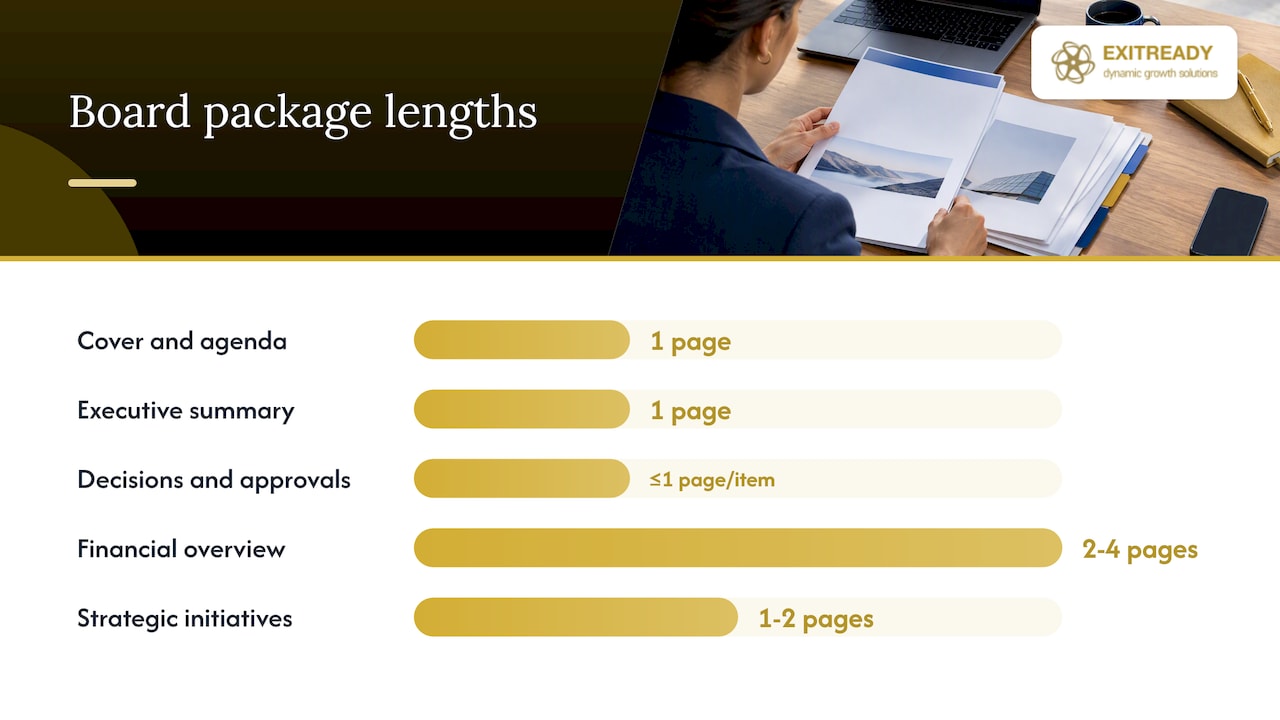
Most strong packages follow the same running order on purpose. Directors know where to look, and nothing important gets buried. A foundational structure, per Paro’s board reporting guide, has five parts: an executive summary, a KPI dashboard, a financial overview, strategic initiative updates and clear board asks.
Here is how we would lay that out for a mid-market company with an owner or CEO, a small board or advisory board, and a possible transaction in the next few years.
| Section | What goes in it | Rough length |
|---|---|---|
| Cover and agenda | Meeting date, time, agenda with time allotted per item | 1 page |
| Executive summary | The few things the board must know, plus what you need decided | 1 page |
| Decisions and approvals | Each item for a vote, with a recommendation and the reasoning | 1 page or less per item |
| KPI scorecard | About 10 metrics against plan, with trend and a one-line explanation | 1 page |
| Financial overview | P&L, balance sheet, cash flow, budget vs. actuals with variance commentary | 2 to 4 pages |
| Strategic initiatives | Progress on the three to five priorities that matter this year | 1 to 2 pages |
| Risks and open issues | What could hurt the plan, and what you are doing about it | 1 page |
| Appendix | Supporting detail, prior minutes, committee reports | As needed |
The lengths are our working guidance, not a published standard. The order, though, is well supported. Zinance’s annotated table of contents front-loads what directors read first and pushes detail to the back, and that is the shape to copy.
The executive summary
This is the page most directors read closely and some read only. Zinance advises keeping it to one or two pages at most and making it answer what the board needs to decide, approve or discuss at this meeting. Put strategic asks ahead of activity logs.
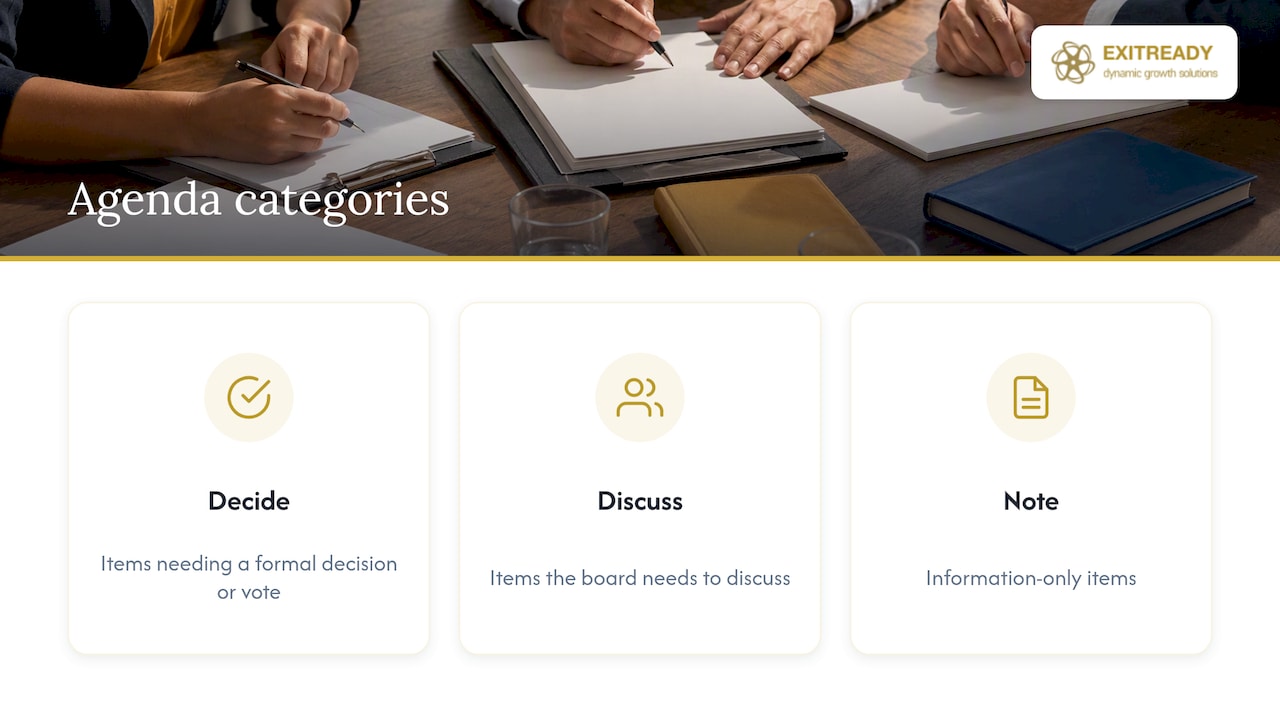
The most common failure is burying the lead. OnBoard’s guidance describes the pitfall as omitting a clear one-page summary that separates information-only items from items needing a formal decision or vote. A simple fix is to label every agenda item “Decide,” “Discuss” or “Note” and group the summary by those labels.
The KPI scorecard
Most owners overreport. Deloitte’s advice on board communications points toward a high-level scorecard rather than every operational metric, and the figure that recurs across the sources we reviewed is around ten critical KPIs. The operational weeds belong in management meetings.
Which ten? It depends on your model, but a workable mix looks like this:
- Growth: revenue vs. plan, bookings or backlog, new and lost customers
- Profitability: gross margin, EBITDA or operating margin
- Cash: cash balance, cash conversion, runway or covenant headroom
- People: key-role vacancies, regretted turnover
- Customers and delivery: retention, on-time delivery or a quality measure
For each metric, show actual, plan, prior period and a short sentence on why it moved. A number without a reason makes directors do the analysis you were hired to do. If you are still deciding what to track, our guide to business performance metrics every owner should track is a starting point, and the operating dashboard design article covers how to make the page readable at a glance.
The financial overview
Include the P&L, balance sheet and cash flow statement, plus a budget-versus-actual comparison. Kruze Consulting’s startup package guide makes the point that variances need explanations, not just figures. We agree, and we would add one habit: show a rolling forecast next to the budget. Directors care less about last month’s miss than about whether the year still lands.
Cash deserves its own few lines even when the company is healthy. Sellers and buyers alike scrutinize cash conversion, and a board that sees it monthly is far less likely to be surprised. Our piece on strategic finance and cash flow cadence goes deeper on the rhythm.
Strategic initiatives and risks
Pick the three to five initiatives the board has endorsed and report each in a fixed format: objective, status (on track, at risk, off track), what changed since last time, and what you need. Resist listing every project. If a project is not on the strategic list, it is management’s business.
The risk page should name the two or three things that could genuinely change the plan, such as a key customer renewal, a loss of a senior leader or a supplier problem. Pair each with an owner and a mitigation.
Timing: when the package should land
According to the practice described in Deloitte’s board communications guidance, packages should reach directors at least a week before the meeting, so they can review and prepare strategic questions. Treat that as a floor. If your bylaws or board charter set a different notice period, follow them.
The same source offers a rule we find useful: spend about one-third of the meeting on management presentations and reserve two-thirds for board discussion. That has a design implication. If the package is good, you do not need to walk through it slide by slide. You highlight, you answer, and you let directors work.
A repeatable process, not a scramble
Here is a view we hold firmly: an effective package is the by-product of a monthly or quarterly close process. It is not a project. If you are rushing to assemble it the week before, the underlying data hygiene in your company is probably not strong enough for a clean exit, because a buyer’s diligence team will ask for the same numbers with less patience.
A cadence that works for most mid-market companies:
- Business day 5 to 10 after month-end: close the books and lock the numbers.
- Business day 10 to 12: update the KPI scorecard from the same source data. Nobody retypes figures.
- Business day 12 to 15: each executive writes a short update on their initiative using the fixed template.
- Two weeks before the meeting: the CEO drafts the executive summary last, once the rest is final.
- At least one week before: send the package, then log questions that arrive early so you can prepare answers.
- After the meeting: record decisions and action items, and open the next cycle with those items on the agenda.
The discipline of writing the summary last matters. It forces you to decide what the headline is, and sometimes you find that the headline is not the one you planned to present. Preparing a short, hard-edged report can also sharpen how you make decisions in general. A decision journal, such as the approach in this decision matrix for founders, is one way to record your assumptions and confidence before the board weighs in, then compare outcomes afterward.
Mistakes that make directors stop reading
- Too much operational detail. If the board is reviewing task lists, the package is serving the CEO’s comfort and not the board’s oversight.
- No asks. A package that only informs invites polite nodding. State what you want.
- Surprises. Bad news belongs in the summary and, ideally, in a call before the package goes out.
- Inconsistent formats. Change the scorecard every quarter and no one can see trends. Add metrics rarely and retire them deliberately.
- Numbers that do not tie. If the KPI page and the financials disagree on revenue, trust drops fast. One data source, one definition.
- Late delivery. Sending the package the night before tells directors their preparation time does not matter.
Where decision rights come in
Board packages often stumble because nobody is sure which decisions belong to the board, which to the CEO and which to the leadership team. If every pricing change or hire arrives as a board item, the package bloats. We suggest writing down thresholds, such as capital commitments above a set amount or any change to the credit facility, so only true board matters reach the agenda. Our decision rights matrix guide walks through how to do this, and the management meeting agenda templates show where the operational discussion should live instead.
Our perspective: the package as an exit-readiness test
We work with mid-market owners who want their companies to run, and sell, without depending on them. Our observation is that the board package is one of the quickest diagnostics of that independence. Ask three questions about yours.
Can someone other than the owner produce it? If the owner personally collects the numbers and writes every paragraph, the company’s reporting depends on one person. That is the same dependency a buyer will price in.
Does it come out of documented systems? A package built from a standard close, a defined KPI list and a template for initiative updates can be repeated by anyone trained. A package built from email threads and memory cannot.
Does it lead to decisions? If meetings end without clear decisions or owners, the board is a formality, and the company is probably also making decisions informally in the owner’s head.
We start our engagements with a diagnostic before recommending any program, because the right fix depends on where the gaps are. In a board context, that often means tightening the KPI set, assigning ownership for each metric, and setting up a reporting calendar that does not rely on the owner. The aim is a company that reports on itself.
— Andre
How we can help
If building a package like this exposes gaps in your numbers, ownership or cadence, that is the kind of work our sprints address. The Growth Sprint runs $7,500 to $10,000 one-off, and the Performance Sprint $15,000 to $20,000 one-off. Enterprise Sprint pricing is not published. For a structured look at how your company runs end to end, see our Enterprise Assessment and AOS program. Not sure where you stand? Start with the Growth Readiness Score Card.
FAQ
What should a board report include?
At minimum: an executive summary, a KPI scorecard, financial statements with budget-versus-actual commentary, updates on strategic initiatives and a clear list of asks for the board. Add a short risk section and an appendix for supporting detail. Keep the main body focused on what directors must decide or discuss.
How long should a board package be?
There is no official page count. The executive summary should fit on one page, and sources we reviewed cap it at two. Most mid-market packages run roughly 10 to 20 pages before the appendix. If directors regularly ask questions that the package already answers, it is probably too long or poorly organized.
How far in advance should the package be sent?
At least one week before the meeting, according to Deloitte. Check your bylaws or board charter as well, since they may set a required notice period.
Is a board pack different from a board report?
A board report is usually a single document, such as the CEO’s update. The board pack, or reporting package, is the full set: agenda, prior minutes, the CEO report, financials, KPIs and supporting papers. In practice the terms are often used loosely, so confirm what your directors expect.
Do private mid-market companies need a formal package?
If you have a board, advisory board or outside investors, yes, and the format matters more than the size of the company. Even without a formal board, producing the package quarterly is a practical way to build the reporting habits buyers and lenders look for.
Sources
- Tips for improving board communications and effectiveness, Deloitte US
- What belongs in a board reporting package, Zinance
- Board Reporting Best Practices and Template, Paro
- How to Organize a Complete Board Pack, OnBoard
- How to Build a Startup Board Reporting Package, Kruze Consulting
- Producing effective board reports, GOV.UK