

Implementing standard work creates a repeatable, visible baseline that lets teams spot deviations and improve through kaizen. Start by collecting cycle-time data and mapping the current work sequence at the gemba, then build from there. Done well, this gives you a clear training reference, fewer defects, and lower work-in-process within the first few cycles.
TL;DR:
- Standard work should be implemented only in cyclical, operator-paced processes, with layout adjustments and operator balancing driving early gains.
- Proper documentation, visual management, and version control are crucial to sustain the standard work, along with leader-led audits and operator feedback.
- Use standard work when work is repetitive and predictable, switch to operations standards or andon/Jidoka for machine-heavy or non-cyclical processes.
- Scaling standard work across multiple lines often requires outside support to diagnose constraints, develop tailored roadmaps, and maintain staff engagement.
Table of Contents
- What standard work means and its three core elements
- What to expect: measurable benefits after implementation
- Standard work versus other lean tools: picking the right fit
- How to implement standard work: a seven-step pilot method
- Artifacts and visual management: what to post at the workstation
- Common challenges and how to work through them
- What the published case studies show
- How standard work fits into a broader operating system
- Getting outside help to implement and sustain standard work
- FAQ
- Sources
What standard work means and its three core elements
Standard work is the best-known way to perform a task right now, documented so anyone can follow it and anyone can spot when it breaks down. It is not a rulebook carved in stone. Lean practitioners describe it as a living baseline: a reference point that makes problems visible so teams can run targeted kaizen instead of guessing at what went wrong.
Three elements hold it together:
- Takt time: the pace of customer demand, calculated as available production time divided by customer demand for the period.
- Work sequence: the specific order operators perform each element, chosen to minimize wasted motion and variation.
- Standard in-process stock (SWIP): the minimum work-in-process needed to keep a process running smoothly between stations.
Standard work differs from a standard operating procedure (SOP) in scope: an SOP often covers a single task or compliance step, while standard work ties takt, sequence, and SWIP together for a repeating, cyclical operation. It applies cleanly to repetitive assembly or packaging work. In non-cyclical work, or in heavily automated processes where machine cycles dominate, a different mix of tools usually fits better, a point worth returning to before you commit a pilot line to it.
What to expect: measurable benefits after implementation
The payoff from standard work shows up fastest in flow and quality, not in abstract morale metrics. A NIST-supported lean rollout at a components manufacturer raised daily output from 75 to 120 units and cut work-in-process from 717 to 156 units after applying Toyota Production System and standard work principles together, a sign of how much slack hides in an unstandardized line.
Reported outcomes across documented implementations include:
- Daily output gains alongside sharp WIP reduction.
- Inefficient operator movements falling by as much as 66%, with standard time cut roughly 18% in a documented case.
- Faster, more consistent training because the standard itself becomes the teaching tool.
- Fewer defects, since a fixed sequence exposes quality slips immediately instead of burying them in variation.
Among the clearer figures to anchor expectations: output climbed from 75 to 120 units per day while WIP dropped from 717 to 156 units after a standard work rollout, a scale of change that low-cost layout and motion fixes typically drive in the early weeks.
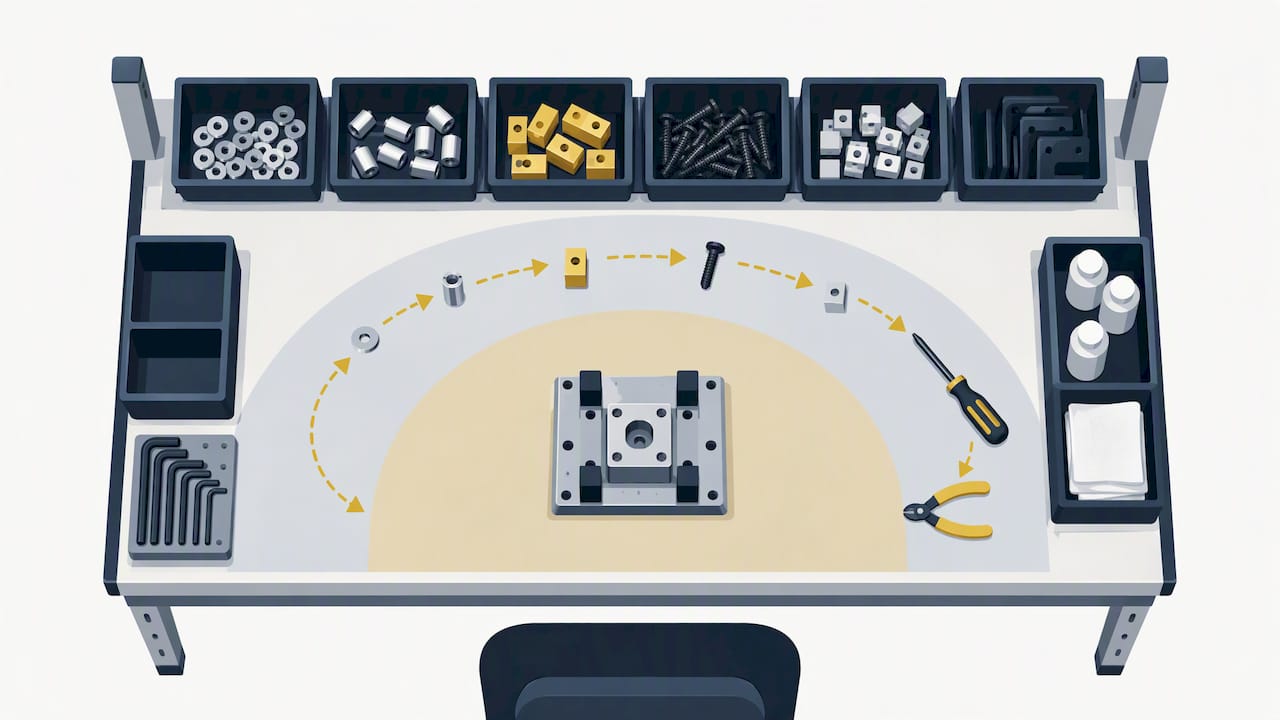
Safety tends to improve alongside quality: a fixed work sequence with defined reach zones and tool placement removes the awkward, improvised movements that cause strain injuries on repetitive lines.
Standard work versus other lean tools: picking the right fit
Standard work is one tool in a larger kit, and using it where another tool fits better wastes the pilot’s early momentum. Operations standards, which document machine settings, maintenance checks, or quality parameters, apply where the work is not cyclical or operator-paced. Andon and Jidoka systems, which stop a line or signal an abnormality automatically, carry more weight in machine-intensive settings where cycle time is dictated by equipment rather than operator sequence.
A practical way to choose:
- Use standard work when a human operator repeats a cyclical task at a pace you can measure against takt time.
- Use operations standard sheets when the process is machine-paced, non-cyclical, or dominated by setup and changeover.
- Use andon/Jidoka when the priority is catching abnormalities in real time rather than balancing operator pace.
- Combine both in mixed lines: standard work for operator stations, andon for automated or semi-automated steps.
In machine-intensive processes, classic takt-based balancing often matters less than clear operation instructions paired with a Jidoka response plan. Matching the tool to the process type up front saves you from retrofitting the wrong framework onto a line that was never going to behave like a manual assembly cell.
How to implement standard work: a seven-step pilot method
A pilot proves the method before you scale it, and the sequence below follows the staged approach documented in standard work implementation case studies: data collection, timing, capacity planning, balancing, documentation, validation, and training.
- Define scope and get leader buy-in. Pick one line or cell with stable demand and a supervisor who will champion the pilot. A swimlane map of current handoffs helps you see where the process actually breaks down before you touch cycle times.
- Collect baseline data. Record available time, demand, and current cycle times at the gemba, element by element. Bimanual (left-hand/right-hand) charts expose wasted motion that a stopwatch alone misses.
- Calculate takt time and build a production capacity sheet. Divide available time by demand, then compare that figure against each operator’s actual cycle time to see where capacity is tight or slack.
- Build an operator balance chart (OBC) and rebalance the line. Plot each operator’s cycle time against takt time on a bar chart, then shift elements between stations until no one is significantly over or under takt.
- Draft the standardized operation routine sheet and standardized operation sheet. Document the work sequence, SWIP quantities, safety checkpoints, and quality checks for each station. A practical SOP-writing framework helps keep the language consistent with other documented procedures.
- Run trials and validate with operators. Walk the new sequence with the people who do the work, capture deviations honestly, and update the documents rather than forcing the floor to match an outdated sheet.
- Build the training and sustainment plan. Train to the standard, establish leader standard work with daily checks, and set a kaizen cadence so operators have a formal channel to propose changes.
Pro Tip: Time the pilot’s first full week against the production capacity sheet, not the OBC alone. The capacity sheet tells you whether the whole line can hit takt; the OBC only tells you whether individual stations are balanced against each other.
Each step builds on the last, and skipping the trial-run step is the most common reason standard work documents end up ignored within a month: operators stop trusting a sheet that does not match what they actually do.
Artifacts and visual management: what to post at the workstation
A standard that lives in a binder does not get used. The standardized operation sheet belongs at the workstation itself, with the work sequence, photos of correct setups, key quality checkpoints, and tool and parts placement marked clearly enough that a new hire can follow it without a supervisor standing over them.
Core artifacts worth posting:
- The standardized operation sheet, showing layout, SWIP locations, and safety or quality checkpoints at a glance.
- The operator balance chart (OBC), so anyone walking the line can see at a glance which stations run close to takt.
- The standardized work combination table (SWCT), breaking out manual, walk, and machine time for each element.
- Visual cues: takt boards showing hourly output against target, andon lights for abnormality signals, and side-by-side photos of correct versus incorrect setups.
Version control matters more than most teams expect. An outdated sheet posted next to a current one creates confusion fast, and a documented SOP version control process keeps the floor working from one source of truth as the standard evolves. For parts and tooling placement specifically, visual location systems such as zone-based bin mapping reduce the search time that often hides inside SWIP numbers.
Common challenges and how to work through them
The most predictable resistance sounds like “people are not robots.” Reframe it: standard work documents the best current method, not a cage, and the explicit goal is to free operators from reinventing a sequence every shift so they can spend that attention on catching problems and improving it.
Typical friction points and countermeasures:
- Pushback on rigidity: frame the standard as the current best method, open for a kaizen-driven update, not a permanent rule.
- Variation and exceptions: capture them in a log, route genuine edge cases to a defined exception process instead of letting them erode the standard quietly.
- Mixed-model lines and bottlenecks: rebalance using the OBC whenever product mix shifts, since a standard built for one mix rarely survives a second unchanged.
- Fading discipline after launch: sustain gains with scheduled audits and leader standard work, so checking the standard becomes part of a supervisor’s own routine rather than an occasional event.
Pro Tip: Give every operator a simple way to flag a deviation the same shift it happens. A kaizen suggestion logged a week later rarely survives into the next revision of the sheet.
What the published case studies show
Published results back up what shop-floor teams often sense intuitively: the first gains come cheap. The NIST-supported rollout mentioned earlier paired standard work with Toyota Production System principles and produced its output and WIP gains mainly through layout adjustments and operator rebalancing, not new equipment.
A separate academic case study on production process standardization followed a staged method: collect and analyze data, study times and motions, redesign workstations visually, implement, then verify and iterate.
Replication tips drawn from these studies:
- Keep the pilot scope to one line or cell before expanding; both case studies built their gains on a contained pilot first.
- Invest real time in motion studies and bimanual charts. They found waste that a simple stopwatch cycle-time study missed.
- Treat layout and tool-placement changes as the first lever to pull. They are faster and cheaper than process redesign.
How standard work fits into a broader operating system
Standard work on one line is a good start. The harder problem for a mid-market manufacturer is making it repeat across every line, shift, and plant without a founder or ops leader personally policing every sheet. Standard work becomes one documented layer inside a broader playbook that also covers delegation, training cadence, and leadership routines, so the standard survives staff turnover instead of decaying with it.
Most mid-market teams we talk with have the shop-floor knowledge to build one good standard but lack the bandwidth to scale it across a facility while running daily operations. That is usually where an outside diagnostic earns its cost: it tells you honestly whether the gap is capacity, sequencing, or leadership follow-through before you commit more internal hours to it.
— Andre
Getting outside help to implement and sustain standard work
If your team has the shop-floor skill but not the hours to roll standard work across every line, that is exactly the gap our engagements are built to close. Our Enterprise Assessment and AOS Value Creation Partnership start with a diagnostic of where your operation actually stands before recommending anything, so you get a roadmap built on your real constraints rather than a generic template.

For teams ready to move faster, our Growth Sprint, Performance Sprint, and Enterprise Sprint programs pair your shop floor with hands-on implementation support through the pilot and rollout stages. A typical engagement covers:
- A diagnostic of current process stability and readiness for standardization.
- A documented implementation roadmap scoped to your facility.
- Direct implementation support through pilot, balancing, and training.
Schedule a strategy call to talk through where your operation stands, or start with our application form if you already know you want a structured engagement.
FAQ
What are the four phases of standard work?
Most implementation frameworks break standard work into data collection, time study and capacity planning, line balancing through an operator balance chart, and documentation with training. The exact phase count varies by source, but the sequence from measurement to documented standard to trained operators stays consistent across the case studies that describe it.
What are examples of standard work?
Common examples include a documented assembly sequence at a single workstation, a standardized operation sheet showing tool placement and SWIP for a packaging line, and an operator balance chart used to rebalance a mixed-model cell. Each example ties takt time, work sequence, and standard in-process stock together for a specific, repeating task.
What is SWIP versus WIP?
WIP (work-in-process) is all inventory sitting between process steps at any given moment, including excess. SWIP (standard in-process stock) is the minimum WIP a process needs to run smoothly without starving the next station, one of the three core elements of standard work alongside takt time and work sequence.
What are the three elements of standard work?
The three elements are takt time, the pace set by customer demand; work sequence, the specific order of operations; and standard in-process stock (SWIP), the minimum buffer needed between stations. These three elements together define a documented, repeatable standard work baseline.
How is standard work different from an SOP?
Standard work ties takt time, work sequence, and SWIP together for a cyclical, repeating operation, while a standard operating procedure typically documents a single task or compliance step without that pacing logic. Both benefit from the same version control and training discipline to stay current on the floor.
Sources
- Success Lean Process Implementation | NIST
- Implementation of Production Process Standardization—A Case Study (MDPI)
- IMPROVEMENT BASED ON STANDARDIZED WORK: AN IMPLEMENTATION CASE STUDY
One Response