

A vendor management playbook is a documented set of templates, checklists, and governance steps that make vendor onboarding, risk-based oversight, and contract renewals repeatable and auditable. It draws on frameworks like NIST’s supply chain risk guidance and federal interagency oversight standards. Start by inventorying your key vendors, assigning risk tiers, and building your first scorecard soon.
TL;DR:
- Vendors should be tiered by risk, with high-risk vendors undergoing enhanced due diligence, including financial and security audits, and regular reassessment.
- A scorecard tracking delivery, quality, responsiveness, SLA adherence, and cost helps foster continuous improvement rather than just compliance.
- Contracts must clearly specify scope, SLAs, renewal terms, and audit rights to prevent surprises during renewal or offboarding.
- The vendor lifecycle includes stages for selection, monitoring, renewal, and offboarding, each with designated owners and specific, documented tasks.
- Implementing a documented, repeatable playbook within 90 days can significantly reduce SLA breaches, surprise renewals, and time spent managing vendors.
Table of Contents
- What goes inside a vendor management playbook
- The vendor lifecycle: stages and what to do at each one
- Vendor checklist fields that actually matter
- Supplier scorecards and the KPIs worth tracking
- Turning risk judgments into repeatable due diligence
- Contract controls that stop renewals from becoming surprises
- Onboarding and offboarding steps that protect data and budget
- Rolling out the playbook in 90 days
- How documented playbooks speed up implementation
- A note on common mistakes and what success looks like
- Where to get the playbook and hands-on help
- FAQ
- Sources
What goes inside a vendor management playbook
A working playbook is a toolkit, not a manual. It gives your team the artifacts to run vendor decisions the same way every time, regardless of who is on the account that quarter.
- A vendor inventory with owner, purpose, and risk tier for each relationship.
- An onboarding checklist and a due diligence evidence template.
- A contract clause library covering SLAs, renewal notices, and termination rights.
- A KPI scorecard with a defined review cadence.
- An offboarding checklist that closes access, data, and finances together.
Most teams keep these as editable worksheets or shared templates so new hires can run a vendor review without retraining.
The vendor lifecycle: stages and what to do at each one
Vendor management breaks into four stages, each with its own owner and output.
- Selection and onboarding. Run an RFx process, complete due diligence, assign a risk tier, and get contract signoff before any data or system access is granted.
- Monitoring. Track KPIs on a scorecard, hold scheduled business reviews, and log issues as they occur rather than at renewal time.
- Renewal. Revisit pricing, SLA performance, and risk tier at a fixed point before the contract’s auto-renewal window closes.
- Offboarding. Trigger a defined exit process when a contract ends, performance fails, or the business relationship no longer fits, covering access revocation and data return.
Each stage should have a named owner, whether that is procurement, IT, legal, or the business unit sponsoring the vendor.
Vendor checklist fields that actually matter
A generic checklist invites generic oversight. The fields below come from a sample vendor management program structure and cover what a reviewer actually needs to see, not just what looks thorough.
- Vendor owner, business purpose, and systems or data the vendor can access.
- Criticality rating and assigned risk tier (low, medium, high).
- Baseline SLA terms and renewal or termination dates.
- Due diligence evidence: SOC 2 or SOC 1 reports, ISO 27001 certification, a software bill of materials for software vendors, and recent financial statements for high-risk suppliers.
- Onboarding tasks: system provisioning, access grants, training completion, and a signed acceptance record.
- Offboarding tasks: access revocation, data destruction confirmation, and final invoice settlement.
This checklist structure, including the ranking and contract administration fields, follows the pattern laid out in a vendor management program sample built for practical use rather than theory.
Pro Tip: Store the due diligence evidence and its collection date in the same record as the risk tier, so a reviewer never has to hunt across systems to confirm a vendor is still current.
Supplier scorecards and the KPIs worth tracking
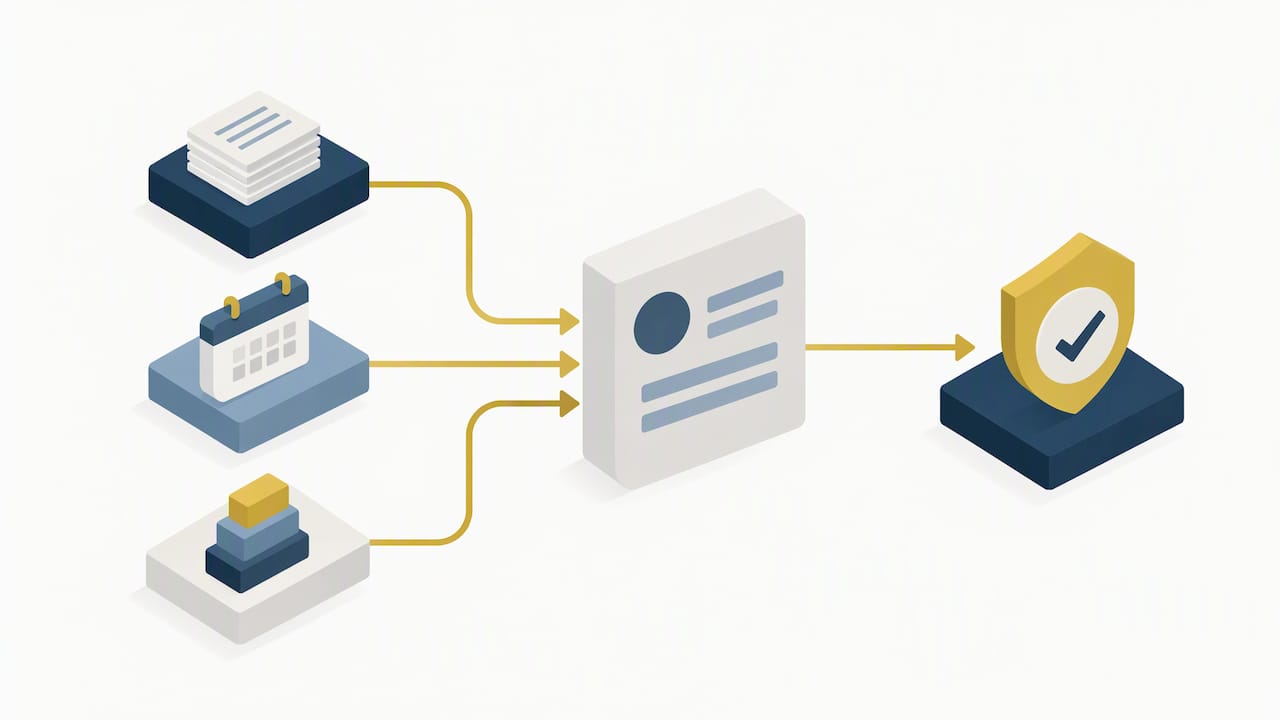
A scorecard only earns its place if it changes the conversation with a vendor, not just the paperwork around it. The dimensions worth measuring are delivery and timeliness, quality or defect rates, responsiveness, SLA adherence, cost and value, compliance, and relationship health or innovation.
Building one that sticks follows a five-step pattern: define objectives and the KPIs tied to them, select metrics, automate data collection, review results with the vendor, and refine the model based on what the reviews reveal.
- Pull delivery and SLA data from ERP or ticketing systems rather than vendor self-reports.
- Pull cost and invoice accuracy data from finance systems.
- Reserve qualitative fields, like responsiveness and flexibility, for supplier-facing review calls.
A useful scorecard moves supplier reviews from a pass or fail check to a recurring improvement conversation, a shift Amazon Business recommends building through defined objectives, automated data, and scheduled refinement rather than a one-time audit.
Turning risk judgments into repeatable due diligence
Subjective risk calls do not scale past a handful of vendors. A tiering schema fixes that by tying the depth of diligence to the risk a vendor actually poses.
- Low-tier vendors get basic verification: business registration, a signed data processing agreement, and a standard contract review.
- Medium-tier vendors add evidence review: security certifications, insurance proof, and a reference check.
- High-tier vendors, those with sensitive data access or operational dependency, get enhanced diligence: financial statements, security audit reports, and a documented site or system review.
NIST’s C-SCRM due diligence guide recommends converting these judgments into templates that record concern levels and a refresh date, so reassessment happens on a schedule rather than only after something goes wrong.
Contract controls that stop renewals from becoming surprises
Contracts are where oversight either gets enforced or quietly disappears. A playbook needs the clauses that make obligations trackable, not just legally sound.
- Define scope, SLAs, and the remedies that apply when a vendor misses them.
- Set term length, renewal notice windows, and termination rights in plain, dated language.
- Require confidentiality, data return or destruction, and subcontractor flow-down obligations.
- Build a central renewal calendar with gated approval before any auto-renewal triggers.
- Reserve audit rights so monitoring can happen mid-contract, not only at renewal.
Interagency guidance on third-party relationships stresses that oversight should scale with risk and that audit and remediation rights need to be written into the contract itself, not assumed.
Onboarding and offboarding steps that protect data and budget
Onboarding and offboarding deserve equal weight. One grants access; the other has to take it back cleanly.
- Onboarding: provision systems, apply an access matrix matched to the vendor’s role, complete training, and confirm a test delivery against the SLA baseline.
- Offboarding: revoke all access, confirm data return or destruction in writing, settle final invoices, and close the vendor record.
Offboarding fails most often when it was never written into the contract at signing, leaving no clear trigger or deadline once the relationship ends.
Rolling out the playbook in 90 days
Assign a vendor management owner, often called a VMO, and pull in procurement, legal, IT, and finance as standing stakeholders. Governance needs a written policy, an exception process for edge cases, an escalation path for unresolved issues, and a fixed reporting cadence to leadership.
In the first 90 days: inventory your top vendors, apply risk tiers to each one, set renewal alerts on every active contract, and run your first scorecard review with at least one critical vendor. These four moves convert the playbook from a document into an operating habit.
How documented playbooks speed up implementation
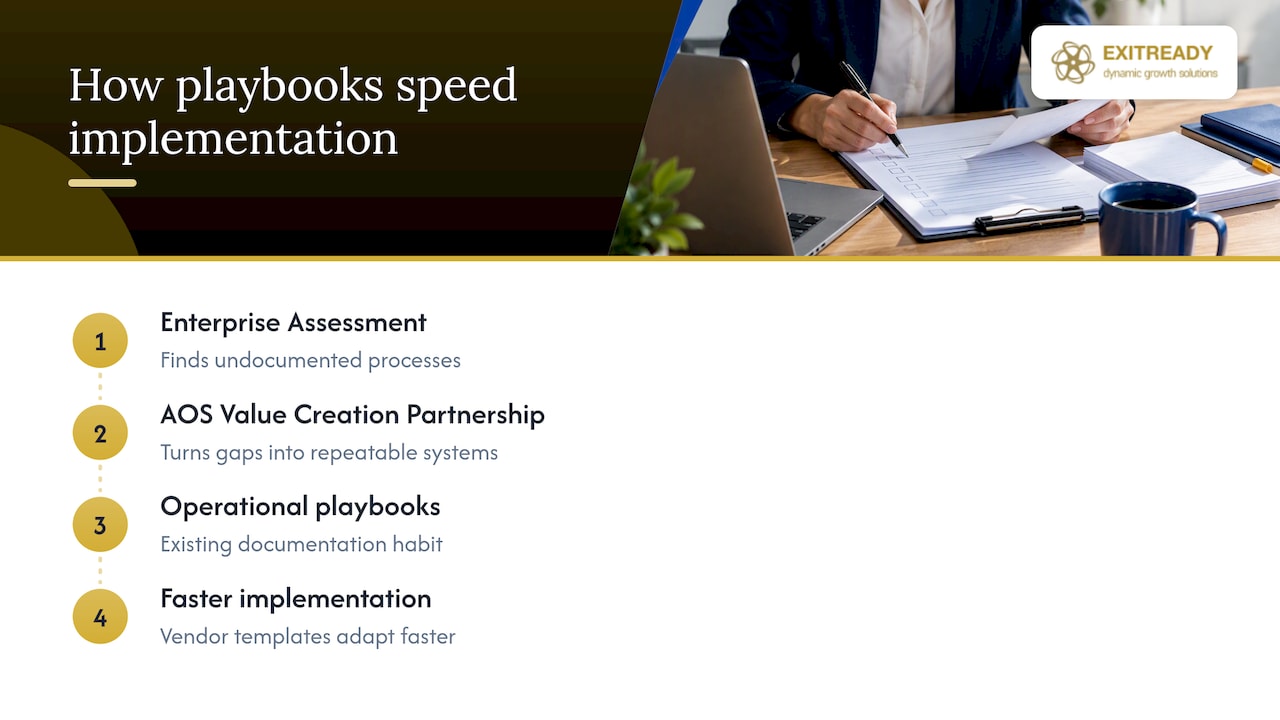
Documented playbooks remove the guesswork that keeps a process owner-dependent. Enterprise Assessment work identifies where vendor oversight and other operational processes lack documentation, and the AOS Value Creation Partnership turns those gaps into certified, repeatable systems. A company that has already mapped its operational playbooks for other functions tends to adapt a vendor management template faster, since the habit of documenting process already exists.
A note on common mistakes and what success looks like
The biggest mistake I see is treating a completed vendor questionnaire as proof of control, when it only proves the vendor filled out a form. The second is skipping offboarding terms at contract signing, then scrambling when the relationship ends. The third is giving every vendor the same scrutiny regardless of risk.
A playbook working well shows up in fewer SLA breaches, fewer surprise renewals, and less of your own time spent chasing vendor issues.
— Andre
Where to get the playbook and hands-on help
Building a vendor management playbook from scratch takes time most mid-market leaders do not have alongside running the business. Dynamic Growth Solutions maps this work directly into its programs: the Enterprise Assessment identifies where your vendor inventory, risk tiers, and contract controls have gaps, and a Growth Sprint turns those findings into a documented, working system inside weeks rather than quarters.

For leaders who want closer support building the playbook alongside their own operating system, Elite 1-on-1 Coaching pairs the assessment with ongoing guidance. Starting with an enterprise assessment can help clarify where vendor oversight stands.
FAQ
What are the four stages of vendor management?
The four stages are selection and onboarding, monitoring, renewal, and offboarding. Each stage has its own tasks: due diligence and contract signoff at onboarding, scorecard reviews during monitoring, SLA and pricing review at renewal, and access revocation plus data closeout at offboarding.
What are some best practices for vendor management?
Tier vendors by risk so low-risk suppliers do not get the same scrutiny as critical ones, and build due diligence into templates rather than one-off reviews. Track performance with a KPI scorecard reviewed on a fixed cadence, and write renewal notice windows and termination rights directly into the contract.
What are the steps in vendor management?
The core steps are building a vendor inventory, assigning risk tiers, completing due diligence, onboarding with a documented checklist, monitoring performance through a scorecard, and managing renewal or offboarding through contract-defined triggers. Interagency third-party guidance recommends scaling the depth of each step to the vendor’s actual risk level.
What is a vendor checklist?
A vendor checklist is a standardized record covering a vendor’s owner, purpose, systems or data accessed, risk tier, contract terms, and required due diligence evidence. It also tracks onboarding tasks, performance issues, and offboarding steps so nothing gets handled inconsistently between vendors.
Sources
- VENDOR MANAGEMENT PROGRAM SAMPLE (Smartsheet)
- How to build a vendor scorecard for procurement excellence (Amazon Business)
- NIST SP 1326: C-SCRM Due Diligence Quick-Start Guide
- Interagency guidance on third-party relationships: Risk management (Federal Register)