

Yes, structured CEO peer groups reliably improve decision quality, reduce isolation, and raise accountability when members commit to confidentiality and consistent participation. The Boardroom Psychological Safety Index links psychological safety directly to sharper strategic thinking, and Chief Executive Network member materials report faster growth among engaged participants. The rest of this article covers the evidence, how these groups actually run, and how to pick one worth your time.
TL;DR:
- CEOs with operationally complex, mid-market companies or private equity-backed businesses gain the most value from peer groups due to relevant benchmarking and strategic input.
- Member data suggests faster revenue growth and higher margins for participants, but these outcomes may reflect self-selection bias and increased CEO resourcefulness.
- Effective peer groups emphasize candid problem-solving, consistent attendance, and real disclosure, with success tied to humility and preparedness rather than polished narratives.
- Structured programs with facilitated accountability and concrete follow-up accelerate turning peer advice into measurable business results.
- Key factors in choosing a group include relevant company size, qualified facilitation, strict confidentiality, regular attendance, and requesting a trial session before committing.
Table of Contents
- What CEOs actually gain from joining a peer group
- Does the data back up the benefits, or is this mostly anecdotal
- How peer groups actually run, week to week
- Which CEOs get the most (and least) value from a group
- A practical checklist for choosing the right group
- Turning peer advice into results you can measure
- How Dynamic Growth Solutions structures facilitated peer learning
- Why the best peer group habit is showing up unprepared to perform
- A guided path if you want structure and accountability built in
- Sources
- FAQ
What CEOs actually gain from joining a peer group
The value of a peer group shows up in five distinct ways, and most CEOs only expect one or two of them going in.
Decision quality and strategic clarity improve because you finally get to stress-test an idea with people who have no stake in telling you what you want to hear. A CEO weighing a pricing overhaul or an acquisition can bring the case to a room of peers who have made similar calls and lived with the consequences. This isn’t theoretical: Forbes reporting documents CEOs leaning on peer networks specifically during crises and periods of major change, when internal teams are often too close to the problem or too invested in a particular outcome to give unfiltered input.
Reduced isolation sounds soft until you consider what the job actually looks like. Most executives cannot be fully candid with their board, their direct reports, or their spouse about the doubts that keep them up at night. A peer group made up of people carrying the same weight, with no reporting relationship and no competitive stake, becomes the one room where a CEO can say “I don’t know” out loud.
Accountability mechanisms turn good intentions into finished work. When you commit to a specific action in front of eight or ten peers who will ask about it next month, the social cost of not following through does more than any personal productivity system.

Benchmarking and operational best practices let you skip years of trial and error. Hearing how another company restructured its sales comp plan or migrated its ERP system saves you from repeating mistakes that are already well documented among your peers, as highlighted by this Lean thinking insights & change-readiness assessment. Groups that address recurring operational pain points, including ERP selection and implementation, often surface the sharpest tactical advice because the problems are concrete and comparable across companies.
Network access rounds out the list: advisors, potential hires, deal flow, and introductions that would otherwise take years to build organically.
- Better decisions come from candid outside challenge, not more internal data.
- Isolation drops when peers share the same weight of responsibility.
- Public commitments in front of the group convert intentions into completed work.
- Benchmarking against peers shortcuts avoidable operational mistakes.
- Warm introductions through the network often beat cold outreach for hires, advisors, and deals.
Pro Tip: Bring one real, unresolved decision to every meeting instead of a status update. Groups create value around problems, not progress reports.
Does the data back up the benefits, or is this mostly anecdotal
The honest answer is both: there’s real measurable signal, and there’s a selection-bias problem that no one in the industry fully solves.
Chief Executive Network’s guide reports that member companies show faster revenue growth and higher operating margins than non-member benchmarks in their industries. That’s a meaningful signal, but it comes from self-reported member data, and CEOs who join peer groups in the first place tend to be more growth-oriented and better resourced than the average business owner, so some of that gap likely reflects who joins rather than what the group produces.
Peer-network members report faster average revenue growth and higher operating margins than non-members, according to Chief Executive Network’s benchmarking data, though the comparison is drawn from voluntary member reporting rather than an independent audit.
Academic research offers a cleaner lens on mechanism, if not magnitude. A conference paper on executive networks found that peer effects measurably influence firm policy decisions, including compensation structures and acquisition strategy, which supports the idea that who you talk to changes what you decide, not just how you feel about the decision. And the Boardroom Psychological Safety Index found psychological safety correlates strongly with decision quality and strategic agility, which is the theoretical case for why confidentiality and trust inside a peer group matter as much as the advice itself.
- Member benchmarks show a real growth and margin gap, with a caveat for self-selection.
- Academic evidence supports measurable peer effects on real firm policy decisions.
- Psychological safety research explains why trust, not just information, drives outcomes.
- No available dataset fully separates group impact from the fact that ambitious CEOs seek out groups in the first place.
How peer groups actually run, week to week
Most groups fall into one of two structural camps, and the choice matters more than most first-time members realize.
- Industry-specific forums group CEOs from the same sector, which sharpens benchmarking but raises confidentiality stakes since members may be near-competitors.
- Cross-industry forums mix CEOs from unrelated businesses, trading some benchmarking precision for freer disclosure and broader pattern recognition.
- Facilitation styles range from a trained, paid facilitator who runs a tight agenda to a rotating member-led format with looser structure and more variable quality.
- Standard meeting cadence is monthly for most established groups, often four hours, built around one or two “hot seat” cases where a single member presents a live problem for group input.
- Membership rules typically include vetting for company size and non-compete industry restrictions, plus a signed confidentiality agreement that makes candid disclosure possible.
- Coaching or advisory add-ons give groups execution muscle between meetings, since a monthly session alone rarely sustains follow-through without someone tracking commitments.
Organizations like YPO and EO formalize this with chapter structures, membership requirements, and defined forum vetting processes designed to keep trust high and relevance consistent across the group. Vistage and the Chief Executive Network run comparable models with paid, trained facilitators rather than peer-led rotation, which tends to produce more consistent meeting quality at a higher membership cost.
Which CEOs get the most (and least) value from a group
Fit matters more than most people expect before they join, and the wrong fit wastes both time and money.
- Mid-market CEOs running companies with real operational complexity, typically past the founder-does-everything stage, tend to get the most value because their problems are advanced enough for peer input to be relevant.
- PE-backed leaders facing board pressure and compressed timelines often benefit from peer groups that understand the specific demands of the first ten months under new ownership.
- Growth-oriented owners actively scaling, hiring, or preparing for a transition get more from the benchmarking and network effects than owners running a stable lifestyle business with no expansion plans.
- Early-stage founders with fewer than five employees frequently find less relevant peer content, since most groups skew toward leaders managing teams and systems rather than solo operators.
- CEOs unwilling to share real numbers or real problems capture almost none of the value, because the entire model depends on candor.
Company size and complexity shift the expected return: a fifty-person company with layered management gets more mileage from benchmarking conversations than a five-person shop still finding product-market fit. The behavioral commitment matters just as much as the fit profile. Consistent attendance, real disclosure, and a willingness to be publicly accountable for commitments separate members who transform their leadership from those who treat it as an expensive networking lunch.
A practical checklist for choosing the right group
Most CEOs pick a peer group the way they pick a gym membership: based on proximity and price, not fit. That’s a mistake worth avoiding, and a short evaluation process fixes it.
- Check membership composition first. Ask how many members run companies within roughly half to double your revenue, since too wide a spread kills relevance.
- Ask directly about the facilitator’s background. A trained, paid facilitator with a defined agenda process tends to produce more consistent value than a purely peer-led rotation.
- Confirm the confidentiality agreement in writing. If a group cannot produce a signed document, treat that as a serious gap, not a formality.
- Ask about meeting cadence and average attendance rate. A group with chronic no-shows has quietly stopped functioning as a group.
- Understand the cost model before you commit. Fees vary widely across providers, from local paid-facilitator forums to national networks, and the number alone tells you little without knowing what’s included.
- Request to attend as a guest before joining. Any group confident in its value will let a prospective member sit in on one session.
- Set a measurable ninety-day objective for your trial term. Decide in advance what “this is working” looks like, whether that’s a resolved hiring decision or a specific operational fix.
Red flags are usually easy to spot once you know to look. High member churn signals a group that isn’t delivering, regardless of what the sales pitch says. An agenda dominated by vendor pitches instead of member cases means the group has drifted from peer advisory into a marketing channel. Weak vetting, where anyone who pays gets in, usually means low candor and low trust once you’re inside the room.
Professional associations like the ESA frame membership value around leadership development and reduced isolation, which is a useful cross-check against a specific group’s own pitch: if a group can’t articulate value beyond “networking,” that’s worth probing further.
Pro Tip: Ask every group the same question during your guest visit: “What’s the last piece of advice a member acted on, and what happened?” A group with a real track record answers instantly with a specific story.
Turning peer advice into results you can measure
Insight without follow-through is the single biggest failure mode in peer groups, and it’s almost entirely preventable with a few habits.
Preparing your case before a meeting matters more than the meeting itself. A CEO who shows up with a vague complaint gets vague advice. A CEO who shows up with a specific decision, the options considered, and a clear question gets specific, usable input. The Peer Learning Institute’s research on peer learning mechanics points to something practitioners call “collateral learning,” where the habits and thinking patterns built through repeated group exposure stick longer than any single piece of advice.
- Prepare a one-page case with the decision, the options, and the specific question before every meeting.
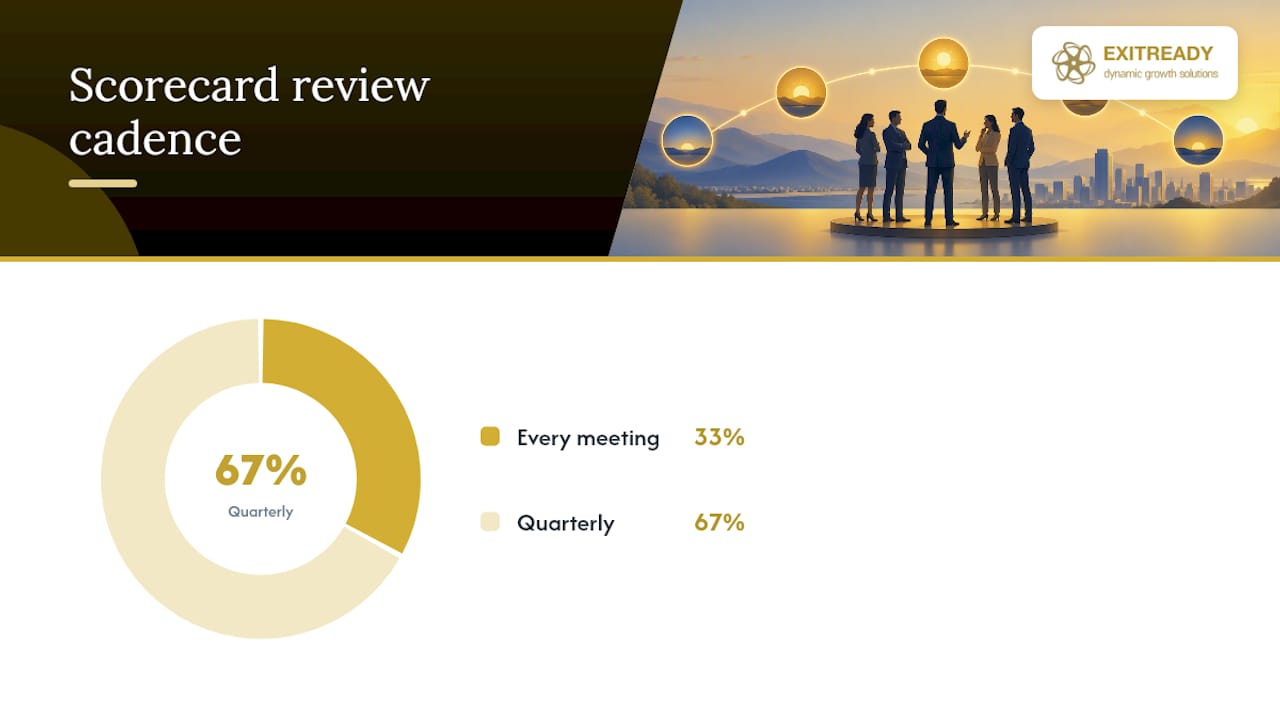
- Track your own commitments in a shared scorecard so the group can hold you to them.
- Pair peer feedback with one-to-one advisory when a decision needs deeper implementation support than a monthly meeting allows.
- Review CEO-level KPIs quarterly to see whether peer input is actually moving the numbers that matter.
A simple internal scorecard makes the difference visible over time.
| Tracking element | What it captures | Review cadence |
|---|---|---|
| Commitment log | Specific actions promised to the group | Every meeting |
| Decision outcomes | Whether peer-informed decisions met expectations | Quarterly |
| CEO KPI movement | Revenue, margin, or operational metrics tied to decisions discussed | Quarterly |
Operational playbooks built around mid-market execution practices can give the group’s advice somewhere concrete to land, since a peer group generates direction but rarely builds the systems that carry a decision through to completion.
How Dynamic Growth Solutions structures facilitated peer learning
A business consulting firm works with mid-market owners through a business operating system built to complement the kind of peer input this article covers rather than replace it. Where a peer group gives you candid outside perspective, AOS focuses on turning a decision into a documented, delegated system that runs without the owner holding every piece together.
The programs map to different points in a CEO’s needs:
- Several structured, time-bound engagements offer facilitated implementation support after a strategic decision, not just advice on making one.
- One-on-one coaching pairs a CEO with ongoing advisory support between the kind of periodic input a peer group provides.
- Mastermind retreats and annual membership programs run facilitated peer sessions, combining group input with structured follow-up.
The engagement sequence typically starts with an assessment of where the business stands operationally, moves into a documented playbook specific to that business, and continues with accountability check-ins so recommendations don’t stall after the first meeting. That sequencing, diagnose first, then build, then track, mirrors the same discipline that separates peer groups that produce results from ones that produce pleasant conversation.
Why the best peer group habit is showing up unprepared to perform
The CEOs who get the least from peer groups are usually the ones trying to look competent in the room. They arrive with a polished narrative instead of a real, unresolved problem, and the group responds with polite nods instead of useful friction.
The ones who benefit most walk in with genuine uncertainty and let the group see it. That takes a kind of humility that doesn’t come naturally to people who spend most of their week being the person with the answers. Regular attendance matters just as much: a peer group’s value compounds the way trust does, slowly and then all at once, and a CEO who shows up every third meeting never quite gets there.
One pattern worth testing: bring your worst decision of the past quarter to the next meeting, not your best one. The room will tell you things your team never will.
— Andre
A guided path if you want structure and accountability built in
Reading about peer group benefits is one thing. Building the habit of candid outside input, backed by a system that turns that input into finished work, is another, and it’s where a facilitated program can shortcut months of trial and error.
If a monthly peer meeting alone hasn’t been enough to move the numbers you care about, Dynamic Growth Solutions offers a more structured alternative built around accountability from day one:
- The Growth Sprint, Performance Sprint, or Enterprise Sprint programs give you a time-bound, facilitated path from decision to execution.
- Elite 1-on-1 Coaching adds ongoing advisory support between sessions, so commitments don’t quietly stall.
- The exclusive CEO retreats and mastermind events, including the Annual Membership, run structured peer sessions with the same candor and accountability this article describes.
A first conversation typically starts with a short assessment of where your business stands operationally and whether a sprint, coaching relationship, or mastermind format fits your current stage best. Schedule a strategy call to talk through what fits, or explore the programs directly at Dynamicgrowthsolutions.
Sources
- Guide to CEO Peer Networks (Chief Executive Network, 2025)
- Strength in numbers: How CEO networks drive success (Forbes, 2025)
- Executive networks and firm policies (conference paper)
- The Boardroom Psychological Safety Index (2025)
FAQ
What are the five temptations of a CEO?
The phrase refers to a leadership framework describing common executive failure patterns, including the temptation to choose status over results and harmony over productive conflict. Definitions vary by source, so treat any specific list as one interpretation rather than a universal standard.
What are the perks of being a CEO?
Beyond compensation, CEOs often cite greater strategic control, access to high-level networks, and the ability to shape company direction as core benefits of the role. These non-financial perks are frequently what draws leaders toward peer groups, since the role’s isolation is a common tradeoff for that autonomy.
How much does a Vistage peer advisory group cost?
Vistage does not publish a single standard fee, since pricing varies by chapter, region, and group type. Prospective members typically get exact figures directly from a local chair during an initial conversation rather than from a public rate card.
How long before a CEO peer group shows measurable results?
Most members report visible traction within two to three quarterly cycles, once trust builds and commitments start compounding. Results depend heavily on preparation and follow-through between meetings, not just attendance.
Is confidentiality actually enforceable in these groups?
Reputable groups use signed confidentiality agreements and membership vetting to protect disclosure, though enforcement in practice relies on group culture as much as the document itself. Groups affiliated with established networks such as YPO or EO build this into their chapter structure from the start.