

Download a working operational assessment checklist, score five operational dimensions on a 1 to 5 scale, and run the review on one function inside a two to four week window. The checklist and maturity scorecard below are built to produce two or three named fixes with an owner and a date, not a report that sits in a folder.
TL;DR:
- Most small to mid-sized businesses should score their critical functions quarterly to track progress and prevent over-reliance on individual owners.
- Evidence for scoring high levels must be present before assigning a four or five, such as documented procedures and real-time dashboards.
- Assessments should focus on one function at a time and be completed within two to four weeks to maintain momentum and actionability.
- Fixes must be narrow, owner-specific, and tied to quantifiable targets, with clear due dates to ensure follow-through.
- External facilitators improve objectivity and speed, especially for unbiased, defendable scores in regulated industries or for high-stakes evaluations.
Table of Contents
- What Is an Operational Assessment Checklist, and When Do You Need One?
- Core Operational Assessment Checklist by Function
- The Five-Dimension Maturity Scorecard You Can Copy Today
- How Do You Run the Assessment Step-by-Step?
- Turning Findings Into Fixes That Actually Get Done
- Templates and Sample Checklist Items You Can Use Immediately
- How to Adapt the Checklist to Your Industry and Size
- Common Pitfalls That Derail an Operational Assessment
- Getting Buy-In: Communicating With Your Team During the Assessment
- What Successful Fixes Actually Look Like
- Why Most Assessments Fail Before They Even Start
- Get an Expert-Led Operational Assessment
- Sources
- FAQ
What Is an Operational Assessment Checklist, and When Do You Need One?
An operational assessment checklist is a structured tool for scoring how well a business function actually runs, using observable evidence instead of gut feel. It differs from a compliance audit in one important way: a compliance audit checks whether you’re following a rule, while an operational assessment checks whether the underlying process actually works, scales, and survives you stepping away.
Most owners confuse the two. A compliance audit might confirm your invoicing procedure exists and matches a policy document. An operational review checklist asks a harder question: does that procedure run the same way when you’re on vacation, and does anyone besides you know what to do when it breaks?
The goal of a proper business operations assessment isn’t documentation for its own sake. It has three practical jobs:
- Reduce owner dependency by surfacing which decisions still route through one person.
- Expose single points of failure before a resignation or an outage turns them into a crisis.
- Produce two to three named, dated fixes rather than a stack of observations nobody acts on.
Cadence matters as much as content. A light re-score once a quarter keeps the scorecard current without eating a full week of management time. A deeper pass once a year, function by function, catches the slow drift that quarterly check-ins miss, like a process that technically still works but now depends entirely on one employee who’s been quietly absorbing all the exceptions.
Core Operational Assessment Checklist by Function
A useful operational audit guide breaks the business into five areas and asks the same question in each: what’s the evidence, not the opinion? The checklist below is grouped that way, with a note on what actually counts as proof for each item, following the risk-based approach that formal quality auditors use: more scrutiny for high-risk processes, less paperwork for low-risk ones.
- Process discipline. Is the current procedure written down, current, and actually followed on the floor? Evidence: a dated SOP document plus a direct observation of someone performing the step exactly as written.
- Metrics and visibility. Can a manager see today’s performance without asking someone to pull a number manually? Evidence: a live dashboard or report, timestamped, that nobody had to build for this review.
- Quality and rework. How often does output get redone, returned, or escalated, and is that tracked anywhere? Evidence: a rework or return log with counts, even a rough one.
- People and ownership. Does every critical task have a named owner and a documented backup? Evidence: a role map or RACI chart with a real second name in the backup column, not a blank.
- Improvement rhythm. Is there a recurring cadence where problems get raised and assigned, or does everything wait for a crisis? Evidence: meeting notes or a tracker showing at least one closed action in the last 30 days.
Scoring only works if every assessor means the same thing by “3” or “4.” Anchor each number to a behavior, not a feeling, and require evidence for anything scored 3 or higher, a rule borrowed directly from structured maturity scoring that prevents lenient grading from creeping in over time.
| Score | What it looks like |
|---|---|
| 1 | No documentation; process lives in one person’s head |
| 2 | Informal notes exist but are outdated or inconsistent |
| 3 | Documented and mostly followed, with gaps under pressure |
| 4 | Documented, followed, and monitored with a real metric |
| 5 | Documented, monitored, and actively improved on a schedule |
The SOP compliance checklist approach adds a useful filter here: auditors commonly test document control, approval workflows, training records, and review cycles. If your process discipline score depends on a document nobody has approved or updated in two years, that’s a 2, not a 4, regardless of how confident the team sounds describing it.
The Five-Dimension Maturity Scorecard You Can Copy Today
The scorecard turns the checklist above into a single number you can track quarter over quarter. Five dimensions, each scored 1 to 5, with a total out of 25. The scale runs from Ad Hoc (level 1, nothing documented, everything depends on memory) to Optimizing (level 5, documented, measured, and actively refined on a schedule), a structure that mirrors standard operational maturity models.
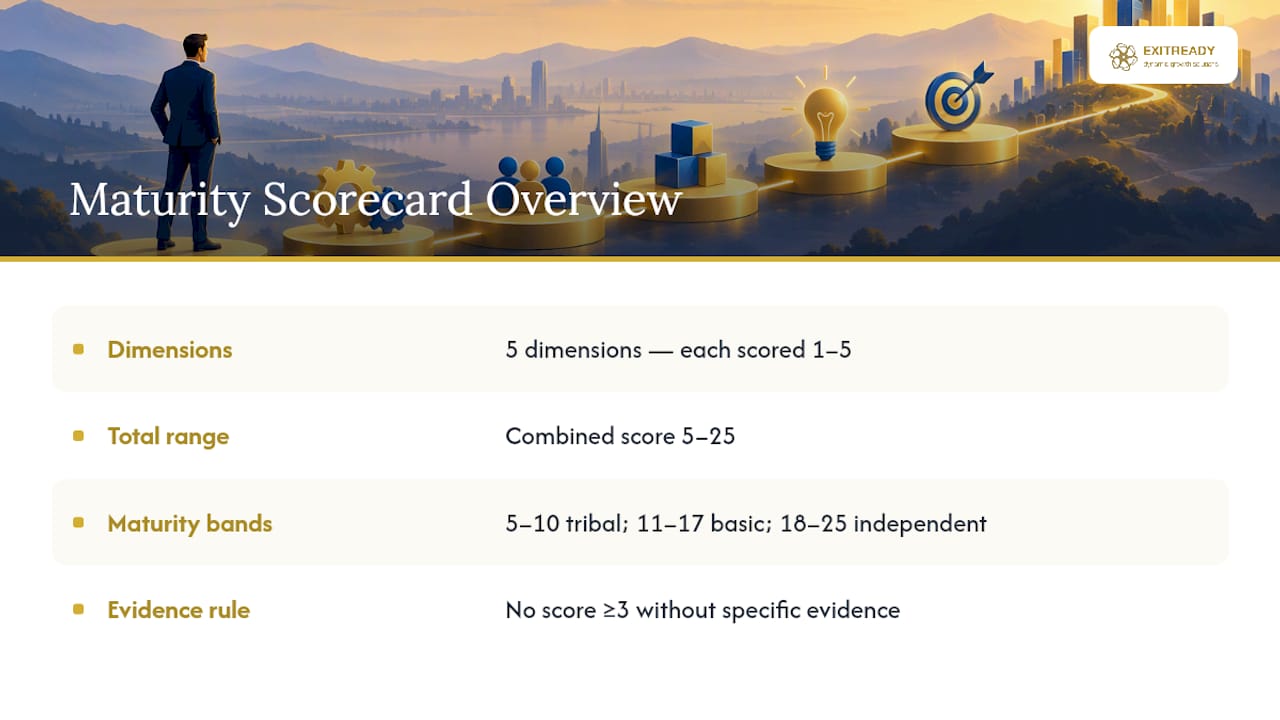
A total between 5 and 10 means the function runs on tribal knowledge, and any absence turns into an emergency. A total between 11 and 17 means the basics exist but break under pressure or growth. A total between 18 and 25 means the function could run without daily owner input, which is the actual definition of operational independence most mid-market owners are chasing.
The rule that keeps this scorecard honest: no score of 3 or higher without a specific piece of evidence attached to it. A dashboard someone built once for the review doesn’t count unless it already existed before you asked for it.
Pro Tip: Run the scorecard on the function that scares you most first, not the easiest one. A low score on your most fragile process gives you the clearest, most defensible case for the two or three fixes that matter this quarter.
The Growth Readiness Score Card applies this same logic across the whole business, useful once you’ve piloted the model on a single function and want a broader read.
How Do You Run the Assessment Step-by-Step?
A focused, single-function assessment fits inside two to four weeks. Longer than that and momentum dies; the exercise turns into a report nobody reads instead of a catalyst for change.
- Week 1: Data pull. Gather whatever reports, logs, and metrics already exist for the function. Don’t build anything new yet; you want to see what’s naturally visible.
- Week 1 to 2: Observation. Watch the process run in real time, at least twice, ideally on different days or with different staff. Note where the written procedure and the actual behavior diverge.
- Week 2 to 3: Interviews. Talk to the people who do the work and one person downstream who depends on its output.
- Week 3: Scoring. Score all five dimensions using the anchors above, with evidence attached to every score of 3 or higher.
- Week 4: Prioritization and handoff. Rank findings and lock in two or three fixes with owners and dates.
Evidence collection works best through three separate lenses: data, direct observation, and conversations. Each one lies on its own in a different way. Data can look clean while masking a workaround. Observation can catch a one-off exception that isn’t actually typical. Conversations reveal what people believe is happening, which sometimes doesn’t match either the data or what you observed. When two of the three lenses contradict each other, that gap is usually the most valuable finding in the whole assessment.
Keep interviews low-pressure and specific:
- “Walk me through what you did the last time this step went wrong.”
- “If you were out for two weeks, who would notice first, and why?”
- “What part of this process do you personally think is a waste of time?”
Frame every question around the process, never the person, and make clear upfront that the goal is fixing gaps, not assigning blame. A closing debrief works well as a short 60-minute agenda covering the scorecard, exceptions found, and the fixes you’re proposing, which keeps the whole assessment from ballooning into an open-ended discussion.
Turning Findings Into Fixes That Actually Get Done
Every finding gets plotted on two axes: impact and effort. High impact, low effort fixes go first. High impact, high effort fixes get scheduled deliberately. Low impact findings, regardless of effort, wait unless they’re free to fix immediately.
Pick two or three fixes maximum for the quarter. More than that and none of them get real attention. For each one, record exactly four things:
- Current state, backed by the specific evidence you collected, not a summary.
- Target state, stated as a number wherever possible (“reduce rework rate from 12% to under 5%” beats “improve quality”).
- Owner, one named person, never a team or department.
- Due date, a real calendar date, not “next quarter.”
Sequencing matters more than most owners expect. A visibility fix, like getting a live dashboard in place, almost always has to happen before a quality fix can be measured at all. Fixing rework without first fixing visibility just means you’re guessing whether the fix worked.
The single biggest way assessments fail after this point isn’t a bad fix. It’s vague ownership, a fix assigned to “the team” that six months later nobody remembers agreeing to. If a fix doesn’t have one name and one date next to it, it isn’t a fix yet. It’s a wish.
Templates and Sample Checklist Items You Can Use Immediately
Four templates cover most of what a first assessment needs: a scorecard spreadsheet for the five dimensions above, an SOP audit checklist, an interview script, and an action tracker for the fixes you assign. None of these need to be built from scratch.
A solid SOP audit checklist template covers purpose, scope, roles, inputs, procedure steps, decision rules, controls, records, and version history, following the structure laid out in standard SOP audit practices. One sample question worth asking on every SOP you review: “What happens when this step hits an exception the document doesn’t cover?” The evidence you want isn’t a verbal answer. It’s a recent example of an exception, how it was handled, and whether that handling got added back into the documentation afterward. Decision points, exception handling, and change logs are consistently the most commonly missed sections in SOPs that otherwise look complete.
Store the scorecard somewhere it survives past this quarter, a shared spreadsheet works fine, and re-run it on the same function every quarter using the same evidence standards. Consistency across cycles is what turns a one-time audit into an actual trend line you can show a buyer, a bank, or your own management team. The Intent Ledger blog has useful templates specifically for decision logs and action tracking if you want a more detailed version of the tracker piece.
How to Adapt the Checklist to Your Industry and Size
The five dimensions stay constant. What changes is where the risk concentrates and how much formal documentation makes sense.
A ten-person service business doesn’t need the same paper trail as a 200-employee manufacturer, and forcing one onto the other wastes time on both ends. That’s the practical version of risk-based thinking: scale the rigor to the risk, not to the size of the org chart.
For a small professional services firm, the “process discipline” dimension usually matters most, because client work often lives entirely in one senior person’s head. For light manufacturing or field service businesses, “quality and rework” tends to carry the most risk, since a bad batch or a missed service call has a direct dollar cost attached. For businesses with distributed teams or multiple locations, “metrics and visibility” often scores lowest first, simply because nobody built a single view across sites.
Company size changes the interview list more than it changes the checklist itself. In a 15-person company, you might interview four people across the whole assessment. In a 150-person company, the same function might need six or eight interviews just to catch the variation between shifts, locations, or client segments. Adjust the sample size, not the standard you’re scoring against.
Regulated industries, healthcare, finance, food service, need one additional layer: cross-check every checklist item against the specific regulatory requirement it maps to, so the assessment doubles as pre-audit prep rather than a separate exercise.
Common Pitfalls That Derail an Operational Assessment
The most common failure isn’t a bad checklist. It’s scope creep. A review that was supposed to cover one function quietly expands to cover three, the two to four week window stretches to ten weeks, and by the time it’s done, half the findings are already stale.
A second pitfall: scoring based on what leadership believes rather than what the evidence shows. Owners routinely score their own operations a point or two higher than an outside observer would, simply because they know the intent behind a process and assume execution matches it. That’s exactly why the evidence requirement on scores of 3 and above exists; it’s a check against optimism bias, not bureaucracy.
A third pitfall is treating the assessment as a one-time event. A checklist run once, with no quarterly re-score, tells you almost nothing about whether a fix actually held. Scores drift, sometimes down as staff turn over, sometimes up as a fix takes hold, and you only see that drift if you’re measuring on a cadence.
Fourth, and probably the most quietly damaging: interviews that feel like performance reviews. If staff sense the assessment is really about finding someone to blame, they’ll describe the process as working better than it does, and your evidence quality drops across the board.
Finally, watch for an assessment that ends in a long list of findings with no prioritization attached. Twenty observations with no ranking is worse than five observations with a clear top three, because the twenty-item version almost never converts into action.
Getting Buy-In: Communicating With Your Team During the Assessment
The assessment succeeds or fails on how it’s framed to the people being observed and interviewed, long before the scoring starts.
Tell staff directly, before the assessment begins, that the goal is finding gaps in the process, not gaps in their performance. That single distinction changes how honestly people answer interview questions. A team that believes it’s being evaluated personally will describe workarounds as normal procedure. A team that believes the process itself is under review will tell you exactly where it breaks.
Share the scorecard dimensions in advance if the team is going to be interviewed or observed. Surprise scoring criteria breed suspicion; visible criteria invite people to point out problems you might otherwise miss entirely.
Close the loop after scoring, even before fixes are implemented. A short update, what was found, what’s being fixed, who owns it, matters more for morale than the fix itself in many cases, because it proves the assessment wasn’t just an exercise that disappears into a drawer. Skipping this step is one of the fastest ways to make the next quarterly re-score harder, since staff will remember that the last round of feedback went nowhere.
For assessments that touch multiple departments, loop in a manager from each area before observation begins, not after findings are drafted. A manager who first hears about a finding in a final readout will often get defensive about it publicly, which undermines the fix before it’s even assigned.
What Successful Fixes Actually Look Like
The pattern that shows up again and again in well-run assessments is sequencing: a visibility fix unlocks a quality fix that was previously impossible to measure.
A distribution business that scores low on “metrics and visibility” often can’t tell whether its rework problem is getting better or worse, because nobody has a baseline. The first fix isn’t fixing the rework itself. It’s building the dashboard that finally shows the rework rate daily instead of guessing at it monthly. Only after that visibility fix lands does the quality fix become measurable, and measurable fixes are the ones that survive past the quarter they were assigned in.
Another common pattern involves the “people and ownership” dimension. A business that scores a 2 here, no documented backup for a critical role, often sees its biggest single improvement simply from cross-training one backup person and documenting the handoff. That single fix doesn’t just reduce risk. It frequently raises the “process discipline” score at the next re-score too, because writing the process down for a backup person forces the same documentation the original assessment flagged as missing.
The improvements that stick share a common trait: they were narrow, owned by one person, and measured against a number set before the fix started. The improvements that fade were the ones described as “getting better organized,” with no owner and no number attached, which is really just the vague-ownership pitfall showing up again after the assessment technically ended.
Why Most Assessments Fail Before They Even Start
The uncomfortable truth about operational assessments is that most of them fail for a reason that has nothing to do with the checklist itself. Owners run the assessment, get an honest picture of how dependent the business is on them personally, and then quietly shelve the findings because fixing them means giving up control they’ve held for years.
That’s a bigger obstacle than any missing template. A checklist can tell you that only one person knows how to handle a specific customer escalation. It can’t make you comfortable training a backup to handle it exactly the way you would. The scoring is the easy part. The follow-through is where owner ego, not process gaps, does the most damage.
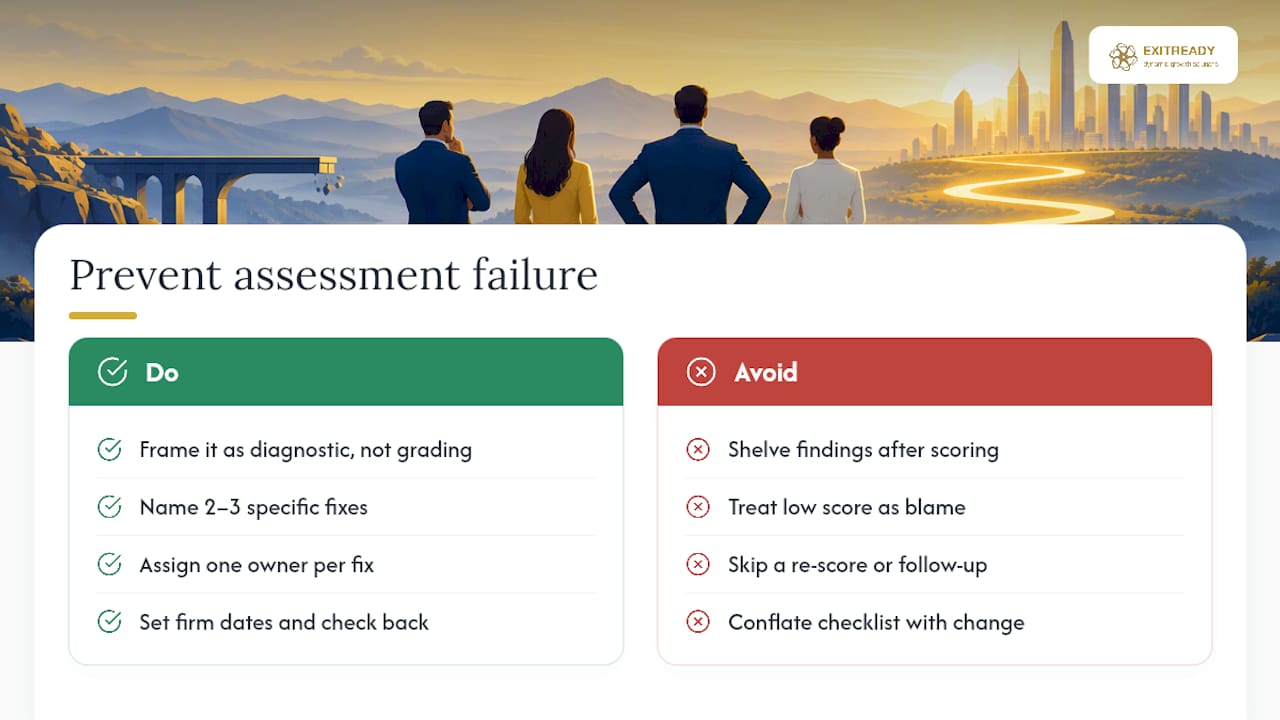
The other underappreciated failure mode is treating the assessment as a grading exercise instead of a diagnostic one. A low score isn’t a verdict on the team’s competence. It’s a map of where the business currently depends on memory instead of structure, and that distinction changes how the findings get communicated internally. Teams that hear “here’s what we found broken” respond very differently than teams that hear “here’s where we’re currently vulnerable, together.”
If there’s one thing worth pushing back on in how most guides frame this topic, it’s the assumption that a good checklist alone produces change. It doesn’t. The checklist produces visibility. What produces change is the discipline to name exactly two or three fixes, assign one person to each, put a real date on them, and then actually check back on that date. Most businesses that skip a re-score aren’t lacking a tool. They’re avoiding the accountability the tool was designed to create.
— Andre
Get an Expert-Led Operational Assessment
Running this checklist yourself gets you real visibility, but a self-scored assessment carries one built-in weakness: you’re grading your own operation, and owner bias is exactly what the evidence-required scoring rule exists to catch. A diagnostic process that removes bias entirely starts with a rigorous, evidence-based review before any recommendation gets made, so the score reflects what an outside operator actually observes, not what you hope is true.

An external facilitator makes the most sense when speed matters, when you need an unbiased score you can defend to a partner or a bank, or when your team simply doesn’t have the bandwidth to both run the business and audit it in the same month. The Enterprise Assessment applies the AOS framework across all five maturity dimensions and layers in documented playbooks designed to reduce owner dependency for good, not just flag it. If you’d rather start with a lighter self-diagnostic, the Growth Readiness Score Card gives you a guided version of the scorecard above with support built in. Reach out to a consulting provider to scope which option fits your business now.
Sources
The Chief Operating Officer blog covers the five-level maturity scale, scorecard structure, and timebox guidance used throughout this checklist. ISO’s Auditing Practices Group explains risk-based thinking for scaling documentation. Workhint, Prima Consulting, and Smartsheet provide practical SOP audit templates and process examples referenced in the templates section.
- Operations assessment: assessment, scorecard and advice (Chief Operating Officer)
- Auditing to ISO 9001:2015 (Auditing Practices Group)
FAQ
What Is an SOP Checklist?
An SOP checklist is a review tool that tests whether a written procedure is current, complete, and actually followed, covering elements like purpose, scope, roles, decision points, and version control. It’s typically used alongside an operational assessment checklist to check whether a single documented process holds up under real conditions, drawing on the SOP audit structure common to most audit templates.
Can You Give Me an Example of an Operational Audit?
A typical operational audit picks one function, say order fulfillment, and reviews it against five dimensions: process documentation, metrics visibility, quality and rework rates, ownership and backup coverage, and improvement rhythm. The auditor scores each dimension with evidence, then converts the two or three weakest areas into named fixes with owners and deadlines, following the timebox and scoring approach most operational reviews use.
What Is a Checklist for Assessment?
A checklist for assessment is a structured list of specific, observable items used to score a process or function consistently across different reviewers and time periods. The strongest versions anchor each score to real evidence, like a dated document or a logged metric, rather than a subjective impression, which is why the maturity scorecard format requires proof for any score of 3 or above.
What Are the 5 C’s of Auditing?
There isn’t a single universal definition of “the 5 C’s of auditing” that applies across every framework, and claiming otherwise would overstate what’s actually standardized in the field. Some auditors use a version built around criteria, condition, cause, consequence, and corrective action when writing up findings, but the five-dimension maturity model used in this checklist (process discipline, metrics and visibility, quality and rework, people and ownership, improvement rhythm) is a more directly useful structure for a business operations assessment.
How Often Should You Re-Run the Operational Assessment Checklist?
A light re-score on the same function works well once a quarter, since it’s fast enough to sustain without pulling management away from daily work. A deeper, full function-by-function pass once a year catches slower drift that quarterly check-ins tend to miss.